
Prague ( PRAHG ; Czech: Praha [ˈpraɦa] ) is the capital and largest city of the Czech Republic and the historical capital of Bohemia. Located on the Vltava River, the city has a population of about 1.4 million, making it the twelfth-largest city in the European Union. Its metropolitan area is home to approximately 2.3 million people.
Prague is a historical city with Romanesque, Gothic, Renaissance, and Baroque architecture. It was the capital of the Kingdom of Bohemia and residence of several Holy Roman Emperors, most notably Charles IV (r. 1346–1378) and Rudolf II (r. 1575–1611). It was an important city to the Habsburg monarchy and Austria-Hungary. The city played major roles in the Bohemian and Protestant Reformations, the Thirty Years' War, and in 20th-century history as the capital of Czechoslovakia between the World Wars and the post-war Communist era.
Prague is home to a number of cultural attractions including Prague Castle, Charles Bridge, Old Town Square with the Prague astronomical clock, the Jewish Quarter, Petřín hill, and Vyšehrad. Since 1992, the historic centre of Prague has been included in the UNESCO list of World Heritage Sites. The city has more than ten major museums, along with numerous theatres, galleries, cinemas, and other historical exhibits. An extensive modern public transportation system connects the city. It is home to a wide range of public and private schools, including Charles University, the oldest university in Central Europe.
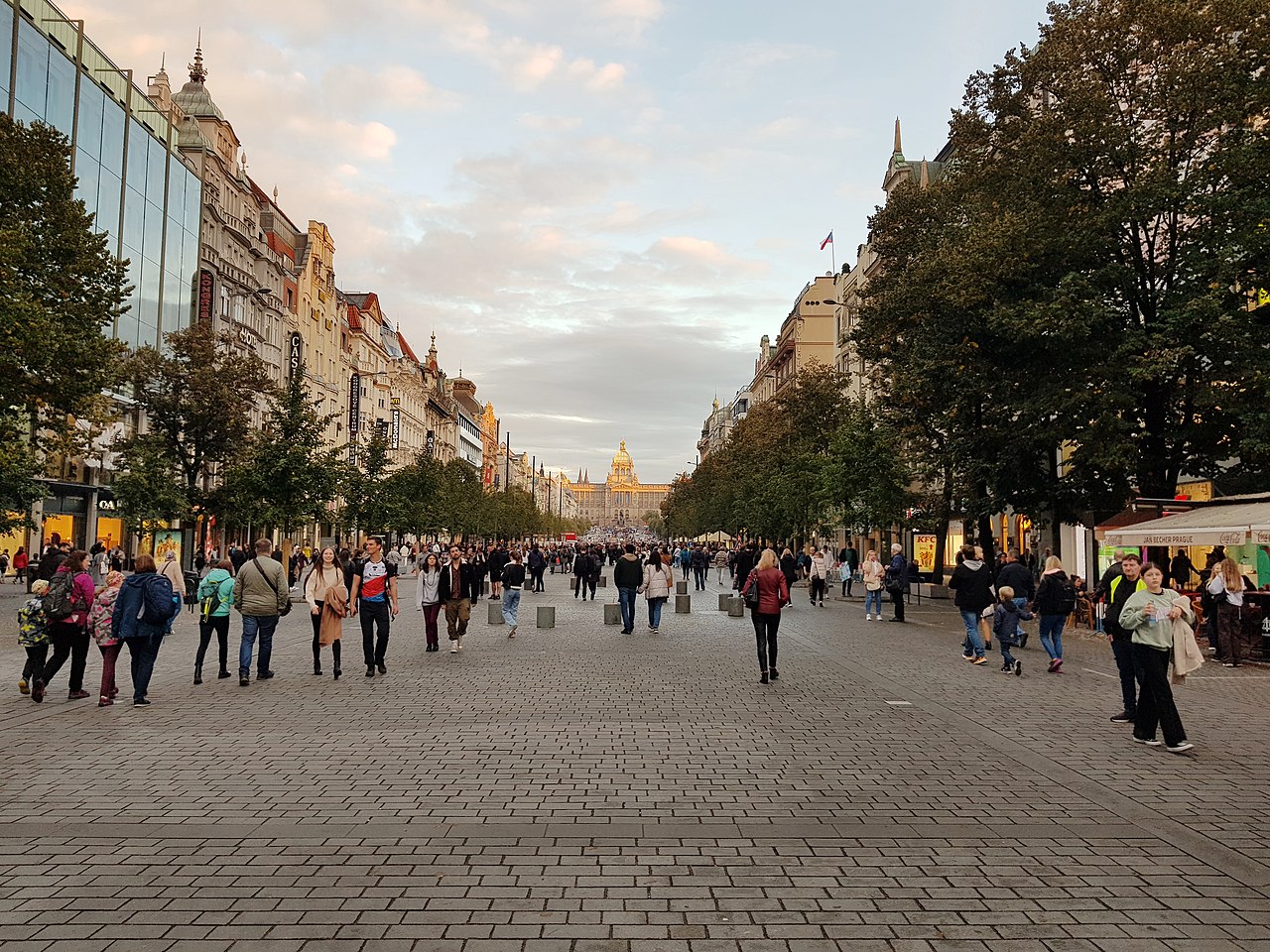
Prague is classified as a "Beta+" global city according to GaWC studies. Its rich history makes it a popular tourist destination, and as of 2017, the city receives more than 8.5 million international visitors annually. In 2017, Prague was listed as the fifth most visited European city after London, Paris, Rome, and Istanbul.
Etymology and names
According to a popular legend, which first appeared in Chronica Boemorum (1119–1125) of Cosmas of Prague, the Czech name Praha is derived from the Czech word práh (meaning 'threshold'). In the 18th century, Josef Dobrovský's theory was accepted, according to which the name is derived from the old Slavic word práh. This word means 'ford' or 'rapid', referring to the city's origin at a crossing point of the Vltava river and to the rapids of the Vltava. Since the 19th century, the accepted theory has been that the name is derived from the old Czech verb pražiti ('to burn') and from vypražený les ('burned forest'), referring to a forest that was burned down so a settlement could be established there. In the mid-20th century, linguist Antonín Profous corrected the theory by saying that the name is indeed derived from pražiti, but this word also means 'to roast' (when speaking about the sun), and the name denoted a hot, arid place (related to the shale bedrock where the Prague Castle was founded).
Prague is nicknamed the "City of a Hundred Spires," based on a count by 19th-century mathematician Bernard Bolzano; today's count is estimated by the Prague Information Service at 500. Other nicknames for Prague also include the Golden City, the Mother of Cities and the Heart of Europe.

The local Jewish community, which belongs to one of the oldest continuously existing in the world, has described the city as עיר ואם בישראל Ir va-em be-yisrael, "The city and mother in Israel".
History
Prague has grown from a settlement stretching from Prague Castle in the north to the fort of Vyšehrad in the south, to become the capital of a modern European country. With archaeological deposits over 10m deep, the city serves as a model for the implementation of comprehensive regulations for the protection of archaeological heritage throughout the Czech Republic.
Early history
The region was settled as early as the Paleolithic age. Jewish chronicler David Solomon Ganz, citing Cyriacus Spangenberg, claimed that the city was founded as Boihaem in c. 1306 BC by an ancient king, Boyya.

Around the fifth and fourth century BC, a Celtic tribe appeared in the area, later establishing settlements, including the largest Celtic oppidum in Bohemia, Závist, in a present-day Dolní Břežany south of Prague, and naming the region of Bohemia, which means "home of the Boii people". In the last century BC, the Celts were slowly driven away by Germanic tribes (Marcomanni, Quadi, Lombards and possibly the Suebi), leading some to place the seat of the Marcomanni king, Maroboduus, in Závist. Around the area where present-day Prague stands, the 2nd century map drawn by Roman geographer Ptolemaios mentioned a Germanic city called Casurgis.
In the late 5th century AD, during the great Migration Period following the collapse of the Western Roman Empire, the Germanic tribes living in Bohemia moved westwards and, probably in the 6th century, the Slavic tribes settled the Central Bohemian Region. In the following three centuries, the Czech tribes built several fortified settlements in the area, most notably in the Šárka valley, Butovice, and Levý Hradec.
The construction of what came to be known as Prague Castle began near the end of the 9th century, expanding a fortified settlement that had existed on the site since the year 800. The first masonry under Prague Castle dates from the year 885 at the latest. The other prominent Prague fort, the Přemyslid fort Vyšehrad, was founded in the 10th century, some 70 years later than Prague Castle. Prague Castle is dominated by the cathedral, which began construction in 1344, but was not completed until the 20th century.

The legendary origins of Prague attribute its foundation to the 8th-century Czech duchess and prophetess Libuše and her husband, Přemysl, founder of the Přemyslid dynasty. Legend says that Libuše, prophesied from her castle at Vyšehrad, came out on a rocky cliff high above the Vltava and prophesied: "I see a great city whose glory will touch the stars". She ordered a castle and a town called Praha to be built on the site.
The region became the seat of the dukes, and later kings of Bohemia. Under Duke of Bohemia Boleslaus II the Pious the area became a bishopric in 973. Until Prague was elevated to archbishopric in 1344, it was under the jurisdiction of the Archbishopric of Mainz.
Prague was an important seat for trading where merchants from across Europe settled, including many Jews, as recalled in 965 by the Hispano-Jewish merchant and traveller Abraham ben Jacob. The Old New Synagogue of 1270 still stands in the city. Prague was also once home to a slave market.

At the site of the ford in the Vltava river, King Vladislaus I had the first bridge built in 1170, the Judith Bridge (Juditin most), named in honour of his wife Judith of Thuringia. This bridge was destroyed by a flood in 1342, but some of the original foundation stones of that bridge remain in the river. It was rebuilt and named the Charles Bridge.
In 1257, under King Ottokar II, Malá Strana ('lesser quarter') was founded in Prague on the site of an older village in what would become the Hradčany (Prague Castle) area. This was the district of the German people, who had the right to administer the law autonomously, pursuant to Magdeburg rights. The new district was on the bank opposite of the Staré Město ("Old Town"), which had borough status and was bordered by a line of walls and fortifications.
Late Middle Ages
Prague flourished during the 14th-century reign (1346–1378) of Charles IV, Holy Roman Emperor and the king of Bohemia of the new Luxembourg dynasty. As King of Bohemia and Holy Roman Emperor, he transformed Prague into an imperial capital. In the 1470s, Prague had around 70,000 inhabitants and with an area of 360 ha (~1.4 square miles) it was the third-largest city in the Holy Roman Empire.

Charles IV ordered the building of the New Town (Nové Město) adjacent to the Old Town and laid out the design himself. The Charles Bridge, replacing the Judith Bridge destroyed in the flood just before his reign, was erected to connect the east bank districts to the Malá Strana and castle area. In 1347, he founded Charles University, the oldest university in Central Europe.
His father John of Bohemia began construction of the Gothic Saint Vitus Cathedral, within the largest of the Prague Castle courtyards, on the site of the Romanesque rotunda. Prague was elevated to an archbishopric in 1344, the year the cathedral was begun.
The city had a mint and was a centre of trade for German and Italian bankers and merchants. The social order, however, became more turbulent due to the rising power of the craft guilds (themselves often torn by internal conflicts), and the increasing number of poor.
The Hunger Wall, a substantial fortification wall south of Malá Strana and the castle area, was built during a famine in the 1360s. The work is reputed to have been ordered by Charles IV as a means of providing employment and food to the workers and their families.
Charles IV died in 1378. During the reign of his son, King Wenceslaus IV (1378–1419), a period of intense turmoil ensued. During Easter 1389, members of the Prague clergy announced that Jews had desecrated the host (Eucharistic wafer), and the clergy encouraged mobs to pillage, ransack, and burn the Jewish quarter. Nearly the entire Jewish population of Prague (ca 750 people) was murdered.
Jan Hus, a theologian and rector at Charles University, preached in Prague. In 1402, he began giving sermons in the Bethlehem Chapel. Inspired by John Wycliffe, these sermons focused on what were seen as radical reforms of a corrupt Church. Having become too dangerous for the political and religious establishment, Hus was summoned to the Council of Constance, put on trial for heresy, and burned at the stake in Konstanz in 1415.
Four years later, Prague experienced its first defenestration, when the people rebelled under the command of the Prague priest Jan Želivský. Hus' death, coupled with Czech proto-nationalism and proto-Protestantism, had spurred the Hussite Wars. Peasant rebels, led by the general Jan Žižka, along with Hussite troops from Prague, defeated Emperor Sigismund in the Battle of Vítkov Hill in 1420.
During the Hussite Wars, when Prague was attacked by "Crusader" and mercenary forces, the city militia fought bravely under the Prague Banner. This swallow-tailed banner is approximately 4 by 6 ft (1.2 by 1.8 m), with a red field sprinkled with small white fleurs-de-lis, and a silver old Town Coat-of-Arms in the centre. The words "PÁN BŮH POMOC NAŠE" (The Lord is our Relief/Help) appeared above the coat-of-arms, with a Hussite chalice centred on the top. Near the swallow-tails is a crescent-shaped golden sun with rays protruding.
One of these banners was captured by Swedish troops during the Battle of Prague (1648) when they captured the western bank of the Vltava river and were repulsed from the eastern bank; it was placed in the Royal Military Museum in Stockholm. Although this flag still exists, it is in very poor condition. They also took the Codex Gigas and the Codex Argenteus. The earliest evidence indicates that a gonfalon with a municipal charge painted on it was used for the Old Town as early as 1419. Since this city militia flag was in use before 1477 and during the Hussite Wars, it is the oldest still preserved municipal flag of Bohemia.
In the following two centuries, Prague strengthened its role as a merchant city. Many noteworthy Gothic buildings were erected and Vladislav Hall of the Prague Castle was added.
Habsburg era
In 1526, the Bohemian estates elected Ferdinand I of the House of Habsburg. The fervent Catholicism of its members brought them into conflict in Bohemia, and then in Prague, where Protestant ideas were gaining popularity. These problems were not preeminent under Holy Roman Emperor Rudolf II, elected King of Bohemia in 1576, who chose Prague as his home. He lived in Prague Castle, where his court welcomed not only astrologers and magicians but also scientists, musicians, and artists. Rudolf was an art lover as well, and Prague became a capital of European culture. This was a prosperous period for the city: famous people living there in that age include the astronomers Tycho Brahe and Johannes Kepler, the painter Arcimboldo, the alchemists Edward Kelley and John Dee, the poet Elizabeth Jane Weston, and others.
In 1618, the famous second defenestration of Prague provoked the Thirty Years' War, a particularly harsh period for Prague and Bohemia. Ferdinand II of Habsburg was deposed, and his place as King of Bohemia taken by Frederick V, Elector Palatine; however, his army was crushed in the Battle of White Mountain (1620) not far from the city. Following this, in 1621, was the execution of 27 Czech Protestant leaders (involved in the uprising) in Old Town Square and the exile of many others. Prague was forcibly converted back to Roman Catholicism, followed by the rest of the Czech lands. The city suffered subsequently during the war under an attack by Electorate of Saxony (1631) and during the Battle of Prague (1648). Prague began a steady decline, which reduced the population from the 60,000 it had had in the years before the war to 20,000. In the second half of the 17th century, Prague's population began to grow again. Jews had been in Prague since the end of the 10th century and, by 1708, they accounted for about a quarter of Prague's population.
In 1689, a great fire devastated Prague, which spurred a renovation and a rebuilding of the city. In 1713–14, a major outbreak of plague hit Prague one last time, killing 12,000 to 13,000 people.
In 1744, during the Austrian War of Succession, Frederick the Great of Prussia invaded Bohemia. He took Prague after a severe and prolonged siege in the course of which a large part of the town was destroyed. Empress Maria Theresa expelled the Jews from Prague in 1745; though she rescinded the expulsion in 1748, the proportion of Jewish residents in the city never recovered. In 1757, during the Seven Years' War, Prussian bombardment destroyed more than one-quarter of the city and heavily damaged St. Vitus Cathedral. However, a month later, Frederick the Great was defeated and forced to retreat from Bohemia.
The economy of Prague continued to improve during the 18th century. The population increased to 80,000 inhabitants by 1771. Many rich merchants and nobles enhanced the city with a host of palaces, churches, and gardens full of art and music, creating the Baroque city features.
In 1784, under Joseph II, the four municipalities of Malá Strana, Nové Město, Staré Město, and Hradčany were merged into a single entity. The Jewish district, called Josefov, was included only in 1850. The Industrial Revolution produced great changes and developments in Prague, as new factories could take advantage of the coal mines and ironworks of the nearby regions. The first general hospital was founded in 1789, with a reconstructed building of the Institute for Noble Women in the Church of the Holy Angels (now Všeobecná fakultní nemocnice v Praze) used for it. The first suburb, Karlín, was created in 1817, and twenty years later the population exceeded 100,000.
The revolutions in Europe in 1848 also touched Prague, but they were fiercely suppressed. In the following years, the Czech National Revival began its rise, until it gained the majority in the town council in 1861. Prague had a large number of German speakers in 1848, but by 1880 the number of German speakers had decreased to 14 percent (42,000), and by 1910 to 6.7 percent (37,000), due to a massive increase in the city's overall population caused by the influx of Czechs from the rest of Bohemia and Moravia and the increasing prestige and importance of the Czech language as part of the Czech National Revival. In 1891, the city council ordered that all German inscriptions be removed in Prague, while Czechs at the same time demanded equal status for the Czech and German languages in Bohemia and Moravia.
20th century
First Czechoslovak Republic
World War I ended with the defeat of the Austro-Hungarian Empire and the creation of Czechoslovakia. Prague was chosen as its capital and Prague Castle as the seat of the president Tomáš Garrigue Masaryk. At this time, Prague was a true European capital with a highly developed industry. By 1930, the population had risen to 850,000.
Second World War
Hitler ordered the German Army to enter Prague on 15 March 1939, and from Prague Castle proclaimed Bohemia and Moravia a German protectorate. For most of its history, Prague had been a multi-ethnic city with important Czech, German and (mostly native German-speaking) Jewish populations. From 1939, when the country was occupied by Nazi Germany, Hitler took over Prague Castle. During the Second World War, most Jews were deported and killed by the Germans. In 1942, Prague was witness to the assassination of one of the most powerful men in Nazi Germany—Reinhard Heydrich—during Operation Anthropoid, accomplished by Czechoslovak national heroes Jozef Gabčík and Jan Kubiš. Hitler ordered bloody reprisals.
In February 1945, Prague suffered several bombing raids by the US Army Air Forces. 701 people were killed, more than 1,000 people were injured and some buildings, factories and historic landmarks (Emmaus Monastery, Faust House, Vinohrady Synagogue) were destroyed. Many historic structures in Prague, however, escaped the destruction of the war and the damage was small compared to the destruction of many other cities in that time. According to American pilots, it was the result of a navigational mistake. In March, a deliberate raid targeted military factories in Prague, killing about 370 people.
On 5 May 1945, two days before Germany capitulated, an uprising against Germany occurred. Several thousand Czechs were killed in four days of bloody street fighting, with many atrocities committed by both sides. Fought concurrently with the Prague uprising, the Prague offensive significantly helped the liberation of Czechoslovakia. At daybreak on 9 May, the 3rd Shock Army of the Red Army took the capital city almost unopposed. The majority (about 50,000 people) of the German population of Prague either fled or were expelled by the Beneš decrees in the aftermath of the war.
Cold War
Prague was a city in a country under the military, economic, and political control of the Soviet Union (see Iron Curtain and COMECON). The world's largest Stalin Monument was unveiled on Letná hill in 1955 and destroyed in 1962. The 4th Czechoslovak Writers' Congress, held in the city in June 1967, took a strong position against the regime. On 31 October 1967 students demonstrated at Strahov. This spurred the new secretary of the Czechoslovak Communist Party, Alexander Dubček, to proclaim a new deal in his city's and country's life, starting the short-lived season of the "socialism with a human face". It was the Prague Spring, which aimed at the renovation of political institutions in a democratic way. The other Warsaw Pact member countries, except Romania and Albania, were led by the Soviet Union to repress these reforms through the invasion of Czechoslovakia and the capital, Prague, on 21 August 1968. The invasion, chiefly by infantry and tanks, effectively suppressed any further attempts at reform. The military occupation of Czechoslovakia by the Red Army would end only in 1991. Jan Palach and Jan Zajíc committed suicide by self-immolation in January and February 1969 to protest against the "normalisation" of the country.
After the Velvet Revolution
In 1989, after riot police beat back a peaceful student demonstration, the Velvet Revolution crowded the streets of Prague, and the capital of Czechoslovakia benefited greatly from the new mood. In 1992, the Historic Centre of Prague and its monuments were inscribed as a cultural UNESCO World Heritage Site. In 1993, after the Velvet Divorce, Prague became the capital city of the new Czech Republic. Since the 1990s, high-rise buildings have been built in Prague in large quantities. In the late 1990s, Prague again became an important cultural centre of Europe and was notably influenced by globalisation. In 2000, the IMF and World Bank summits took place in Prague and anti-globalisation riots took place here. In 2002, Prague suffered from widespread floods that damaged buildings and its underground transport system.
In 2012, Prague's main airport, Prague Ruzyně International Airport was renamed Václav Havel Airport, in honour of the Czech Republic's former first president Václav Havel, who died previously in late 2011.
Prague launched a bid for the 2016 Summer Olympics, but failed to make the candidate city shortlist. In June 2009, as the result of financial pressures from the global recession, Prague's officials chose to cancel the city's planned bid for the 2020 Summer Olympics.
On 21 December 2023, a mass shooting took place at Charles University in central Prague. Fifteen people were killed and 25 were injured. It was the deadliest mass murder in the history of the Czech Republic.
Geography
Prague is situated on the Vltava River. The Berounka flows into the Vltava in the suburbs of Lahovice. There are 99 watercourses in Prague with a total length of 360 km (220 mi). The longest streams are Rokytka and Botič.
There are 4 reservoirs, 47 fishponds, 33 retention reservoirs, and dry polders in the city. The largest pond is Velký Počernický rybník with 41.76 ha (103.2 acres). The largest body of water is Hostivař Reservoir with 42 hectares (103.8 acres).
In terms of geomorphological division, most of Prague is located in the Prague Plateau. In the south, the city's territory extends into the Hořovice Uplands, in the north it extends into the Central Elbe Table lowland. The highest point is the top of the hill Teleček on the western border of Prague, at 399 m (1,309 ft) above sea level. Notable hills in the centre of Prague are Petřín with 327 m (1,073 ft) and Vítkov with 270 m (890 ft). The lowest point is the Vltava in Suchdol at the place where it leaves the city, at 172 m (564 ft).
Prague is located approximately at 50°5′N 14°25′E. Prague is approximately at the same latitude as Frankfurt, Germany; Paris, France; and Vancouver, Canada. The northernmost point is at 50°10′39″N 14°31′37″E, the southernmost point is at 49°56′31″N 14°23′44″E, the westernmost point is at 50°6′14″N 14°13′31″E, and the easternmost point is at 50°5′14″N 14°42′23″E. Farthest geographical points of the city territory are marked physically by so-called Prague Poles.
Climate
Prague has an oceanic climate (Köppen: Cfb; Trewartha: Dobk) bordering on a humid continental climate (Dfb), defined as such by the 0 °C (32 °F) isotherm. The winters are relatively cold with average temperatures at about freezing point (0 °C), and with very little sunshine. Snow cover can be common between mid-November and late March, although snow accumulations of more than 200 mm (8 in) are infrequent. There are also a few periods of mild temperatures in winter. Summers usually bring plenty of sunshine and temperatures around 25 °C (77 °F), but there has been a considerable increase in days with over 30 °C (86 °F) in later years. Nights can be quite cool even in summer, though. Precipitation in Prague is low by Czech standards (about 500 mm per year) since it is located in the rain shadow of the Sudetes and other mountain ranges. The driest season is usually winter, while late spring and summer can bring quite heavy rain, especially in the form of thundershowers. The number of hours of average sunshine has increased over time. Temperature inversions are relatively common between mid-October and mid-March, bringing foggy, cold days and sometimes moderate air pollution. Prague is also a windy city with common sustained western winds and an average wind speed of 16 km/h (10 mph) that often helps break temperature inversions and clear the air in cold months.