
Piracy is an act of robbery or criminal violence by ship or boat-borne attackers upon another ship or a coastal area, typically intending to steal cargo and valuable goods, or take hostages. Those who conduct acts of piracy are called pirates, and vessels used for piracy are called pirate ships. The earliest documented instances of piracy date to the 14th century BC, when the Sea Peoples, a group of ocean raiders, attacked the ships of the Aegean and Mediterranean civilizations. Narrow channels which funnel shipping into predictable routes have long created opportunities for piracy, as well as for privateering and commerce raiding.
Historic examples of such areas include the waters of Gibraltar, the Strait of Malacca, Madagascar, the Gulf of Aden, and the English Channel, whose geographic structures facilitated pirate attacks. The term piracy generally refers to maritime piracy, although the term has been generalized to refer to acts committed on land, in the air, on computer networks, and (in science fiction) outer space. Piracy usually excludes crimes committed by the perpetrator on their own vessel (e.g., theft) as well as privateering, which implies authorization by a state government.
Piracy, or pirating, is the name of a specific crime under customary international law and also of many crimes under the municipal law of many states. In the 21st century, seaborne piracy against transport vessels remains a significant issue, with estimated worldwide losses of US$25 billion in 2023, increased from US$16 billion in 2004.
The waters between the Red Sea and the Indian Ocean, off the Somali coast and in the Strait of Malacca and Singapore have frequently been targeted by modern pirates armed with automatic firearms and occasionally explosive weaponry. They often use small motorboats to attack and board ships, a tactic that exploits the limited crew sizes on modern cargo and transport vessels. The international community is facing many challenges in bringing modern pirates to justice, as these attacks often occur in international waters. Nations have used their naval forces to repel and pursue pirates, and some private vessels use armed security guards, high-pressure water cannons, or sound cannons to repel boarders, and use radar to avoid potential threats.
Romanticised accounts of piracy during the Age of Sail have long been a part of Western pop culture. The two-volume A General History of the Pyrates, published in London in 1724, is generally credited with bringing key piratical figures and a semi-accurate description of their milieu in the "Golden Age of Piracy" to the public's imagination. A General History inspired and informed many later fictional depictions of piracy, most notably the novels Treasure Island (1883) and Peter Pan (1911), both of which have been adapted and readapted for stage, film, television, and other media across over a century. More recently, pirates of the "golden age" were further stereotyped and popularized by the Pirates of the Caribbean film franchise, which began in 2003.
Etymology
The English word "pirate" is derived from the Latin pirata ("pirate, corsair, sea robber"), which comes from Greek πειρατής (peiratēs), "brigand", from πειράομαι (peiráomai), "I attempt", from πεῖρα (peîra), "attempt, experience". The meaning of the Greek word peiratēs literally is "anyone who attempts something". Over time, it came to be used to describe anyone who committed robbery or brigandage on land or at sea. The term first appeared in English c. 1300. Spelling did not become standardised until the eighteenth century, and spellings such as "pirrot", "pyrate" and "pyrat" occurred until this period.

History
Europe
Antiquity
The earliest documented instances of piracy are the exploits of the Sea People who threatened ships sailing in the Aegean and Mediterranean in the 14th century BC. In classical antiquity, the Phoenicians, Illyrians and Tyrrhenians were known as pirates. In the pre-classical era, the ancient Greeks condoned piracy as a viable profession; it apparently was widespread and "regarded as an entirely honourable way of making a living". References are made to its perfectly normal occurrence in many texts, including Homer's Iliad and Odyssey, and abduction of women and children to be sold into slavery was common. By the era of Classical Greece, piracy was looked upon as a "disgrace" to have as a profession.
In the 3rd century BC, pirate attacks on Olympus in Lycia brought impoverishment. Among the most famous ancient pirating peoples were the Illyrians, who inhabited the western Balkan Peninsula. Constantly raiding the Adriatic Sea, the Illyrians caused many conflicts with the Roman Republic. It was not until 229 BC when the Romans decisively beat the Illyrian fleets that their threat was ended. During the 1st century BC, there were pirate states along the Anatolian coast, threatening the commerce of the Roman Empire in the eastern Mediterranean. On one voyage across the Aegean Sea in 75 BC, Julius Caesar was kidnapped and briefly held by Cilician pirates and held prisoner in the Dodecanese islet of Pharmacusa. The Senate invested the general Gnaeus Pompeius Magnus with powers to deal with piracy in 67 BC (the Lex Gabinia), and Pompey, after three months of naval warfare, managed to suppress the threat.
As early as 258 AD, the Gothic-Herulic fleet ravaged towns on the coasts of the Black Sea and Sea of Marmara. The Aegean coast suffered similar attacks a few years later. In 264, the Goths reached Galatia and Cappadocia, and Gothic pirates landed on Cyprus and Crete. In the process, the Goths seized enormous booty and took thousands into captivity. In 286 AD, Carausius, a Roman military commander of Gaulish origins, was appointed to command the Classis Britannica, and given the responsibility of eliminating Frankish and Saxon pirates who had been raiding the coasts of Armorica and Belgic Gaul. In the Roman province of Britannia, Saint Patrick was captured and enslaved by Irish pirates.

Middle Ages
The most widely recognized and far-reaching pirates in medieval Europe were the Vikings, seaborne warriors from Scandinavia who raided and looted mainly between the 8th and 12th centuries, during the Viking Age in the Early Middle Ages. They raided the coasts, rivers, and inland cities of all Western Europe as far as Seville, which was attacked by the Norse in 844. Vikings also attacked the coasts of North Africa and Italy and plundered all the coasts of the Baltic Sea. Some Vikings ascended the rivers of Eastern Europe as far as the Black Sea and Persia.
In the Late Middle Ages, the Frisian pirates known as Arumer Zwarte Hoop led by Pier Gerlofs Donia and Wijerd Jelckama, fought against the troops of the Holy Roman Emperor Charles V with some success.
Toward the end of the 9th century, Moorish pirate havens were established along the coast of southern France and northern Italy. In 846 Moor raiders sacked the extra muros Basilicas of Saint Peter and Saint Paul in Rome. In 911, the bishop of Narbonne was unable to return to France from Rome because the Moors from Fraxinet controlled all the passes in the Alps. Moor pirates operated out of the Balearic Islands in the 10th century. From 824 to 961, Arab pirates in the Emirate of Crete raided the entire Mediterranean. In the 14th century, raids by Moorish pirates forced the Venetian Duke of Crete to ask the Republic of Venice to keep its fleet on constant guard.
After the Slavic invasions of the former Roman province of Dalmatia in the 5th and 6th centuries, a tribe called the Narentines revived the old Illyrian piratical practices and often raided the Adriatic Sea from the 7th century onward. Their raids in the Adriatic increased rapidly, until the whole Sea was no longer safe for travel.
The Narentines took more liberties in their raiding quests while the Venetian Navy was abroad, as when it was campaigning in Sicilian waters in 827–882. As soon as the Venetian fleet returned to the Adriatic, the Narentines reverted to their habits, even signing a Treaty in Venice and baptising their Slavic pagan leader into Christianity. In 834 or 835, they broke the treaty, and again they raided Venetian traders returning from Benevento. All of Venice's military attempts to punish them in 839 and 840 utterly failed.
Later, they raided the Venetians more often, together with the Arabs. In 846, the Narentines broke through to Venice itself and raided its lagoon city of Caorle. This led to a Byzantine military campaign against them, which brought Christianity to them. After the Arab raids on the Adriatic coast circa 872 and the Imperial Navy's retreat, the Narentines continued their raids on Venetian waters, leading to new conflicts with the Italians in 887–888. The Venetians futilely continued to fight them throughout the 10th and 11th centuries.

Domagoj was accused of attacking a ship which was bringing home the papal legates who had participated in the Eighth Catholic Ecumenical Council, after which Pope John VIII addressed Domagoj with a request that his pirates stop attacking Christians at sea.
In 937, Irish pirates sided with the Scots, Vikings, Picts, and Welsh in their invasion of England. Athelstan drove them back.
The Slavic piracy in the Baltic Sea ended with the Danish conquest of the Rani stronghold of Arkona in 1168. In the 12th century, the coasts of western Scandinavia were plundered by Curonians and Oeselians from the eastern coast of the Baltic Sea. In the 13th and 14th centuries, pirates threatened the Hanseatic routes and nearly brought sea trade to the brink of extinction. The Victual Brothers of Gotland were a companionship of privateers who later turned to piracy as the Likedeelers. They were especially noted for their leaders Klaus Störtebeker and Gödeke Michels. Until about 1440, maritime trade in both the North Sea, the Baltic Sea, and the Gulf of Bothnia was seriously in danger of attack by pirates.

H. Thomas Milhorn mentions a certain Englishman named William Maurice, convicted of piracy in 1241, as the first person known to have been hanged, drawn and quartered, which would indicate that the then-ruling King Henry III took an especially severe view of this crime.
The ushkuiniks were Novgorodian pirates who looted the cities on the Volga and Kama Rivers in the 14th century.
As early as Byzantine times, the Maniots (one of Greece's toughest populations) were known as pirates. The Maniots considered piracy a legitimate response to their land's poverty, and it became their main source of income. The main victims of Maniot pirates were the Ottomans, but the Maniots also targeted ships of European countries.
Zaporizhian Sich was a pirate republic in Europe from the 16th through to the 18th century. Situated in Cossack territory in the remote steppe of Eastern Europe, it was populated with Ukrainian peasants who had run away from their feudal masters, outlaws, destitute gentry, run-away slaves from Turkish galleys, etc. The remoteness of the place and the rapids of the Dnieper river effectively guarded it against invasions by vengeful powers.
The main target of the inhabitants of the Zaporizhian Sich who called themselves "Cossacks", were rich settlements at the Black Sea shores of Ottoman Empire and Crimean Khanate. By 1615 and 1625, Zaporozhian Cossacks had even managed to raze townships on the outskirts of Istanbul, forcing the Ottoman Sultan to flee his palace. Don Cossacks under Stenka Razin even ravaged the Persian coasts.
Mediterranean corsairs
Though less famous and romanticized than Atlantic or Caribbean pirates, corsairs in the Mediterranean were equal to or outnumbered the former at any given point in history. Mediterranean piracy was conducted almost entirely with galleys until the mid-17th century, when they were gradually replaced with highly maneuverable sailing vessels such as xebecs and brigantines. They were of a smaller type than battle galleys, often referred to as galiots or fustas.
Pirate galleys were small, nimble, lightly armed, but often crewed in large numbers to overwhelm the often minimal crews of merchant ships. In general, pirate craft were extremely difficult for patrolling craft actually to hunt down and capture. Anne Hilarion de Tourville, a French admiral of the 17th century, believed that the only way to run down raiders from the infamous corsair Moroccan port of Salé was by using a captured pirate vessel of the same type.
Using oared vessels to combat pirates was common, even among the major powers in the Caribbean. Purpose-built galleys, or hybrid sailing vessels, were built by the English in Jamaica in 1683 and by the Spanish in the late 16th century. Specially-built sailing frigates with oar-ports on the lower decks, like the James Galley and Charles Galley, and oar-equipped sloops proved highly useful for pirate hunting, though they were not built in sufficient numbers to check piracy until the 1720s.
The expansion of Muslim power through the Ottoman conquest of large parts of the eastern Mediterranean in the 15th and 16th centuries resulted in extensive piracy on sea trade. The so-called Barbary pirates began to operate out of North African ports in Algiers, Tunis, Tripoli, Morocco, around 1500, preying primarily on the shipping of Christian powers, including massive slave raids at sea as well as on land. The Barbary pirates were nominally under Ottoman suzerainty, but had considerable independence to prey on the enemies of Islam. The Muslim corsairs were technically often privateers with support from legitimate, though highly belligerent, states. They considered themselves holy Muslim warriors, or ghazis, carrying on the tradition of resisting the incursions by Western Christians that had begun with the First Crusade in the late 11th century.
Coastal villages and towns of Italy, Spain, and islands in the Mediterranean were frequently attacked by Muslim corsairs, and their inhabitants almost completely abandoned long stretches of the Italian and Spanish coasts. After 1600, the Barbary corsairs occasionally entered the Atlantic and struck as far north as Iceland. According to Robert Davis between 1 million and 1.25 million Europeans were abducted by Barbary corsairs and sold into slavery in North Africa and the Ottoman Empire between the 16th and 19th centuries. The most famous corsairs were the Ottoman Albanian Hayreddin and his older brother Oruç Reis (Redbeard), Turgut Reis (known as Dragut in the West), Kurtoglu (known as Curtogoli in the West), Kemal Reis, Salih Reis, and Koca Murat Reis. A few Barbary corsairs, such as the Dutch Jan Janszoon and the English John Ward (Muslim name Yusuf Reis), were renegade European privateers who had converted to Islam.
The Barbary pirates had a direct Christian counterpart in the military order of the Knights of Saint John, which operated first out of Rhodes and, after 1530, Malta. However, they were fewer in number and enslaved fewer people. Both sides waged war against the respective enemies of their faith, and both used galleys as their primary weapons. Both sides also used captured or bought galley slaves to man the oars of their ships. The Muslims relied mostly on captured Christians, the Christians used a mix of enslaved Muslims, Christian convicts, and a small contingency of buonavoglie, free men who, out of desperation or poverty, had taken to rowing.
Historian Peter Earle has described the two sides of the Christian-Muslim Mediterranean conflict as "mirror image[s] of maritime predation, two businesslike fleets of plunderers set against each other". This conflict of faith in the form of privateering, piracy and slave raiding generated a complex system that was upheld/financed/operated on the trade in plunder and enslaved people that was generated from a low-intensive conflict, as well as the need for protection from violence. The system has been described as a "massive, multinational protection racket", the Christian side of which did not end until 1798, during the Napoleonic Wars. The Barbary corsairs were quelled as late as the 1830s, effectively ending the last vestiges of counter-crusading jihad.
Piracy off the Barbary coast was often assisted by competition among European powers in the 17th century. France encouraged the corsairs against Spain, and later Britain and Holland supported them against France. By the second half of the 17th century, the greater European naval powers began to initiate reprisals to intimidate the Barbary States into making peace with them. The most successful of the Christian states in dealing with the corsair threat was England. From the 1630s onwards, England had signed peace treaties with the Barbary States on various occasions, but invariably breaches of these agreements led to renewed wars.
Albanian piracy, mainly centered in the town of Ulcinj (thus came to be known as Dulcignotti), flourished during the 15th to the 19th century.
France, which had recently emerged as a leading naval power, achieved comparable success soon afterwards, with bombardments of Algiers in 1682, 1683, and 1688 securing a lasting peace, while Tripoli was similarly coerced in 1686. In 1783 and 1784, the Spaniards bombarded Algiers in an effort to stem the piracy. The second time, Admiral Barceló damaged the city so severely that the Algerian Dey asked Spain to negotiate a peace treaty. From then on, Spanish vessels and coasts were safe for several years.
Until the American Declaration of Independence in 1776, British treaties with the North African states protected American ships from the Barbary corsairs. Morocco, which in 1777 was the first independent nation to recognize the United States publicly, became, in 1784, the first Barbary power to seize an American vessel after independence. While the United States managed to secure peace treaties, these obliged it to pay tribute for protection from attack. Payments in ransom and tribute to the Barbary states amounted to 20% of United States government annual expenditures in 1800, leading to the Barbary Wars that ended the payment of tribute. Algiers broke the 1805 peace treaty after only two years and refused to implement the 1815 treaty until Britain compelled it to do so in 1816.
In 1815, the sacking of Palma on the island of Sardinia by a Tunisian squadron, which carried off 158 inhabitants, roused widespread indignation. Britain had, by this time, banned the slave trade and was seeking to induce other countries to do likewise. This led to complaints from states that were still vulnerable to the corsairs that Britain's enthusiasm for ending the trade in enslaved Africans did not extend to stopping the enslavement of Europeans and Americans by the Barbary States.
To neutralise this objection and further the anti-slavery campaign, in 1816 Lord Exmouth was sent to secure new concessions from Tripoli, Tunis, and Algiers, including a pledge to treat Christian captives in any future conflict as prisoners of war rather than enslaved people and the imposition of peace between Algiers and the kingdoms of Sardinia and Sicily. On his first visit, he negotiated satisfactory treaties and sailed for home. While he was negotiating, some Sardinian fishermen who had settled at Bona on the Tunisian coast were brutally treated without his knowledge. As Sardinians, they were technically under British protection, and the government sent Exmouth back to secure reparation. On August 17, in combination with a Dutch squadron under Admiral Van de Capellen, he bombarded Algiers. Both Algiers and Tunis made fresh concessions as a result.
Securing uniform compliance with a total prohibition of slave-raiding, which was traditionally of central importance to the North African economy, presented difficulties beyond those faced in ending attacks on ships of individual nations, which had left slavers able to continue their accustomed way of life by preying on less well-protected peoples. Algiers renewed its slave-raiding, though on a smaller scale. Measures to be taken against the city's government were discussed at the Congress of Aix-la-Chapelle in 1818. In 1820, another British fleet under Admiral Sir Harry Neal again bombarded Algiers. Corsair activity based in Algiers did not entirely cease until its conquest by France in 1830.
Southeast Asia
In thalassocratic Austronesian cultures in Island Southeast Asia, maritime raids for enslaved people and resources against rival polities have ancient origins. It was associated with prestige and prowess and often recorded in tattoos. Early European cultures recorded reciprocal raiding traditions as being prevalent throughout Island Southeast Asia.
With the advent of Islam and the colonial era, enslaved people became a valuable resource for trading with European, Arab, and Chinese slavers, and the volume of piracy and slave raids increased significantly. Numerous native peoples engaged in sea raiding; they include the Iranun and Balanguingui slavers of Sulu, the Iban headhunters of Borneo, the Bugis sailors of South Sulawesi, and the Malays of western Southeast Asia. Piracy was also practiced on a smaller scale by foreign seafarers, including Chinese, Japanese, and European traders, as well as renegades and outlaws. The volume of piracy and raids was often dependent on the ebb and flow of trade and monsoons, with pirate season (known colloquially as the "Pirate Wind") starting from August to September.
Slave raids were of high economic importance to the Muslim Sultanates in the Sulu Sea: the Sultanate of Sulu, the Sultanate of Maguindanao, and the Confederation of Sultanates in Lanao (the modern Moro people). It is estimated that from 1770 to 1870, around 200,000 to 300,000 people were enslaved by Iranun and Banguingui slavers. David P. Forsythe put the estimate much higher, at around 2 million people abducted and enslaved within the first two centuries of Spanish rule of the Philippines after 1565.
These enslaved people were taken from piracy on passing ships as well as coastal raids on settlements as far as the Malacca Strait, Java, the southern coast of China, and the islands beyond the Makassar Strait. Most of the slaves were Tagalogs, Visayans, and "Malays" (including Bugis, Mandarese, Iban, and Makassar). There were also occasional European and Chinese captives, usually ransomed through Tausug intermediaries of the Sulu Sultanate. Enslaved people were the primary indicators of wealth and status, and they were the source of labor for the farms, fisheries, and workshops of the sultanates. While enslaved people were rarely sold, they were trafficked extensively in enslaved people purchased from the Iranun and Banguingui slave markets. By the 1850s, enslaved people constituted 50% or more of the population of the Sulu archipelago.
The scale was so massive that the word for "pirate" in Malay became lanun, an exonym of the Iranun people. Slaves and the slave trade largely ran the economy of the Sulu sultanates. Male captives of the Iranun and the Banguingui were treated brutally; even fellow Muslim captives were not spared. They were usually forced to serve as galley slaves on the lanong and garay warships of their captors. Female captives, however, were usually treated better. There were no recorded accounts of rapes, though some were starved for discipline. Within a year of capture, most of the captives of the Iranun and Banguingui would be bartered off in Jolo usually for rice, opium, bolts of cloth, iron bars, brassware, and weapons. The buyers were usually Tausug datu from the Sultanate of Sulu who had preferential treatment, but buyers also included European (Dutch and Portuguese) and Chinese traders as well as Visayan pirates (renegados).
Spanish authorities and native Christian Filipinos responded to the Moro slave raids by building watchtowers and forts across the Philippine archipelago, many of which are still standing today. In Northern Luzon, particularly in the Pangasinan, Ilocos and Cagayan, the coastal villages and towns were frequently raided by Moro and Chinese pirates, locally known as tírong or cumaw (raiders, attackers or pirates). These pirates looted and burned villages (barrios) and captured women and children for enslavement. To counter these threats, Spanish authorities constructed circular adobe watchtowers, or baluartes, measuring 6 to 7 meters high. These structures, built strategically along the coastline using coral blocks bonded with a mixture of lime and egg whites, served as both lookout points and defensive fortifications, protecting villages from pirate attacks.
Some provincial capitals were also moved further inland. Major command posts were built in Manila, Cavite, Cebu, Iloilo, Zamboanga, and Iligan. Defending ships were also built by local communities, especially in the Visayas Islands, including the construction of war "barangayanes" (balangay) that were faster than the Moro raiders and could give chase. As resistance against raiders increased, Lanong warships of the Iranun were eventually replaced by the smaller and faster garay warships of the Banguingui in the early 19th century. The Moro raids were eventually subdued by several major naval expeditions by the Spanish and local forces from 1848 to 1891, including retaliatory bombardment and capture of Moro settlements. By this time, the Spanish had also acquired steam gunboats (vapor), which could easily overtake and destroy the native Moro warships.
Several famous pirates, such as Intjeh Cohdja and Wassingrana, were hunted by the VOC for hijacking their merchant ships in the Eastern salient of Java.
Aside from the Iranun and Banguingui pirates, other polities were also associated with maritime raiding. The Bugis sailors of South Sulawesi were infamous as pirates who used to range as far west as Singapore and as far north as the Philippines in search of targets. The Orang laut pirates controlled shipping in the Straits of Malacca and the waters around Singapore, and the Malay and Sea Dayak pirates preyed on maritime shipping in the waters between Singapore and Hong Kong from their haven in Borneo.
East Asia
In East Asia, by the ninth century, populations centered mostly around merchant activities in coastal Shandong and Jiangsu. Wealthy benefactors including Chang Pogo established Silla Buddhist temples in the region. Chang Pogo had become incensed at the treatment of his fellow citizens, who in the unstable milieu of late Tang often fell victim to coastal pirates or inland bandits. After returning to Silla around 825, and in possession of a formidable private fleet headquartered at Cheonghae (Wando), Chang Pogo petitioned the Silla king Heungdeok (r. 826–836) to establish a permanent maritime garrison to protect Silla merchant activities in the Yellow Sea. Heungdeok agreed and, in 828, formally established the Cheonghae (淸海, "clear sea") Garrison (청해진) at what is today Wando island off Korea's South Jeolla province. Heungdeok gave Chang an army of 10,000 men to establish and man the defensive works. The remnants of Cheonghae Garrison can still be seen on Jang islet just off Wando's southern coast. Chang's force, though nominally bequeathed by the Silla king, was effectively under his own control. Chang became the arbiter of Yellow Sea commerce and navigation.
From the 13th century, the Wokou, based in Japan, made their debut in East Asia, initiating invasions that would persist for 300 years. The wokou raids peaked in the 1550s, but by then the wokou were mostly Chinese smugglers who reacted strongly against the Ming dynasty's strict prohibition on private sea trade.
During the Qing period, Chinese pirate fleets grew increasingly large. The effects of large-scale piracy on the Chinese economy were immense. They preyed voraciously on China's junk trade, which flourished in Fujian and Guangdong and was a vital artery of Chinese commerce. Pirate fleets exercised hegemony over villages on the coast, collecting revenue by exacting tribute and running extortion rackets. In 1802, the menacing Zheng Yi inherited the fleet of his cousin, captain Zheng Qi, whose death provided Zheng Yi with considerably more influence in the world of piracy. Zheng Yi and his wife, Zheng Yi Sao (who would eventually inherit the leadership of his pirate confederacy), then formed a pirate coalition that, by 1804, consisted of over ten thousand men. Their military might alone was sufficient to combat the Qing navy. However, a combination of famine, Qing naval opposition, and internal rifts crippled piracy in China around the 1820s, and it has never again reached that level.
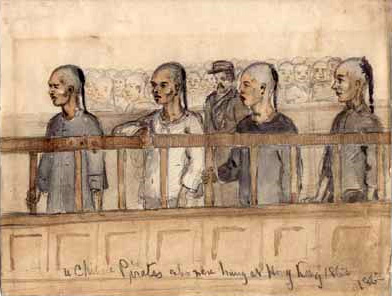
In the 1840s and 1850s, United States Navy and Royal Navy forces campaigned together against Chinese pirates. Major battles were fought such as those at Ty-ho Bay and the Tonkin River though pirate junks continued operating off China for years more. However, some British and American individual citizens also volunteered to serve with Chinese pirates to fight against European forces. The British offered rewards for the capture of Westerners serving with Chinese pirates. During the Second Opium War and the Taiping Rebellion, piratical junks were again destroyed in large numbers by British naval forces, but ultimately it was not until the 1860s and 1870s that fleets of pirate junks ceased to exist.
Chinese Pirates also plagued the Tonkin Gulf area.
Piracy in the Ming dynasty
Pirates in the Ming era tended to come from populations on the geographic periphery of the state. They were recruited largely from the lower classes of society, including poor fishermen, and many were fleeing from obligatory labor on state-building projects organized by the dynasty. These lower-class men, and sometimes women, may have fled taxation or conscription by the state in search of better opportunities and wealth, and willingly joined local pirate bands. These local, lower-class individuals seem to have felt unrepresented, and traded the small amount of security afforded them from their allegiance to the state for the promise of a relatively improved existence engaging in smuggling or other illegal trade.