
South India, also known as Southern India or Peninsular India, is the southern part of the Deccan Peninsula in India encompassing the states of Andhra Pradesh, Karnataka, Kerala, Tamil Nadu and Telangana as well as the union territories of Lakshadweep and Puducherry, occupying 19.31% of India's area (635,780 km2 or 245,480 sq mi) and 20% of India's population. It is bound by the Bay of Bengal in the east, the Arabian Sea in the west and the Indian Ocean in the south. The geography of the region is diverse, with two mountain ranges, the Western and Eastern Ghats, bordering the plateau heartland. The Godavari, Krishna, Kaveri, Penna, Tungabhadra and Vaigai rivers are important non-perennial sources of water. Chennai, Bengaluru, Hyderabad, Coimbatore and Kochi are the largest urban areas in the region.
The majority of the people in South India speak at least one of the four major Dravidian languages: Telugu, Tamil, Kannada and Malayalam. During its history, a number of dynastic kingdoms ruled over parts of South India, and shaped the culture in those regions. Major dynasties that were established in South India include the Cheras, Cholas, Pandyas, Pallavas, Satavahanas, Chalukyas, Hoysalas, Rashtrakutas and Vijayanagara. European countries entered India through Kerala and the region was colonized by Britain, Portugal and France.
After experiencing fluctuations in the decades immediately after Indian independence, the economies of South Indian states have registered a sustained higher-than-national-average growth over the past three decades. South India has the largest combined largest gross domestic product compared to other regions in India. The South Indian states lead in some socio-economic metrics of India with a higher HDI as the economy has undergone growth at a faster rate than in most northern states. As of 2011, literacy rates in the southern states are higher than the national average at approximately 76%. The fertility rate in South India is 1.9, the lowest of all regions in India.

Etymology
"South India" is also known as "Peninsular India" indicating its location in a peninsula surrounded by water on three sides. The term "Deccan", referring to the area covered by the Deccan Plateau that covers most of peninsular India excluding the coastal areas, is an anglicised form of the Prakrit word dakkhiṇa derived from the Sanskrit word dakshiṇa meaning south. Carnatic, derived from "Karnāḍ" or "Karunāḍ" meaning black country, has also been associated with South India.
History
Ancient and medieval era
Carbon dating shows that ash mounds associated with Neolithic cultures in South India date back to 8000 BCE. Towards the beginning of 1000 BCE, iron technology spread through the region; however, there does not appear to be a fully developed Bronze Age preceding the Iron Age in South India. The region was in the middle of a trade route that extended from Muziris to Arikamedu linking the Mediterranean to East Asia. Trade with Phoenicians, Romans, Greeks, Arabs, Syrians, Jews, and Chinese began during the Sangam period (c. 3rd century BCE to c. 4th century CE). The region was part of the ancient Silk Road connecting the East with the West.
Several dynasties such as the Cheras of Karuvur, the Pandyas of Madurai, the Cholas of Thanjavur, the Zamorins of Kozhikode, the Satavahanas of Amaravati, the Pallavas of Kanchi, the Kadambas of Banavasi, the Western Gangas of Kolar, the Rashtrakutas of Manyakheta, the Chalukyas of Badami, the Hoysalas of Belur, and the Kakatiyas of Orugallu ruled over the region from the 6th century BCE to the 14th century CE. In the 15th century, Vijayanagara empire was the last kingdom to conquer all of Southern India. After repeated invasions from the Sultanate of Delhi, the Vijayanagara empire fell in 1646 and the region was ruled by various Deccan Sultanates, polygars and Nayak governors of the erstwhile Vijayanagara empire who declared independence.

Colonial era
The Europeans arrived in the 15th century; and by the middle of the 18th century, the French and the British were involved in a protracted struggle for military control over South India. After the defeat of Tipu Sultan in the Fourth Anglo-Mysore War in 1799 and the end of the Vellore Mutiny in 1806, the British consolidated their power over much of present-day South India, with the exception of French Pondichéry. The British Empire took control of the region from the British East India Company in 1857. During the British colonial rule, the region was divided into the Madras Presidency (later, the Madras Province), Hyderabad State, Mysore, and the Madras States Agency (composed of Travancore, Cochin, Jeypore, and a number of other minor princely states). The region played a major role in the Indian independence movement. Of the 72 delegates who participated in the first session of the Indian National Congress at Bombay in December 1885, 22 hailed from South India.
Post-independence
After Indian Independence in 1947, the region was organized into the states of Madras State, Mysore State, Hyderabad State, and Travancore-Cochin. Dravida Nadu was a proposal for a separate sovereign state for the speakers of the Dravidian languages in South India. Initially, the demand of Dravida Nadu proponents was limited to Tamil-speaking regions, but it was later expanded to include other Indian states with a majority of Dravidian-speakers in the region. The States Reorganisation Act 1956, which reorganized the states based on linguistic lines, weakened the demand for a separate sovereign state.
The reorganisation resulted in the region being organised into the states of Andhra Pradesh, Kerala, Madras, and Mysore. The Madras State retained its name with Kanyakumari district added to it from Travancore-Cochin, and the state was subsequently renamed as Tamil Nadu in 1968. Andhra Pradesh was created from the merger of Andhra State with the Telugu-speaking districts of Hyderabad State. Kerala was formed by the merger of Malabar district and Kasaragod taluk of South Canara district of Madras State with Travancore-Cochin. Mysore State was reorganised with the addition of the districts of Bellary and South Canara (excluding Kasaragod taluk) and the Kollegal taluk of Coimbatore district from the Madras State, the districts of Belgaum, Bijapur, North Canara, and Dharwad from Bombay State, the Kannada-majority districts of Bidar, Raichur and Gulbarga from Hyderabad State and the province of Coorg. Mysore State was renamed as Karnataka in 1973. The union territory of Puducherry was created in 1954 comprising the previous French enclaves of Pondichéry, Karaikal, Yanam and Mahé. The Laccadive Islands which were divided between South Canara and Malabar districts of Madras State were united and organized into the union territory of Lakshadweep. Telangana was created on June 2, 2014, by bifurcating Andhra Pradesh and comprises ten districts in northwestern Andhra Pradesh.
Geography
Topography
South India is a peninsula in the shape of an inverted triangle bound by the Indian Ocean in the South, the Arabian Sea in the west, the Bay of Bengal in the east and the Vindhya and Satpura ranges in the north. The Narmada River flows westwards in the depression between the Vindhya and Satpura ranges, which define the northern spur of the region. The southernmost tip of mainland India is at Kanyakumari where the Indian Ocean meets the Bay of Bengal and the Arabian Sea. The Palk Strait, the Gulf of Mannar, and the chain of low sandbars and islands known as Rama's Bridge separate the region from Sri Lanka, which lies off the southeastern coast of the Indian mainland.
The low-lying islands of Lakshadweep are situated off the southwestern coast of India. In the Lakshadweep, the Eight Degree Channel separates the Laccadive and Amindivi Islands from the Minicoy Island to the south. Laccadive Sea is a smaller sea. There are coral reefs located in the Gulf of Mannar and the Lakshadweep islands.
The Western Ghats runs south along the western coast from south of the Tapti river to Kanyakumari and forms a narrow strip of land with the Arabian Sea, divided into Konkan and Malabar regions. Anaimudi in the Anaimalai Hills in the Western Ghats is the highest peak in South India at 2,695 m (8,842 ft). The Eastern Ghats run parallel to the eastern coast along the Bay of Bengal and the strip of land between them forms the Coromandel region. They are a discontinuous range of mountains, which have been eroded and quadrisected by the four major rivers of South India–Godavari, Mahanadi, Krishna, and Kaveri. Both the mountain ranges meet at Nilgiris, which run in a crescent approximately along the borders of Tamil Nadu with northern Kerala and Karnataka, encompassing the Palakkad and Wayanad hills and the Sathyamangalam ranges, and extending to the relatively low-lying hills of the Eastern Ghats on the western portion of the Tamil Nadu–Andhra Pradesh border, forming the Tirupati and Annamalai hills.

The Deccan Plateau is the elevated region bound by the mountain ranges. The plateau rises to 100 m (330 ft) in the north and to more than 1 km (0.62 mi) in the south, forming a raised triangle within the downward-pointing triangle of the Indian subcontinent's coastline. It also slopes gently from West to East resulting in major rivers arising in the Western Ghats and flowing east into the Bay of Bengal. The volcanic basalt beds of the Deccan were laid down in the massive Deccan Traps eruption, which occurred towards the end of the Cretaceous period, between 67 and 66 million years ago. Multiple layers were formed by repeated volcanic activity that lasted many years and when the volcanoes became extinct, they left a region of highlands with typically vast stretches of flat areas on the top. Large lakes in the region include Vembanad, and Pulicat Lakes.
Climate
The region has a tropical climate and depends on monsoons for rainfall. According to the Köppen climate classification, it has a non-arid climate with minimum mean temperatures of 18 °C (64 °F). The humid tropical monsoon climate characterised by moderate to high year-round temperatures and seasonally heavy rainfall above 2,000 mm (79 in) per year, is experienced in a strip of south-western lowlands abutting the Malabar Coast, the Western Ghats, and the Lakshadweep islands.
A tropical wet and dry climate, drier than areas with a tropical monsoon climate, prevails over most of the inland peninsular region except for a semi-arid rain shadow east of the Western Ghats. Winter and early summer are long dry periods with temperatures averaging above 18 °C (64 °F); summer is exceedingly hot with temperatures in low-lying areas exceeding 50 °C (122 °F); and the rainy season lasts from June to September, with annual rainfall averaging between 750 and 1,500 mm (30 and 59 in) across the region. Post September, only parts of Tamil Nadu receives precipitation, leaving other states comparatively dry. A hot semi-arid climate predominates in the land east of the Western Ghats and the Cardamom Hills. The region – which includes Karnataka, inland Tamil Nadu and western Andhra Pradesh – gets between 400 and 750 mm (16 and 30 in) of rainfall annually, with hot summers and dry winters with average temperatures of 20–24 °C (68–75 °F). The months between March and May are hot and dry, with mean monthly temperatures hovering around 32 °C (90 °F), with an average of 320 mm (13 in) precipitation. Without artificial irrigation, this region is not suitable for agriculture.
The southwest monsoon from June to September accounts for most of the rainfall in the region. The Arabian Sea branch of the southwest monsoon hits the Western Ghats along the coastal state of Kerala and moves northward along the Konkan coast, bringing rainfall to the coastal areas west of the Western Ghats. The lofty Western Ghats prevent the winds from reaching the interior of the Deccan Plateau, resulting in the leeward region (the region deprived of winds) receiving very little rainfall. The Bay of Bengal branch of the southwest monsoon heads toward northeast India, picking up moisture from the Bay of Bengal. The Coramandel coast does not receive much rainfall from the southwest monsoon, due to the shape of the land. Tamil Nadu and southeastern Andhra Pradesh receive rains from the northeast monsoon. The northeast monsoon takes place from November to early March, when the surface high-pressure system is strongest. The North Indian Ocean tropical cyclones occur throughout the year in the Bay of Bengal and the Arabian Sea, bringing devastating winds and heavy rainfall.
Flora and fauna
There is a wide diversity of plants and animals in South India, resulting from its varied climates and geography. Deciduous forests are found along the Western Ghats while tropical dry forests and scrub lands are common in the interior Deccan Plateau. The southern Western Ghats have rain forests located at high altitudes called the South Western Ghats montane rain forests, and the Malabar Coast moist forests are found on the coastal plains. The Western Ghats is one of the eight hottest biodiversity hotspots in the world and a UNESCO World Heritage Site.
Important ecological regions of South India include the Nilgiri Biosphere Reserve in the Nilgiri Hills, and the Agasthyamala Biosphere Reserve in the Agastya Mala-Cardamom Hills. The Gulf of Mannar Biosphere Reserve covers an area of 10,500 km2 (4,100 sq mi) of ocean, islands and the adjoining coastline including coral reefs, salt marshes, and mangroves. It is home to several endangered aquatic species, including dolphins, dugongs, whales and sea cucumbers. There are 28 bird sanctuaries including Kadalundi, Kallaperambur, Kazhuveli, Kumarakom, Neelapattu, Point Calimere, Pulicat, Ranganathittu, Thattekad, and Vedanthangal, which are home to numerous migratory and local birds.

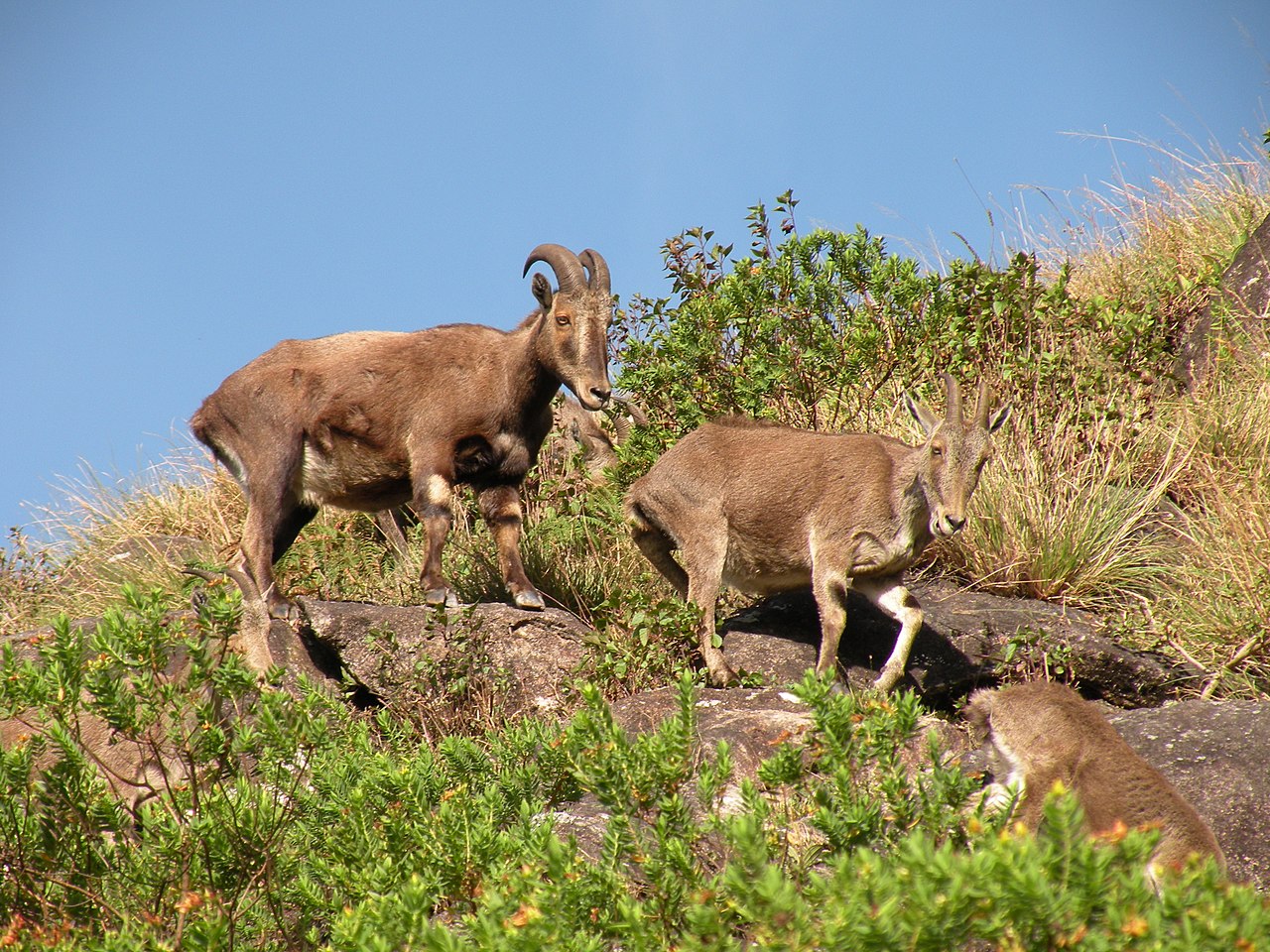
South India is home to significant population of endangered Bengal tigers and Indian elephants, and is home to one-third of the tiger population and more than half of the elephant population in India. There are 14 Tiger reserves designated under Project Tiger and 11 Project Elephant reserves. Elephant populations are found in eight fragmented sites in the region: in northern Karnataka, along the Western Ghats, in Bhadra–Malnad, in Brahmagiri–Nilgiris–Eastern Ghats, in Nilambur–Silent Valley–Coimbatore, in Anamalai–Parambikulam, in Periyar–Srivilliputhur, and in Agasthyamalai Other threatened and endangered species found in the region include the grizzled giant squirrel, grey slender loris, Indian leopard. lion-tailed macaque, Nilgiri langur, Nilgiri tahr, and sloth bear.
Politics
Politics in South India is characterized by a mix of regional and national political parties. The Justice Party and Swaraj Party were the two major parties in the erstwhile Madras Presidency. The Justice Party eventually lost the 1937 elections to the Indian National Congress, and Chakravarti Rajagopalachari became the Chief Minister of the Madras Presidency. During the 1920s and 1930s, the Self-Respect Movement, spearheaded by Theagaroya Chetty and E. V. Ramaswamy (Periyar), emerged in the Madras Presidency. In 1944, Periyar transformed the party into a social organisation, renaming the party Dravidar Kazhagam, and withdrew from electoral politics, with the initial aim of secession from the rest of India upon Indian independence.
After independence, C. N. Annadurai, a follower of Periyar, formed the Dravida Munnetra Kazhagam (DMK) in 1948. The Indian National Congress dominated the political scene in Madras in the 1950s and 1960s under the leadership of K. Kamaraj, who led the party after the death of Jawaharlal Nehru and ensured the selection of Prime Ministers Lal Bahadur Shastri and Indira Gandhi. The anti-Hindi agitations led to the rise of the DMK, which came to power in 1967. In 1972, a split in the DMK resulted in the formation of the All India Anna Dravida Munnetra Kazhagam (AIADMK) led by M. G. Ramachandran. Dravidian parties continue to dominate Tamil Nadu electoral politics, the national parties usually aligning as junior partners to the major Dravidian parties, AIADMK and DMK.
The Congress continues to be a major party in Karnataka, Kerala, Puducherry, and Telangana. The party ruled with minimal opposition for 30 years in Andhra Pradesh, before the formation of the Telugu Desam Party by Nandamuri Taraka Rama Rao in 1982. In Karnataka, the Bharatiya Janata Party and Janata Dal (Secular) emerged as significant parties in the late 20th century. Two prominent coalitions in Kerala are the United Democratic Front, led by the Congress, and the Left Democratic Front, led by the Communist Party of India (Marxist). For the past fifty years, these two coalitions have been alternately in power; and E. M. S. Namboodiripad, the first elected chief minister of Kerala in 1957, is credited as the leader of the first democratically elected communist government in the world. Parties which split from the Congress such as YSR Congress in Andhra Pradesh, and All India N.R. Congress in Puducherry, have emerged as significant regional parties in their respective regions. The Telangana Rashtra Samithi emerged as a prominent party in Telangana, after its campaign for statehood for Telangana and the state's formation in 2014.
Rajagopalachari was the first and only Indian to hold the post Governor General of India, before the position was abolished in January 1950. The region has produced six Indian presidents, namely, Sarvepalli Radhakrishnan, V. V. Giri, Neelam Sanjiva Reddy, R. Venkataraman, K. R. Narayanan, and APJ Abdul Kalam. Indian prime ministers from South India include P. V. Narasimha Rao, and H. D. Deve Gowda.
Administration
South India consists of the five southern Indian states of Andhra Pradesh, Telangana, Karnataka, Kerala, and Tamil Nadu, and the union territories of Puducherry, and Lakshadweep. Puducherry and the five states each have an elected legislature, while Lakshadweep is administered by the union government.
A governor, who is appointed by the president of India, is the de jure head of the government in the states. The governor appoints the leader of the state legislature's ruling party or coalition as the chief minister, who is the de facto head of the government.
Each state or territory is further divided into districts, each of which is administered by a district collector. For land revenue administration, the districts are further subdivided into revenue divisions administered by revenue divisional officers which are further subdivided into revenue divisions and taluks or tehsils administered by tehsildars. The taluks are divided into revenue blocks called firkas which consist of revenue villages. The local administration consists of municipal corporations, municipalities, and town panchayats in the urban areas, and panchayat unions and village panchayats, in rural areas.
States
Union territories
Legislative representation
South India elects 132 members to the Lok Sabha, accounting for roughly one-fourth of the total strength. The region is allocated 58 seats in the Rajya Sabha, out of the total of 245.
The state legislatures of Tamil Nadu, Kerala and Puducherry are unicameral, while Andhra Pradesh, Karnataka, and Telangana have bicameral legislatures. States with bicameral legislatures have an upper house (Legislative Council) with members not more than one-third the size of the Assembly. State legislatures elect members for terms of five years. Governors may suspend or dissolve assemblies and can administer when no party is able to form a government.
Demographics
As per the 2011 census of India, the estimated population of South India was 252 million, around one fifth of the total population of the country. The region's total fertility rate (TFR) was less than the population replacement level of 2.1 set by the United Nations, with Kerala and Tamil Nadu having the lowest TFRs in India at 1.7. As a result, the proportion of the population of South India to India's total population has shown a declining trend from 1981 to 2011. Scheduled Castes and Tribes form 18% of the population of the region. Agriculture is the major employer in the region, with 47.5% of the population being involved in agrarian activities. About 60% of the population lives in permanent housing structures. In 2011, about 67.8% of the people in South India had access to tap water, with wells and springs being major sources of water supply.
After experiencing fluctuations in the decades immediately after the independence of India, the economies of South Indian states have, over the past three decades, registered growth higher than the national average. While South Indian states have improved in some of the socio-economic metrics, poverty continues to affect the region as it does the rest of the country, although it has considerably decreased over the years. The HDI in the southern states is high, and the economy has grown at a faster rate than those of most northern states.
As per the 2011 census, the average literacy rate in South India is approximately 80%, considerably higher than the Indian national average of 74%, with Kerala having the highest literacy rate of 93.91%. South India has a higher sex ratio than the national average with Kerala and Tamil Nadu being the top two states in the country. The South Indian states rank amongst the top half in economic freedom, access to electricity, access to drinking water, house ownership, TV ownership, and lower poverty rate. In early 2010s, the average per capita income of the South Indian states was ₹19,531 (US$200), more than double of the average of other Indian states (₹8,951 (US$94)). Of the three demographically related targets of the Millennium Development Goals set by the United Nations and expected to be achieved by 2015, Kerala and Tamil Nadu achieved the goals related to improvement of maternal health and of reducing infant mortality and child mortality by 2009.
Languages
The largest linguistic group in South India is the Dravidian family of languages, consisting of approximately 73 languages. The major languages spoken include Telugu, Tamil, Kannada, and Malayalam. Deccani Urdu a regional dialect of Urdu spoken in the region. Other minor languages include Konkani and Tulu. English is widely spoken in urban areas. Kannada, Konkani, Malayalam, Tamil, Telugu, and Urdu are amongst the 22 official languages of India. Tamil was the first language to be granted classical language status by the Government of India in 2004. Later, Telugu (2008), Kannada (2008) and Malayalam (2013) were also declared as classical languages. These four languages combined have a higher literary output than the combined output of all other literary languages of India.
Religion
Evidence of prehistoric religion in South India comes from scattered Mesolithic rock paintings depicting dances and rituals, such as the Kupgal petroglyphs of eastern Karnataka, at Stone Age sites. Hinduism, regarded as one of the oldest religions. is the major religion in South India, with about 82.6% of the population adhering to it. Its major spiritual traditions include Shaivism and Vaishnavism, although Buddhist and Jain philosophies were also influential earlier. Ayyavazhi originated in South India in the 19th century.
Islam was introduced to the Malabar Coast in the early 7th century CE by the Arab traders, and spread during the rule of the Deccan Sultanates, in the 17th and 18th centuries. As of 2011, about 11.6% of the population In South India follow the religion. Christianity was introduced to South India by Thomas the Apostle, who visited Muziris in Kerala in 52 CE and proselytised the natives. As of 2011, about 5.1% of the population follow the religion. Kerala is also home to one of the oldest Jewish communities in the world, who are supposed to have arrived on the Malabar coast during the reign of King Solomon.
Largest cities
Transport
Road
South India has an extensive road network with 23,304 km (14,480 mi) of National Highways and 49,927 km (31,023 mi) of State Highways. The Golden Quadrilateral connecting Chennai with Mumbai and Kolkata traverses Tamil Nadu, Karnataka and Andhra Pradesh. Bus services are provided by state-run transport corporations, namely the Andhra Pradesh State Road Transport Corporation, Tamil Nadu State Transport Corporation, Karnataka State Road Transport Corporation, Telangana State Road Transport Corporation, Kerala State Road Transport Corporation, and Puducherry Road Transport Corporation.
Rail
In 1832, the proposal to construct the first railway line in India at Madras was made. In 1835, a railway track was constructed between Red Hills and Chintadripet in Madras and became operational in 1837. The Madras Railway was established in 1845. The Great Southern of India Railway Company was founded in England in 1853 and registered in 1859. The construction on the first main line in the South between Royapuram in Madras and Arcot started in 1853, which became operational on 1 July 1856. Construction of track in the Madras Presidency began in 1859 and the 80 miles (130 km) link from Trichinopoly to Negapatam and a link from Tirur to the Port of Beypore at Kozhikode on the Malabar Coast, which eventually got expanded into the Mangalore-Chennai line via Palakkad Gap were opened in 1861. The Carnatic Railway Company was founded in 1864 and opened a Madras–Arakkonam–Conjeevaram–Katpadi junction line in 1865. These two companies subsequently merged in 1874 to form the South Indian Railway Company. In 1880, the Great Indian Peninsula Railway, established by the British, built a railway network radiating from Madras. In 1879, the Madras Railway constructed a line from Royapuram to Bangalore; and the Maharaja of Mysore established the Mysore State Railway to build an extension from Bangalore to Mysore. The Madras and Southern Mahratta Railway was founded on 1 January 1908 by merging the Madras Railway and the Southern Mahratta Railway.
On 14 April 1951, the Madras and Southern Mahratta Railway, the South Indian Railway, and the Mysore State Railway were merged to form the Southern Railway, the first zone of Indian Railways. The South Central zone was created on 2 October 1966 as the ninth zone of Indian Railways and the South Western zone was created on 1 April 2003. Most of the region is covered by the three zones, with small portions of the coasts covered by East Coast Railway and Konkan Railway. In 2019, the South Coast Railway zone was formed and it became operational on 1 June 2026. The Nilgiri Mountain Railway of Southern Railway is a UNESCO World Heritage Site. Indian Railways under the ownership of the Ministry of Railways of the Government of India operates the railway system.
Suburban and Metro
Currently, operational metro systems are there in four cities Chennai, Bengaluru, Hyderabad and Kochi. Chennai Suburban founded in 1928 is one of the oldest and largest urban networks in the country. Opened in 1995, Chennai MRTS was the first elevated urban railway in India. Hyderabad MMTS was opened in 2003, becoming the second city in South India to have a local rail transit system. As of December 2022, South India has 205.06 km of operational metro lines and 16 systems.