
The racket sport traditionally named lawn tennis was invented in Edgbaston, Birmingham, England, and is now commonly known simply as tennis. It is the direct descendant of what is now known as real tennis or royal tennis, which continues to be played today as a separate sport with more complex rules.
Most rules of (lawn) tennis derive from this precursor and it is reasonable to see both sports as variations of the same game. Most historians believe that tennis originated in northern France in the 12th century, but the ball was then struck with the palm of the hand, hence the name jeu de paume (lit. 'game of the palm'). It was not until the 16th century that rackets came into use and the game began to be called 'tennis'. It was popular in the Kingdom of France as well as in England, where Henry VIII of England was a notable enthusiast of the game now referred to as real tennis.
By the late 19th century real tennis had a long history of rule codification, with Marylebone Cricket Club's 1872 Rules of Real Tennis regarded as the most authoritative. There was no such consensus for lawn tennis. As the new game began to spread in the early 1870s, several competing rulebooks emerged, causing confusion among players and clubs. In March 1875, an open meeting at Lord's was organised, resulting in the publication of the 1875 MCC Laws of Lawn Tennis in May. This code provided the foundations for the rules used at the first Wimbledon Championships in 1877.
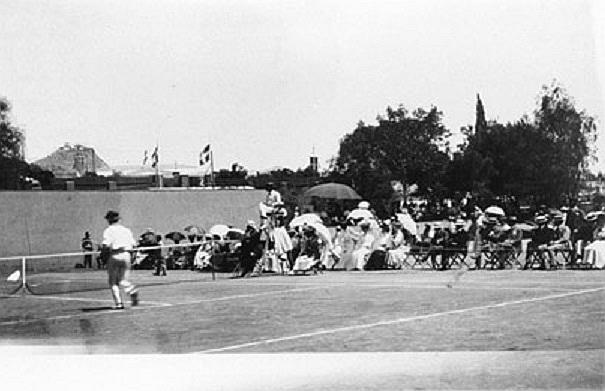
The Davis Cup, an annual competition between men's national teams, dates to 1900. The analogous competition for women's national teams, the Fed Cup, was founded as the Federation Cup in 1963 to celebrate the 50th anniversary of the founding of the International Tennis Federation, also known as the ITF. Promoter C. C. Pyle created the first modern professional tennis tour in 1926, with a group of American and French tennis players playing exhibition matches to paying audiences. The most notable of these early professionals were the American Vinnie Richards and the Frenchwoman Suzanne Lenglen. Players turning pro could not compete in the major (amateur) tournaments.
In 1968 commercial pressures and rumours of some amateurs taking money under the table led to the abandonment of this distinction, inaugurating the Open Era, in which all players could compete in all tournaments and top players were able to make their living from tennis. With the beginning of the Open Era, the establishment of an international professional tennis circuit, and revenues from the sale of television rights, tennis's popularity has spread worldwide, and the sport has shed its upper/middle-class Anglophone image (although it is acknowledged that this stereotype still exists).
Etymology
The word tennis came into use in English in the mid-14th century from French, via the Anglo-Norman term Tenez, which can be translated as 'hold!', 'receive!' or 'take!', a call from the server to his opponent indicating that he is about to serve. The first known appearance of the word in English literature is by poet John Gower in his poem titled 'In Praise of Peace' dedicated to King Henry IV and composed in 1400; "Of the tenetz to winne or lese a chase, Mai no lif wite er that the bal be ronne". (Whether a chase is won or lost at tennis, Nobody can know until the ball is run).

Origin
References to tennis are found in literature dating back to the Middle Ages. In The Second Shepherds' Play (c. 1500), a tennis ball is listed among the three gifts which the shepherds give to the newborn Christ. In The Turke and Gowin (c. 1500) Sir Gawain, a knight of King Arthur's round table, plays tennis against a group of 17 giants.
Jeu de paume
Most historians believe that tennis originated in northern France in the 12th century, but the ball was then struck with the palm of the hand, hence the name jeu de paume (lit. 'game of the palm'). Originally it was played with a bare hand, and later with a glove. This game may have been played by monks in monastery cloisters, but the construction and appearance of courts more resemble medieval courtyards and streets than religious buildings.
Real tennis
By the 16th century the glove had become a racquet, the game had moved to an enclosed playing area and the rules had stabilised. This version of the game is known today as real tennis.

Real tennis quickly became a popular leisure pursuit for European royalty. In 1437 at the Blackfriars, Perth, the playing of tennis indirectly led to the death of King James I of Scotland, when the drain outlet, through which he hoped to escape assassins, had been blocked to prevent the loss of tennis balls. James was trapped and killed. Francis I of France (1515–1547) was an enthusiastic player and promoter of real tennis, building courts and encouraging play among the courtiers and commoners. His successor, Henry II (1547–59), was also an excellent player and continued the tradition. The deaths of two French kings can be linked to tennis—Louis X died of a severe chill after playing, while Charles VIII died after hitting his head either en route to a game, or, according to a tertiary source, during one. King Charles IX granted a constitution to the Corporation of Tennis Professionals in 1571, creating the first pro tennis 'tour', establishing three professional levels: apprentice, associate, and master. A professional named Forbet wrote and published the first codification of the rules in 1599.
In England, royal interest in the game began with Henry V (1413–22), but it was Henry VIII (1509–47) who made the biggest impact. As a young monarch he played the game with gusto at Hampton Court on a court he had built in 1530. It is believed that his second wife, Anne Boleyn, was watching a game of real tennis when she was arrested, and that Henry was playing when news was brought to him of her execution. By the reign of James I (1603–25), London had fourteen tennis courts.
In 1555 an Italian priest, Antonio Scaino da Salothe, wrote the first known book about tennis, Trattato del Giuoco della Palla. More references to tennis are found in the literature of this period. Perhaps most famously, a basket of "tennis balles" is given to King Henry in William Shakespeare's Henry V (1599), in mockery of his youth and playfulness. Shakespeare appears to have read about this incident from some earlier chronicles and ballads. One of the earliest paintings to feature tennis is Giambattista Tiepolo's The Death of Hyacinth (1752–1753), which includes a strung racquet and three tennis balls. The theme of the painting is the mythological story of Apollo and Hyacinth as recounted in Ovid's Metamorphoses. Giovanni Andrea dell'Anguillara translated the Metamorphoses into Italian in 1561, and replaced the original text's references to ancient discus with the more contemporary game of tennis (Italian: pallacorda). Tiepolo's painting had been commissioned in 1752 by German count Wilhelm Friedrich Schaumburg Lippe, who was an avid tennis player.

The game thrived among seventeenth century nobility in France, Spain, Italy and the Austro-Hungarian Empire but suffered under English Puritanism. By the Age of Napoleon the royal families of Europe were besieged and real tennis was largely abandoned. Real tennis played a minor role in the history of the French Revolution, through the Tennis Court Oath (Serment du Jeu de Paume). On 20 June 1789, members of the Third Estate found themselves locked out of a meeting of the Estates-General and convened at a real tennis court near Versailles to sign this pledge, which formed a decisive early step in starting the revolution. The French Revolution also led to the decommissioning of many real tennis courts in France, as tennis fell out of vogue due to its aristocratic associations.
An epitaph in St Michael's Church, Coventry, written circa 1705 read, in part:
In England, during the 18th and early 19th centuries as real tennis declined, three other racquet sports emerged: racquets, squash racquets and lawn tennis (the modern game). Many historic tennis courts have been preserved in the British Isles, including courts at Oxford, Cambridge, Falkland Palace in Fife where Mary Queen of Scots regularly played, and Hampton Court Palace.

Birth of lawn tennis
The lawyer and memoirist William Hickey recalled that in 1767 "in the summer we had another club, which met at the Red House in Battersea fields, nearly opposite Ranelagh.... The game we played was an invention of our own, and called field tennis, which afforded noble exercise.... The field, which was of sixteen acres in extent, was kept in as high an order, and smooth as a bowling green."
The modern sport is tied to two separate inventions.
Between 1859 and 1865, in Birmingham, England, Major Harry Gem, a solicitor, and his friend Augurio Perera, a Spanish merchant, combined elements of the game of racquets and a ball of wind and played it on a croquet lawn in Edgbaston. In 1872, both men moved to Leamington Spa and in 1874, with two doctors from the Warneford Hospital, founded the world's first tennis club, the Leamington Tennis Club.

In December 1873 Major Walter Clopton Wingfield designed an hourglass-shaped tennis court in order to obtain a patent on his court (as the rectangular court was already in use and was unpatentable). A temporary patent on this hourglass-shaped court was granted to him in February, 1874, which he never renewed when it expired in 1877. It is commonly believed, mistakenly, that Wingfield obtained a patent on the game he devised to be played on that type of court, but in fact Wingfield never applied for nor received a patent on his game, although he did obtain a copyright — but not a patent — on his rules for playing it. And, after a running series of articles and letters in the British sporting magazine The Field, and a meeting at London's Marylebone Cricket Club, the official rules of lawn tennis were promulgated by that Club in 1875, which preserved none of the aspects of the variations that Wingfield had dreamed up and named Sphaeristikè (Greek: σφαιριστική, that is, "sphere-istic", an ancient Greek adjective meaning "of or pertaining to use of a ball, globe or sphere"), which was soon corrupted to "sticky". Wingfield claimed that he had invented his version of the game for the amusement of his guests at a weekend garden party on his estate of Nantclwyd, in Llanelidan, Wales in 1874, but research has demonstrated that even his game was not likely played during that country weekend in Wales. He had likely based his game on both the evolving sport of outdoor tennis and on real tennis. Much of modern tennis terminology also derives from this period, for Wingfield and others borrowed both the name and much of the French vocabulary of real tennis, and applied them to their variations of real tennis. In the scholarly work Tennis: A Cultural History, Heiner Gillmeister reveals that on 8 December 1874, Wingfield had written to Harry Gem, commenting that he had been experimenting with his version of lawn tennis for a year and a half. Gem himself had largely credited Perera with the invention of the game.
Wingfield did patent his hourglass court in 1874, but not his eight-page rule book titled "Sphairistike or Lawn Tennis", but he failed in enforcing his patent. In his version, the game was played on an hourglass-shaped court, and the net was higher (4 feet 8 inches) than it is in official lawn tennis. The service had to be made from a diamond-shaped box in the middle of one side of the court only, and the service had to bounce beyond the service line instead of in front of it. He adopted the rackets-based system of scoring where games consisted of 15 points (called 'aces'). None of these quirks survived the Marylebone Cricket Club's 1875 Rules of Lawn Tennis that have been official, with periodic slight modifications, ever since then. Those rules were adopted by the All England Lawn Tennis and Croquet Club for the first Lawn Tennis Championship, at Wimbledon in 1877 (the men who devised those rules were members of both clubs). Wingfield does deserve great credit for popularizing the game of lawn tennis, as he marketed, in one boxed set, all the equipment needed to play his or other versions of it, equipment that had been available previously only at several different outlets. Because of this convenience, versions of the game spread in Britain, and by 1875 lawn tennis had virtually supplanted croquet and badminton as outdoor games for both men and women.
Mary Ewing Outerbridge played the game in Bermuda at Clermont, a house with a spacious lawn in Paget parish. Innumerable histories claim that in 1874, Mary returned from Bermuda on board the ship S.S. Canima and introduced lawn tennis to the United States, setting up supposedly the first tennis court in the United States on the grounds of the Staten Island Cricket and Baseball Club, which was near where the Staten Island Ferry Terminal is today. The club was founded on or about 22 March 1872. She is also mistakenly said to have played the first tennis game in the U.S. against her sister Laura in Staten Island, New York on an hourglass-shaped court. However, all this would have been impossible, as the tennis equipment she is said to have brought back from Bermuda was not available in Bermuda until 1875, and her next trip to Bermuda, when it was available there, was in 1877. In fact, lawn tennis was first introduced in the United States on a grass court on Col. William Appleton's Estate in Nahant, Massachusetts by Dr. James Dwight ("the Father of American Lawn Tennis"), Henry Slocum, Richard Dudley Sears and Sears' half-brother Fred Sears, in 1874.
Terminology
Wingfield borrowed both the name and much of the French vocabulary of real tennis:
Tennis comes from the French tenez, the formal imperative form of the verb tenir, to hold, meaning "hold!", "receive!" or "take!", an interjection used as a call from the server to his opponent to indicate that he is about to serve.
Racket (or racquet) derives from the Arabic rāhat (al-yad), meaning the palm (of the hand).
Deuce comes from "a deux du jeu" - two points away from game (that is, two consecutive points must be scored to win the game).
The origin of the use of love for zero is disputed. It is ascribed to derive from l'œuf, French for "the egg", traditionally representing the shape of a zero. Another possibility is that it derives from the Dutch expression "iets voor lof doen", which means to do something for praise, implying no monetary stakes.
The reason for the numbering of scores being "15", "30" and "40" is unknown. Historical sources suggest the system was originally 15, 30, 45 with the 45 simplified to 40 over time. Common theories are that it originated from the quarters of a clock, or from gambling stakes or just a trick from royal families to confuse the servants and maids so they would not understand the system of scoring.
Tournaments and tours of the Amateur Era
Amateur tournaments
The Four Majors
The four majors or Grand Slam tournaments, the four biggest competitions on the tennis circuit, are Wimbledon, the US Open, the French Open, and the Australian Open. Since the mid-1920s they became and have remained the more prestigious events in tennis. Winning these four tournaments in the same year is called the Calendar Grand Slam (a term borrowed from bridge).
1877: Wimbledon
The Championships, Wimbledon, were founded by the All England Lawn Tennis and Croquet Club in 1877 to raise money for the club. The first Championships were contested by 22 men and the winner received a Silver Gilt Cup proclaiming the winner to be "The All England Lawn Tennis Club Single Handed Champion of the World". The first Championships culminated a significant debate on how to standardize the rules. The following year, it was recognized as the official British Championships, although it was open to international competitors. In 1884 the Ladies Singles and Gentlemen's Doubles Championships were inaugurated, followed by the Ladies and Mixed Doubles in 1913.
1881: U.S. Open
Tennis was first played in the U.S. on a grass court set up on the Estate of Col. William Appleton in Nahant, Massachusetts by James Dwight, Richard Dudley Sears and Fred Sears in 1874. In 1881, the desire to play tennis competitively led to the establishment of tennis clubs.
The first American National tournament was played in 1880 at the Staten Island Cricket and Baseball Club in New York. An Englishman named Otway Woodhouse won the singles match. There was also a doubles match which was won by a local pair. There were different rules at each club. The ball in Boston was larger than the one normally used in NY. On 21 May 1881, the United States National Lawn Tennis Association (now the United States Tennis Association) was formed to standardize the rules and organize competitions.
The U.S. National Men's Singles Championship, now the US Open, was first held in 1881 at Newport, Rhode Island. The U.S. National Women's Singles Championships were first held in 1887 in Philadelphia.
The tournament was made officially one of the tennis 'Majors' from 1924 by the International Lawn Tennis Federation (ILTF).
1891/1925: French Open
Tennis was predominantly a sport of the English-speaking world, dominated by Great Britain and the United States. It was also popular in France, where the French Open dates to 1891 as the Championat de France International de Tennis. This tournament was not recognised as a Major or Grand Slam tournament until it was opened to all nationalities in 1925.
1905: Australian Open
The Australian Open was first played in 1905 as The Australasian (Australia and New Zealand) Championships. Because of its geographic remoteness, historically, the event did not gain attendance from the top tennis players. It became one of the major tennis tournaments starting in 1924 (designated by the ILTF). In 1927, because of New Zealand tennis authorities releasing their commitments to the tournament, it became known as the Australian Championships. For most of the 1970s and the early 1980s, the event lacked participation from top ranked tennis professionals. Since its move to Melbourne Park in 1988, the Australian Open has gained the popularity of the other three majors.
The Davis Cup
In 1898, Dwight F. Davis of the Harvard University tennis team designed a tournament format with the idea of challenging the British to a tennis showdown. The first match, between the United States and Great Britain was held in Boston, Massachusetts in 1900. The American team, of which Dwight Davis was a part, surprised the British by winning the first three matches. By 1905 the tournament had expanded to include Belgium, Austria, France, and Australasia, a combined team from Australia and New Zealand that competed jointly until 1913.
The tournament initially was known as the International Lawn Tennis Challenge. It was renamed the Davis Cup following the death of Dwight Davis in 1945. The tournament has vastly expanded and, on its 100th anniversary in 1999, 130 nations competed.
International Tennis Federation
1913 also saw 12 national tennis associations agree at a Paris conference to form the International Lawn Tennis Federation (ILTF), renamed in 1977 as the current International Tennis Federation (ITF). The rules the association promulgated in 1924 have remained remarkably stable in the ensuing century, the one major change being the addition of the tie-break system designed by James Van Alen.
The same year, tennis withdrew from the Olympics after the 1924 Games but returned 60 years later as a 21-and-under demonstration event in 1984. This reinstatement was credited by the efforts by the then ITF President Philippe Chatrier, ITF General Secretary David Gray and ITF Vice President Pablo Llorens as well as support from IOC President Juan Antonio Samaranch. The success of the event was overwhelming, and the IOC decided to reintroduce tennis as a full medal sport at Seoul in 1988.
The Fed Cup
The idea of a Davis Cup-style tournament for national women's teams is surprisingly old—it was first proposed in 1919 by Hazel Hotchkiss Wightman. After she was turned down, she donated a trophy in 1923 that would be known as the Wightman Cup, awarded in an annual match between the two strongest women's tennis nations of the time, the United States and Great Britain.
Wightman's original idea for a worldwide women's team tournament would bear fruit more than 40 years later in 1962, when Nell Hopman persuaded the ITF to begin sponsoring such an event. The first Federation Cup was played in 1963 as part of the ITF's 50th anniversary celebrations; it involved 16 countries and was played over one week. By the 1990s, over 70 nations competed each year, and regional qualifiers were introduced in 1992. In 1995, the ITF introduced a new Davis Cup-style format for the competition and rechristened it the Fed Cup.
The professional circuit
In 1926, promoter C.C. Pyle established the first professional tour with a group of American and French players playing exhibition matches to paying audiences. The most notable early professionals were American Vinnie Richards and Frenchwoman Suzanne Lenglen. Players turning pro could not compete in the major (amateur) tournaments.
Before the Open Era, the leading professional players were under contract with a professional promoter who controlled their appearances. For example, in 1926, Lenglen and Richards toured North America along with Paul Féret and Mary K. Browne under contract to Charles C. Pyle. The main events of the professional circuit comprised head-to-head competition and by-invitation Pro Championships, which were the equivalent of the Grand Slam tournaments on the professional circuit.