
Real tennis – one of several games sometimes called "the sport of kings" – is the original racquet sport from which the modern game of tennis (also called "lawn tennis") is derived. It is also known as court tennis in the United States, royal tennis in England and Australia, and courte-paume in France (to distinguish it from longue-paume, and in reference to the older, racquetless game of jeu de paume, the ancestor of modern handball and racquet games). Many French real tennis courts are at jeu de paume clubs.
The term real was first used by journalists in the early 20th century as a retronym to distinguish the ancient game from modern lawn tennis (even though, at present, the latter sport is seldom contested on lawns outside the few social-club-managed estates such as Wimbledon).
There are 45 active real tennis courts in the world, located in the United Kingdom, Australia, the United States and France. There are also currently six disused courts, such as the two in the Republic of Ireland. The sport is supported and governed by various organizations around the world.

Equipment
Balls
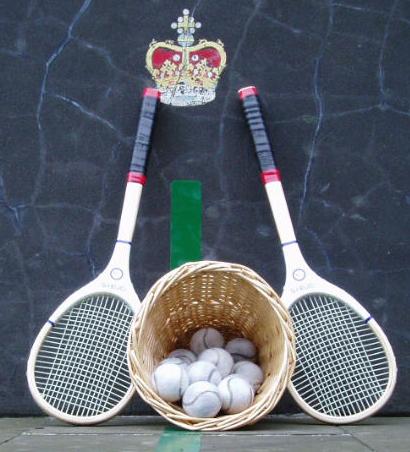
Unlike latex-based technology underlying the modern lawn tennis ball, the game uses a cork-cored ball which is very close in design to the original balls used in the game. The 2+1⁄2-inch (64 mm) diameter balls are handmade and consist of a core made of cork with fabric tape tightly wound around it, compacted by outer windings of string, and covered with a hand-sewn layer of heavy, woven, woollen cloth, traditionally Melton cloth (not felt, which is unwoven and not strong enough to last as a ball covering). The balls were traditionally white, but around the end of the 20th century "optic yellow" was introduced for improved visibility, as had been done years earlier in lawn tennis. The balls are much less bouncy than lawn tennis balls, and weigh about 2+1⁄2 ounces (71 grams); lawn tennis balls typically weigh 2 ounces (57 g).
Despite trials by Dunlop to introduce machine-made balls in the 1970s, almost all balls are entirely hand made by club professionals. The inner core of a ball can last several years, but the cover must be replaced every two to three weeks, depending on usage. Balls are produced in sets of around 60 and hand-sewn by the professional at each club. They are not available for purchase by the general public. Balls are stored in a wicker or plastic basket placed in a hole in the floor underneath the net. A trough under the net allows balls hit into the net to roll into the basket. The entire basket of balls is tipped into a tray in the dedans prior to play to reduce time spent fetching balls; ball boys are not required in real tennis.
Rackets
The spellings racket and racquet are both used by different sources.

The 27-inch (690 mm) short, asymmetrical racquets are made of wood and use very tight nylon strings to cope with the heavy balls. The racquet is oval-shaped to make it easier to strike balls close to the floor or in corners, and to facilitate a fast shot with a low trajectory that is difficult for an opponent to return. However, the rackets have a small sweet spot, which discourages a large swing in a shot and emphasises accuracy. Rackets are made of a combination of ash, hickory, vulcanized fibre and willow. Gut strings have now entirely been replaced by nylon, allowing strings to be tighter. Rackets are laminated, with improvements in epoxy resulting in stronger, sturdier rackets which last longer and have changed the game to be faster and more hard hitting.
Most of the rackets in the world are produced by Grays of Cambridge, based in Cambridge in the United Kingdom. Companies that have previously produced real tennis rackets include Dunlop, Slazenger and Gold Leaf Athletics. The introduction of graphite rackets in lawn tennis has reduced the demand for wooden rackets of any sport, resulting in the larger companies leaving the industry.
More recently, Harrow Sports has introduced graphite rackets which are not permitted by the rules of the game as of 2025, but are being trialled at the club level.
Due to the small nature of the game, rackets are almost exclusively sold by club professionals, who also provide restringing services to club members. Even at the elite level, professionals string their own rackets.
Courts
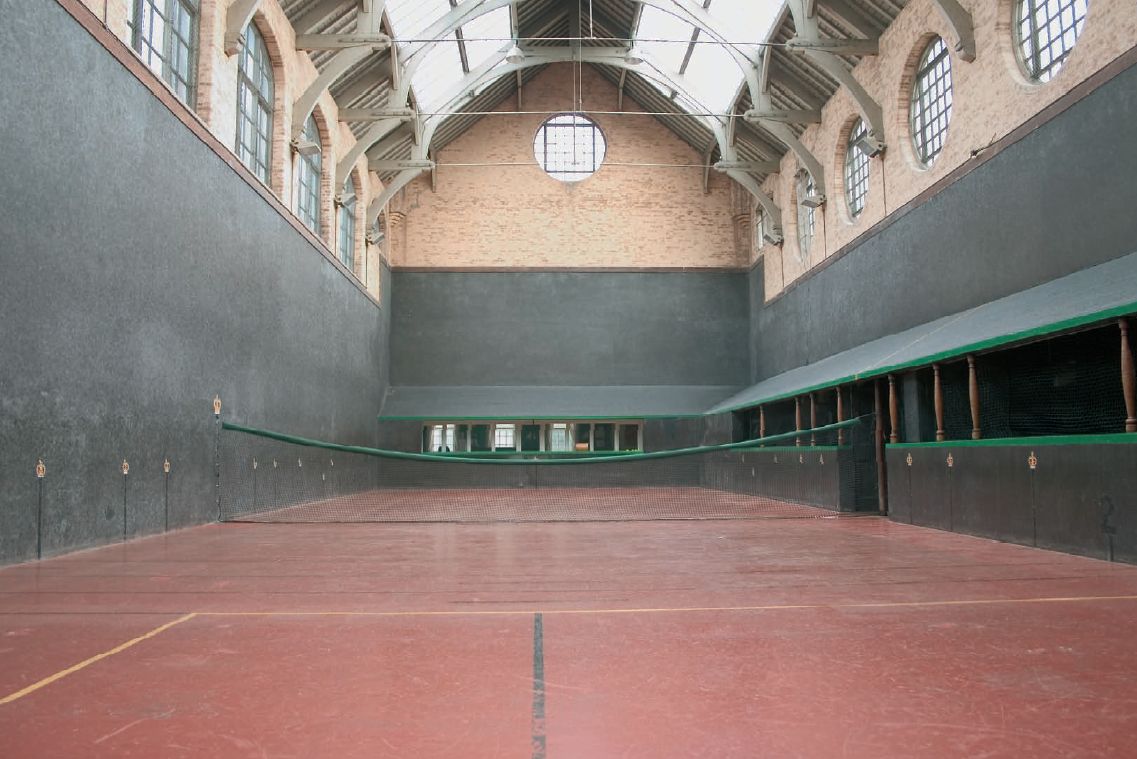
There are two basic designs in existence today: jeu quarré, which is an older design, and jeu à dedans. Both are doubly asymmetric: the two ends of the court differ in shape, as do the left and right sides. All existing tennis courts in the modern day are of the jeu à dedans variety, except the court at Falkland Palace in Scotland. The jeu à dedans court is a rectangular indoor court with high walls on all four sides and a high ceiling. The floor size of a court can vary from 28.3 by 9.1 metres (93 ft × 30 ft) at Oxford to 29.6 by 9.6 metres (97 ft × 31 ft), and can be constructed of dyed concrete or, in some older courts, flagstone. The surrounding walls are usually constructed of brick or cinder block and are plastered smooth. Some courts, notably Prested and Washington have glass walls down to floor level, though many more have installed glass walls higher up to increase viewing capacity without impacting play.
Three walls feature sloping wooden roofs, known as penthouses, built 2 to 2.2 metres (6 ft 7 in to 7 ft 3 in) above the floor and extending to a width of 1.6 to 2.2 metres (5 ft 3 in to 7 ft 3 in). The wall without a penthouse is called the main wall. Protruding from the main wall is the tambour, an angled wall 0.7 to 1.0 metre (2 ft 4 in to 3 ft 3 in) wide at an angle of approximately 53 degrees, though some courts can be up to 59 degrees.
Counting clockwise from the main wall, the penthouses are called the dedans penthouse, the service penthouse and the grille penthouse. The side with the dedans penthouse is also known as the service end, and the side with the grille penthouse is also known as the hazard end. Beneath the penthouses are various openings in the wall, which have various mechanics in the gameplay and allow spectators to view the game. Underneath the dedans penthouse is the dedans, between 5.7 and 6.7 metres (19 and 22 ft) wide positioned centrally along the wall. A net across the opening allows spectators to view the game without fear of injury. Beneath the grille penthouse is the grille, a roughly square opening measuring between 0.9 by 0.9 metres (2 ft 11 in × 2 ft 11 in) and 1.0 by 1.0 metre (3 ft 3 in × 3 ft 3 in) positioned the upper right hand side as viewed from the court. The grille is usually blocked by a solid wood cover with a picture or club logo, though American courts usually have netting instead. Beneath the service penthouse is a long opening, divided up into smaller openings by wooden or metal posts. The central such opening, known as the line, extends to the floor and allows players to enter the court and change ends. Counted from the centre of the court, the openings are known symmetrically as first gallery, the door, second gallery and last gallery, though at the end of the court closest to the grille penthouse the final opening is instead called the winning gallery and contains a bell which rings when a ball enters the opening.
Strung across the centre of the court is a net, which sags in the middle. At the centre of the court, the net is positioned 3 feet (0.91 m) above the playing surface, rising to 5 feet (1.5 m) at the sides of the court. Most courts have a trough and a sunken basket at the base of the net for collecting balls at the change of ends.
The service court is marked on the hazard side by a line called the service line approximately 7 yards (6.4 m) from the back wall, and a line parallel to the main wall called the fault line. Often, the service court is painted a different colour to the rest of the floor. A series of lines called chase lines measuring distance from the back of the court on the service side and the service line on the hazard side towards the net. Courts in the United Kingdom, United States and Australia mark the distance in intervals yards from the back wall. The lines are numbered on the side walls, up to 6 on the service side and 2 on the hazard side, with the seventh line corresponding to the last gallery and second gallery respectively. Subsequent lines correspond to the gallery openings up to first gallery. Often, the last gallery and second gallery lines on the service end are a different colour to the remainder of the lines to make them easier to identify. At Prested in Essex, the floor is painted in alternating green and blue colours in lieu of chase lines. In France the lines are measured in pied du roi units, numbering up to 14 on the service side and 4 on the hazard side.

As many courts were built before the introduction of electric lighting, most courts have clerestory windows above the main and service walls. Typically, these areas are considered out of court, and are demarcated with an out of court line that extends around the top of the playing area. Often the out of court area is not plastered like the playing area. Notable exceptions include Hobart, where the wall between the windows is considered in play, and Hyde Bridport, where the two windows at the ends of the court are still in play. Alternatively, some courts have skylights in the roof of the building. All courts now use artificial lighting, allowing play at all times of day. Some modern courts, such as Radley and Oratory, do not have windows at all, and are lit entirely artificially. Most courts have gabled roofs, with the ridge line along the length of the court. Each court has local rules as to whether balls hit over the beams are in or out of play.
The court at Falkland Palace is the last remaining jeu quarré design which, unlike jeu à dedans court, does not have a tambour, a dedans and a dedans penthouse. Instead, it has an ais, a piece of wood on what would be the dedans wall adjacent to the service penthouse, and four lunes, openings in the walls high above what would be the dedans. The court is the only existing, playable court in the world to not have a roof.
Manner of play
Service
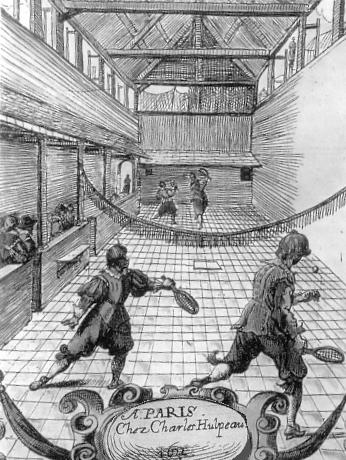
To begin play, the players traditionally spin a racket or toss a coin to decide who serves first. Serves are always made from the service end of the court, that is, the side of the net with spectator seating in the dedans behind it. Unlike lawn tennis, at least one foot must be grounded during the service, but the player may serve from anywhere in the court between the dedans wall and the second gallery line. The serve is played onto the service penthouse, and must touch the service penthouse at least once on the receiver's (hazard) side of the court. It may also touch the service wall above the penthouse or the service penthouse on the server's side. From there, it may touch any other surface including the back wall, back penthouse or battery wall. Serves may be volleyed by the receiver, or be played off a single bounce on the floor. To be a valid serve, the ball must land in the rectangle marked by the service line and the fault line. Serves which land between the fault line and the main wall, beyond the service line, or fail to touch the service penthouse are called fault. Players are permitted a second serve, but if it is also a fault, then the server double faults and the receiver wins the point. Under French rules, balls which land between the fault line and the main wall are not considered a fault, and are instead called a pass, with the serve replayed.
In doubles play, the two players in the pair alternate serving or receiving at the end of each game. The first player will serve or receive the entirety of the first game, with the second player serving or receiving the entirety of the second game and so on. This means that a player from one team will only serve or receive from one player from the other team for the entire set. The exception is if a serve lands between the center line and the fault line, in which case either receiving player may elect to play the ball. At the start of each new set, the players may switch who is serving first and second. The pair at the service end must nominate the first server before the pair at the hazard end nominates the first receiver, so players will occasionally play tactically to ensure that they are at the hazard end at the end of each set to ensure they can choose the match-ups for the new set.
Because there are numerous surfaces for the ball to touch during a serve, there are many different styles of serves which are chosen to achieve different tactical advantages. Since the court is asymmetric, different techniques are required for right and left-handed players. Some of the most common serves include:
Railroad
Served from the back of the court close to the service wall, the railroad is played overhead with a fast right-to-left action. For right handed players, the stance is usually front-on with the service motion led by the elbow to impart side-spin on the ball, whereas for left handed players, the service is similar to a slice serve in lawn tennis. An ideal railroad will bounce no more than a few inches from the bottom of the penthouse, then kick off the floor back towards the galleries, forcing the receiver to play the wall close to the side penthouse and out of position up the court.
Bobble
Served from the center of the court, often around last gallery, the bobble is played with no spin and hit softly at around hip height. It should bounce or roll several times on the service penthouse but not the service wall, forming an arc and falling close to the grille wall with as little forward momentum as possible. Often served as a second serve, it is often the first serve learnt by beginners.
Demi-piqué
Served from the centre of the court, near last gallery, the demi-piqué is played with left-to-right spin – for right handers it is played at head height while for left handers it is played below the waist. A demi-piqué strikes the service penthouse once near hazard first gallery, then the side wall, then may or may not hit the service penthouse a second time on the way down. The uncertainty of the trajectory on the way down makes it difficult to volley.
Underarm twist
Served mostly by right handers from the back of the court near the service wall, the underarm twist is played with right-to-left spin and played around knee height. For variation, it may or may not hit the service wall. It is typically much slower in pace than a railroad, despite having similar spin that kicks back towards the galleries. Left handers achieve a similar effect with a railroad, which is typically easier to learn than for right handers.
Side wall
Served from the back of the court near the side penthouse, the side wall serve is played with a left-to-right spin at around head height. It is hit directly onto the side wall above the net, then hitting the service penthouse on the way down. If allowed to hit the back wall, the serve will spin towards the grille, making it more difficult to hit to the right hander's forehand corner.
High serve/Chandelle
Served from the main wall at around last gallery, the high serve, also known as a chandelle, is hit as close to the roof as possible, falling once on the service penthouse and then close to the back wall. The serve can be played with either side spin or under spin, resulting in different variations when bouncing off the service penthouse.
High side wall
Similar to the high serve, the high side wall will hit the service wall before the service penthouse, resulting in the ball running along the grille wall. Difficult to return when served well, if served too long results in a fault (or pass in France), while if served too short is generally easy for the receiver.
Giraffe
Also similar to the high serve, except served from close to the service penthouse at about second gallery.
Drag
Served from very close to the service wall, the drag is played with heavy backspin. For right handers, this is typically achieved by serving as a backhand, while for left handers it can be served forehand. When served short, the backspin causes the ball to loose forward momentum, while when served long will spin off the back wall towards the tambour
Boomerang
Served from the center of the court, the boomerang is played deep onto the service penthouse, before bouncing up to the grille penthouse, then the back wall, returning to the service penthouse and falling flush with the grille wall. When served well, it is impossible to return, so there is a gentlemen's agreement that the serve is not used in high level play.
Piqué
Served from near the main around the second gallery line, the piqué is played with an overhead action, hit hard directly at the service penthouse. The ball then flies high in the air and lands near the grille wall close to the fault line. It is often used to target a weaker receiver in doubles play.
Caterpillar
Served from near the second gallery line in the centre of the court, the serve is played with a side wall action for right-handers or a railroad action for left-handers. The ball is played deep into the service penthouse, then striking the service wall, the grille penthouse, the back wall before finally falling flush with the grille wall close to the fault line. Rarely seen in singles play, it is often used to target a weaker receiver in doubles play.
African hunting dog
Served from the back of the court near the service wall, the African hunting dog is played overhead with a left-to-right spin, similar to a slice serve in lawn tennis. It typically bounces several times on the service penthouse before spinning off the back wall towards the center of the court. As it does not keep the ball close to any walls, it is generally easy for the receiver, and is often only seen by players with prior experience in lawn tennis, and not at all in high level play.
Returns
Once the ball has been served, the players have to return it to the opposite side by striking it with the racket. Unlike for lawn tennis, the ball does not have to bounce off the floor before it can be returned. It can be played in any direction, as long as its trajectory would bring it to hit the floor on the opposing side first.
Chases
Because of the asymmetry of the court, play generally favours the player at the service end of the court. The presence of the tambour at the hazard end introduces uncertainty for the receiving player. Unlike lawn tennis, where players alternately serve and receive entire games, in real tennis players must win the right to serve. To do so, the receiver must lay a chase, though a server can also lose the right to serve by laying a hazard chase. There are four ways to lay a chase:
The receiver hits a 'winner', that is, a shot which is not reached by the server. The chase is marked at the point the ball becomes dead, i.e., the second bounce on the floor, as measured from the back wall using the chase lines.
The receiver hits the ball into the galleries on the service side of the net (last gallery, second gallery, the door, or the line). The chase is marked by the line corresponding to the gallery the ball entered. Hitting a gallery post corresponds to entering the gallery closer to the net.
The server hits the ball into any of the galleries on the hazard side of the net except the winning gallery (which would win the point). The server loses the right to serve and has laid a hazard chase, which is marked by the line corresponding to the gallery the ball entered.
The server hits a ball not retrieved by the receiver but becomes dead between the net and the service line. The server loses the right to serve and has laid a hazard chase, which is marked by the point the ball becomes dead as measured from the service line.