New Bern (pronounced /'nu bərn/ NEW-bern, is a city in Craven County, North Carolina, United States, and its county seat. It had a population of 31,291 at the 2020 census. It is located at the confluence of the Neuse and the Trent Rivers, near the headwaters of Pamlico Sound on the North Carolina coast. It lies 112 miles (180 km) east of Raleigh, 89 miles (143 km) north of Wilmington, and 162 miles (261 km) south of Norfolk, Virginia.
New Bern was founded in October 1710 by the Palatines and Swiss under the leadership of Christoph von Graffenried. The new colonists named their settlement after Bern, the Swiss region from which many of the colonists and their patron had emigrated. New Bern is the second-oldest European-settled colonial town in North Carolina, after Bath. It served as the capital of North Carolina from 1770 to 1792. After the American Revolution (1775–1783), New Bern became wealthy and quickly developed a rich cultural life. At one time, New Bern was called "the Athens of the South", renowned for its Masonic Temple and Athens Theater. These are both still very active today.
New Bern has four historic districts listed on the National Register of Historic Places; their numerous contributing buildings include residences, stores, and churches dating back to the early 18th century. Within walking distance of the waterfront are more than 164 homes and buildings listed on the National Register. Also nearby are several bed and breakfasts, hotels, restaurants, banks, antiques stores, and specialty shops. The historic districts contain many of the city's 2,000 crape myrtles—its official flower—and developed gardens. New Bern has two "Local Historic Districts", a municipal zoning overlay that affords legal protection to the exteriors of New Bern's historic structures.
New Bern was settled in October 1710 by the Palatines and Swiss under the leadership of Christoph von Graffenried. The new colonists named their settlement after the Canton of Bern, home of their patron. Von Graffenried had the original plat of the town laid out in the shape of a cross, though later development and additional streets have obscured this pattern within the regular street grid. The British governor's palace (present-day Tryon Palace) served as the capitol of North Carolina from 1770 until the state government relocated to Raleigh in 1792, after a fire had destroyed much of the capitol. This became the first permanent capital city of North Carolina.
Reading level
Audio Summary
Played with your browser's voice. Studio-quality audio can be added with a text-to-speech service.
Ask about this article
📝 Quick Quiz1 / 4
What is "New Bern, North Carolina" primarily known for?
Vocix Daily — In Your Inbox
Top stories, deep-dive articles, and "On This Day" history — one crisp digest delivered every morning.
Sources & references
Reference material for this entry is drawn from the open encyclopedic record, including Wikipedia , available under the CC BY-SA 4.0 license. Images are credited individually beside each photo.
No printer was available in North Carolina until 1749, when the North Carolina Assembly commissioned James Davis from Williamsburg, Virginia, to act as their official printer. Before this time, the laws and legal journals of North Carolina were handwritten and were largely kept in a disorganized manner, prompting them to hire Davis. Davis settled in New Bern and was appointed by colonial postmaster general Benjamin Franklin as North Carolina's first postmaster, who also became active in North Carolina's politics, as a member of the assembly and later as the sheriff. Davis also founded and printed the North-Carolina Gazette in New Bern, North Carolina's first newspaper.
During the 19th-century Federal period, New Bern became the largest city in North Carolina, developed on the trade of goods and slaves associated with plantation agriculture. After Raleigh was named the state capital in 1792, New Bern rebuilt its economy by expanding on trade via shipping routes to the Caribbean and New England. It was part of the Triangle Trade in sugar, slaves, and desired goods. It reached a population of 3,600 in 1815.
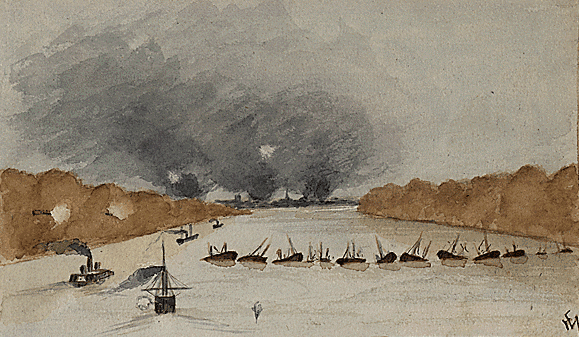
In 1862 during the early stages of the American Civil War, the area was the site of the Battle of New Bern. Federal (Union) forces captured and occupied the town until the end of the war in 1865. Nearly 10,000 enslaved blacks escaped during this period in the region and went to the Union Army camps for protection and freedom. The Union Army set up the Trent River contraband camp at New Bern to house the refugees. It organized the adults for work. Missionaries came to teach literacy to both adults and children.
Due to the continuous occupation by the Union Army, New Bern avoided some of the destruction of the war years. Much social disruption occurred because of the occupation and the thousands of freedmen camped near the city. Whereas the 1860 Census had shown a population of 5,432 (of whom 3,072, or 57%, were black), the population had swollen by the end of the war to more than 20,000, mostly because of the influx of freedmen. Still, New Bern recovered more quickly than many cities after the war. By the 1870s, the lumber industry was developing as the chief part of New Bern's economy. Timber harvested could be sent down the two nearby rivers. The city continued to be a center for freedmen, who created communities independent of white supervision, thriving churches, fraternal associations, and their own businesses. By 1877, the city had a majority-black population.
The state legislature defined the city and county as part of North Carolina's 2nd congressional district, which as former plantation territory, held a concentration of the state's black residents. They elected four blacks to the US Congress in the late 19th century. The state's passage of a constitutional suffrage amendment in 1900 used various devices to disenfranchise black citizens. As a result, they were totally closed out of the political process, including participation on juries and in local offices; white Democrats maintained this suppression mostly, until after passage of federal civil-rights legislation, including the Voting Rights Act of 1965, which provided for federal enforcement of constitutional rights.
By 1890, New Bern had become the largest lumber center in North Carolina and one of the largest in all of the South. During this time, as many as 16 lumber mills were running and employing hundreds of men from New Bern and the area. The competitive nature of the lumber barons and the abundance of lumber and craftsmen led to the construction in New Bern of some of the finest homes in the South, many of which have survived. The lumber boom lasted until the 1920s. One-by-one, the lumber mills went out of business. Today, only Weyerhaeuser manufactures lumber in the area.
The city has four National Historic Districts and two local ones, which have helped preserve the character of the architecture. The Downtown Local Historic District is 368.64 acres (149.18 ha) or 0.576 square miles (1.49 km2); the Riverside Local Historic District covers 51.94 acres (21.02 ha) or 0.081 square miles (0.21 km2). Union Point Park borders the Neuse and Trent rivers.
Hurricanes
New Bern's location near the Atlantic Coast renders it subject to the effects of Atlantic hurricane seasons. For example, in the 18th century, the town suffered severe damage in the Great Chesapeake Bay Hurricane of 1769. Other hurricanes, such as Hurricane Ione in 1955 and Hurricane Floyd in 1999, have also caused significant flooding and damage.
In September 2018, Hurricane Florence made landfall in the United States just south of Wrightsville Beach, 88.4 miles southwest of New Bern. A storm surge of up to 13.5 feet, in addition to days of heavy rains, severely flooded various parts of the town. [National Hurricane Center Storm Surge Inundation Map, Sept 13, 2018]
Geography
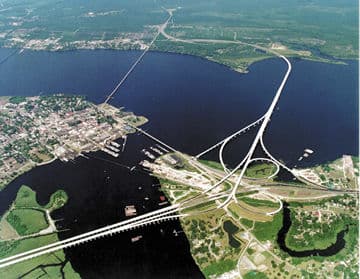
New Bern is located at the confluence of the Trent and Neuse Rivers, two tidal waterways, in North Carolina's Inner Banks region.
According to the United States Census Bureau, the city has a total area of 29.7 square miles (76.9 km2), of which 1.4 square miles (3.7 km2), or 4.87%, is covered by water.
U.S. routes 17 and 70 pass through the city, merging briefly as a four-lane expressway passing south of the city center. US 70 leads west 33 miles (53 km) to Kinston and southeast 35 miles (56 km) to Morehead City near the Atlantic Ocean. Raleigh, the state capital, is 112 miles (180 km) west via US 70. US 17 leads southwest 37 miles (60 km) to Jacksonville, and crosses the Neuse River on a new bridge to lead north 36 miles (58 km) to Washington.
Climate
New Bern experiences a humid subtropical climate typical of the Atlantic coastal plain. Summers are hot and humid, with frequent afternoon thunderstorms that account for much of the higher summer precipitation. Spring and fall are generally mild, with fall foliage occurring from late October to early November. Winters are relatively mild and drier than the remainder of the year, with infrequent snowfall.
Demographics
2020 census
As of the 2020 census, New Bern had a population of 31,291. The median age was 42.8 years. 20.8% of residents were under the age of 18 and 24.0% of residents were 65 years of age or older. For every 100 females there were 86.8 males, and for every 100 females age 18 and over there were 82.7 males age 18 and over.
There were 13,798 households in New Bern, including 8,070 families. Of all households, 25.0% had children under the age of 18 living in them. 40.1% were married-couple households, 18.4% were households with a male householder and no spouse or partner present, and 36.0% were households with a female householder and no spouse or partner present. About 35.1% of all households were made up of individuals and 17.0% had someone living alone who was 65 years of age or older.
Around 2,000 refugees from Myanmar have been resettled in New Bern.
95.1% of residents lived in urban areas, while 4.9% lived in rural areas.
There were 15,655 housing units, of which 11.9% were vacant. The homeowner vacancy rate was 2.7% and the rental vacancy rate was 9.5%.
2015 estimates
The median income for a household in the city in 2015 was $41,285.
2010 census
The City of New Bern 2010 Census information shows the population of the area was approximately 29,524 people. From 2000 to 2010, the New Bern city population growth percentage was 27.7% (or from 23,128 people to 29,524 people). 22.8% of the New Bern city residents were under 18 years of age. Census 2010 race data for New Bern city include the racial breakdown percentages of 57.0 white, 32.8% black, 3.6% Asian, 5.8% Hispanic and less than 1% Native American, Also, there were 14,471 housing units in the City of New Bern, 88.2% of which were occupied housing units.
Arts and culture
New Bern has several sites listed on the National Register of Historic Places.
Education
Colleges
Craven Community College
University of Mount Olive at New Bern
High schools
New Bern High School
Craven Early College High School
Middle schools
Grover C. Fields Middle School
H.J. McDonald Middle School
West Craven Middle School
Elementary schools
Trent Park Elementary School
Oaks Road Elementary School
J.T. Barber Elementary School
Brinson Memorial Elementary School
Ben D. Quinn Elementary School
Albert H. Bangert Elementary School
Creekside Elementary School
Bridgeton Elementary School
Private schools
Calvary Baptist Christian School
St. Paul Catholic School (St. Paul Education Center)