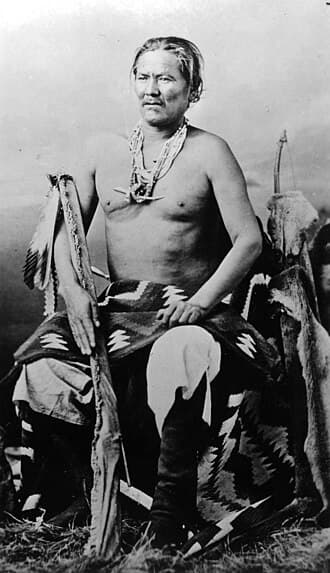
The Navajo are an Indigenous People of the Southwestern United States. The Navajo term for themselves is Diné. Their language is Navajo (Navajo: Diné bizaad), a Southern Athabascan language. The states with the largest Diné populations are Arizona (140,263) and New Mexico (108,305). More than three-quarters of the Diné population resides in these two states.
The overwhelming majority of Diné are enrolled in the Navajo Nation. Some Diné are enrolled in the Colorado River Indian Tribes, another federally recognized tribe. Historic achievements of the Navajo and related tribes include the Pueblo architecture as well as the taming of the horse after European colonization. The Navajo have a rich artistic tradition in beadwork and colorful styles in painting and dress.
With more than 399,494 enrolled tribal citizens as of 2021, the Navajo Nation is the second largest federally recognized tribe in the United States. The Navajo Nation has the largest reservation in the country. The reservation straddles the Four Corners region and covers more than 27,325 square miles (70,770 square kilometers) of land in Arizona, Utah, and New Mexico. The Navajo Reservation is slightly larger than the state of West Virginia.
The Navajo are speakers of a Na-Dené Southern Athabaskan language which they call Diné bizaad (lit. 'People's language'). The term Navajo comes from Spanish missionaries and historians who referred to the Pueblo Indians through this term, although they referred to themselves as the Diné, meaning '(the) people'.
The language comprises two geographic, mutually intelligible dialects. It is closely related to the languages of the Apache. The Navajo and Apache are believed to have migrated from northwestern Canada and eastern Alaska, where the majority of Athabaskan speakers reside. Additionally, some Navajo know Navajo Sign Language, which is either a dialect or daughter of Plains Sign Talk. Some also know Plains Sign Talk itself.
A southward migration of Athabaskan peoples from subarctic North America has been dated to around 1,000 years ago. It has been suggested that the Navajo and Apaches may have migrated due to the effects of a volcanic explosion in the Saint Elias Mountains of Alaska around 803 AD. Part of the migration was along the Rocky Mountains before arriving in the present-day southwest United States.
Reading level
Audio Summary
Played with your browser's voice. Studio-quality audio can be added with a text-to-speech service.
Ask about this article
📝 Quick Quiz1 / 3
What is "Navajo" primarily known for?
Vocix Daily — In Your Inbox
Top stories, deep-dive articles, and "On This Day" history — one crisp digest delivered every morning.
Sources & references
Reference material for this entry is drawn from the open encyclopedic record, including Wikipedia , available under the CC BY-SA 4.0 license. Images are credited individually beside each photo.
Initially, the Navajo were largely hunters and gatherers. Later, they adopted farming from existing Pueblo people, growing mainly the traditional Native American "Three Sisters" of corn, beans, and squash. They adopted herding sheep and goats from the Spaniards as a main source of trade and food. Meat became essential in the Navajo diet. Sheep became a form of currency and familial status. Women began to spin and weave wool into blankets and clothing; they created items of highly valued artistic expression, which were also traded and sold.
Oral history indicates a long relationship with Pueblo people and a willingness to incorporate Puebloan ideas and linguistic variance. There were long-established trading practices between the groups. Mid-16th century Spanish records recount that the Pueblo exchanged maize and woven cotton goods for bison meat, hides, and stone from Athabaskans traveling to the pueblos or living nearby. In the 18th century, the Spanish reported that the Navajo maintained large herds of livestock and cultivated large crop areas.
Spanish contact
Western historians believe that the Spanish before 1600 referred to the Navajo as Apaches or Quechos. Fray Geronimo de Zarate-Salmeron, who was in Jemez in 1622, used Apachu de Nabajo in the 1620s to refer to the people in the Chama Valley region, east of the San Juan River and northwest of present-day Santa Fe, New Mexico. Navahu comes from the Tewa language, meaning 'a large area of cultivated lands'. By the 1640s, the Spanish began using the term Navajo to refer to the Diné.
During the 1670s, the Spanish wrote that the Diné lived in a region known as Dinétah, about 60 miles (97 km) west of the Rio Chama Valley region. In the 1770s, the Spanish sent military expeditions against the Navajo in the Mount Taylor and Chuska Mountain regions of New Mexico. The Spanish, Navajo and Hopi continued to trade with each other and formed a loose alliance to fight Apache and Comanche bands for the next 20 years. During this time there were relatively minor raids by Navajo bands and Spanish citizens against each other.
In 1800, Governor Chacon led 500 men to the Tunicha Mountains against the Navajo. Twenty Navajo chiefs asked for peace. In 1804 and 1805, the Navajo and Spaniards mounted major expeditions against each other's settlements. In May 1805, another peace was established. Similar patterns of peace-making, raiding, and trading among the Navajo, Spaniards, Apache, Comanche, and Hopi continued until the arrival of Americans in 1846.
Territory of New Mexico 1846–1863
The Navajos encountered the United States Army in 1846 when General Stephen W. Kearny invaded Santa Fe with 1,600 men during the Mexican–American War. On November 21, 1846, following an invitation from a small party of American soldiers under the command of Captain John Reid, who journeyed deep into Navajo country and contacted him, Narbona and other Navajos negotiated a treaty of peace with Colonel Alexander Doniphan at Bear Springs, Ojo del Oso (later the site of Fort Wingate). This agreement was not honored by some Navajo, nor by some New Mexicans. The Navajos raided New Mexican livestock, and New Mexicans took women, children, and livestock from the Navajo.
In 1849, the military governor of New Mexico, Colonel John MacRae Washington—accompanied by John S. Calhoun, an Indian agent—led 400 soldiers into the Navajo country, penetrating Canyon de Chelly. He signed a treaty with two Navajo leaders: Mariano Martinez as Head Chief and Chapitone as Second Chief. The treaty acknowledged the transfer of jurisdiction from the United Mexican States to the United States. The treaty allowed forts and trading posts to be built on Navajo land. In exchange, the United States, promised "such donations [and] such other liberal and humane measures, as [it] may deem meet and proper." While en route to sign this treaty, the prominent Navajo peace leader Narbona was killed, causing hostility between the treaty parties.
During the next 10 years, the U.S. established forts on traditional Navajo territory. Military records cite this development as a precautionary measure to protect citizens and the Navajos from each other. However, the Spanish/Mexican-Navajo pattern of raids and expeditions continued. Over 400 New Mexican militia conducted a campaign against the Navajo, against the wishes of the Territorial Governor, in 1860–61. They killed Navajo warriors, captured women and children for slaves, and destroyed crops and dwellings. The Navajos call this period Naahondzood, 'the fearing time'.
In 1861, Brigadier-General James H. Carleton, Commander of the Federal District of New Mexico, initiated a series of military actions against the Navajos and Apaches. Colonel Kit Carson was at the new Fort Wingate with Army troops and volunteer New Mexico militia. Carleton ordered Carson to kill Mescalero Apache men and destroy any Mescalero property he could find. Carleton believed these harsh tactics would bring any Indian tribe under control. The Mescalero surrendered and were sent to the new reservation called Bosque Redondo.
In 1863, Carleton ordered Carson to use the same tactics on the Navajo. Carson and his force swept through Navajo land, killing Navajos and destroying crops and dwellings, fouling wells, and capturing livestock. Facing starvation and death, Navajo groups came to Fort Defiance for relief. On July 20, 1863, the first of many groups departed to join the Mescalero at Bosque Redondo. Other groups continued to come in through 1864.
However, not all the Navajos came in or were found. Some lived near the San Juan River, some beyond the Hopi villages, and others lived with Apache bands.
Long Walk
Beginning in the spring of 1864, the Army forced around 9,000 Navajo men, women, and children to walk over 300 miles (480 km) to Fort Sumner, New Mexico, for internment at Bosque Redondo. The internment was disastrous for the Navajo, as the government failed to provide enough water, wood, provisions, and livestock for the 4,000 to 5,000 people. Large-scale crop failure and disease were also endemic during this time, as were raids by other tribes and white civilians. Some Navajos froze in the winter because they could make only poor shelters from the few materials they were given. This period is known among the Navajos as "the Fearing Time". In addition, a small group of Mescalero Apache, longtime enemies of the Navajos, had been relocated to the area, which resulted in conflicts.
In 1868, the Treaty of Bosque Redondo was negotiated between Navajo leaders and the federal government, allowing the surviving Navajos to return to a reservation on a portion of their former homeland.
Reservation era
The United States military continued to maintain forts on the Navajo reservation in the years after the Long Walk. From 1873 to 1895, the military employed Navajos as "Indian Scouts" at Fort Wingate to help their regular units. During this period, Chief Manuelito founded the Navajo Tribal Police. It operated from 1872 to 1875 as an anti-raid task force working to maintain the peaceful terms of the 1868 Navajo treaty.
By treaty, the Navajos were allowed to leave the reservation for trade, with permission from the military or local Indian agent. Eventually, the arrangement led to a gradual end in Navajo raids, as the tribe was able to increase their livestock and crops. Also, the tribe gained an increase in the size of the Navajo reservation from 3.5 million acres (14,000 km2; 5,500 sq mi) to 16 million acres (65,000 km2; 25,000 sq mi) as it stands today. But economic conflicts with non-Navajos continued for many years as civilians and companies exploited resources assigned to the Navajo. The US government made leases for livestock grazing, took land for railroad development, and permitted mining on Navajo land without consulting the tribe.
In 1883, Lt. Parker, accompanied by 10 enlisted men and two scouts, went up the San Juan River to separate the Navajos and citizens who had encroached on Navajo land. In the same year, Lt. Lockett, with the aid of 42 enlisted soldiers, was joined by Lt. Holomon at Navajo Springs. Evidently, citizens of the surnames Houck and/or Owens had murdered a Navajo chief's son, and 100 armed Navajo warriors were looking for them.
In 1887, citizens Palmer, Lockhart, and King fabricated a charge of horse stealing and randomly attacked a dwelling on the reservation. Two Navajo men and all three whites died as a result, but a woman and a child survived. Capt. Kerr (with two Navajo scouts) examined the ground and then met with several hundred Navajos at Houcks Tank. Rancher Bennett, whose horse was allegedly stolen, told Kerr that his horses were stolen by the three whites to catch a horse thief. In the same year, Lt. Scott went to the San Juan River with two scouts and 21 enlisted men. The Navajos believed Scott was there to drive off the whites who had settled on the reservation and had fenced off the river from the Navajo. Scott found evidence of many non-Navajo ranches. Only three were active, and the owners wanted payment for their improvements before leaving. Scott ejected them.
In 1913, an Indian agent ordered a Navajo and his three wives to come in and then arrested them for having a plural marriage. A small group of Navajos used force to free the women and retreated to Beautiful Mountain with 30 or 40 sympathizers. They refused to surrender to the agent, and local law enforcement and military refused the agent's request for an armed engagement. General Scott arrived, and with the help of Henry Chee Dodge, a leader among the Navajo, defused the situation.
Boarding schools and education
During the time on the reservation, the Navajo tribe was forced to assimilate into white society. Navajo children were sent to boarding schools within the reservation and off the reservation. The first Bureau of Indian Affairs (BIA) school opened at Fort Defiance in 1870 and led the way for eight others to be established. Many older Navajos were against this education and would hide their children to keep them from being taken.
Once the children arrived at the boarding school, their lives changed dramatically. European Americans taught the classes under an English-only curriculum and punished any student caught speaking Navajo. The children were under militaristic discipline, run by the Siláo. In multiple interviews, subjects recalled being captured and disciplined by the Siláo if they tried to run away. Other conditions included inadequate food, overcrowding, required manual labor in kitchens, fields, and boiler rooms, and military-style uniforms and haircuts.
Change did not occur in these boarding schools until after the Meriam Report was published in 1929 by the Secretary of Interior, Hubert Work. This report discussed Indian boarding schools as being inadequate in terms of diet, medical services, dormitory overcrowding, undereducated teachers, restrictive discipline, and manual labor by the students to keep the school running.
This report was the precursor to education reforms initiated under President Franklin D. Roosevelt, under which two new schools were built on the Navajo reservation. However, Rough Rock Day School was run in the same militaristic style as Fort Defiance and did not implement educational reforms. Navajo accounts of the Evangelical Missionary School portray it as having a family-like atmosphere with home-cooked meals, new or gently used clothing, humane treatment, and a Navajo-based curriculum. Educators found the Evangelical Missionary School curriculum to be much more beneficial for Navajo children.
In 1937, Boston heiress Mary Cabot Wheelright and Navajo singer and medicine man Hastiin Klah founded the Wheelwright Museum of the American Indian in Santa Fe. It is a repository for sound recordings, manuscripts, paintings, and sandpainting tapestries of the Navajos. It also featured exhibits to express the beauty, dignity, and logic of the Navajo religion. When Klah met Cabot in 1921, he witnessed decades of efforts by the US government and missionaries to assimilate the Navajos into mainstream society. The museum was founded to preserve the religion and traditions of the Navajo, which Klah was sure would otherwise soon be lost forever.
The result of these boarding schools led to much language loss within the Navajo Nation. After the Second World War, the Meriam Report funded more children to attend these schools with six times as many children attending boarding schools than before the war. English being the primary language spoken at these schools as well as the local towns surrounding the Navajo reservations contributed to residents becoming bilingual; however, Navajo was still the primary language spoken at home.
Livestock Reduction 1930s–1950s
The Navajo Livestock Reduction was imposed upon the Navajo Nation by the federal government starting in 1933, during the Great Depression. Under various forms, it continued into the 1950s. Worried about large herds in the arid climate, at a time when the Dust Bowl was endangering the Great Plains, the government decided that the land of the Navajo Nation could support only a fixed number of sheep, goats, cattle, and horses. The Federal government believed that land erosion was worsening in the area and the only solution was to reduce the number of livestock.
In 1933, John Collier was appointed commissioner of the BIA. In many ways, he worked to reform government relations with the Native American tribes, but the reduction program was devastating for the Navajo, for whom their livestock was so important. The government set land capacity in terms of "sheep units". In 1930 the Navajos grazed 1,100,000 mature sheep units. These sheep provided half the cash income for the individual Navajo.
Collier's solution was to first launch a voluntary reduction program, which was made mandatory two years later in 1935. The government paid for part of the value of each animal, but it did nothing to compensate for the loss of future yearly income for many Navajo. In the matrilineal and matrilocal world of the Navajo, women were especially hurt, as many lost their only source of income with the reduction of livestock herds.
The Navajos did not understand why their centuries-old practices of raising livestock should change. They were united in opposition but they were unable to stop it. Historian Brian Dippie notes that the Indian Rights Association denounced Collier as a "dictator" and accused him of a "near reign of terror" on the Navajo reservation. Dippie adds that "He became an object of 'burning hatred' among the very people whose problems so preoccupied him." The long-term result was strong Navajo opposition to Collier's Indian New Deal.
Navajo code talkers in World War II
Many Navajo young people moved to cities to work in urban factories during World War II. Many Navajo men volunteered for military service in keeping with their warrior culture, and they served in integrated units. The War Department in 1940 rejected a proposal by the BIA that segregated units be created for the Indians. The Navajos gained firsthand experience with how they could assimilate into the modern world, and many did not return to the overcrowded reservation, which had few jobs.
Up to four hundred Navajo code talkers played a significant role in United States Marine Corps (USMC) history. Using their own language, they utilized a military code; for example, the Navajo word 'turtle' represented a tank. In 1942, Marine staff officers composed several combat simulations and the Navajo translated it and transmitted it in their dialect to another Navajo on the other line. This Navajo then translated it back into English faster than any other cryptographic facility, which demonstrated their efficacy. As a result, General Vogel recommended their recruitment into the USMC code talker program.
Each Navajo went through a basic boot camp at the Marine Corps Recruit Depot in San Diego, before being assigned to Field Signal Battalion training at Camp Pendleton. Once the code talkers completed training in the States, they were sent to the Pacific for assignment to the Marine combat divisions. The Navajo language code was never deciphered by the Japanese. A higher number of Navajos volunteered for the code talker program than were accepted.
Uranium mining
In the 1940s, large quantities of uranium were discovered in Navajo land. From then into the early 21st century, the U.S. allowed mining without sufficient environmental protection for workers, waterways, and land. The Navajos have claimed high rates of death and illness from lung disease and cancer resulting from environmental contamination. Since the 1970s, legislation has helped to regulate the industry and reduce the toll.
After 1945
Culture
The name Navajo comes from the late 18th century via the Spanish (Apaches de) Navajó '(Apaches of) Navajó', which was derived from the Tewa navahúuˀu 'farm fields adjoining a valley'. The Navajos call themselves Diné.
Like other Apacheans, the Navajos were semi-nomadic from the 16th through the 20th centuries. Their extended kinship groups had seasonal dwelling areas to accommodate livestock, agriculture, and gathering practices. As part of their traditional economy, Navajo groups may have formed trading or raiding parties, traveling relatively long distances.
Navajo clans or k’é
There is a system of clans or k’é that defines relationships between individuals and families. The clan system is exogamous: people can only marry (or date) partners outside their own clans, which for this purpose include the clans of their four grandparents. Some Navajos favor their children to marry into their father's clan. While clans are associated with a geographical area, the area is not for the exclusive use of any one clan. Members of a clan may live hundreds of miles apart but still have a clan bond.
Historically, the structure of the Navajo society is largely a matrilineal system, in which the family of the women owned livestock, dwellings, planting areas, and livestock grazing areas. Once married, a Navajo man would follow a matrilocal residence and live with his bride in her dwelling and near her mother's family. Daughters (or, if necessary, other female relatives) were traditionally the ones who received the generational property inheritance. In cases of marital separation, women would maintain the property and children. Children are "born to" and belong to the mother's clan, and are "born for" the father's clan. The mother's eldest brother has a strong role in her children's lives. As adults, men represent their mother's clan in tribal politics.
Traditionally, there are four clans said to be the original ones, given to the Navajo from Asdzą́ą́ Nádleehé or Changing Woman. Today there are more than 100 clans, some of which include other Native nations, such as Naashtʼézhí diné’e referring to the Zuni, of the Naashgalí diné’é, referring to the Mescalero Apache.
Gender roles
Men and women are seen as contemporary equals as both males and females are needed to reproduce. Although women may carry a bigger burden, fertility is so highly valued that males are expected to provide economic resources (known as bridewealth). Corn is a symbol of fertility in Navajo culture as they eat white corn in the wedding ceremonies. It is considered to be immoral and/or stealing if one does not provide for the other in the premarital or marital relationship.
Ethnobotany
Traditional dwellings
A hogan, the traditional Navajo home, is built as a shelter for either a man or a woman. Male hogans are square or conical with a distinct rectangular entrance, while a female hogan is an eight-sided house. Hogans are traditionally made of logs and covered in mud, with the door always facing east to welcome the sun each morning. Navajos also have several types of hogans for lodging and ceremonial use. Ceremonies, such as healing ceremonies or the kinaaldá, take place inside a hogan. According to Kehoe, this style of housing is distinctive to the Navajos. She writes, "Even today, a solidly constructed, log-walled Hogan is preferred by many Navajo families." Most Navajo people today live in apartments and houses in urban areas.