
The Munich Agreement was reached in Munich on 30 September 1938, by Nazi Germany, the United Kingdom, France, and Italy. The agreement provided for the German annexation of part of the First Czechoslovak Republic called the Sudetenland, where three million people, mainly ethnic Germans, lived. The pact is known in some areas as the Munich Dictate (Czech: Mnichovský diktát; Slovak: Mníchovský diktát), or the Munich Betrayal (Czech: Mnichovská zrada; Slovak: Mníchovská zrada), because of a previous 1924 alliance agreement and a 1925 military pact between France and the Czechoslovak Republic.
Germany had started a low-intensity undeclared war on Czechoslovakia on 17 September 1938. In reaction, Britain and France on 20 September formally requested Czechoslovakia cede the Sudetenland territory to Germany. This was followed by Polish and Hungarian territorial demands brought on 21 and 22 September, respectively. Meanwhile, German forces conquered parts of the Cheb District and Jeseník District, where battles included use of German artillery, Czechoslovak tanks, and armored vehicles. Lightly armed German infantry briefly overran other border counties before being repelled. Poland grouped its army units near its common border with Czechoslovakia and conducted an unsuccessful probing offensive on 23 September. Hungary moved its troops towards the border with Czechoslovakia, without attacking. The Soviet Union announced its willingness to come to Czechoslovakia's assistance, provided the Red Army would be able to cross Polish and Romanian territory; both countries refused.
An emergency meeting of the main European powers—not including Czechoslovakia, although their representatives were present in the town, nor the Soviet Union, an ally to France and Czechoslovakia—took place in Munich, on 29–30 September. An agreement was quickly reached on Adolf Hitler's terms, and signed by the leaders of Germany, France, Britain, and Italy. The Czechoslovak mountainous borderland marked a natural border between the Czech state and the Germanic states since the early Middle Ages; it also presented a major natural obstacle to a possible German attack. Strengthened by border fortifications, the Sudetenland was of absolute strategic importance to Czechoslovakia. On 30 September, president Beneš submitted to the combination of military pressure by Germany, Poland, and Hungary, and diplomatic pressure by Britain and France, and agreed to surrender territory to Germany following the Munich terms.

The Munich Agreement was soon followed by the First Vienna Award on 2 November 1938, separating largely Hungarian inhabited territories in southern Slovakia and southern Subcarpathian Rus' from Czechoslovakia. On 30 November, Czechoslovakia ceded to Poland small patches of land in the Spiš and Orava regions. In March 1939, the First Slovak Republic, a German puppet state, proclaimed its independence. Shortly afterwards, Hitler reneged on his promise to respect the integrity of Czechoslovakia by occupying the remainder of the country and creating the Protectorate of Bohemia and Moravia. The conquered nation's armaments industry and tanks and its large army allowed Germany to strengthen.
Much of Europe celebrated the Munich Agreement, as they considered it a way to prevent a major war on the continent. Hitler announced that it was his last territorial claim in Northern Europe. Today, the Munich Agreement is regarded as a failed act of appeasement, and the term has become "a byword for the futility of appeasing expansionist totalitarian states".
History
Background
Demands for autonomy
The First Czechoslovak Republic was created in 1918 following the collapse of the Austro-Hungarian Empire at the end of World War I. The Treaty of Saint-Germain recognized the independence of Czechoslovakia and the Treaty of Trianon defined the borders of the new state, which was divided into the regions of Bohemia and Moravia in the west and Slovakia and Subcarpathian Rus' in the east, including more than three million Germans, 22.95% of the total population of the country. They lived mostly in border regions of the historical Czech Lands for which they coined the new name Sudetenland, which bordered on Germany and the newly created country of Austria.

The Sudeten Germans were not consulted on whether they wished to be citizens of Czechoslovakia. Although the constitution guaranteed equality for all citizens, there was a tendency among political leaders to transform the country "into an instrument of Czech and Slovak nationalism." Some progress was made to integrate the Germans and other minorities, but they continued to be underrepresented in the government and the army. Moreover, the Great Depression, beginning in 1929, impacted the highly industrialized and export-oriented Sudeten Germans more than it did the Czech and Slovak populations. By 1936, 60 percent of the unemployed people in Czechoslovakia were Germans.
In 1933, Sudeten German leader Konrad Henlein founded the Sudeten German Party (SdP), which was "militant, populist, and openly hostile" to the Czechoslovak government. It soon captured two-thirds of the vote in districts with a heavy German population. Historians differ as to whether the SdP was a Nazi front organisation from its beginning, or if it evolved into one. By 1935, the SdP was the second-largest political party in Czechoslovakia as German votes concentrated on this party, and Czech and Slovak votes were spread among several parties.
Shortly after the Anschluss of Austria to Germany, Henlein met with Hitler in Berlin on 28 March 1938, and was instructed to make demands unacceptable to the democratic Czechoslovak government, led by President Edvard Beneš. On 24 April, the SdP issued a series of demands known as the Karlsbader Programm. Henlein demanded autonomy for Germans in Czechoslovakia. The Czechoslovak government responded by saying that it was willing to provide more minority rights to the German minority but was initially reluctant to grant autonomy. The SdP gained 88% of the ethnic German votes in May 1938.

With tension high between the Germans and the Czechoslovak government, Beneš, on 15 September 1938, secretly offered to give 6,000 square kilometres (2,300 sq mi) of Czechoslovakia to Germany, in exchange for a German agreement to admit 1.5 to 2.0 million Sudeten Germans expelled by Czechoslovakia. Hitler did not reply.
Sudeten crisis
As the previous appeasement of Hitler had shown, France and Britain were intent on avoiding war. The French government did not wish to face Germany alone and took its lead from British Conservative government of Prime Minister Neville Chamberlain. He considered the Sudeten German grievances justified and believed Hitler's intentions to be limited. [citation needed] Both Britain and France, therefore, advised Czechoslovakia to accede to Germany's demands. Beneš resisted and, on 19 May, initiated a partial mobilization in response to a possible German invasion.
On 20 May, Hitler presented his generals with a draft plan of attack on Czechoslovakia that was codenamed Operation Green. He insisted that he would not "smash Czechoslovakia" militarily without "provocation", "a particularly favourable opportunity" or "adequate political justification." On 28 May, Hitler called a meeting of his service chiefs, ordered an acceleration of U-boat construction and brought forward the construction of his new battleships, Bismarck and Tirpitz, to spring 1940. He demanded that the increase in the firepower of the battleships Scharnhorst and Gneisenau be accelerated. While recognizing that this would still be insufficient for a full-scale naval war with Britain, Hitler hoped it would be a sufficient deterrent. Ten days later, Hitler signed a secret directive for war against Czechoslovakia to begin no later than 1 October.

On 22 May, Juliusz Łukasiewicz, the Polish ambassador to France, told French Foreign Minister Georges Bonnet that if France moved against Germany to defend Czechoslovakia, "We shall not move." Łukasiewicz also told Bonnet that Poland would oppose any attempt by Soviet forces to defend Czechoslovakia from Germany. Édouard Daladier told Jakob Suritz, the Soviet ambassador to France, "Not only can we not count on Polish support but we have no faith that Poland will not strike us in the back." However, the Polish government indicated multiple times (in March 1936 and May, June and August 1938) that it was prepared to fight Germany if the French decided to help Czechoslovakia: "Beck's proposal to Bonnet, his statements to Ambassador Drexel Biddle, and the statement noted by Vansittart, show that the Polish foreign minister was, indeed, prepared to carry out a radical change of policy if the Western powers decided on war with Germany. However, these proposals and statements did not elicit any reaction from British and French governments that were bent on averting war by appeasing Germany."
Hitler's adjutant, Fritz Wiedemann, recalled after the war that he was "very shocked" by Hitler's new plans to attack Britain and France three to four years after "deal[ing] with the situation" in Czechoslovakia. General Ludwig Beck, chief of the German general staff, noted that Hitler's change of heart in favour of quick action was because Czechoslovak defences were still being improvised, which would no longer be the case two to three years later, and British rearmament would not come into effect until 1941 or 1942. General Alfred Jodl noted in his diary that the partial Czechoslovak mobilization of 21 May had led Hitler to issue a new order for Operation Green on 30 May and that it was accompanied by a covering letter from Wilhelm Keitel that stated that the plan must be implemented by 1 October at the very latest.
In the meantime, the British government demanded that Beneš request a mediator. Not wishing to sever his government's ties with Western Europe, Beneš reluctantly accepted. The British appointed Lord Runciman, a former Liberal cabinet minister, who arrived in Prague on 3 August with instructions to persuade Beneš to agree to a plan acceptable to the Sudeten Germans. On 20 July, Bonnet told the Czechoslovak ambassador in Paris that while France would declare its support in public to help the Czechoslovak negotiations, it was not prepared to go to war over Sudetenland. In August, the German press was full of stories alleging Czechoslovak atrocities against Sudeten Germans, with the intention of forcing the West into putting pressure on the Czechoslovaks to make concessions. Hitler hoped that the Czechoslovaks would refuse and that the West would then feel morally justified in leaving the Czechoslovaks to their fate. In August, Germany sent 750,000 soldiers along the border of Czechoslovakia, officially as part of army maneuvres. On 4 or 5 September, Beneš submitted the Fourth Plan, granting nearly all the demands of the agreement. The Sudeten Germans were under instruction from Hitler to avoid a compromise, and the SdP held demonstrations that provoked a police action in Ostrava on 7 September, in which two of their parliamentary deputies were arrested. The Sudeten Germans used the incident and false allegations of other atrocities as an excuse to break off further negotiations.
On 12 September, Hitler made a speech at a Nazi Party rally in Nuremberg on the Sudeten crisis condemning the actions of the government of Czechoslovakia. Hitler denounced Czechoslovakia as being a fraudulent state that was in violation of international law's emphasis of national self-determination, claiming it was a Czech hegemony although the Germans, the Slovaks, the Hungarians, the Ukrainians and the Poles of the country actually wanted to be in a union with the Czechs. Hitler accused Beneš of seeking to gradually exterminate the Sudeten Germans and claimed that since Czechoslovakia's creation, over 600,000 Germans had been intentionally forced out of their homes under the threat of starvation if they did not leave. He alleged that Beneš's government was persecuting Germans along with Hungarians, Poles, and Slovaks and accused Beneš of threatening the nationalities with being branded traitors if they were not loyal to the country. He stated that he, as the head of state of Germany, would support the right of the self-determination of fellow Germans in the Sudetenland. He condemned Beneš for his government's recent execution of several German protesters. He accused Beneš of being belligerent and threatening behaviour towards Germany which, if war broke out, would result in Beneš forcing Sudeten Germans to fight against their will against Germans from Germany. Hitler accused the government of Czechoslovakia of being a client regime of France, claiming that the French Minister of Aviation Pierre Cot had said, "We need this state as a base from which to drop bombs with greater ease to destroy Germany's economy and its industry."
Berchtesgaden meeting
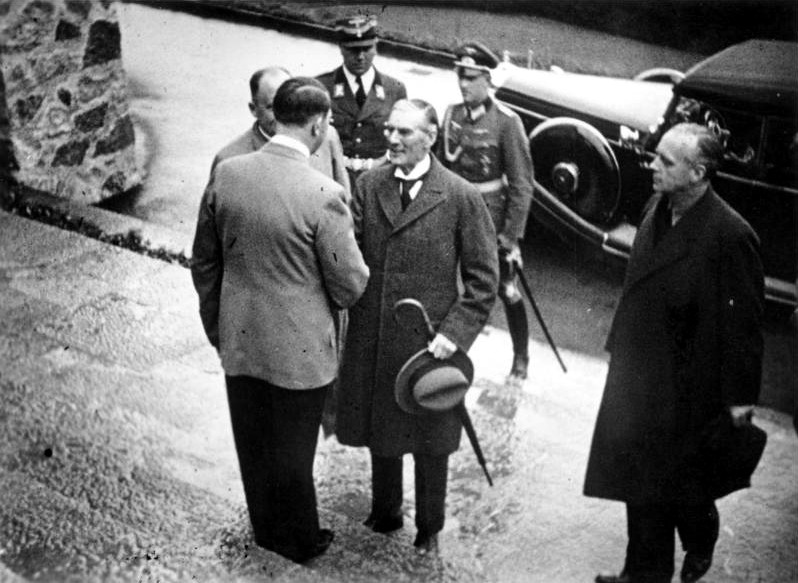
On 13 September, after internal violence and disruption in Czechoslovakia ensued, Chamberlain asked Hitler for a personal meeting to find a solution to avert a war. Chamberlain decided to do this after conferring with his advisors Lord Halifax, Sir John Simon, and Sir Samuel Hoare. The meeting was announced at a special press briefing at 10 Downing Street, and led to a swell of optimism in British public opinion. Chamberlain arrived by a chartered British Airways Lockheed Electra in Germany on 15 September and then arrived at Hitler's residence in Berchtesgaden for the meeting. The flight was one of the first times a head of state or diplomatic official flew to a diplomatic meeting in an airplane, as the tense situation left little time to take a train or boat. Henlein flew to Germany on the same day. That day, Hitler and Chamberlain held discussions in which Hitler insisted that the Sudeten Germans must be allowed to exercise the right of national self-determination and be able to join Sudetenland with Germany. Hitler repeatedly falsely claimed that the Czechoslovak government had killed 300 Sudeten Germans. Hitler also expressed concern to Chamberlain about what he perceived as British "threats." Chamberlain responded that he had not issued "threats" and in frustration asked Hitler "Why did I come over here to waste my time?" Hitler responded that if Chamberlain was willing to accept the self-determination of the Sudeten Germans, he would be willing to discuss the matter. Hitler also convinced Chamberlain that he did not truly wish to destroy Czechoslovakia, but that he believed that upon a German annexation of the Sudetenland the country's minorities would each secede and cause the country to collapse. Chamberlain and Hitler held discussions for three hours, and the meeting adjourned. Chamberlain flew back to Britain and met with his cabinet to discuss the issue.
After the meeting, Daladier flew to London on 16 September to meet with British officials to discuss a course of action. The situation in Czechoslovakia became tenser that day, with the Czechoslovak government issuing an arrest warrant for Henlein, who had arrived in Germany a day earlier to take part in the negotiations. The French proposals ranged from waging war against Germany to supporting the Sudetenland being ceded to Germany. The discussions ended with a firm British-French plan in place. Britain and France demanded that Czechoslovakia cede to Germany all territories in which the German population represented over 50% of the Sudetenland's total population. In exchange for that concession, Britain and France would guarantee the independence of Czechoslovakia. Czechoslovakia rejected the proposed solution.

On 17 September 1938 Hitler ordered the establishment of Sudetendeutsches Freikorps, a paramilitary organization that took over the structure of Ordnersgruppe, an organization of ethnic Germans in Czechoslovakia that had been dissolved by the Czechoslovak authorities the previous day due to its implication in a large number of terrorist activities. The organization was sheltered, trained and equipped by German authorities and conducted cross-border terrorist operations into Czechoslovak territory. Relying on the Convention for the Definition of Aggression, Czechoslovak president Edvard Beneš and the government-in-exile later regarded 17 September 1938 as the beginning of the undeclared German-Czechoslovak war. This understanding has been assumed also by the contemporary Czech Constitutional court. In the following days, Czechoslovak forces suffered over 100 personnel killed in action, hundreds wounded and over 2,000 abducted to Germany.
On 18 September, Italy's Duce Benito Mussolini made a speech in Trieste, Italy, where he declared "If there are two camps, for and against Prague, let it be known that Italy has chosen its side", with the clear implication being that Mussolini supported Germany in the crisis.
On 20 September, German opponents within the military met to discuss the final plans of a plot they had developed to overthrow the Nazi regime. The meeting was led by General Hans Oster, the deputy head of the Abwehr (Germany's counter-espionage agency). Other members included Captain Friedrich Wilhelm Heinz, and other military officers leading the planned coup d'etat met at the meeting. On 22 September, Chamberlain, about to board his plane to go to Germany for further talks at Bad Godesberg, told the press who met him there that "My objective is peace in Europe, I trust this trip is the way to that peace." Chamberlain arrived in Cologne, where he received a lavish grand welcome with a German band playing "God Save the King" and Germans giving Chamberlain flowers and gifts. Chamberlain had calculated that fully accepting German annexation of all of the Sudetenland with no reductions would force Hitler to accept the agreement. Upon being told of this, Hitler responded "Does this mean that the Allies have agreed with Prague's approval to the transfer of the Sudetenland to Germany?", Chamberlain responded "Precisely", to which Hitler responded by shaking his head, saying that the Allied offer was insufficient. He told Chamberlain that he wanted Czechoslovakia to be completely dissolved and its territories redistributed to Germany, Poland, and Hungary, and told Chamberlain to take it or leave it. Chamberlain was shaken by this statement. Hitler went on to tell Chamberlain that since their last meeting on the 15th, Czechoslovakia's actions, which Hitler claimed included killings of Germans, had made the situation unbearable for Germany.
Later in the meeting, a deception was undertaken to influence and put pressure on Chamberlain: one of Hitler's aides entered the room to inform Hitler of more Germans being killed in Czechoslovakia, to which Hitler screamed in response "I will avenge every one of them. The Czechs must be destroyed." The meeting ended with Hitler refusing to make any concessions to the Allies' demands. Later that evening, Hitler grew worried that he had gone too far in pressuring Chamberlain, and telephoned Chamberlain's hotel suite, saying that he would accept annexing only the Sudetenland, with no designs on other territories, provided that Czechoslovakia begin the evacuation of ethnic Czechs from the German majority territories by 26 September at 8:00am. After being pressed by Chamberlain, Hitler agreed to have the ultimatum set for 1 October (the same date that Operation Green was set to begin). Hitler then said to Chamberlain that this was one concession that he was willing to make to the Prime Minister as a "gift" out of respect for the fact that Chamberlain had been willing to back down somewhat on his earlier position. Hitler went on to say that upon annexing the Sudetenland, Germany would hold no further territorial claims upon Czechoslovakia and would enter into a collective agreement to guarantee the borders of Germany and Czechoslovakia.
A new Czechoslovak cabinet, under General Jan Syrový, was installed and on 23 September a decree of general mobilization was issued which was accepted by the public with a strong enthusiasm – within 24 hours, one million men joined the army to defend the country. The Czechoslovak Army, modern, experienced and possessing an excellent system of frontier fortifications, was prepared to fight. The Soviet Union announced its willingness to come to Czechoslovakia's assistance, provided that the Red Army would be able to cross Polish and Romanian territory. Both countries refused to allow the Soviet army to use their territories.
In the early hours of 24 September, Hitler issued the Godesberg Memorandum, which demanded that Czechoslovakia cede the Sudetenland to Germany no later than 28 September, with plebiscites to be held in unspecified areas under the supervision of German and Czechoslovak forces. The memorandum also stated that if Czechoslovakia did not agree to the German demands by 2 pm on 28 September, Germany would take the Sudetenland by force. On the same day, Chamberlain returned to Britain and announced that Hitler demanded the annexation of the Sudetenland without delay. The announcement enraged those in Britain and France who wanted to confront Hitler once and for all, even if it meant war, and its supporters gained strength. The Czechoslovak Ambassador to the United Kingdom, Jan Masaryk, was elated upon hearing of the support for Czechoslovakia from British and French opponents of Hitler's plans, saying "The nation of Saint Wenceslas will never be a nation of slaves."
On 25 September, Czechoslovakia agreed to the conditions previously agreed upon by Britain, France, and Germany. The next day, however, Hitler added new demands, insisting that the claims of ethnic Germans in Poland and Hungary also be satisfied.
On 26 September, Chamberlain sent Sir Horace Wilson to carry a personal letter to Hitler declaring that the Allies wanted a peaceful resolution to the Sudeten crisis. Later that evening, Hitler made his response in a speech at the Berlin Sportpalast; he claimed that the Sudetenland was "the last territorial demand I have to make in Europe" and gave Czechoslovakia a deadline of 28 September at 2:00 pm to cede the Sudetenland to Germany or face war. At this point the British government began to make war preparations, and the House of Commons was reconvened from a parliamentary recess.
On 27 September 1938, when negotiations between Hitler and Chamberlain were strained, Chamberlain addressed the British people, saying, in particular: "How horrible, fantastic, incredible it is that we should be digging trenches and trying on gas masks here because of a quarrel in a far-away country between people of whom we know nothing."
On 28 September at 10:00 am, four hours before the deadline and with no agreement to Hitler's demand by Czechoslovakia, the British ambassador to Italy, Lord Perth, called Italy's Foreign Minister Galeazzo Ciano to request an urgent meeting. Perth informed Ciano that Chamberlain had instructed him to request that Mussolini enter the negotiations and urge Hitler to delay the ultimatum. At 11:00 am, Ciano met Mussolini and informed him of Chamberlain's proposition; Mussolini agreed with it and responded by telephoning Italy's ambassador to Germany and told him "Go to the Fuhrer at once, and tell him that whatever happens, I will be at his side, but that I request a twenty-four-hour delay before hostilities begin. In the meantime, I will study what can be done to solve the problem." Hitler received Mussolini's message while in discussions with the French ambassador. Hitler responded "My good friend, Benito Mussolini, has asked me to delay for twenty-four hours the marching orders of the German army, and I agreed." Of course, this was no concession, as the invasion date was set for 1 October 1938. Upon speaking with Chamberlain, Lord Perth gave Chamberlain's thanks to Mussolini as well as Chamberlain's request that Mussolini attend a four-power conference of Britain, France, Germany, and Italy in Munich on 29 September to settle the Sudeten problem prior to the deadline of 2:00 pm. Mussolini agreed. Hitler's only request was to make sure that Mussolini be involved in the negotiations at the conference. Nevile Henderson, Alexander Cadogan, and Chamberlain's personal secretary Lord Dunglass passed the news of the conference to Chamberlain while he was addressing Parliament, and Chamberlain suddenly announced the conference and his acceptance to attend at the end of the speech to cheers. When United States President Franklin D. Roosevelt learned the conference had been scheduled, he telegraphed Chamberlain, "Good man."
Resolution
Discussions began at the Führerbau immediately after Chamberlain and Daladier arrived, giving them little time to consult. The meeting was held in English, French, and German. A deal was reached on 29 September, and at about 1:30 a.m. on 30 September 1938, Adolf Hitler, Neville Chamberlain, Benito Mussolini and Édouard Daladier signed the Munich Agreement. The agreement was officially introduced by Mussolini although in fact the Italian plan was nearly identical to the Godesberg proposal: the German army was to complete the occupation of the Sudetenland by 10 October, and an international commission would decide the future of other disputed areas.
Czechoslovakia was informed by Britain and France that it could either resist Nazi Germany alone or submit to the prescribed annexations. The Czechoslovak government, realizing the hopelessness of fighting the Nazis alone, reluctantly capitulated (30 September) and agreed to abide by the agreement. The settlement gave Germany the Sudetenland starting 10 October, and de facto control over the rest of Czechoslovakia as long as Hitler promised to go no further. On 30 September after some rest, Chamberlain went to Hitler's apartment in the Prinzregentenstraße and asked him to sign a statement calling the Anglo-German Naval Agreement "symbolic of the desire of our two countries never to go to war with one another again." After Hitler's interpreter translated it for him, he happily agreed.
On 30 September, upon his return to Britain, Chamberlain delivered his controversial "peace for our time" speech to crowds in London.
Reactions
Immediate response
Czechoslovakia
The Czechoslovaks were dismayed with the Munich settlement. They were not invited to the conference and felt they had been betrayed by the British and French governments. Many Czechs and Slovaks refer to the Munich Agreement as the Munich Diktat (Czech: Mnichovský diktát; Slovak: Mníchovský diktát). The phrase "Munich Betrayal" (Mnichovská zrada; Mníchovská zrada) is also used because the military alliance Czechoslovakia had with France proved useless. This was also reflected by the fact that especially the French government had expressed the view that Czechoslovakia would be considered as being responsible for any resulting European war should the Czechoslovak Republic defend itself with force against German incursions.
The slogan "About us, without us!" (O nás bez nás!; O nás bez nás!) summarizes the feelings of the people of Czechoslovakia (now Slovakia and the Czech Republic) towards the agreement. With Sudetenland gone to Germany, Czecho-Slovakia (as the state was now renamed) lost its defensible border with Germany and the Czechoslovak border fortifications. Without them its independence became more nominal than real. Czechoslovakia also lost 70 per cent of its iron/steel industry, 70 per cent of its electrical power and 3.5 million citizens to Germany as a result of the settlement. The Sudeten Germans celebrated what they saw as their liberation. The imminent war, it seemed, had been avoided.
The Nobel laureate, Thomas Mann, took to pen and pulpit in defense of his surrogate homeland proclaiming his pride at being a Czechoslovak citizen and praising the republic's achievements. He attacked a "Europe ready for slavery" writing that "The Czechoslovak people is ready to take up a fight for liberty and transcends its own fate" and "It is too late for the British government to save the peace. They have lost too many opportunities." President Beneš of Czechoslovakia was nominated for a Nobel Peace Prize in 1939.
Germany
Though the British and French were pleased, a British diplomat in Berlin claimed he had been informed by a member of Hitler's entourage that soon after the meeting with Chamberlain, Hitler had furiously said: "Gentlemen, this has been my first international conference and I can assure you that it will be my last." On another occasion, he had been heard saying of Chamberlain: "If ever that silly old man comes interfering here again with his umbrella, I'll kick him downstairs and jump on his stomach in front of the photographers." In one of his public speeches after Munich, Hitler declared: "Thank God we have no umbrella politicians in this country."
Hitler felt cheated of the limited war against the Czechs which he had been aiming for all summer. In early October, Chamberlain's press secretary asked for a public declaration of German friendship with Britain to strengthen Chamberlain's domestic position; Hitler instead delivered speeches denouncing Chamberlain's "governessy interference". In August 1939, shortly before the invasion of Poland, Hitler told his generals: "Our enemies are men below average, not men of action, not masters. They are little worms. I saw them at Munich."
Before the Munich Agreement, Hitler's determination to invade Czechoslovakia on 1 October 1938 had provoked a major crisis in the German command structure. The Chief of the General Staff, General Ludwig Beck, protested in a lengthy series of memos that it would start a world war that Germany would lose, and urged Hitler to put off the projected conflict. Hitler called Beck's arguments against war "kindische Kräfteberechnungen" ("childish force calculations"). On 4 August 1938, a secret Army meeting was held. Beck read his lengthy report to the assembled officers. They all agreed something had to be done to prevent certain disaster. Beck hoped they would all resign together but no one resigned except Beck. His replacement, General Franz Halder, sympathized with Beck and they were both recruited into Hans Oster's September Conspiracy which planned to arrest Hitler the moment he gave the invasion order.
This plan would only work if Britain issued a strong warning and a letter to the effect that they would fight to preserve Czechoslovakia. This would help to convince the German people that certain defeat awaited Germany. Agents were therefore sent to England to tell Chamberlain that an attack on Czechoslovakia was planned, and of their intention to overthrow Hitler if this occurred. The proposal was rejected by the British Cabinet and no such letter was issued. Accordingly, the proposed removal of Hitler did not go ahead.
On 7 October 1938, Hitler visited the Sudeten territories. He arrived by train in Neustadt (now Prudnik, Poland), a town right next to the former Czechoslovak border, and then travelled to Město Albrechtice, Krnov, Bruntál, and Zlaté Hory.
Britain and France
The agreement was generally applauded. Prime Minister Daladier of France did not believe, as one scholar put it, that a European War was justified "to maintain three million Germans under Czech sovereignty." Gallup Polls in Britain, France, and the United States indicated that the majority of people supported the agreement. President Beneš of Czechoslovakia was nominated for a Nobel Peace Prize in 1939.
The New York Times headline on the Munich agreement read "Hitler gets less than his Sudeten demands" and reported that a "joyful crowd" hailed Daladier on his return to France and that Chamberlain was "wildly cheered" on his return to Britain.
In France, the only political party to oppose the Munich Agreement was the Communist Party.
The British population had expected an imminent war, and the "statesman-like gesture" of Chamberlain was at first greeted with acclaim. He was greeted as a hero by the royal family and invited on the balcony at Buckingham Palace before he had presented the agreement to the British Parliament. The generally positive reaction quickly soured, despite royal patronage. However, there was opposition from the start. Clement Attlee and the Labour Party opposed the agreement, in alliance with two Conservative MPs, Duff Cooper and Vyvyan Adams, who had been seen up to then as a reactionary element in the Conservative Party.
Daladier believed that Hitler's ultimate goals were a threat. He told the British in a late April 1938 meeting that Hitler's real long-term aim was to secure "a domination of the Continent in comparison with which the ambitions of Napoleon were feeble." He went on to say: "Today it is the turn of Czechoslovakia. Tomorrow it will be the turn of Poland and Romania. When Germany has obtained the oil and wheat it needs, she will turn on the West. Certainly we must multiply our efforts to avoid war. But that will not be obtained unless Great Britain and France stick together, intervening in Prague for new concessions but declaring at the same time that they will safeguard the independence of Czechoslovakia. If, on the contrary, the Western Powers capitulate again they will only precipitate the war they wish to avoid." Perhaps discouraged by the arguments of French military leaders and civilian officials regarding their unprepared military and weak financial situation, and still traumatized by France's bloodbath in World War I, which he had personally witnessed, Daladier ultimately let Chamberlain have his way. On his return to Paris, Daladier, who had expected a hostile crowd, was acclaimed.
In the days following Munich, Chamberlain received more than 20,000 letters and telegrams of thanks, and gifts including 6000 assorted bulbs from grateful Dutch admirers and a cross from Pope Pius XI.
Poland
Poland was building up a secret Polish organization in the area of Trans-Olza from 1935. In summer 1938, Poland tried to organize guerrilla groups in the area. On 21 September, Poland officially requested a direct transfer of the area to its own control. Polish envoy to Prague Kazimierz Papée marked that the return of Cieszyn Silesia will be a sign of a goodwill and the "redress of injustice" of 1920. Similar notes were sent to Paris and London with a request that Polish minority in Czechoslovakia should gain the same rights as Sudeten Germans. On the next day Beneš sent a letter to Polish president Ignacy Mościcki with a promise of "border's rectification", but the letter was delivered only on 26 September. The answer of Mościcki delivered on 27 September was evasive, but it was accompanied with the demand of Polish government to hand over two Trans-Olza counties immediately, as a prelude to ultimate settlement of the border dispute. Beneš's answer was not conclusive: he agreed to hand over the disputed territory to Poland but argued that it could not be done on the eve of the German invasion, because it would disrupt Czechoslovak preparations for war. Poles recognised the answer as playing for time.
Polish diplomatic actions were accompanied by placing army along the Czechoslovak border on 23–24 September and by giving an order to the so-called "battle units" of Trans-Olza Poles and the "Trans-Olza Legion", a paramilitary organisation that was made up of volunteers from all over Poland, to cross the border to Czechoslovakia and attack Czechoslovak units. The few who crossed, however, were repulsed by Czechoslovak forces and retreated to Poland.
The Polish ambassador in Germany learned about the results of Munich Conference on 30 September from Ribbentrop, who assured him that Berlin conditioned the guarantees for the remainder of Czechoslovakia on the fulfilment of Polish and Hungarian territorial demands. Polish foreign minister Józef Beck was disappointed with such a turn of events. In his own words the conference was "an attempt by the directorate of great powers to impose binding decisions on other states (and Poland cannot agree on that, as it would then be reduced to a political object that others conduct at their will)." As a result, at 11:45 p.m. on 30 September, 11 hours after the Czechoslovak government accepted the Munich terms, Poland gave an ultimatum to the Czechoslovak government. It demanded the immediate evacuation of Czechoslovak troops and police and gave Prague time until noon the following day. At 11:45 a.m. on 1 October the Czechoslovak Foreign Ministry called the Polish ambassador in Prague and told him that Poland could have what it wanted but then requested a 24-hour delay. On 2 October, the Polish Army, commanded by General Władysław Bortnowski, annexed an area of 801.5 km2 with a population of 227,399 people. Administratively the annexed area was divided between Frysztat County and Cieszyn County.