
Pride and Prejudice is a novel by English author Jane Austen. Written when she was aged 20–21, it was her third novel scribed and became the second to see print when it was published in 1813. A novel of manners, it follows the character development of Elizabeth Bennet, the protagonist of the book, who learns about the repercussions of hasty judgments and comes to appreciate the difference between superficial goodness and actual goodness.
Her father, Mr Bennet—owner of the Longbourn estate in Hertfordshire—has five daughters; but this estate is entailed by a strict settlement that Mr Bennet entered into when coming of age, so now can only be inherited in the male line. His wife brought a settlement of £5,000 into the marriage as her 'separate estate', and has since inherited an additional £4,000 on the death of her father; however, Mrs Bennet and her daughters face living only on the interest from these sums upon Mr Bennet's death. To his regret, he has failed to save out of the income from the Longbourn estate to provide enhanced marriage portions for his daughters. From the Bennets' perspective, it is imperative that at least one of their daughters marry well to support the others, which is a primary motivation driving the plot.
Pride and Prejudice has consistently appeared near the top of lists of "most-loved books" among literary scholars and the reading public. It has become one of the most popular novels in English literature, with over 20 million copies sold, and has inspired many derivatives in modern literature. For more than a century, dramatic adaptations, reprints, unofficial sequels, films, and TV versions of Pride and Prejudice have portrayed the memorable characters and themes of the novel, reaching mass audiences.

Plot summary
In the early 19th century, during the Napoleonic Wars, the Bennet family lives at their Longbourn estate, situated near the small town of Meryton in Hertfordshire, England. Mrs Bennet's greatest desire is to marry off her five daughters to secure their futures. A regiment of militia is encamped outside the town, and the younger Bennet daughters flirt with the officers.
The arrival of Mr Bingley, a rich bachelor who rents the neighbouring Netherfield estate, gives her hope that one of her daughters might contract a marriage to their advantage, because, as stated in the novel's opening sentence, "It is a truth universally acknowledged, that a single man in possession of a good fortune, must be in want of a wife." At a ball, the family is introduced to the Netherfield party, including Mr Bingley, his two sisters, Caroline, who is unmarried, and Louisa, who is married to Mr Hurst, and his closest friend Mr Darcy. Mr Bingley's friendly and cheerful manner earns him popularity among the guests. He appears interested in Jane, the eldest Bennet daughter. Mr Darcy, reputed to be twice as wealthy as Mr Bingley, is haughty and aloof, causing a decided dislike of him. He declines to dance with Elizabeth, the second-eldest Bennet daughter, as she is "not handsome enough". Although she jokes about it with her friend, Elizabeth is deeply offended. Despite this first impression, Mr Darcy secretly begins to find himself drawn to Elizabeth as they continue to encounter each other at social events, appreciating her wit and frankness.
Mr Collins, a recently ordained clergyman and, as a distant cousin, the presumptive inheritor of the Longbourn estate, visits the Bennet family with the intention of finding a wife among the five girls under the advice of his patroness Lady Catherine de Bourgh, also revealed to be Mr Darcy's aunt. He decides to pursue Elizabeth. The Bennet family meets the charming militia officer George Wickham, who tells Elizabeth in confidence that Mr Darcy had treated him badly in the past. Elizabeth's prejudice toward Mr Darcy leads her to believe Wickham. Elizabeth dances with Mr Darcy at a ball where Mrs Bennet hints loudly that she expects Jane and Bingley to become engaged. Elizabeth rejects Mr Collins's marriage proposal, to her mother's fury and her father's relief. Mr Collins subsequently proposes to Charlotte Lucas, a friend of Elizabeth's, and is accepted. Having heard Mrs Bennet's words at the ball, and disapproving of the marriage, Mr Darcy prompts Mr Bingley to leave for London and then, supported by the two sisters, persuades him not to return to Netherfield. A heartbroken Jane visits her Aunt and Uncle Gardiner in London to raise her spirits, while Elizabeth's hatred for Mr Darcy grows, as she correctly suspects he was responsible for Mr Bingley's departure.

In the spring, Elizabeth visits Charlotte and Mr Collins in Kent. Elizabeth and her hosts are invited to Rosings Park, Lady Catherine's home. Mr Darcy and his cousin, Colonel Fitzwilliam, are also visiting. Fitzwilliam tells Elizabeth how Mr Darcy recently saved a friend, presumably Bingley, from an undesirable match. Elizabeth realises that the prevented engagement was to Jane. Mr Darcy proposes to Elizabeth, declaring his love for her despite her low social connections. She is shocked, as she was unaware of Mr Darcy's interest, and rejects him angrily, saying that he is the last person she would ever marry and that she could never love a man who caused her sister such unhappiness; she further accuses him of treating Wickham unjustly. Mr Darcy brags about his success in separating Bingley and Jane and sarcastically dismisses the accusation regarding Wickham without addressing it. The next day, Mr Darcy gives Elizabeth a letter explaining that Wickham, the son of his late father's steward, had refused the parish "living" Mr Darcy's father had intended for him, and was instead given money to pursue a career in the law. Wickham had quickly squandered the money and then tried to elope with Darcy's 15-year-old sister, Georgiana, for her considerable dowry. Mr Darcy also writes that he separated Jane and Bingley because he believed her to be indifferent to Bingley and because of the lack of propriety displayed by her family. While still believing Mr Darcy having been mistaken about Jane, Elizabeth realises from his letter how much he has had to be on guard against marital adventurers, and is ashamed by her mother's predatory behaviour and her own prejudice.
Months later, Elizabeth accompanies the Gardiners on a tour of Derbyshire. They persuade Elizabeth to visit Pemberley, Darcy's estate there, noting that he is unlikely to be at home. When Mr Darcy returns unexpectedly, he is exceedingly gracious with Elizabeth and the Gardiners. Elizabeth is surprised by Darcy's behaviour and grows fond of him, even coming to regret rejecting his proposal. In Derbyshire, she receives news that her sister Lydia has run off with Wickham. She tells Mr Darcy, and both depart in haste. The errant couple is eventually tracked down in London. After an agonising interim, Wickham agrees to marry Lydia; all assume that Mr Gardiner has paid off Wickham, and Mr Bennet is deeply troubled at how this debt may be repaid. But when Lydia and Wickham, now married, visit the Bennet family at Longbourn, Lydia accidentally lets slip to Jane and Elizabeth that Mr Darcy was at her wedding. Jane assures Lydia that they will not probe her further, but Elizabeth, seized with suppositions, writes to Aunt Gardiner for further information. Although Mr Darcy, seeking to avoid placing Mr Bennet and Elizabeth under further obligations, had sworn everyone involved to secrecy, Mrs Gardiner now feels obliged to inform Elizabeth in a confidential letter that he had secured the match at great expense and trouble to himself. Mrs Gardiner concludes this letter by observing that Mr Darcy is clearly in need of a wife, and supposes that Elizabeth is the object of his 'sly' intentions. She indirectly implies that Elizabeth herself may already be aware of this.
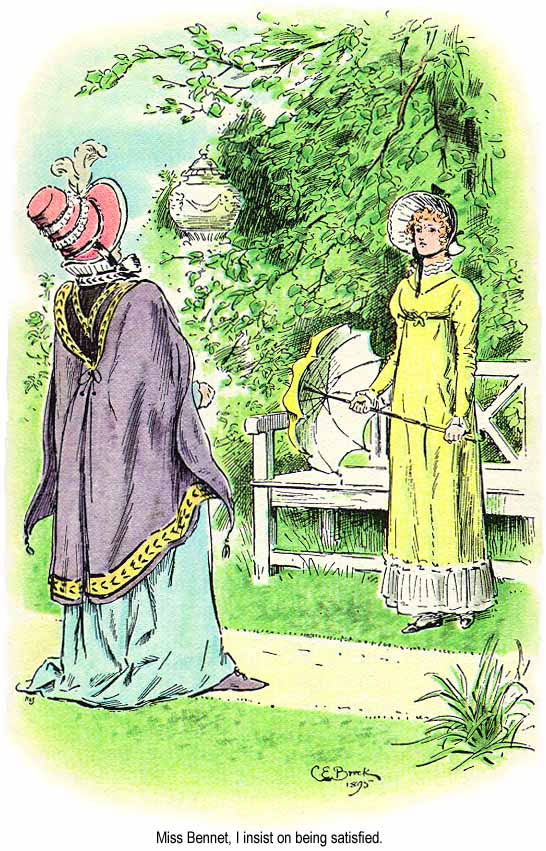
Mr Bingley and Mr Darcy return to Netherfield. Jane accepts Mr Bingley's proposal. A week later, Lady Catherine, having heard from a confidential letter that Mr Collins has nevertheless shared with her that Elizabeth and Mr Darcy may intend to marry, visits Elizabeth and demands she promise never to accept Mr Darcy's proposal, as she and Darcy's late mother had already planned his marriage to her daughter Anne. While admitting that she and Mr Darcy were not engaged, Elizabeth insistently refuses to offer any assurance that they would never do so. Outraged Lady Catherine storms off, pointedly refusing to proffer the conventional civilities, to confront Mr Darcy with the same demands she had made of Elizabeth. Darcy similarly refuses to comply, and heartened at his aunt's indignant relaying of Elizabeth's response, returns with Bingley to Longbourn. When Elizabeth reveals that she had already known of his part in Lydia's marriage, and offers him her thanks, Darcy realises that this may not present the bar to their engagement that he had feared. He again proposes marriage and is accepted. That evening, Darcy seeks the proper approval of Mr Bennet and receives it, though Mr Bennet needs extensive persuading from Elizabeth that this truly is her wish. He eventually gives his blessing, at which Elizabeth lets him into the secret of what Darcy had done for Lydia, which ostensibly takes the burden from Mr Bennet's shoulders. He may now immediately make an offer to repay the debt in full, and although it had been refused by Mr Darcy, the Bennet family honour will be restored.

Characters
Elizabeth Bennet – the second-eldest of the Bennet daughters, she is attractive, witty and intelligent – but with a tendency to form tenacious and prejudiced first impressions. As the story progresses, so does her tumultuous relationship with Mr Darcy. The course of Elizabeth and Darcy's relationship is ultimately decided when Darcy overcomes his pride, and Elizabeth overcomes her prejudice, leading them both to surrender to their love for each other.
Mr Fitzwilliam Darcy – Mr Bingley's friend and owner of the Darcy family seat of Pemberley in Derbyshire, said to be worth at least £10,000 a year. Although he is handsome, tall, and intelligent, Darcy lacks ease and social graces, so others frequently mistake his initially haughty reserve as proof of excessive pride. A new visitor to the Meryton setting of the novel, he is ultimately Elizabeth Bennet's love interest. Though he appears to be proud and is frequently disliked at first impression for this reason, his servants vouch for his kindness and decency.
Mr Bennet – A logical and reasonable middle-aged landed gentleman of a more modest income of £2,000 per annum, and the dryly sarcastic patriarch of the Bennet family, with five unmarried daughters. His estate, Longbourn, is entailed to the male line. His affection for his wife wore off early in their marriage and is now reduced to mere toleration. He is often described as 'indolent' in the novel. He favors Elizabeth, finding her and Jane to be the most sensible of the household. His detachment from the actions of his wife and younger daughters, and disinclination to impose economy on their spendthrift ways, is the ultimate cause of their current predicament; he knows this, and increasingly regrets it, but does nothing about it.

Mrs Bennet (née Gardiner) – the early middle-aged wife of Mr Bennet, and the mother of their five daughters. Mrs Bennet is a hypochondriac who imagines herself susceptible to attacks of tremors and palpitations (her "poor nerves") whenever things are not going her way. She is silly, frivolous, and tactless, and is given to embarrassing her husband and older daughters with a casual disregard for conventions of property, responsibility or propriety. Her main ambition in life is to marry her daughters off to wealthy men, as they will receive very little inheritance on the death of their father. She received a dowry of £5,000 from her father, which is settled as providing her with a lifetime allowance of 'pin money' and as marriage portions for her daughters after her death. She then inherited a further £4,000 on her father's death. But rather than manage within these constraints, she seeks to evade her responsibilities through her daughters' marriages.
Jane Bennet – the eldest Bennet sister. She is considered the most beautiful young lady in the neighbourhood and is inclined to see only the good in others (but can be persuaded otherwise on sufficient evidence). She falls in love with Charles Bingley, a rich young man recently moved to Hertfordshire and a close friend of Mr Darcy.
Mary Bennet – the middle Bennet sister, and the plainest of her siblings. Mary has a serious disposition and mostly reads and plays music, although she is often impatient to display her accomplishments and is rather vain about them. She frequently moralises to her family. According to James Edward Austen-Leigh's A Memoir of Jane Austen, Mary ended up marrying one of her Uncle Philips's law clerks and moving into Meryton with him.
Catherine "Kitty" Bennet – the fourth Bennet daughter. Though older than Lydia, she is her shadow and follows her in her pursuit of the officers of the militia. She is often portrayed as envious of Lydia and is described as a "silly" young woman. However, it is said that she improved when removed from Lydia's influence. According to James Edward Austen-Leigh's A Memoir of Jane Austen, Kitty later married a clergyman who lived near Pemberley.
Lydia Bennet – the youngest Bennet sister. She is frivolous, headstrong, irresponsible, and spoiled, and is her mother's favorite. Her main activity in life is socialising, especially flirting with the officers of the militia. This leads to her running off with George Wickham, although he has no intention of marrying her. Lydia shows no regard for the moral code of her society; as Ashley Tauchert says, she "feels without reasoning". Mr Darcy settles on her a 'separate estate' of £1,000 at her eventual wedding to Wickham.
Charles Bingley – a handsome, amiable, and wealthy young man who leases Netherfield Park with hopes of purchasing it. Though genial and well-mannered, he is easily influenced by his friend Mr Darcy and his sisters' opinions, which leads to the disruption of his romance with Jane Bennet. His inherited fortune of £100,000 is derived from "trade" rather than landed wealth.

Caroline Bingley – the snobbish sister of Charles Bingley, with an inheritance of her own of £20,000. She harbours designs on Mr Darcy and is jealous of his growing attachment to Elizabeth. She also disapproves of her brother's admiration for Jane Bennet and is disdainful of Meryton society, driven by her vanity and desire for social elevation.
George Wickham – Wickham is a charming but reprehensible cad. He has been acquainted with Mr Darcy since infancy, being the son of Mr Darcy's father's steward. An officer in the militia, he is superficially charming and rapidly forms an attachment with Elizabeth Bennet. He later runs off with Lydia with no intention of marriage, which would have resulted in her and her family's complete disgrace; but for Darcy's intervention to bribe Wickham to marry her by paying off his immediate debts and purchasing for him a commission in a regular infantry regiment.
Mr William Collins – Mr Collins is Mr Bennet's distant cousin, a clergyman and rector of Hunsford in Kent; and the current inheritor presumptive to his estate of Longbourn House. He is an obsequious, sanctimonious and pompous man, prone to making long and tedious speeches, who is excessively devoted to his patroness and neighbour, Lady Catherine de Bourgh; and regularly dines with her at Rosings, providing a conduit of information on many confidential matters to do with the Hunsford parish and its households. The Collinses are, however, not regularly invited to dine at any other households in the locality (nor do these households dine at Rosings), both because the Hunsford rectory income is insufficient to match the 'style of living' expected of Kent landed gentry; but also by implication, because Mr Collins cannot be trusted to keep confidences from Lady Catherine.
Lady Catherine de Bourgh – the overbearing aunt of Mr Darcy. Lady Catherine is the wealthy widow of Sir Lewis de Bourgh of Rosings Park, where she resides with her daughter Anne, who has inherited her father's estate which unusually is not entailed in the male line. She meddles improperly in the business of the Overseers of the Poor and Justices of the Peace, is haughty, hectoring, pompous, domineering, and condescending, and has long planned to marry off her daughter, Anne, to Darcy to 'unite the two estates', claiming it to be the dearest wish of both her and her late sister, Lady Anne Darcy (née Fitzwilliam). Unstated, but always understood, is that Lady Catherine has few other apparent options. Anne may be the sole owner of Rosings, but she is of the same age as Mr Darcy - around 28 - and not in good health. She may be unlikely otherwise to marry, and may not live long. Consequently Rosings, if otherwise entailed, might be expected to pass to another branch of the de Bourgh family, and Lady Catherine could be homeless.
Mr Edward Gardiner and Mrs Gardiner – Edward Gardiner is Mrs Bennet's brother and a successful London tradesman of sensible and gentlemanly character. Aunt Gardiner is genteel and elegant and is close to her nieces Jane and Elizabeth. The Gardiners are the parents of four children. They host the marriage of Lydia with Wickham from their home in Gracechurch Street, and are instrumental in bringing about the marriage between Darcy and Elizabeth.
Georgiana Darcy – Georgiana is Mr Darcy's quiet, amiable and shy younger sister, with a settled dowry of £30,000 from the Pemberley estate, who is 16 when the story begins. When still 15, Miss Darcy almost eloped with Mr Wickham but was saved by her brother, whom she idolises. Thanks to years of tutelage under masters, she is accomplished at the piano, singing, playing the harp, drawing, and modern languages and is therefore described as Caroline Bingley's idea of an "accomplished woman".
Charlotte Lucas – Elizabeth's 27-year-old friend. She marries Mr Collins for financial security, fearing becoming a burden to her family. Austen uses Charlotte's decision to illustrate how women of the time often married out of convenience rather than love, without condemning her choice. Charlotte is the daughter of Sir William Lucas and Lady Lucas, neighbours of the Bennet family.
Colonel Fitzwilliam – Colonel Fitzwilliam is the younger son of an earl and the nephew of Lady Catherine de Bourgh and Lady Anne Darcy; this makes him the cousin of Anne de Bourgh and the Darcy siblings, Fitzwilliam and Georgiana. He is about 30 years old at the beginning of the novel. He is the coguardian of Miss Georgiana Darcy, along with his cousin, Mr Darcy. According to Colonel Fitzwilliam, as a younger son, he cannot marry without thought to his prospective bride's dowry.
Major themes
A theme in much of Austen's work is the importance of environment and upbringing in developing young people's character and morality. Social standing and wealth are not necessarily advantages in her works, and a further theme common to Austen's work is ineffectual parents. In Pride and Prejudice, the failure of Mr and Mrs Bennet as parents is blamed for Lydia's lack of moral judgment. Darcy has been taught to be principled and scrupulously honourable, but he is also proud and overbearing. Kitty, rescued from Lydia's bad influence and spending more time with her older sisters after they marry, is said to improve greatly in their superior society.
The American novelist Anna Quindlen observed in an introduction to an edition of Austen's novel in 1995:
Pride and Prejudice is also about that thing that all great novels consider, the search for self. And it is the first great novel that teaches us this search is as surely undertaken in the drawing room, making small talk as in the pursuit of a great white whale or the public punishment of adultery.
Title
Many critics take the title as the start when analysing the themes of Pride and Prejudice but Robert Fox cautions against reading too much into the title (which was initially First Impressions), because commercial factors may have played a role in its selection. "After the success of Sense and Sensibility, nothing would have seemed more natural than to bring out another novel of the same author using again the formula of antithesis and alliteration for the title."
The qualities of the title are not exclusively assigned to one or the other of the protagonists; both Elizabeth and Darcy display pride and prejudice." The phrase "pride and prejudice" had been used over the preceding two centuries by Joseph Hall, Jeremy Taylor, Joseph Addison and Samuel Johnson. Austen is thought to have taken her title from a passage in Fanny Burney's Cecilia (1782), a novel she is known to have admired:
"The whole of this unfortunate business," said Dr. Lyster, "has been the result of PRIDE and PREJUDICE. ... if to PRIDE and PREJUDICE you owe your miseries, so wonderfully is good and evil balanced, that to PRIDE and PREJUDICE you will also owe their termination." (capitalisation as in the original)
Marriage and the Family Name
The opening line of the novel announces: "It is a truth universally acknowledged, that a single man in possession of a good fortune must be in want of a wife." This sets marriage as a motif and a central idea in the novel. Readers are poised to question whether or not these single men need a wife, and what for; or if the need is dictated by the "neighbourhood" families and their daughters who require a "good fortune". According to American Book Review the opening line of Pride and Prejudice is considered second on their list of top 100 greatest opening lines in English literature after Moby Dick's "Call me Ishmael".
Marriage is a complex social activity that takes political, social, and economic factors into account. In the case of Charlotte Lucas, the seeming success of her marriage to Mr Collins lies in the comfortable financial circumstances of their household rather than in mutual respect or companionship; while the relationship between Mr and Mrs Bennet serves to illustrate bad marriages based on an impulsive attraction and surface over substance (economic, social and psychological). The Bennet's marriage turns out to be deeply disfunctional in failing to meet one of a propertied family's most basic requirements; that of providing their daughters with marriage settlements appropriate for a gentleman's children. This increasingly humiliates Mr Bennet in the course of the book, made worse by Mrs Bennet's blithe unconcern at relying on other families' money instead, and her total disregard of any requirement for these obligations to be repaid. As is conventional in a romantic novel, the eventual marriages of Jane and Elizabeth as main protagonists are presented as a happy-ever-after. But otherwise, marriages in Austen's fiction are realistic and compromised; if anything, the "sad omens" for the Bennets' marriage are now worse.
The Bennets' failing marriage is an example that the youngest Bennet, Lydia, re-enacts with Wickham, and the results are far from felicitous. Indeed, the married Lydia rapidly adopts her mother's mercenary attitudes. Although the central characters, Elizabeth and Darcy, begin the novel as hostile acquaintances and unlikely friends, they eventually work toward a better understanding of themselves and each other, which frees them to truly fall in love. But only once they have both painfully confronted a complex of economic obligations and dependancies around one another, that they have been precipitated into by their families' circumstances. From the outset, both have determined to marry only on their own terms, recognising that this may be contrary to the wishes of their parents, but both also remain bound within their families and must be ready to trust these family concerns openly with one another. This does not eliminate the challenges of the real differences in their technically equivalent social status as gentry and their female relations. It does, however, provide them with a better understanding of each other's point of view from the different ends of the rather wide scale of differences within that category.
When Elizabeth rejects Darcy's first proposal, the argument of marrying for love is introduced. Elizabeth accepts Darcy's proposal only when she is certain she loves him and her feelings are reciprocated. Austen's complex sketching of different marriages ultimately allows readers to question what forms of alliance are desirable, especially when it comes to privileging economic, sexual, or companionate attraction.
It is a common assumption of all parties in the novel that the primary necessity for the marriage of a man of good fortune is to maintain and perpetuate his family name through his offspring. And equally, that one necessity for the marriage of a woman of property is to maintain that property for her offspring in her new family name. Although both Elizabeth and Darcy have already determined to marry for love, both recognise that they also have obligations in marriage to their family names and landed estates. Elizabeth is determined that she will marry a 'gentleman', knowing that her marriage otherwise would sully the Bennet family name, and potentially constrain the inheritance of her future offspring; Darcy already feels committed to contracting a marriage to provide an heir and mistress for the Pemberley estate, and to continue the Darcy family name. Counterpart pressures, to maintain ancient family names and to preserve landed estates in that name through male inheritance, are operating everywhere across England amongst the social circles in which the novel takes place. Everywhere too, these social pressures are having to be balanced against an increasing recognition of individual aspirations in marriage; to enable heirs to choose companionable partners, to provide for the futures of daughters and younger sons and enable these to marry in their turn, to allow younger sons to be educated and to embark on careers of 'gentlemanlike' quality, and to provide for widows and unmarried daughters.
The novel is concerned with the marital prospects of the heirs of three historic landed estates: Longbourn, represented by five daughters; Pemberley, represented by a son and daughter; and Rosings Park, represented by a single (and no longer young) daughter. Only one of these appears assured of male succession in the family name. This prospect of the failure of male succession had become a common theme across rural England in the 18th century, arising in almost all family estates at one time or another; and in response to this, landowners and their lawyers had developed legal instruments - entail and strict settlement - to balance the consequential conflicts of interest. To be sufficiently confident of producing a son to maintain an estate in the family name, it was better if an heir did not need to wait for their father's death before marrying; but there must then be provision for an assured and substantial income from the estate to that heir during their father's life to be committed in a legal marriage settlement. In order to ensure that inheritance of the estate could be maintained in the family, even were a future heir to produce no sons, there must be provision for portions from the estate to be paid for current younger sons' educations and marriages into 'gentlemanlike' careers in the Army, Church and Law, so that these sons might raise gentlemanly cousins within the family who might if needed, continue succession of the estate in the family name. In order to ensure that daughters from the family could marry gentlemen, they must be provided with settled dowries from the estate to commit to their legal marriage settlement. Provisions in all these forms would commonly be expected to be spelled out in the strict settlement that each heir would enter into on coming of age. Technically, the entail was a trust, so that the entailed estate would be held by trustees (commonly the family's lawyers) to the benefit of the 'tenant in tail', the heir's unborn eldest son. The heir would now be a 'tenant for life' in receipt of an annual allowance. Once the heir's father died, his son would become 'tenant in possession' with full access to the income from the estate, but unable to sell or mortgage any part of it. Payments due under the settlement - such as settled dowries - would be made by the trustees; though in the case of Longbourn, it appears that no provision had been made in Mr Bennet's strict settlement for daughters' dowries, Mrs Bennet's own dowry of £5,000 being settled for this purpose instead. Mrs Bennet rails repeatedly at the unfairness of the Longbourn entail; unable to realise, though her older daughters do, that it was only through that entail that she and Mr Bennet could have married as young as they did.
Of the other two landed estates that figure in the novel, Rosings Park and Pemberley, the reader is to understand that Pemberley is also entailed with a strict settlement, as Georgiana Darcy is stated as being provided with a settled dowry of £30,000 from it. In respect of Rosings, Lady Catherine states that it is not entailed away from the female line; "it was not thought necessary in Sir Lewis de Bourgh's family"; though this statement prompts the likelihood that the Rosings estate nevertheless is entailed by strict settlement in the de Bourgh family to the direct descendants of an ancient forbear, though not specifying 'male' or 'female'. Anne de Bourgh is identified by Mr Collins as "the heiress of Rosings", indicating a female inheritance that has already happened. Consequently, if the estate is entailed, then it may be inferred that the current 'tenant in possession' and owner of the Rosings estate, is Lady Anne de Bourgh; and that Anne's yet unborn heir would 'tenant in tail'. This would explain why it would be necessary for Mr Darcy and Lady Anne to marry if the two ancient estates are to be united in their children. But in any case, assuming Mr Collins is correct, Lady Catherine cannot be the current owner of Rosings. Under all the bluster of Lady Catherine's outburst to Elizabeth in the garden at Longbourn, the reality is that Lady Catherine has been scheming to detach Rosings Park from a branch of the ancient de Bourgh family and convey it into a branch of the Darcy family. Which is precisely the sort of dynastic larceny by marriage that the legal institutions of marriage in the English landed gentry in this period sought to forestall.
If entail and strict settlement tended only to be undertaken in respect of larger landed estates; dowries and associated marriage settlements, in the levels of English society represented in the novel, were effectively universal. Amy Erickson has demonstrated that in more than 10% of marriages, as found in probate accounts for married men of all classes, some sort of marriage settlement sum is referenced which is bound to be repaid to the widow by the executors of the husband's will. Even humble marriages might well be covered by a simple bond for repayment, and around a quarter were for less than £13. But in the families with any degree of land or property, dowries for daughters were expected to be considerably larger—£500 and upwards—and would commonly be incorporated into a formal marriage settlement applying the legal principle of 'separate estate'. The Dowry sum would not be paid directly to the couple (as by the Common Law doctrine of 'coverture' it would have then become the outright property of the husband), instead it was held by trustees in trust for the future children of the marriage. The marriage settlement would specify payments from this settled fund out of its income without drawing on the capital, typically including, 'pin money', annual payments to the wife during the marriage of money to be spent at her own discretion on non-essentials and clothing; and 'jointure', eventual annual payments to support the living costs of the wife as an unmarried widow. Once both the married couple had died, the capital fund would be shared out to any surviving offspring in proportions to be determined, commonly by the wife's will. Income from the fund during the marriage after payment of 'pin money' might be allowed to be available from her to the husband (with the approval of the trustees); but he could not touch the capital—most usually held in interest-bearing securities. Should the wife inherit further money during the marriage, the testator—for instance, her own parents—could specify that inheritance as being into the 'separate estate', rather than to the couple directly. By securing substantial dowries and inheritances through marriage settlements as 'separate estates' the fathers of marriageable daughters sought to ensure that they continued to be able to maintain themselves and their children in presentable attire for polite company, even were their husband to turn out as irresponsible with his own money; that the daughter would be assured of a sustainable living in widowhood; and that eventually the settled property would pass to her offspring.
Unmarried girls in these levels of society were commonly already known as having been provided by their family with a particular value of dowry in 'separate estate'; and it is a tacit rebuke to Mr and Mrs Bennet that they have failed properly to do so. Mrs Bennet blames the entail, but the real cause is their own improvidence over the years. It was not uncommon for the groom's family, before the marriage, to increase the bride's separate estate and pin money; but the manner by which Mrs Bennet continues openly assuming that Darcy and Bingley will do so for her and her daughters, is vulgar, demeans the honour of the Bennet family name, and leaves Mr Bennet both angered and ashamed.
Wealth
Wealth is a strong theme in the novel where the male characters of marrying age are usually described, first and foremost, by their annual income. For example, Mr Bingley is introduced as a 4000 pounds-a-year person, similar to the initial mentions of Mr Darcy and Colonel Fitzwilliam.
Money plays a fundamental role in the marriage market for the young ladies seeking a well-off husband and for men who wish to marry a woman of means. George Wickham tries to elope with Georgiana Darcy for her settled dowry, and Colonel Fitzwilliam states that he will marry someone with wealth.
Marrying a woman of a rich family also ensured a linkage to a higher-class family, as is visible in the desires of Bingley's sisters to have their brother married to Georgiana Darcy. Mrs Bennet is frequently seen encouraging her daughters to marry a wealthy man of high social class. In chapter 1, when Mr Bingley arrives, she is "thinking of his marrying one of them".
Inheritance of landed wealth was by descent but could be further restricted by entailment, which in the case of the Longbourn estate restricted inheritance to male heirs only; Mr Collins was to inherit the family estate upon Mr Bennet's death in default of there being a son. His proposal to Elizabeth would have ensured her security; but she refuses his offer. The procedure of entail ensured that family estates of ancient creation were very rarely sold outright, typically passing instead to another branch of the same family where there was no male heir, or where the estate had fallen heavily in debt. Recently created estates were much more likely to come onto the market.
Inheritance laws benefited males both through entail and because, through the doctrine of coverture, married women had severely constricted independent legal rights in Common Law - especially to any landed property they brought into the marriage - until the second half of the 19th century. For the upper-middle and aristocratic classes, marriage to a man with a reliable income was almost the only route to security for the woman and the children she was to have. The irony of the opening line is that generally within this society it would be a single woman without a good fortune who must be in want of a wealthy husband, to have a secure life and children. Against this however, the Common Law of England provided almost unrestricted economic freedom for those unmarried women who had nevertheless inherited substantial property - as Anne de Bourgh and Caroline Bingley have done, and Georgiana Darcy will do when she comes of age. "English property law was distinctive in two respects: first, married women under coverture were even more restricted than in the rest of Europe; second, single women enjoyed a position unique in Europe as legal individuals in their own right, with no requirement for a male guardian". As a 'feme sole' the legal status of an unmarried woman or widow in England did not differ from that of a man. Consequently, when propertied women married, and especially when widows remarried, it was standard practice in this period for their assets to be placed in trust before the marriage in a 'separate estate' to which their husband would have no legal right of access.
Differing levels of wealth amongst the country gentry are observed in the three rural counties in which the action of the book takes place. Kent, the location of Hunsford and Rosings Park and an area Austen knew well in visiting her brother's estate at Godmersham Park, was favoured by prosperous families from the City of London as a county where recently wealthy men might buy a landed estate and establish themselves as gentlemen. In the novel, the style of living in these Kent households is noted as being beyond the social range of the characters from Hertfordshire. Hertfordshire in this period, similarly attracted numbers of socially aspiring men from London - as with Mr Bingley - but generally at a lesser degree of wealth and less extravagant living style. Whereas in Kent and Hertfordshire there is a considerable turnover for families buying and selling estates, this is not the case in Derbyshire, where the Darcy family has held the estate of Pemberley for generations. Similarly almost all estates around Derbyshire will have remained under the same family name throughout periods of relative affluence and austerity, although the Bingleys will eventually purchase a family estate in a neighbouring county.
Class
Austen might be known now for her "romances," but the marriages in her novels engage with economics and class distinction. Pride and Prejudice is no exception.
When Darcy proposes to Elizabeth, he cites their economic and social differences as an obstacle his excessive love has had to overcome, though he still anxiously harps on the problems it poses for him within his social circle. His aunt, Lady Catherine, later characterises these differences in particularly harsh terms when she conveys what Elizabeth's marriage to Darcy will become, "Will the shades of Pemberley be thus polluted?" Although Elizabeth responds to Lady Catherine's accusations that hers is a potentially contaminating economic and social position (Elizabeth even insists she and Darcy, as a gentleman's daughter and a gentleman, are "equals"), Lady Catherine refuses to accept the possibility of Darcy's marriage to Elizabeth. However, as the novel closes, "...through curiosity to see how his wife conducted herself", Lady Catherine condescends to visit them at Pemberley.
As is apparent from Elizabeth's response, the key class distinction in the social world of Pride and Prejudice is between those who are 'gentlemen' and those who are not. The main signifier of gentlemanly status in this world is the possession in the family of inherited landed wealth. Pemberley, Rosings Park and Longbourn are all inherited estates of longstanding; so the families that possess them do have the settled status of gentlemen, whereas Lucas Lodge is not, and Sir William and his family do not. Gentlemanly status could, however, be maintained by families not in possession of an estate for those in specific occupations; chiefly the Church, the Law, and the Armed Forces. But within these professions, the distinction was still evident. Officers in regular regiments of foot were gentlemen; officers in the Marines were not. Incumbent beneficed clergy (prebendaries, rectors and vicars) were gentleman, perpetual and assistant curates were not. For younger sons of titled and gentry families like Colonel Fitzwilliam, the Law, Church and the Army represented alternative refuges of gentility for those without landed wealth of their own. In this, the English landed gentry were unusual in Europe; younger sons of equivalent minor nobility in France, Sweden or Italy who entered salaried professions commonly were considered to have lost noble status.
Associated with the distinction between who is a gentleman and who is not, is the key question of the book: which qualities are 'gentlemanlike' and which are not? Elizabeth refuses Mr Darcy's first proposal on the grounds that it is, as his behaviour towards her and her family has consistently been, not gentlemanlike. Mr Darcy is incredulous at the charge, but eventually comes to accept the truth of it: "Your reproof, so well applied, I shall never forget: ‘Had you behaved in a more gentlemanlike manner.’" As historic gentlemanly status depended on retaining inherited land under the family name, so the conventional gentlemanlike qualities were seen in maintaining the dignity of that family name, the discharge of family obligations as 'debts of honour', and in deference to the wishes of one's elders and betters; qualities given formal status through the legal instruments of entailed succession and strict settlement by which both Pemberley and Longbourn are bound. But in the course of the plot, both Elizabeth and Mr Darcy come to see true gentlemanly qualities as rather being grounded in concern for the feelings of others, and in avoiding hurtful or overbearing deeds and words. Kitson Clark argues that in this, Austen prefigures changing ideals of gentlemanly qualities that underpin Victorian social and educational ethics.
The Bingleys present a particular problem for navigating class. Though Caroline Bingley and Mrs Hurst behave and speak of others as if they have always belonged in the upper echelons of society, Austen makes it clear that the Bingley fortunes stem from trade. The fact that Bingley rents Netherfield Hall – it is, after all, "to let" – distinguishes him significantly from Darcy, whose estate belonged to his father's family and who, through his mother, is the grandson and nephew of an earl. Bingley, unlike Darcy, does not yet own an estate but has portable and growing wealth that makes him a good catch on the marriage market for poorer daughters of the gentry, like Jane Bennet, or of ambitious merchants. Class plays a central role in the evolution of the characters, and Jane Austen's radical approach to class is seen as the plot unfolds.
An undercurrent of the old Anglo-Norman upper class is hinted at in the story, as suggested by the names of Fitzwilliam Darcy and his aunt, Lady Catherine de Bourgh; Fitzwilliam, D'Arcy, de Bourgh (Burke), and even Bennet, are traditional Norman surnames.