
Jane Austen ( OST-in, AW-stin; 16 December 1775 – 18 July 1817) was an English writer known primarily for her six novels, which implicitly interpret, critique, and comment on the English landed gentry at the end of the 18th century.
Austen's plots often explore the dependence of women on marriage for the pursuit of favourable social standing and economic security. Her works are implicit critiques of the novels of sensibility of the second half of the 18th century and are part of the transition to 19th-century literary realism. Her use of social commentary, realism, wit, and irony have earned her acclaim amongst critics and scholars.
Austen wrote major novels before the age of 22, but she was not published until she was 35. The anonymously published Sense and Sensibility (1811), Pride and Prejudice (1813), Mansfield Park (1814), and Emma (1815) were moderate successes, but they did not bring her public fame in her lifetime. She wrote two other novels—Northanger Abbey and Persuasion, both published posthumously in 1817—and began another, eventually titled Sanditon, but it was left unfinished on her death. She also left behind three volumes of juvenile writings in manuscript, the short epistolary novel Lady Susan, and the unfinished novel The Watsons.

Since her death Austen's novels have rarely been out of print. A significant transition in her reputation occurred in 1833, when they were republished in Richard Bentley's Standard Novels series (illustrated by Ferdinand Pickering and sold as a set). They gradually gained wide acclaim and popular readership. In 1869 her nephew published A Memoir of Jane Austen. Her work has inspired a large number of critical essays and has been included in many literary anthologies.
Her novels have been frequently adapted into film and television. Notable film adaptations include Pride and Prejudice (1940), Sense and Sensibility (1995), Emma (1996), Mansfield Park (1999), Bride and Prejudice (2004), Pride & Prejudice (2005), Love & Friendship (2016), and Emma (2020). Notable television adaptations include Persuasion (1995), Pride and Prejudice (1995), Northanger Abbey (2007), Persuasion (2007), Lost in Austen (2008), Sense and Sensibility (2008), Emma (2009), and Sanditon (2019–2023).
Biographical sources
The scant biographical information about Austen comes from her surviving letters and a number of sketches her family members and contemporaries wrote about her.

Only about 160 of the approximately 3,000 letters Austen would have written in the course of her lifetime have survived and been published. It is believed that Cassandra Austen destroyed the bulk of the letters she received from her sister, by burning or otherwise. One theory is that she wanted to ensure that the "younger nieces did not read any of Jane's sometimes acid or forthright comments on neighbours or family members." In the interest of protecting reputations from Jane's penchant for honesty and forthrightness, Cassandra, it is surmised, may have omitted details of illnesses, unhappiness and anything she considered unsavoury. It is certainly the case that important details about her life and the actions of the Austen family were deliberately omitted, such as any mention of Austen's brother George, whose undiagnosed developmental challenges led the family to have him raised away from their home, as was common for the time, or of wealthy Aunt Jane Leigh-Perrot, who was arrested, tried, and acquitted on charges of grand larceny.
The first Austen biography was her brother Henry Thomas Austen's 1818 "Biographical Notice". It appeared in a posthumous edition of Northanger Abbey and included extracts from two letters, apparently published against the judgement of other family members. Details of Austen's life continued to be omitted or embellished in her nephew's A Memoir of Jane Austen, published in 1869, and in William and Richard Arthur Austen-Leigh's biography Jane Austen: Her Life and Letters, published in 1913, all of which included additional letters.
Austen's family and relatives built a legend of "good quiet Aunt Jane", portraying her as a woman in a happy domestic situation, whose family was the mainstay of her life. Critics have long taken issue with this depiction of a "mild" Austen. Modern biographers include details excised from the letters and family biographies, but the biographer Jan Fergus writes that the challenge is to keep the view balanced, not to present her languishing in periods of deep unhappiness as "an embittered, disappointed woman trapped in a thoroughly unpleasant family."
Early years to age 20
Family
Jane Austen was born on 16 December 1775 in Steventon, Hampshire. Her father, George Austen (1731–1805), wrote of her arrival in a letter that her mother, Cassandra, "certainly expected to have been brought to bed a month ago." He added that the newborn infant was "a present plaything for Cassy and a future companion." The winter of 1775-1776 was particularly harsh, and it was not until 5 April that she was baptised at the local church and christened Jane.
George served as the rector of the Anglican parishes of Steventon and Deane. The Reverend Austen came from an old and wealthy family of wool merchants. As each generation of eldest sons received inheritances, George's branch of the family fell into poverty. He and his two sisters were orphaned as children and had to be taken in by relatives. In 1745, at the age of fifteen, George's sister Philadelphia was apprenticed to a milliner in Covent Garden. At the age of sixteen, George entered St John's College, Oxford, where he most likely met Cassandra Leigh (1739–1827). She came from the prominent Leigh family. Her father was rector at All Souls College, Oxford, where she grew up among the gentry. Her eldest brother James inherited a fortune and large estate from his great-aunt Perrot, with the only condition that he change his name to Leigh-Perrot.
George Austen and Cassandra Leigh were engaged, probably around 1763, when they exchanged miniatures. He received the living of the Steventon parish from Thomas Knight, the wealthy husband of his second cousin. They married on 26 April 1764 at St Swithin's Church in Bath, by licence, in a simple ceremony, two months after Cassandra's father died. Their income was modest, with George's small per annum living; Cassandra brought to the marriage the expectation of a small inheritance at the time of her mother's death.

After the living at the nearby Deane rectory had been purchased for George by his wealthy uncle Francis Austen, the Austens took up temporary residence there, until Steventon rectory, a 16th-century house in disrepair, underwent necessary renovations. Cassandra gave birth to three children while living at Deane: James in 1765, George in 1766, and Edward in 1767. Her custom was to keep an infant at home for several months and then place it with Elizabeth Littlewood, a woman living nearby to nurse and raise for twelve to eighteen months.
Steventon
In 1768 the family finally took up residence in Steventon. Henry was the first child to be born there, in 1771. At about this time, Cassandra could no longer ignore the signs that little George was developmentally disabled. He had seizures and may have been deaf and mute. At this time she chose to send him to be fostered. In 1773 Cassandra was born, followed by Francis in 1774, and Jane in 1775.
According to the biographer Park Honan, the Austen home had an "open, amused, easy intellectual atmosphere", in which the ideas of those with whom members of the Austen family might disagree politically or socially were considered and discussed.

The family relied on the patronage of their kin and hosted visits from numerous family members. The elder Cassandra spent the summer of 1770 in London with George's sister, Philadelphia, and her daughter Eliza, accompanied by his other sister, Mrs Walter, and her daughter Philly. Philadelphia and Eliza Hancock were, according to Le Faye, "the bright comets flashing into an otherwise placid solar system of clerical life in rural Hampshire, and the news of their foreign travels and fashionable London life, together with their sudden descents upon the Steventon household in between times, all helped to widen Jane's youthful horizon and influence her later life and works."
Cassandra Austen's cousin Thomas Leigh visited a number of times in the 1770s and 1780s, inviting young Cassie to visit them in Bath in 1781. The first mention of Jane occurs in family documents upon her return, "... and almost home they were when they met Jane & Charles, the two little ones of the family, who had to go as far as New Down to meet the chaise, & have the pleasure of riding home in it." Le Faye writes that "Mr Austen's predictions for his younger daughter were fully justified. Never were sisters more to each other than Cassandra and Jane; while in a particularly affectionate family, there seems to have been a special link between Cassandra and Edward on the one hand, and between Henry and Jane on the other."
From 1773 until 1796 George supplemented his income by farming and by teaching three or four boys at a time, who boarded at his home. He had an annual income of £200 (equivalent to £26,000 in 2025) from his two livings. This was a very modest income at the time; by comparison, a skilled worker like a blacksmith or a carpenter could make about £100 annually while the typical annual income of a gentry family was between £1,000 and £5,000. He also rented the 200-acre Cheesedown farm from his benefactor Thomas Knight, which could make a profit of £300 (equivalent to £40,000 in 2025) a year.

During this period of her life, Jane attended church regularly, socialised with friends and neighbours, and read novels—often of her own composition—aloud to her family in the evenings. Socialising with the neighbours often meant dancing, either impromptu in someone's home after supper or at the balls held regularly at the assembly rooms in the town hall. Her brother Henry later said that "Jane was fond of dancing, and excelled in it".
Education
In 1783 Austen and her sister Cassandra were sent to Oxford to be educated by Ann Cawley, who took them to Southampton later that year. That autumn both girls were sent home after catching typhus, of which Jane nearly died. She was from then home-educated, until she attended boarding school with her sister from early in 1785 at the Reading Abbey Girls' School, ruled by Mrs La Tournelle. The curriculum probably included French, spelling, needlework, dancing, music and drama. The sisters returned home before December 1786 because the school fees for the two girls were too high for the Austen family. After 1786 Austen "never again lived anywhere beyond the bounds of her immediate family environment".
Her education came from reading, guided by her father and brothers James and Henry. Irene Collins said that Austen "used some of the same school books as the boys". Austen apparently had unfettered access both to her father's library and that of a family friend, Warren Hastings. Together these collections amounted to a large and varied library. Her father was also tolerant of Austen's sometimes risqué experiments in writing, and provided both sisters with expensive paper and other materials for their writing and drawing.
Private theatricals were an essential part of Austen's education. From her early childhood, the family and friends staged a series of plays in the rectory barn, including Richard Sheridan's The Rivals (1775) and David Garrick's Bon Ton. Austen's eldest brother James wrote the prologues and epilogues and she probably joined in these activities, first as a spectator and later as a participant. Most of the plays were comedies, which suggests how Austen's satirical gifts were cultivated. At the age of 12 she tried her own hand at dramatic writing; she wrote three short plays during her teenage years.
Juvenilia (1787–1793)
From at least the time she was aged eleven, Austen wrote poems and stories to amuse herself and her family. She exaggerated mundane details of daily life and parodied common plot devices in "stories [] full of anarchic fantasies of female power, licence, illicit behaviour, and general high spirits", according to Janet Todd. Austen compiled fair copies of twenty-nine early works from 1787 to 1793 into three bound notebooks with 90,000 words, now known as the Juvenilia, named "Volume the First", "Volume the Second" and "Volume the Third". The Juvenilia are often, according to the scholar Richard Jenkyns, "boisterous" and "anarchic"; he compares them to the work of the 18th-century novelist Laurence Sterne.
Among these works is a satirical novel in letters titled Love and Freindship [sic], written when aged fourteen in 1790, in which she mocked popular novels of sensibility. The next year, she wrote The History of England, a manuscript of thirty-four pages accompanied by thirteen watercolour miniatures by her sister, Cassandra. Austen's History parodied popular historical writing, particularly Oliver Goldsmith's History of England (1764). Honan speculates that not long after writing Love and Freindship Austen decided to "write for profit, to make stories her central effort", that is, to become a professional writer. When she was around eighteen years old, Austen began to write longer, more sophisticated works.
In August 1792, aged seventeen, Austen started Catharine or the Bower, which presaged her mature work, especially Northanger Abbey, but was left unfinished until picked up in Lady Susan, which Todd describes as less prefiguring than Catharine. A year later she began, but abandoned, a short play, later titled Sir Charles Grandison or the happy Man, a comedy in 6 acts, which she returned to and completed around 1800. This was a short parody of various school textbook abridgements of Austen's favourite contemporary novel, The History of Sir Charles Grandison (1753) by Samuel Richardson.
When Austen became an aunt for the first time aged eighteen, she sent her newborn niece Fanny Catherine Austen Knight "five short pieces of ... the Juvenilia now known collectively as 'Scraps' .., purporting to be her 'Opinions and Admonitions on the conduct of Young Women'". For Jane-Anna-Elizabeth Austen (also born in 1793), her aunt wrote "two more 'Miscellanious Morsels', dedicating them to [Anna] on 2 June 1793, 'convinced that if you seriously attend to them, You will derive from them very important Instructions, with regard to your Conduct in Life.'" There is manuscript evidence that Austen continued to work on these pieces as late as 1811 (when she was 36), and that her niece and nephew Anna and James Edward Austen made further additions as late as 1814.
Between 1793 and 1795 (aged eighteen to twenty), Austen wrote Lady Susan, a short epistolary novel, usually described as her most ambitious and sophisticated early work. It is unlike any of Austen's other works. Austen's biographer Claire Tomalin describes the novella's heroine as a sexual predator who uses her intelligence and charm to manipulate, betray and abuse her lovers, friends and family. Tomalin writes:
Told in letters, it is as neatly plotted as a play, and as cynical in tone as any of the most outrageous of the Restoration dramatists who may have provided some of her inspiration ... It stands alone in Austen's work as a study of an adult woman whose intelligence and force of character are greater than those of anyone she encounters.
According to Janet Todd, the model for the title character may have been Eliza de Feuillide, who inspired Austen with stories of her glamorous life and various adventures. Eliza's French husband was guillotined in 1794 during the Reign of Terror amidst the French Revolution; she married Jane's brother Henry Austen in 1797.
Ages 20 to 34
Tom Lefroy
When Austen was twenty, Tom Lefroy, a neighbour, visited Steventon from December 1795 to January 1796. He had just finished a university degree and was moving to London for training as a barrister. Lefroy and Austen would have been introduced at a ball or other neighbourhood social gathering, and it is clear from Austen's letters to Cassandra that they spent considerable time together: "I am almost afraid to tell you how my Irish friend and I behaved. Imagine to yourself everything most profligate and shocking in the way of dancing and sitting down together."
Austen wrote in her first surviving letter to her sister Cassandra that Lefroy was a "very gentlemanlike, good-looking, pleasant young man". Five days later in another letter, Austen wrote that she expected an "offer" from her "friend" and that "I shall refuse him, however, unless he promises to give away his white coat", going on to write "I will confide myself in the future to Mr Tom Lefroy, for whom I don't give a sixpence" and refuse all others. The next day, Austen wrote: "The day will come on which I flirt my last with Tom Lefroy and when you receive this it will be all over. My tears flow as I write at this melancholy idea".
Halperin cautioned that Austen often satirised popular sentimental romantic fiction in her letters, and some of the statements about Lefroy may have been ironic. However, it is clear that Austen was genuinely attracted to Lefroy and subsequently none of her other suitors ever quite measured up to him. The Lefroy family intervened and sent him away at the end of January. Marriage was impractical as both Lefroy and Austen must have known. Neither had any money, and he was dependent on a great-uncle in Ireland to finance his education and establish his legal career. If Lefroy later visited Hampshire, he was carefully kept away from the Austens, and Jane never saw him again. In November 1798 Lefroy was still on Austen's mind as she wrote to her sister she had tea with one of his relatives, wanted desperately to ask about him, but could not bring herself to raise the subject.
Early manuscripts (1796–1798)
After finishing Lady Susan, Austen began her first full-length novel Elinor and Marianne. Her sister remembered that it was read to the family "before 1796" and was told through a series of letters. Without surviving original manuscripts, there is no way to know how much of the original draft survived in the novel published anonymously in 1811 as Sense and Sensibility.
Austen began a second novel, First Impressions (later published as Pride and Prejudice), in 1796. She completed the initial draft in August 1797, aged 21; as with all of her novels, Austen read the work aloud to her family as she was working on it and it became an "established favourite". At this time, her father made the first attempt to publish one of her novels; in November 1797 he wrote to Thomas Cadell, an established publisher in London, to ask if he would consider publishing First Impressions. Cadell returned George's letter, marking it "Declined by Return of Post". Jane may not have known of her father's efforts. Following the completion of First Impressions, Austen returned to Elinor and Marianne and from November 1797 until mid-1798, revised it heavily; she eliminated the epistolary format in favour of third-person narration and produced something close to Sense and Sensibility.
In 1797 Austen met her cousin (and future sister-in-law) Eliza de Feuillide, a French aristocrat whose first husband the Comte de Feuillide had been guillotined, causing her to flee to Britain, where she married Henry Austen. The description of the execution of the Comte de Feuillide related by his widow left Austen with an intense horror of the French Revolution that lasted for the rest of her life.
During the middle of 1798, after finishing revisions of Elinor and Marianne, Austen began writing a third novel with the working title Susan—later Northanger Abbey—a satire on the popular Gothic novel. Austen completed her work about a year later. In early 1803, Henry Austen offered Susan to Benjamin Crosby, a London publisher, who paid £10 for the copyright. Crosby promised early publication and went so far as to advertise the book publicly as being "in the press", but did nothing more. The manuscript remained in Crosby's hands, unpublished, until Austen repurchased the copyright from him in 1816.
Bath and Southampton
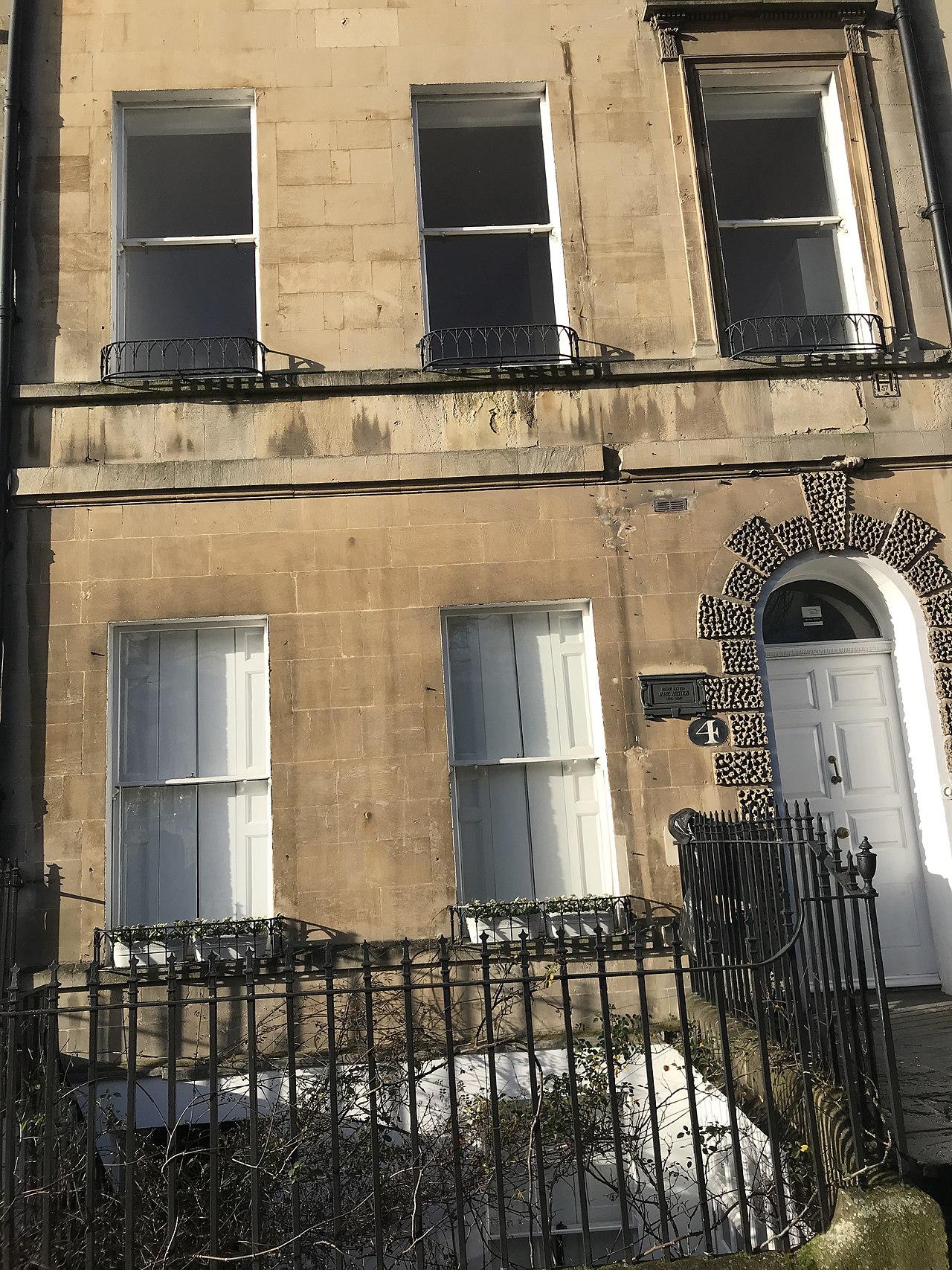
In December 1800 George Austen unexpectedly announced his decision to retire from the ministry, leave Steventon, and move the family to 4, Sydney Place in Bath, Somerset. While retirement and travel were good for the elder Austens, Jane Austen was shocked to be told she was moving 50 miles (80 km) away from the only home she had ever known. An indication of her state of mind is her lack of productivity as a writer during the time she lived in Bath. She was able to make some revisions to Susan, and she began and then abandoned a new novel, The Watsons, but there was nothing like the productivity of the years 1795–1799. Tomalin suggests this reflects a deep depression disabling her as a writer, but Honan disagrees, arguing Austen wrote or revised her manuscripts throughout her creative life, except for a few months after her father died. It is often claimed that Austen was unhappy in Bath, which caused her to lose interest in writing, but it is just as possible that Austen's social life in Bath prevented her from spending much time writing novels. The critic Robert Irvine argued that if Austen spent more time writing novels when she was in the countryside, it might just have been because she had more spare time as opposed to being more happy in the countryside as is often argued. Furthermore, Austen frequently both moved and travelled over southern England during this period, which was hardly a conducive environment for writing a long novel. Austen sold the rights to publish Susan to the publisher Crosby & Company, who paid her £10 (equivalent to £720 in 2025). Crosby & Company advertised Susan, but never published it.
The years from 1801 to 1804 are something of a blank space for Austen scholars as Cassandra destroyed all her letters from her sister in this period for unknown reasons. In December 1802 Austen received her only known proposal of marriage. She and her sister visited Alethea and Catherine Bigg, old friends who lived near Basingstoke. Their younger brother, Harris Bigg-Wither, had recently finished his education at Oxford and was also at home. Bigg-Wither proposed and Austen accepted. As described by Caroline Austen, Jane's niece, and Reginald Bigg-Wither, a descendant, Harris was not attractive—he was a large, plain-looking man who spoke little, stuttered when he did speak, was aggressive in conversation, and almost completely tactless. However, Austen had known him since both were young and the marriage offered many practical advantages to Austen and her family. He was the heir to extensive family estates located in the area where the sisters had grown up. With these resources, Austen could provide her parents a comfortable old age, give Cassandra a permanent home and, perhaps, assist her brothers in their careers. By the next morning, Austen realised she had made a mistake and withdrew her acceptance. No contemporary letters or diaries describe how Austen felt about this proposal. Irvine described Bigg-Wither as somebody who "...seems to have been a man very hard to like, let alone love".
In 1814 Austen wrote a letter to her niece Fanny Knight, who had asked for advice about a serious relationship, telling her that "having written so much on one side of the question, I shall now turn around & entreat you not to commit yourself farther, & not to think of accepting him unless you really do like him. Anything is to be preferred or endured rather than marrying without Affection". The scholar Douglas Bush wrote that Austen had "had a very high ideal of the love that should unite a husband and wife ... All of her heroines ... know in proportion to their maturity, the meaning of ardent love". A possible autobiographical element in Sense and Sensibility occurs when Elinor Dashwood contemplates "the worse and most irremediable of all evils, a connection for life" with an unsuitable man.
In 1804, while living in Bath, Austen started, but did not complete, her novel The Watsons. The story centres on an invalid and impoverished clergyman and his four unmarried daughters. Sutherland describes the novel as "a study in the harsh economic realities of dependent women's lives". Honan suggests, and Tomalin agrees, that Austen chose to stop work on the novel after her father died on 21 January 1805 and her personal circumstances resembled those of her characters too closely for her comfort.
Her father's relatively sudden death left Jane, Cassandra, and their mother in a precarious financial situation. Edward, James, Henry, and Francis Austen (known as Frank) pledged to make annual contributions to support their mother and sisters. For the next four years, the family's living arrangements reflected their financial insecurity. They spent part of the time in rented quarters in Bath before leaving the city in June 1805 for a family visit to Steventon and Godmersham. They moved for the autumn months to the newly fashionable seaside resort of Worthing, on the Sussex coast, where they resided at Stanford Cottage. It was here that Austen is thought to have written her fair copy of Lady Susan and added its "Conclusion". In 1806, the family moved to Southampton, where they shared a house with Frank Austen and his new wife. A large part of this time they spent visiting various branches of the family.
On 5 April 1809, about three months before the family's move to Chawton, Austen wrote an angry letter to Richard Crosby, offering him a new manuscript of Susan if needed to secure the immediate publication of the novel, and requesting the return of the original so she could find another publisher. Crosby replied that he had not agreed to publish the book by any particular time, or at all, and that Austen could repurchase the manuscript for the £10 he had paid her and find another publisher. She did not have the resources to buy the copyright back at that time, but was able to purchase it in 1816.
Ages 34 to 41
Chawton
Around early 1809, Austen's brother Edward offered his mother and sisters a more settled life—the use of a large cottage in Chawton village which was part of the estate around Edward's nearby property Chawton House. Jane, Cassandra and their mother moved into Chawton cottage on 7 July 1809. Life was quieter in Chawton than it had been since the family's move to Bath in 1800. The Austens did not socialise with gentry and entertained only when family visited. Her niece Anna described the family's life in Chawton as "a very quiet life, according to our ideas, but they were great readers, and besides the housekeeping our aunts occupied themselves in working with the poor and in teaching some girl or boy to read or write."
Published author
Like many women authors at the time, Austen published her books anonymously. At the time, the ideal roles for a woman were as wife and mother, and writing for women was regarded at best as a secondary form of activity; a woman who wished to be a full-time writer was felt to be degrading her femininity, so books by women were usually published anonymously in order to maintain the conceit that the female writer was only publishing as a sort of part-time job, and was not seeking to become a "literary lioness" (i.e. a celebrity). Another reason noted is that the novel was still seen as a lesser form of literature at the time compared with poetry, and many female and male authors published novels anonymously, whereas works of poetry, by both female and male writers, were almost always attributed to the author.
During her time at Chawton, Austen published four generally well-received novels. Through her brother Henry, the publisher Thomas Egerton agreed to publish Sense and Sensibility, which, like all of Austen's novels except Pride and Prejudice, was published "on commission", that is, at the author's financial risk. When publishing on commission, publishers would advance the costs of publication, repay themselves as books were sold and then charge a 10% commission for each book sold, paying the rest to the author. If a novel did not recover its costs through sales, the author was responsible for them. The alternative to selling via commission was by selling the copyright, where an author received a one-time payment from the publisher for the manuscript, which occurred with Pride and Prejudice. Austen's experience with Susan (the manuscript that became Northanger Abbey) where she sold the copyright to the publisher Crosby & Sons for £10, who did not publish the book, forcing her to buy back the copyright in order to get her work published, left Austen leery of this method of publishing. The final alternative, of selling by subscription, where a group of people would agree to buy a book in advance, was not an option for Austen as only authors who were well known or had an influential aristocratic patron who would recommend an up-coming book to their friends, could sell by subscription. Sense and Sensibility appeared in October 1811, and was described as being written "By a Lady". As it was sold on commission, Egerton used expensive paper and set the price at 15 shillings (equivalent to £52 in 2025).
Reviews were favourable and the novel became fashionable among young aristocratic opinion-makers; the edition sold out by mid-1813. Austen's novels were published in larger editions than was normal for this period. The small size of the novel-reading public and the large costs associated with hand production (particularly the cost of handmade paper) meant that most novels were published in editions of 500 copies or fewer to reduce the risks to the publisher and the novelist. Even some of the most successful titles during this period were issued in editions of not more than 750 or 800 copies and later reprinted if demand continued. Austen's novels were published in larger editions, ranging from about 750 copies of Sense and Sensibility to about 2,000 copies of Emma. It is not clear whether the decision to print more copies than usual of Austen's novels was driven by the publishers or the author. Since all but one of Austen's books were originally published "on commission", the risks of overproduction were largely hers (or Cassandra's after her death) and publishers may have been more willing to produce larger editions than was normal practice when their own funds were at risk. Editions of popular works of non-fiction were often much larger.
Austen made £140 (equivalent to £9,800 in 2025) from Sense and Sensibility, which provided her with some financial and psychological independence. After the success of Sense and Sensibility, all of Austen's subsequent books were billed as written "By the author of Sense and Sensibility" and Austen's name never appeared on her books during her lifetime. Egerton then published Pride and Prejudice, a revision of First Impressions, in January 1813. Austen sold the copyright to Pride and Prejudice to Egerton for £110 (equivalent to £6,600 in 2025). To maximise profits, he used cheap paper and set the price at 18 shillings (equivalent to £54 in 2025). He advertised the book widely and it was an immediate success, garnering three favourable reviews and selling well. Had Austen sold Pride and Prejudice on commission, she would have made a profit of £475, or twice her father's annual income. By October 1813, Egerton was able to begin selling a second edition. Mansfield Park was published by Egerton in May 1814. While Mansfield Park was ignored by reviewers, it was very popular with readers. All copies were sold within six months, and Austen's earnings on this novel were larger than for any of her other novels.