
Mogadishu, locally known as Xamar or Hamar, is the capital and most populous city of Somalia. The city has served as an important port connecting traders across the Indian Ocean for millennia and has an estimated urban population of 4,126,815.
Mogadishu is located in the coastal Banaadir region on the Indian Ocean, which, unlike other Somali regions, is considered a municipality rather than a maamul goboleed (federal state).
Mogadishu has a long history, which ranges from the ancient period up until the present, serving as the capital of the Sultanate of Mogadishu in the 9th–13th century, which for many centuries controlled the Indian Ocean gold trade and eventually came under the Ajuran Sultanate in the 13th century which was an important player in the medieval Silk Road maritime trade. Mogadishu enjoyed the height of its prosperity during the 14th and 15th centuries and was, during the early modern period, considered the wealthiest city on the East African coast, as well as the center of a thriving textile industry. In the 17th century, Mogadishu and parts of southern Somalia fell under the Hiraab Imamate. In the 19th century, it came under the sphere of influence of the Sultanate of the Geledi.

In 1894, the Somali chief signed a treaty of peace, friendship, and protection with Filonardi of the Commercial Company of Benadir. The onset of Italian colonial rule occurred in stages, with treaties signed in the 1880s followed by economic engagement between Somali clans and the Commercial Company of Benadir, and then direct governance by the Italian Empire after 1906, British Military Administration of Somalia after World War II and the Trust Territory of Somaliland administered by Italy in the 1950s.
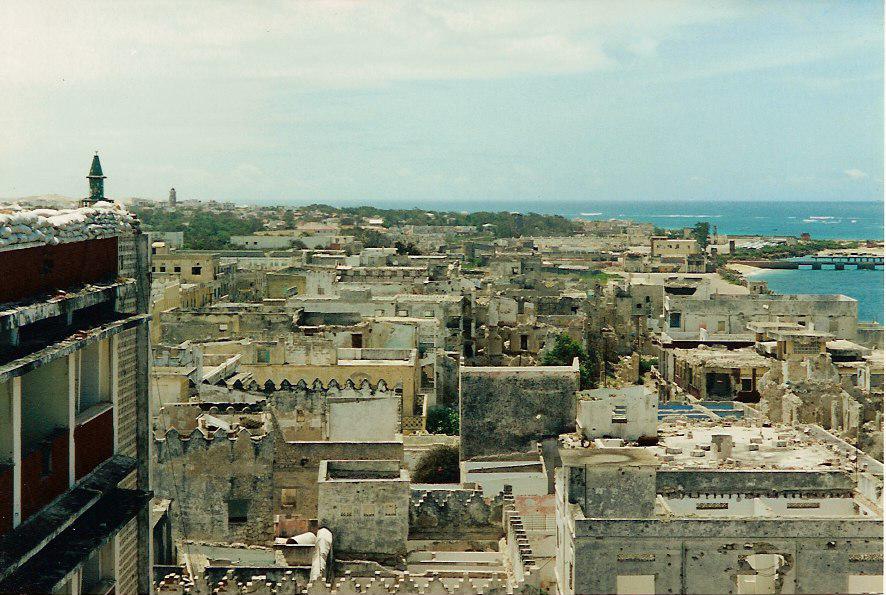
This was followed by independence in 1960, the Somali Democratic Republic era during Siad Barre's presidency (1969–1991). The three-decade long Somali Civil War afterwards devastated the city. In the late 2010s and 2020s, a period of major reconstruction commenced.
Etymology
The origins of the name Mogadishu (Muqdisho) is thought to possibly be derived from a morphology of the Somali words Muuq and Disho, which mean "sight killer" or "blinder", possibly referring to the city's blinding beauty. The 16th century explorer Leo Africanus knew the city as Magadazo (alt. Magadoxo) and described it as a "beautiful, rich place". Another theory is that the name consists of two Somali words, Maqal and Disho, meaning "the place where sheep are slaughtered".

The name used by the locals is Xamar (Hamar), which may refer to the color red. This could be in reference to the reddish environment and hills, meaning a city that was built on red sand. The early neighborhood of Hamar Weyne combines two words, hamar (red) and wein(big). It is also the Somali word for tamarind.
In Abyssinia, the city of Mogadishu and its surrounding area were known as Machidas. A powerful kingdom, with which the Abyssinians were frequently at war, once thrived there. Described as a fine city built at a short distance from the seashore, Machidas was located to the north of Zanguebar and featured a king's palace, several mosques and houses of stone painted in fresco with terraced flat roofs. The name Machidas also appears on maps from the 18th and 19th centuries.
Arabic sources record Mogadishu as Maqdīshū (مَقْدِيشُو). The book An Azanian Trio suggests a link to the Hebrew mqdsh ("holy place"), possibly tied to chronicles of two rabbis in the city's early history.

History
Antiquity
Sarapion
The ancient city of Sarapion is believed to have been the predecessor state of Mogadishu. It is mentioned in the Periplus of the Erythraean Sea, a Greek travel document dating from the first century AD, as one of a series of commercial ports on the Somali littoral. According to the Periplus, maritime trade already connected peoples in the Mogadishu area with other communities along the Indian Ocean.
During ancient times, Mogadishu was part of the Somali city-states that engaged in a lucrative trade network connecting Somali merchants with Phoenicia, Ptolemic Egypt, Greece, Parthian Persia, Sabaeans, Nabataea and the Roman Empire. Somali sailors used the ancient Somali maritime vessel known as the beden to transport their cargo.
Foundation and origins
The founding ethnicity of Mogadishu and its subsequent sultanate has been a topic of intrigue in Somali Studies. Ioan Lewis and Enrico Cerulli believed that the city was founded and ruled by a council of Arab and Persian families. However, the reference I.M. Lewis and Cerulli received traces back to one 19th-century text called the Kitab Al-Zunuj, which has been discredited by modern scholars as unreliable and unhistorical. More importantly, it contradicts ancient oral and written sources, as well as archaeological evidence on the pre-existing civilizations and communities that flourished on the Somali coast, which were the forefathers of Mogadishu and other coastal cities. Thus, the Persian and Arab founding "myths" are regarded as an outdated, false colonialist reflection on Africans' ability to create their own sophisticated states. It has now been widely accepted that there were already communities on the Somali coast with ethnic Somali leadership, of whom the Arab and Persian families had to ask for permission to settle in their cities. It also seems the local Somalis retained their political and numerical superiority on the coast, while the Muslim immigrants would go through an assimilation process by adopting the local language and culture.
Mogadishu, along with Zeila and other Somali coastal cities, was founded upon an indigenous network involving hinterland trade, and that happened even before significant Arab migrations or trade with the Somali coast. That goes back approximately four thousand years and is supported by archaeological and textual evidence.
This is corroborated by the first-century AD Greek document, the Periplus of the Erythraean Sea, detailing multiple prosperous port cities in ancient Somalia, as well as the identification of ancient Sarapion with the city that would later be known as Mogadishu. When Ibn Battuta visited the Sultanate in the 14th century, he identified the Sultan as being of Barbara origin, an ancient term to describe the ancestors of the Somali people. According to Ross E. Dunn, neither Mogadishu nor any other city on the coast could be considered alien enclaves of Arabs or Persians, but were, in fact, African towns.
Yaqut al-Hamawi, a Muslim medieval geographer in the year 1220, describes Mogadishu as the most prominent town on the coast. Yaqut also mentioned Mogadishu as being a town inhabited by Berbers, described as "dark-skinned" and considered ancestors of modern Somalis. By the thirteenth century, Ibn Sa'id described Mogadishu, Merca and Barawa located on the Benadir coast had become Islamic and commercial centers in the Indian Ocean. He said the local people in the Benadir coast and the interior were predominantly inhabited by Somalis, with a minority of Arab, Persian and Indian merchants living in the coastal towns. Ibn al-Mujawir mentions the Banu Majid, who fled the Mundhiriya region in Yemen in the year 1159 and settled in Mogadishu and also traders from the port towns of Abyan and Haram.
Mogadishu is traditionally inhabited by four clans. These are the Moorshe, Iskashato, DhabarWeyne, and the Bandawow. Moorshe is regarded as the oldest group in Mogadishu and is considered to be a sub-clan of Ajuran who established one of the most powerful medieval kingdoms in Africa, the Ajuran Sultanate. The Gibil Madow (Dark Skins) faction of the Benadiri are said to hail from the Somali clan groups from inland which make up the majority of Benadiris with a small minority being Gibil Cads (Light Skins) which descend from Muslim immigrants.
Medieval Period
Mogadishu Sultanate
The Mogadishu Sultanate was a medieval Somali sultanate centered in southern Somalia. It rose as one of the pre-eminent powers in the Horn of Africa under the rule of Fakhr ad-Din before becoming part of the expanding Ajuran Empire in the 13th century. The Mogadishu Sultanate maintained a vast trading network, dominated the regional gold trade, minted its own currency, and left an extensive architectural legacy in present-day southern Somalia. A local city-state with much influence over the hinterland neighbouring coastal towns. Commerce relationships also existed with inland towns such as Harar.
For many years Mogadishu functioned as the pre-eminent city in the بلد البربر (Bilad al Barbar – "Land of the Berbers"), as medieval Arabic-speakers named the Somali coast. Following his visit to the city, the 12th-century Syrian historian Yaqut al-Hamawi (a former slave of Greek origin) wrote a global history of many places he visited Mogadishu and called it the richest and most powerful city in the region and was an Islamic center across the Indian Ocean.

Medieval Mogadishu
During his travels, ibn Sa'id al-Maghribi (1213–1286) noted that Mogadishu city had already become the leading Islamic centre in the region. By the time of the Tangier born traveller ibn Battuta's appearance on the coastline of Somalia in 1331, the city was at the zenith of its prosperity. He described Mogadishu as "an exceedingly large city" with many rich merchants, which was famous for its high quality fabric that it exported to Mamluk Sultanate-ruled Egypt, among other places. He also describes the hospitality of the people of Mogadishu and how locals would put travellers up in their home to help the local economy. Battuta added that the city was ruled by a Somali sultan, Abu Bakr ibn Shaikh 'Umar, He noted that Sultan Abu Bakr had dark skin complexion and spoke in his native tongue (Somali) but was also fluent in Arabic. The Sultan also had a retinue of viziers, legal experts, commanders, royal eunuchs, and other officials at his beck and call. Ibn Khaldun (1332 to 1406) noted in his book that Mogadishu was a massive metropolis. He also claimed that the city was very populous with many wealthy merchants.
This period gave birth to notable figures like Abd al-Aziz of Mogadishu who was described as the governor and island chief of Maldives by ibn Battuta. After him is named the Abdul-Aziz Mosque of Mogadishu, which survived for centuries.
The island's appellation "Madagascar" is not of local origin but rather was popularized in the Middle Ages by Europeans. The name Madageiscar was first recorded in the memoirs of 13th-century Venetian explorer Marco Polo as a corrupted transliteration of the name Mogadishu, the famous port with which Polo had confused the island.
Vasco da Gama, who passed by Mogadishu in the 15th century, noted that it was a large city with houses of four or five stories high and large palaces in its centre and many mosques with cylindrical minarets. In the 16th century, Duarte Barbosa noted that many ships from the Kingdom of Cambaya sailed to Mogadishu with cloths and spices for which they in return received gold, wax and ivory. Barbosa also highlighted the abundance of meat, wheat, barley, horses, and fruit on the coastal markets, which generated enormous wealth for the merchants. Mogadishu, the center of a thriving weaving industry known as toob benadir (specialized for the markets in Egypt and Syria), together with Merca and Barawa also served as transit stops for Swahili merchants from Mombasa and Malindi and for the gold trade from Kilwa. Jewish merchants from Ormus also brought their Indian textile and fruit to the Somali coast in exchange for grain and wood.
Duarte Barbosa, the famous Portuguese traveller, wrote about Mogadishu (c 1517–1518):It has a king over it, and is a place of great trade in merchandise. Ships come there from the kingdom of Cambay (India) and from Aden with stuffs of all kinds, and with spices. And they carry away from there much gold, ivory, beeswax, and other things upon which they make a profit. In this town there is plenty of meat, wheat, barley, and horses, and much fruit: it is a very rich place.
In 1542, the Portuguese commander João de Sepúvelda led a small fleet on an expedition to the Somali coast. During this expedition, he briefly attacked Mogadishu, capturing an Ottoman ship and firing upon the city, which compelled the sultan of Mogadishu to sign a peace treaty with the Portuguese.
According to the 16th-century explorer, Leo Africanus indicates that the native inhabitants of the Mogadishu polity were of the same origins as the denizens of the northern people of Zeila region. They were generally tall with an olive skin complexion, some darker. They would wear traditional rich white silk wrapped around their bodies and have Islamic turbans, and coastal people only wore sarongs and wrote in Arabic as a lingua franca. Their weaponry consisted of traditional Somali weapons such as swords, daggers, spears, battle axe, and bow and arrows. However, they received assistance from its close ally, the Ottoman Empire, and with the import of firearms such as muskets and cannons. Most were Muslims, although a few adhered to pre-Islamic beliefs; there were also some Orthodox Tewahedo Christians further inland. Mogadishu itself was a wealthy, and well-built city-state, which maintained commercial trade with kingdoms across the world. The metropolis city was surrounded by walled stone fortifications.
The Ajuran Sultanate collapsed in the 17th century due to heavy taxation against their subjects, which started a rebellion. The ex-subjects became a new wave of Somali migrants, the Abgaal, moved both into the Shebelle River basin and Mogadishu. A new political elite led by Abgaal Yaquub imams, with ties to the new leaders in the interior, moved into the Shangani District of the city. Remnants of the Ajuran lived in the other key-quarters of Hamar Weyne District. Ajuran merchants began to look for new linkages and regional trade opportunities since the Abgaal had commandeered the existing trading networks.
Early Modern period (1700s–1900s)
Hiraab Imamate
By the 17th century, the Hiraab Imamate was a powerful kingdom that ruled large parts of southern and central Somalia. It successfully revolted against the Ajuran Sultanate and established an independent rule for at least two centuries from the seventeen hundreds and onwards. The Hiraab Imamate also exerted a centralized authority during its existence and possessed some of the organs and trappings of a traditional integrated state: a functioning bureaucracy, a state flag, regular correspondence with neighbouring civilizations in written Arabic, taxation in the form of livestock and cash crops including a third of the Mogadishu emporium port's revenue as well as a professional army.
By the late 19th century, the Imamate began to decline due to internal problems, the Imamate also faced challenges from Imperialist kingdoms, the Zanzibari Sultan from the coast and Geledi Sultanate, and Hobyo Sultanate from the interior from both directions.
Geledi Sultanate
The Sultanate of Geledi and the Omani Empire vied over who would be the superior power on the Benadir Coast, with Sultan Yusuf Mahamud ultimately being the dominant force with the Omanis having a nominal presence and Said bin Sultan even paying tribute to him to keep Omani representatives in Mogadishu. Mogadishu under Abgaal control had been in a period of decline and disarray near the end of the Hiraab Imamate. Following a struggle between the two leading figures of each respective quarter (Shingani and Hamarweyn) Sultan Yusuf marched into the city with an 8,000 strong army and ruled in favour of the Shingani leader, with the loser fleeing the city. Yusuf would nominate a relative of the deposed chief to lead the Hamarweyn quarter ending the dispute. Sultan Yusuf is even referred to as the governor of Mogadishu in some sources, highlighting the power he exerted over the city.
Despite the Somali political decline, trade with Geledi Sultanate flourished during Geledi Sultan Ahmed Yusuf's reign. British explorer John Kirk visited the region in 1873 and noted a variety of things. Roughly 20 large dhows were docked in both Mogadishu and Merka filled with grain produced from the farms of the Geledi in the interior. Kirk met the Imam Mahmood who reigned over Mogadishu. The Shebelle River itself was referred to as the 'Geledi river' by Kirk, perhaps in respect of the volume of produce that the Sultanate output. In Barawa there was little grain instead a large quantity of ivory and skins which had already been loaded onto ships destined for Zanzibar.
The Geledi Sultans were at the height of their power. They dominated the East African ivory trade, and also held sway over the Jubba and Shebelle valleys in the hinterland. The Omani Sultans' authority in Mogadishu, however, was largely nominal (existing by name only). When Imam Azzan bin Qais of Oman sought to build a fort in the city, he was thus obligated to request permission from Sultan Ahmed Yusuf the real power broker who in turn convinced the Hiraab Imam to acquiesce to the decision. Omani and later Zanzibari officials were mere representatives of the Sultan to collect customs and needed the fort for their own security rather than control of the city. The Fort of Garessa was eventually constructed in 1870. The Sultan of Zanzibar later leased and then sold the infrastructure that he had built to the Italians, but not the land itself, which was Somali owned. In the late 1800s, the Khedivate of Egypt temporarily occupied Mogadishu without facing any local opposition. However, due to logistical challenges and the deployment of warships by Britain, they were forced to retreat.
Italian Somaliland (late 1800s–1960)
In 1905, Italy made Mogadishu the capital of the newly established Italian Somaliland. The Italians subsequently spelled the name of the city as Mogadiscio. After World War I, the surrounding territory came under Italian control with some resistance.
Thousands of Italians and other people from the Italian empire began to settle in Mogadishu and founded small manufacturing companies across Somalia. They also developed some agricultural areas in the south near the capital, such as Janale and the Villaggio duca degli Abruzzi (present-day Jowhar). In the 1930s, new buildings and avenues were built. A 114 km (71 mi) narrow-gauge railway was laid from Mogadishu to Jowhar. An asphalt road, the Strada Imperiale, was also constructed and intended to link Mogadishu to Addis Ababa.
In 1940, the Italo-Somali population numbered 22,000, accounting for over 44% of the city's population of 50,000 residents. Mogadishu remained the capital of Italian Somaliland throughout the latter polity's existence. In World War II it was captured by British forces in February 1941.
After World War II Mogadishu was made the capital of the Trust Territory of Somaliland, an Italian administered fiduciary political entity under the UN mandate, for ten years (1950–1960).
Somali Republic (1960–1991)
British Somaliland became independent on 26 June 1960 as the State of Somaliland, and the Trust Territory of Somalia (the former Italian Somaliland) followed suit five days later. On 1 July 1960, the two territories united to form the Somali Republic, with Mogadishu serving as the nation's capital. A government was formed by Abdullahi Issa and other members of the trusteeship and protectorate governments, with Haji Bashir Ismail Yusuf as President of the Somali National Assembly, Aden Abdullah Osman Daar as President of the Somali Republic, and Abdirashid Ali Shermarke as Prime Minister (later to become president from 1967 to 1969). On 20 July 1961 and through a popular referendum, the people of Somalia ratified a new constitution, which was first drafted in 1960. In 1967, Muhammad Haji Ibrahim Egal became Prime Minister, a position to which he was appointed by Shermarke.
On 15 October 1969, while paying a visit to the northern town of Las Anod, Somalia's then President Abdirashid Ali Shermarke was assassinated by one of his own bodyguards. His assassination was quickly followed by a military coup d'état on 21 October 1969 (the day after his funeral), in which the Somali Army seized power without encountering armed opposition, essentially a bloodless takeover. The putsch was spearheaded by Major General Mohamed Siad Barre, who at the time commanded the army.
Alongside Barre, the Supreme Revolutionary Council (SRC) that assumed power after President Sharmarke's assassination was led by Lieutenant Colonel Salaad Gabeyre Kediye and Chief of Police Jama Ali Korshel. Kediye officially held the title of "Father of the Revolution," and Barre shortly afterwards became the head of the SRC. The SRC subsequently renamed the country the Somali Democratic Republic, arrested members of the former civilian government, banned political parties, dissolved the parliament and the Supreme Court, and suspended the constitution.
The revolutionary army established large-scale public works programmes, including the Mogadishu Stadium. In addition to a nationalization programme of industry and land, the Mogadishu-based new regime's foreign policy placed an emphasis on Somalia's traditional and religious links with the Arab world, eventually joining the Arab League in 1974.
After fallout from the unsuccessful Ogaden campaign of the late 1970s, the Barre administration began arresting government and military officials under suspicion of participation in the 1978 coup d'état attempt. Most of the people who had allegedly helped plot the putsch were summarily executed. However, several officials escaped abroad and started to form dissident groups dedicated to ousting Barre's regime by force.
Civil war
By the late 1980s, Barre's regime had become increasingly unpopular. The authorities became ever more totalitarian, and resistance movements, encouraged by Ethiopia's communist Derg administration, sprang up across the country. Mogadishu saw its first major outbreak of violence during the 14 July 1989 riots, during the crackdown Barres forces killed approximately 400 civilians. The July 1989 riots resulted in a large exodus of foreigners from the city and intensification of opposition towards the regime. This incident and other events over the following months led to the toppling of Barre's government, and the final splintering and disappearance of the Somali Armed Forces. Many of the opposition groups began competing for influence in the power vacuum that followed the ouster of Barre's regime. Armed factions led by United Somali Congress commanders General Mohamed Farah Aidid and Ali Mahdi Mohamed, in particular, clashed as each sought to exert authority over the capital.
During the United Nations Operation in Somalia II several gun battles took place in Mogadishu between Somali factions, volunteers and peacekeepers. Among these was the Battle of Mogadishu of 1993, a US apprehension of two high-ranking lieutenants of the Somali National Alliance. The UN soldiers withdrew altogether from the country on 3 March 1995, having incurred more significant casualties.
In 2006, the Islamic Courts Union (ICU), an Islamist organization, assumed control of much of the southern part of the country and imposed sharia law. The new Transitional Federal Government (TFG), established two years earlier, sought to establish its authority. With the assistance of Ethiopian troops, AMISOM peacekeepers and air support by the United States, it drove out the rival ICU and solidified its rule. On 8 January 2007, as the Battle of Ras Kamboni raged, TFG President and founder Abdullahi Yusuf Ahmed, a former colonel in the Somali Army, entered Mogadishu for the first time since being elected to office. The government then relocated to Villa Somalia in Mogadishu from its interim location in Baidoa, marking the first time since the fall of the Barre regime in 1991 that the federal government controlled most of the country.
Following this defeat, the Islamic Courts Union splintered into factions. Some of the more radical elements, including a youth militia within the Courts' military wing known as al-Shabaab, regrouped to continue their insurgency against the TFG and oppose the Ethiopian military's presence in Somalia. Throughout 2007 and 2008 al-Shabaab scored military victories by seizing control of key towns and ports in both central and southern Somalia. At the end of 2008, the group had captured Baidoa but not Mogadishu. By January 2009, al-Shabaab and other militias had managed to force the Ethiopian troops to retreat and leave behind an under-equipped African Union peacekeeping force to assist the Transitional Federal Government's troops.
Between 31 May and 9 June 2008, representatives of Somalia's federal government and the moderate Alliance for the Re-liberation of Somalia (ARS) group of Islamist rebels participated in peace talks in Djibouti brokered by the UN. The conference ended with a signed agreement calling for the withdrawal of Ethiopian troops in exchange for the cessation of armed conflict. Parliament was subsequently expanded to 550 seats to accommodate ARS members, which then elected a new president. With the help of a small team of African Union troops, the coalition government also began a counteroffensive in February 2009 to retake control of the southern half of the country. To solidify its control of southern Somalia, the TFG formed an alliance with the Islamic Courts Union, other members of the Alliance for the Re-liberation of Somalia, and Ahlu Sunna Waljama'a, a moderate Sufi militia.
In November 2010, a new technocratic government was elected to office, which enacted numerous reforms, especially in the security sector. By August 2011, the new administration and its AMISOM allies had managed to capture all of Mogadishu from the Al-Shabaab militants. Mogadishu has subsequently experienced a period of intense reconstruction spearheaded by the Somali diaspora, the municipal authorities, and Turkey, a historic ally of Somalia.