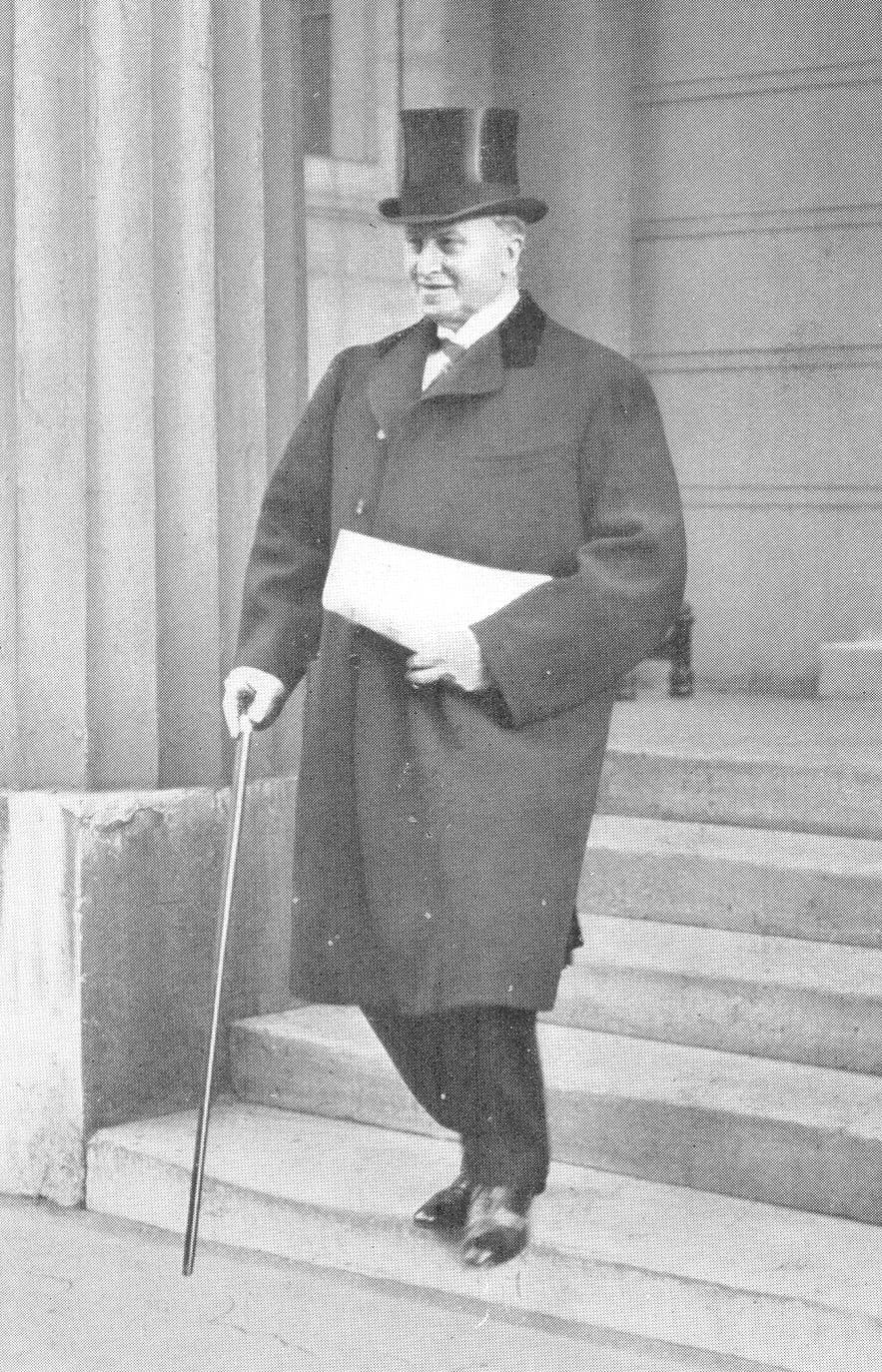
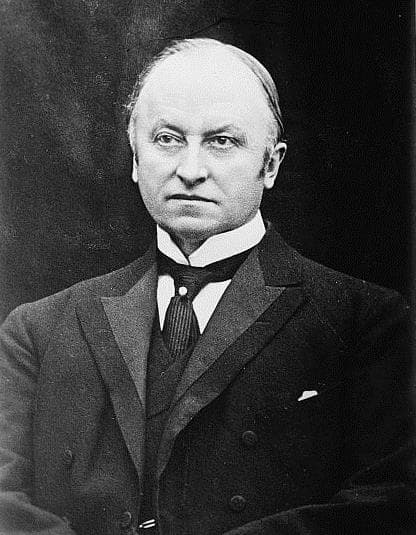
George Nathaniel Curzon, 1st Marquess Curzon of Kedleston (11 January 1859 – 20 March 1925), known as Lord Curzon (), was a British statesman, Conservative politician, explorer and writer who served as Viceroy of India from 1899 to 1905 and Foreign Secretary from 1919 to 1924.
Curzon was born in Derbyshire into an aristocratic family and educated at Eton College and Balliol College, Oxford, before entering Parliament in 1885. In the following years, he travelled extensively in Russia, Central Asia and the Far East, and published several books on the region in which he detailed his geopolitical outlook and underlined the perceived Russian threat to British control of India. In 1891, Curzon was named Under-Secretary of State for India, and in 1899 he was appointed Viceroy of India. During his tenure, he pursued a number of reforms of the British administration, attempted to address the British maltreatment of Indians, undertook the restoration of the Taj Mahal, and sent a British expedition to Tibet to counter Russian ambitions. In 1905, he presided over the partition of Bengal and came into conflict with Lord Kitchener over issues of military organisation. Unable to secure the backing of the government in London, he resigned later that year and returned to England.
In 1907, Curzon became Chancellor of Oxford University, and the following year he was elected to the House of Lords as an Irish representative peer. During the First World War, he served in H. H. Asquith's coalition cabinet as Lord Privy Seal, and from late 1916 he was Leader of the House of Lords and served in the war cabinet of Prime Minister David Lloyd George and the War Policy Committee. He was appointed Secretary of State for Foreign Affairs in October 1919 and lent his name to Britain's proposed Soviet-Polish boundary, the Curzon Line. He also oversaw the division of the British Mandate of Palestine and the creation of the Emirate of Transjordan, and was the chief Allied negotiator of the 1922 Treaty of Lausanne which defined the borders of modern Turkey. In 1921, he was created a marquess. On Bonar Law's retirement as prime minister in 1923, Curzon was a contender for the office but was passed over in favour of Stanley Baldwin. He remained as foreign secretary until 1924 when the Baldwin government fell, and died a year later at the age of 66.
Reading level
Audio Summary
Played with your browser's voice. Studio-quality audio can be added with a text-to-speech service.
Ask about this article
📝 Quick Quiz1 / 4
What is "George Curzon, 1st Marquess Curzon of Kedleston" primarily known for?
Vocix Daily — In Your Inbox
Top stories, deep-dive articles, and "On This Day" history — one crisp digest delivered every morning.
Sources & references
Reference material for this entry is drawn from the open encyclopedic record, including Wikipedia , available under the CC BY-SA 4.0 license. Images are credited individually beside each photo.
Curzon was the eldest son and the second of the eleven children of Alfred Curzon, 4th Baron Scarsdale (1831–1916), who was the rector of Kedleston in Derbyshire. George's mother was Blanche (1837–1875), the daughter of Joseph Pocklington-Senhouse of Netherhall in Cumberland. He was born at Kedleston Hall, built on the site where his family, who were clergymen and priests, had lived since the 12th century. His mother, exhausted by childbirth, died when George was 16; her husband survived her by 41 years. Neither parent exerted a major influence on Curzon's life. Scarsdale was an austere and unindulgent father who believed that landowners should stay on their land and not indefinitely tour the world for pleasure. He disapproved of the journeys across Asia between 1887 and 1895 which made his son one of the most travelled men to be a member of any British cabinet. An influential presence in Curzon's childhood was that of his brutal, sadistic governess, Ellen Mary Paraman, whose tyranny in the nursery stimulated his combative qualities and encouraged the obsessional side of his nature. Paraman used to beat him and periodically forced him to parade through the village wearing a conical hat bearing the words liar, sneak, and coward. Curzon later noted, "No children well born and well-placed ever cried so much and so justly."
He was educated at Wixenford School, Eton College, and Balliol College, Oxford. His over-intimate relationship at Eton College with Oscar Browning led to the latter's dismissal. A spinal injury incurred while riding during his adolescence was a lifelong impediment to Curzon that required him to wear a metal corset for the remainder of his life.
Curzon was President of the Union and Secretary of the Oxford Canning Club (a Tory political club named after George Canning), but as a consequence of the extent of his time-expenditure on political and social societies, he failed to achieve a first class degree in Greats, although he subsequently won both the Lothian Prize Essay and the Arnold Prize, the latter for an essay on Sir Thomas More, about whom he knew little. In 1883, Curzon received the most prestigious fellowship at the university, a Prize Fellowship at All Souls College. While at Eton and at Oxford, Curzon was a contemporary and close friend of Cecil Spring Rice and Edward Grey. Spring Rice contributed, alongside John William Mackail, to the composition of a famous sardonic doggerel about Curzon that was published as part of The Balliol Masque, about which Curzon wrote in later life "never has more harm been done to one single individual than that accursed doggerel has done to me." It read:
When Spring Rice was assigned to the British Embassy to the United States in 1894–1895, he was suspected by Curzon of trying to prevent Curzon's engagement to the American Mary Leiter, whom Curzon nevertheless married. Spring Rice assumed for a certainty, like many of Curzon's other friends, that Curzon would inevitably become Foreign Secretary: he wrote to Curzon in 1891, 'When you are Secretary of State for Foreign Affairs I hope you will restore the vanished glory of England, lead the European concert, decide the fate of nations, and give me three months' leave instead of two'.
Old texts state that he spent few months in a cottage in Dehradun, India. Though exact records are not available there is a road named after him there (probably near his erstwhile cottage).
Early political career
In his youth, Curzon regularly attended debates at the House of Commons. Curzon became Assistant Private Secretary to the Marquess of Salisbury in 1885, and in 1886 entered Parliament as Member for Southport in south-west Lancashire. His maiden speech, which was chiefly an attack on home rule and Irish nationalism, was regarded in much the same way as his oratory at the Oxford Union: brilliant and eloquent but also presumptuous and rather too self-assured. The press reaction was mainly favourable. The Times called it 'brilliant' while other newspapers described it as 'capital' and a 'decided success', and the St James' Gazette deemed it 'very successful' though 'unnecessarily flippant in tone'. Subsequent performances in the Commons, often dealing with Ireland or reform of the House of Lords (which he supported), received similar verdicts. He was Under-Secretary of State for India in 1891–1892 and Under-Secretary of State for Foreign Affairs in 1895–1898.
In the meantime Curzon had travelled around the world: Russia and Central Asia (1888–1889); Persia (September 1889 – January 1890); Siam, French Indochina, China, Korea and Japan (1892); and a daring foray into Afghanistan and the Pamirs (1894–1895). He published several books describing central and eastern Asia and related foreign policy issues. A bold and compulsive traveller, driven by orientalism, he was awarded the Patron's Medal of the Royal Geographical Society for his exploration of the source of the Amu Darya (Oxus). His journeys allowed him to study the problems of Asia and their implications for British India, while reinforcing his pride in his nation and her imperial mission.
Curzon believed Russia to be the most likely threat to British India, Britain's most valuable possession, from the 19th century through the early 20th century. In 1879 Russia had begun construction of the Transcaspian Railway along the Silk Road, officially solely to enforce local control. The line starts from the city of Kyzyl-Su, formerly Krasnovodsk (nowadays Turkmenbashi) (on the Caspian Sea), travels southeast along the Karakum Desert, through Ashgabat, continues along the Kopet Dagh Mountains until it reaches Tejen. Curzon dedicated an entire chapter in his book Russia in Central Asia to discussing the perceived threat to British control of India. This railway connected Russia with the most wealthy and influential cities in Central Asia at the time, including the Persian Khorasan Province, and would allow the rapid deployment of Russian supplies and troops into the area. Curzon also believed that the resulting greater economic interdependence between Russia and Central Asia would be damaging to British interests.
Persia and the Persian Question, written in 1892, has been considered Curzon's magnum opus and can be seen as a sequel to Russia in Central Asia. Curzon was commissioned by The Times to write several articles on the Persian political environment, but while there he decided to write a book on the country as whole. This two-volume work covers Persia's history and governmental structure, as well as graphics, maps and pictures (some taken by Curzon himself). Curzon was aided by General Albert Houtum-Schindler and the Royal Geographical Society (RGS), both of which helped him gain access to material to which as a foreigner he would not have been entitled to have access. General Schindler provided Curzon with information regarding Persia's geography and resources, as well as serving as an unofficial editor.
Curzon was appalled by his government's apathy towards Persia as a valuable defensive buffer to India from Russian encroachment. Years later Curzon would lament that "Persia has alternatively advanced and receded in the estimation of British statesmen, occupying now a position of extravagant prominence, anon one of unmerited obscurity."
First marriage (1895–1906)
On 22 April 1895, Curzon married Mary Victoria Leiter, the eldest daughter and co-heiress of Levi Leiter, an American millionaire of Swiss descent, who co-founded the Chicago department store Field & Leiter (later Marshall Field). While he married Mary for her wealth so he could save his estate, he later developed feelings for her. Mary had a long and nearly fatal illness near the end of summer 1904, from which she never really recovered. Falling ill again in July 1906, she died on the 18th of that month in her husband's arms, at the age of 36. It was the greatest personal loss of his life.
She was buried in the church at Kedleston, where Curzon designed his memorial for her, a Gothic chapel added to the north side of the nave. Although he was neither a devout nor a conventional churchman, Curzon retained a simple religious faith; in later years he sometimes said that he was not afraid of death because it would enable him to join Mary in heaven.
They had three daughters during a firm and happy marriage: Mary Irene (known as Irene), who inherited her father's Barony of Ravensdale and was created a life peer in her own right; Cynthia Blanche, who became the first wife of the fascist politician Sir Oswald Mosley; and Alexandra Naldera ("Baba"), Curzon's youngest daughter; she married Edward "Fruity" Metcalfe, the best friend, best man and equerry of Edward VIII. Mosley exercised a strange fascination for the Curzon women: Irene had a brief romance with him before either were married; Baba became his mistress; and Curzon's second wife, Grace, had a long affair with him.
Viceroy of India (1899–1905)
Curzon, in 1901, had famously said, "As long as we rule India we are the greatest power in the world. If we lose it, we shall drop straightaway to a third-rate power."
In January 1899 Curzon was appointed as Viceroy of India. He was created a baron in the peerage of Ireland as Baron Curzon of Kedleston, in the County of Derby, on his appointment. (The title was "Curzon of Kedleston" rather than simply "Curzon" because his kinsmen the Earls Howe were already Viscounts and Barons Curzon.) As Viceroy, he was ex officio Grand Master of the Order of the Indian Empire and Order of the Star of India. This peerage was created in the Peerage of Ireland (the last so created) so that he would be free, until his father's death, to re-enter the House of Commons on his return to Britain.
Reaching India shortly after the suppression of the frontier risings of 1897–98, he paid special attention to the independent tribes of the north-west frontier, inaugurated a new province called the North West Frontier Province, and pursued a policy of forceful control mingled with conciliation. In response to what he called "a number of murderous attacks upon Englishmen and Europeans", Curzon advocated at the Quetta Durbar extremely draconian punishments which he believed would stop what he viewed as such especially abominable crimes. In his own private correspondence, Curzon pondered "Is it possible, under the law, to flog these horrible scoundrels before we execute them? Supposing we remove them for execution to another and distant jail, could we flog them in the first jail before removal? I believe that if we could postpone the execution for a few weeks and give the criminal a few good public floggings – or even one, were more not possible – it would act as a real deterrent. But I have a suspicion that British law does not smile upon anything so eminently practical." The only major armed outbreak on this frontier during the period of his administration was the Mahsud-Waziri campaign of 1901.
In the context of the Great Game between the British and Russian Empires for control of Central Asia, he held deep mistrust of Russian intentions. This led him to encourage British trade in Persia, and he paid a visit to the Persian Gulf in 1903. Curzon argued for an exclusive British presence in the Gulf, a policy originally proposed by John Malcolm. The British government was already making agreements with local sheiks/tribal leaders along the Persian Gulf coast to this end. Curzon had convinced his government to establish Britain as the unofficial protector of Kuwait with the Anglo-Kuwaiti Agreement of 1899. The Lansdowne Declaration in 1903 stated that the British would counter any other European power's attempt to establish a military presence in the Gulf. Only four years later this position was abandoned and the Persian Gulf was declared a neutral zone in the Anglo-Russian Convention of 1907, prompted in part by the high economic cost of defending India from Russian advances.
Trucial States
That neutral status did not extend to the Trucial States, which were bound to Britain under a number of treaties signed since the General Maritime Treaty of 1820, including the Exclusive Agreement of 1892, which bound the Trucial Sheikhs 'not to enter into any agreement or correspondence with any Power other than the British Government'. On 21 November 1903, Curzon held a Darbar in Sharjah (today one of the United Arab Emirates) and addressed the Sheikhs of the Trucial Coast assembled on the Argonaut, moored some five miles offshore of Sharjah because of the shallow waters nearer land.
In his address to them, Curzon made it clear they should consider themselves blessed by the Pax Brittanica: they were to be appreciative of the peace the British had brought. The 'pacificated Arabs' were to consider that 'the influence of the British government must remain supreme' and abide by their treaty obligations by sea and on land. Three years later, in 1906, the Sheikhs were all presented with a bound collection of the treaties their predecessors had entered into with the British, as a reminder of the obligations they were considered to have inherited. Printed in both Arabic and English, the collection was introduced by a transcribed copy of Curzon's 1903 Durbar address.
Indian reform
At the end of 1903, Curzon sent a British expedition to Tibet under Francis Younghusband, ostensibly to forestall a Russian advance. After bloody conflicts with Tibet's poorly armed defenders, the mission penetrated to Lhasa, where the Treaty of Lhasa was signed in September 1904.
During his tenure, Curzon undertook the restoration of the Taj Mahal and expressed satisfaction that he had done so. Curzon was influenced by Hindu philosophy and quoted:
India has left a deeper mark upon the history the philosophy and the religion of mankind than any other terrestrial unit in the universe.
Within India, Curzon appointed a number of commissions to inquire into education, irrigation, police and other branches of administration, on whose reports legislation was based during his second term of office as viceroy. Reappointed Governor-General in August 1904, he presided over the 1905 partition of Bengal.
In 'Lion and the Tiger : The Rise and Fall of the British Raj, 1600–1947', Denis Judd wrote: "Curzon had hoped… to bind India permanently to the Raj. Ironically, his partition of Bengal, and the bitter controversy that followed, did much to revitalize Congress. Curzon, typically, had dismissed the Congress in 1900 as 'tottering to its fall'. But he left India with Congress more active and effective than at any time in its history." Curzon was determined to address the British maltreatment of Indians. In particular, he incurred the displeasure of many in the European community in India by pressing for severe punishment for Europeans who had attacked Indians. On two occasions, he imposed collective punishment on British Army units which had attacked Indians: when soldiers of the West Kent Regiment raped a Burmese woman, he had the whole regiment exiled to Aden without leave. He later imposed similar punishment on the 9th Queen's Royal Lancers for the murder of an Indian cook.
Mahatma Gandhi lauded Curzon as the first viceroy to express sympathy for indentured Indian labourers and question why the system should continue. Curzon was especially concerned with the treatment of Indian emigrants to the Transvaal and Natal. After learning about the realities of labour conditions for indentured Indians, he deemed it impossible to defend the system in its current state, and committed to a stance of reform. In 1900, Curzon wrote an appeal to the Permanent Under-Secretary for India calling for indentured labourers to be treated better given their contribution to colonial defences, although this did not prompt immediate change. On 14 May 1903, he wrote a lengthy despatch to the India Office demanding full discretion to withdraw from the system of indentured labour if they would not concede to the proper treatment of Indian workers. He continued to champion this cause throughout his time as viceroy.
Curzon proposed the Partition of Bengal and put it into effect on 16 October 1905 creating the new province of Eastern Bengal and Assam. Behind this incident, his excuse was that the area of Bengal was too large and it was difficult for the British to administer efficiently but actually his intention was to divide Bengalis into religious and territorial grounds to weaken the growing nationalism in Bengal. He said, "Partition of Bengal is a settled fact and what is settled cannot be unsettled." Huge protest (Swadeshi movement) was seen from every corner of Bengal and on 1911 this so-called "settled fact" became "unsettled" by Lord Hardinge. It was done in response to the Swadeshi movement's riots in protest against the policy but the partition animated the Muslims to form their own national organization along communal lines.
Indian Army
Curzon took an active interest in military matters and in 1901 he founded the Imperial Cadet Corps, or ICC. The ICC was a corps d'elite, designed to give Indian princes and aristocrats military training, after which a few would be given officer commissions in the Indian Army but these commissions were "special commissions" which did not empower their holders to command any troops. Predictably, this was a major stumbling block to the ICC's success, as it caused much resentment among former cadets. Though the ICC closed in 1914, it was a crucial stage in the drive to Indianise the Indian Army's officer corps, which was haltingly begun in 1917.
Military organisation proved to be the final issue faced by Curzon in India. It often involved petty issues that had much to do with clashes of personality: Curzon once wrote on a document "I rise from the perusal of these papers filled with the sense of the ineptitude of my military advisers", and once wrote to the Commander-in-Chief, India, Herbert Kitchener, 1st Earl Kitchener, advising him that signing himself "Kitchener of Khartoum" took up too much time and space, which Kitchener thought petty (Curzon simply signed himself "Curzon" as if he were a hereditary peer, although he later took to signing himself "Curzon of Kedleston"). A difference of opinion with Kitchener regarding the status of the military member of the Viceroy's Executive Council (who controlled army supply and logistics, which Kitchener wanted under his own control), led to a controversy in which Curzon failed to obtain the support of the home government. He resigned in August 1905 and returned to England.
Indian famine
A major famine coincided with Curzon's time as viceroy in which 1 to 4.5 million people died. Curzon implemented a variety of measures, including opening up famine relief works that fed between 3 and 5 million, reducing taxes and spending vast amounts of money on irrigation works. In Late Victorian Holocausts, the historian Mike Davis criticised Curzon for cutting back rations and raising relief eligibility. At the time, Curzon stated that "any government which imperiled the financial position of India in the interests of prodigal philanthropy would be open to serious criticism; but any government which by indiscriminate alms-giving weakened the fibre and demoralized the self-reliance of the population, would be guilty of a public crime."
Return to Britain
Arthur Balfour's refusal to recommend an earldom for Curzon in 1905 was repeated by Sir Henry Campbell-Bannerman, the Liberal prime minister, who formed his government the day after Curzon returned to England. In deference to the wishes of the King and the advice of his doctors, Curzon did not stand in the general election of 1906 and thus found himself excluded from public life for the first time in twenty years. It was at this time, the nadir of his career, that Mary died.
After the death of Lord Goschen in 1907, the post of Chancellor of Oxford University fell vacant. Curzon was elected as Chancellor of Oxford after by 1,001 votes to 440 against Lord Rosebery. He proved to be an active chancellor – "[he] threw himself so energetically into the cause of university reform that critics complained he was ruling Oxford like an Indian province."
House of Lords
In 1908, Curzon was elected an Irish representative peer, and thus relinquished any idea of returning to the House of Commons. In 1909–1910 he took an active part in opposing the Liberal government's proposal to abolish the legislative veto of the House of Lords, and in 1911 was created Baron Ravensdale, of Ravensdale in the County of Derby, with remainder (in default of heirs male) to his daughters, Viscount Scarsdale, of Scarsdale in the County of Derby, with remainder (in default of heirs male) to the heirs male of his father, and Earl Curzon of Kedleston, in the County of Derby, with the normal remainder, all in the Peerage of the United Kingdom.
He became involved with saving Tattershall Castle, Lincolnshire, from destruction. This experience strengthened his resolve for heritage protection. He was one of the sponsors of the Ancient Monuments Consolidation and Amendment Act 1913. He served as President of the Committee commissioning the Survey of London which documented the capital's principal buildings and public art.
On 5 May 1914, he spoke out against a bill in the House of Lords that would have permitted women who already had the right to vote in local elections the right to vote for members of Parliament.
First World War
Curzon joined the Cabinet, as Lord Privy Seal, when Asquith formed his coalition in May 1915. Like other politicians (e.g. Austen Chamberlain, Arthur Balfour) Curzon favoured British Empire efforts in Mesopotamia, believing that the increase in British prestige would discourage a German-inspired Muslim revolt in India. Curzon was a member of the Dardanelles Committee and told that body (October 1915) that the recent Salonika expedition was "quixotic chivalry". Early in 1916 Curzon visited Sir Douglas Haig (newly appointed Commander-in-Chief of British forces in France) at his headquarters in France. Haig was impressed by Curzon's brains and decisiveness, and considered that he had mellowed since his days as viceroy (Major-General Haig had been Inspector-General of Cavalry, India, at the time) and had lost "his old pompous ways". Curzon served in Lloyd George's small War cabinet as Leader of the House of Lords from December 1916, and he also served on the War Policy Committee. With Allied victory over Germany far from certain, Curzon wrote a paper (12 May 1917) for the War Cabinet urging that Britain seize Palestine and possibly Syria. Like other members of the War Cabinet, Curzon supported further Western Front offensives lest, with Russian commitment to the war wavering, France and Italy be tempted to make a separate peace.
At the War Policy Committee (3 October 1917) Curzon objected in vain to plans to redeploy two divisions to Palestine, with a view to advancing into Syria and knocking the Ottoman Empire out of the war altogether. Curzon's commitment wavered somewhat as the losses of the Third Battle of Ypres mounted. In the summer of 1917 the Chief of the Imperial General Staff (CIGS) General William Robertson sent Haig a biting description of the members of the War Cabinet, who he said were all frightened of Lloyd George; he described Curzon as "a gasbag". During the crisis of February 1918, Curzon was one of the few members of the government to support Robertson, threatening in vain to resign if he were removed. Despite his opposition to women's suffrage (he had been co-president of the National League for Opposing Woman Suffrage), the House of Lords voted conclusively in its favour.
Second marriage (1917)
After a long affair with the romantic novelist Elinor Glyn, Curzon married the former Grace Elvina Hinds in January 1917. She was the wealthy Alabama-born widow of Alfredo Huberto Duggan (died 1915), a first-generation Irish Argentinian appointed to the Argentine Legation in London in 1905. Elinor Glyn was staying with Curzon at the time of the engagement and read about it in the morning newspapers.
Grace had three children from her first marriage, two sons, Alfred and Hubert, and a daughter, Grace Lucille. Alfred and Hubert, as Curzon's step-sons, grew up within his influential circle. Curzon had three daughters from his first marriage, but he and Grace (despite fertility-related operations and several miscarriages) did not have any children together, which put a strain on their marriage. Letters written between them in the early 1920s imply that they still lived together, and remained devoted to each other. In 1923, Curzon was passed over for the office of Prime Minister partly on the advice of Arthur Balfour, who joked that Curzon "has lost the hope of glory but he still possesses the means of Grace" (a humorous allusion to the well known "General Thanksgiving" prayer of the Church of England, which thanks God for "the means of grace, and for the hope of glory").
In 1917, Curzon bought Bodiam Castle in East Sussex, a 14th-century building that had been gutted during the English Civil War. He restored it extensively, and then bequeathed it to the National Trust. From 1915 he also rented Montacute House as a residence for himself and Elinor Glyn.
Foreign Secretary (1919–1924)
Relations with Lloyd George
Curzon did not have David Lloyd George's support. Curzon and Lloyd George had disliked one another since the 1911 Parliament Crisis. The Prime Minister thought him overly pompous and self-important, and it was said that he used him as if he were using a Rolls-Royce to deliver a parcel to the station; Lloyd George said much later that Winston Churchill treated his ministers in a way that Lloyd George would never have treated his: "They were all men of substance — well, except Curzon." Multiple drafts of resignation letters written at this time were found upon Curzon's death. Despite their antagonism, the two were often in agreement on government policy. Lloyd George needed the wealth of knowledge Curzon possessed so was both his biggest critic and, simultaneously, his largest supporter. Likewise, Curzon was grateful for the leeway he was allowed by Lloyd George when it came to handling affairs in the Middle East.
Other cabinet ministers also respected his vast knowledge of Central Asia but disliked his arrogance and often blunt criticism. Believing that the Foreign Secretary should be non-partisan, he would objectively present all the information on a subject to the Cabinet, as if placing faith in his colleagues to reach the appropriate decision. Conversely, Curzon would take personally and respond aggressively to any criticism.
It has been suggested that Curzon's defensiveness reflected institutional insecurity by the Foreign Office as a whole. During the 1920s the Foreign Office was often a passive participant in decisions which were mainly reactive and dominated by the prime minister. The creation of the job of Colonial Secretary, the Cabinet Office and the League of Nations added to the Foreign Office's insecurity.