
The Lockheed C-130 Hercules is an American four-engine turboprop military transport aircraft designed and built by Lockheed (now Lockheed Martin). Capable of using unprepared runways for takeoffs and landings, the C-130 was designed as a troop, medevac, and cargo transport aircraft. The versatile airframe has found uses in other roles, including as a gunship (AC-130), for airborne assault, search and rescue, scientific research support, weather reconnaissance, aerial refueling, maritime patrol, and aerial firefighting. It is the main tactical airlifter for many military forces worldwide. More than 40 variants of the Hercules, including civilian versions marketed as the Lockheed L-100, operate in more than 60 nations.
The C-130 entered service with the U.S. in 1956, followed by Australia and many other nations. During its years of service, the Hercules has participated in numerous military, civilian and humanitarian aid operations. In 2007, the transport became the fifth aircraft to mark 50 years of continuous service with its original primary customer, which for the C-130 is the United States Air Force (USAF). The C-130 is the longest continuously produced military aircraft, having achieved 70 years of production in 2024.
Design and development
Background and requirements
The Korean War showed that World War II-era piston-engine transports—Fairchild C-119 Flying Boxcars, Douglas C-47 Skytrains and Curtiss C-46 Commandos—were no longer adequate. On 2 February 1951, the United States Air Force issued a General Operating Requirement (GOR) for a new transport to Boeing, Douglas, Fairchild, Lockheed, Martin, Chase Aircraft, North American, Northrop, and Airlifts Inc.
The new transport would have a capacity of 92 passengers, 72 combat troops or 64 paratroopers in a cargo compartment that was approximately 41 ft (12 m) long, 9 ft (2.7 m) high, and 10 ft (3.0 m) wide. Unlike transports derived from passenger airliners, it was to be designed specifically as a combat transport with loading from a hinged loading ramp at the rear of the fuselage. A notable advance for large aircraft was the introduction of a turboprop powerplant, the Allison T56 which was developed for the C-130. It gave the aircraft greater range than a turbojet engine as it used less fuel. Turboprop engines also produced much more power for their weight than piston engines. However, the turboprop configuration chosen for the T56, with the propeller connected to the compressor, had the potential to cause structural failure of the aircraft if an engine failed. Safety devices had to be incorporated to reduce the excessive drag from a windmilling propeller.
Design phase
The Hercules resembles a larger, four-engine version of the Fairchild C-123 Provider with a similar wing and cargo ramp layout. The C-123 had evolved from the Chase XCG-20 Avitruc first flown in 1950. The Boeing C-97 Stratofreighter had rear ramps, which made it possible to drive vehicles onto the airplane (also possible with the forward ramp on a C-124). The ramp on the Hercules was also used to airdrop cargo, which included a low-altitude parachute-extraction system for Sheridan tanks and even dropping large improvised "daisy cutter" bombs. The new Lockheed cargo plane had a range of 1,100 nmi (1,270 mi; 2,040 km) and it could operate from short and unprepared strips.
Fairchild, North American, Martin, and Northrop declined to participate in the competition. The remaining five companies submitted a total of ten design proposals: Lockheed presented two, Boeing one, Chase three, Douglas three, and Airlifts Inc. one. The competition ultimately narrowed to a close contest between the lighter of Lockheed's two submissions—designated the preliminary L-206 project—and a four-turboprop aircraft design proposed by Douglas.

The Lockheed design team was led by Willis Hawkins, starting with a 130-page proposal for the Lockheed L-206. Hall Hibbard, Lockheed vice president and chief engineer, saw the proposal and directed it to Kelly Johnson, who did not care for the low-speed, unarmed aircraft, and remarked, "If you sign that letter, you will destroy the Lockheed Company." Both Hibbard and Johnson signed the proposal and the company won the contract for the now-designated Model 82 on 2 July 1951.
The first flight of the YC-130 prototype was made on 23 August 1954 from the Lockheed plant in Burbank, California. The aircraft, serial number 53-3397, was the second prototype, but the first of the two to fly. The YC-130 was piloted by Stanley Beltz and Roy Wimmer on its 61-minute flight to Edwards Air Force Base; Jack Real and Dick Stanton served as flight engineers. Kelly Johnson flew chase in a Lockheed P2V Neptune.
After the two prototypes were completed, production began in Marietta, Georgia, where over 2,300 C-130s have been built through 2009.

The initial production model, the C-130A, was powered by Allison T56-A-9 turboprops with three-blade propellers and originally equipped with the blunt nose of the prototypes. Deliveries began in December 1956, continuing until the introduction of the C-130B model in 1959. Some A-models were equipped with skis and re-designated C-130D. As the C-130A became operational with Tactical Air Command (TAC), the C-130's lack of range became apparent and additional fuel capacity was added with wing pylon-mounted tanks outboard of the engines; this added 6,000 pounds (2,700 kg) of fuel capacity for a total capacity of 40,000 pounds (18,000 kg).
Naming
The C-130 was named "Hercules" by its manufacturer, Lockheed, after the Greek mythological hero known for his strength, courage and perseverance. Hercules is also the name of a constellation, which fits the company's tradition of naming aircraft after celestial constellations, along with the P-2V Neptune and P-3 Orion.
Among the U.S. Armed Forces personnel, the C-130 is nicknamed in military slang as the "Herk" or "Herky Bird".
Due to its versatile airframe and multiple variants designed for diverse military applications and missions, on which it has served from the 1950s to the present day, its name has also been described as fitting for its achievements in military history, with the Royal Australian Air Force comparing them to the legendary feats and labours of Hercules.
As an homage to the feats of the aircraft and of its namesake, the Hellenic Air Force painted one of its C-130 aircraft with a livery depicting Hercules in the style of Ancient Greek vase painting, with the inscription "Expanding the legendary feats of Hercules".
Improved versions
The C-130B model was developed to complement the A-models that had previously been delivered, and incorporated new features, particularly increased fuel capacity in the form of auxiliary tanks built into the center wing section and an AC electrical system. Four-bladed Hamilton Standard propellers replaced the Aero Products' three-blade propellers that distinguished the earlier A-models. The C-130B had ailerons operated by hydraulic pressure that was increased from 2,050 to 3,000 psi (14.1 to 20.7 MPa), as well as uprated engines and four-blade propellers that were standard until the J-model.

The B model was originally intended to have "blown controls", a system that blows high-pressure air over the control surfaces to improve their effectiveness during slow flight. It was tested on an NC-130B prototype aircraft with a pair of T-56 turbines providing high-pressure air through a duct system to the control surfaces and flaps during landing. This greatly reduced landing speed to just 63 knots and cut landing distance in half. The system never entered service because it did not improve takeoff performance by the same margin, making the landing performance pointless if the aircraft could not also take off from where it had landed.
An electronic reconnaissance variant of the C-130B was designated C-130B-II. A total of 13 aircraft were converted. The C-130B-II was distinguished by its false external wing fuel tanks, which were disguised signals intelligence (SIGINT) receiver antennas. These pods were slightly larger than the standard wing tanks found on other C-130Bs. Most aircraft featured a swept blade antenna on the upper fuselage, as well as extra wire antennas between the vertical fin and upper fuselage not found on other C-130s. Radio call numbers on the tail of these aircraft were regularly changed to confuse observers and disguise their true mission.
The extended-range C-130E model entered service in 1962 after it was developed as an interim long-range transport for the Military Air Transport Service. Essentially a B-model, the new designation was the result of the installation of 1,360 US gallons (5,100 litres) Sargent Fletcher external fuel tanks under each wing's midsection and more powerful Allison T56-A-7A turboprops. The hydraulic boost pressure to the ailerons was reduced back to 2,050 psi (14.1 MPa) as a consequence of the external tanks' weight in the middle of the wingspan. The E model also featured structural improvements, avionics upgrades, and a higher gross weight. Australia took delivery of 12 C-130E Hercules during 1966–67 to supplement the 12 C-130A models already in service with the RAAF. Sweden and Spain fly the TP-84T version of the C-130E fitted for aerial refueling capability.

The KC-130 tankers, originally C-130F procured for the US Marine Corps (USMC) in 1958 (under the designation GV-1) are equipped with a removable 3,600 US gallons (14,000 L) stainless steel fuel tank carried inside the cargo compartment. The two wing-mounted hose and drogue aerial refueling pods each transfer up to 300 US gallons per minute (1,100 L/min) to two aircraft simultaneously, allowing for rapid cycle times of multiple-receiver aircraft formations, (a typical tanker formation of four aircraft in less than 30 minutes). The US Navy's C-130G has increased structural strength allowing higher gross weight operation.
Further developments
The C-130H model has updated Allison T56-A-15 turboprops, a redesigned outer wing, updated avionics, and other minor improvements. Later H models had a new, fatigue-life-improved, center wing that was retrofitted to many earlier H-models. For structural reasons, some models are required to land with reduced amounts of fuel when carrying heavy cargo, reducing usable range.
The H model remains in widespread use with the United States Air Force (USAF) and many foreign air forces. Initial deliveries began in 1964 (to the RNZAF), remaining in production until 1996. An improved C-130H was introduced in 1974, with Australia purchasing 12 of the type in 1978 to replace the original 12 C-130A models, which had first entered Royal Australian Air Force (RAAF) service in 1958. The U.S. Coast Guard employs the HC-130H for long-range search and rescue, drug interdiction, illegal migrant patrols, homeland security, and logistics.
C-130H models produced from 1992 to 1996 were designated as C-130H3 by the USAF, with the "3" denoting the third variation in design for the H series. Improvements included ring laser gyros for the INUs, GPS receivers, a partial glass cockpit (ADI and HSI instruments), a more capable APN-241 color radar, night vision device compatible instrument lighting, and an integrated radar and missile warning system. The electrical system upgrade included Generator Control Units (GCU) and Bus Switching units (BSU) to provide stable power to the more sensitive upgraded components.
The equivalent model for export to the UK is the C-130K, known by the Royal Air Force (RAF) as the Hercules C.1. The C-130H-30 (Hercules C.3 in RAF service) is a stretched version of the original Hercules, achieved by inserting a 100 in (2.5 m) plug aft of the cockpit and an 80 in (2.0 m) plug at the rear of the fuselage. A single C-130K was purchased by the Met Office for use by its Meteorological Research Flight, where it was classified as the Hercules W.2. This aircraft was heavily modified, with its most prominent feature being the long red and white striped atmospheric probe on the nose and the move of the weather radar into a pod above the forward fuselage. This aircraft, named Snoopy, was withdrawn in 2001 and was then modified by Marshall of Cambridge Aerospace as a flight testbed for the A400M turbine engine, the TP400. The C-130K is used by the RAF Falcons for parachute drops. Three C-130Ks (Hercules C Mk.1P) were upgraded and sold to the Austrian Air Force in 2002.
Enhanced models
The MC-130E Combat Talon was developed for the USAF during the Vietnam War to support special operations missions in Southeast Asia, and led to both the MC-130H Combat Talon II as well as a family of other special missions aircraft. 37 of the earliest models currently operating with the Air Force Special Operations Command (AFSOC) are scheduled to be replaced by new-production MC-130J versions. The EC-130 Commando Solo is another special missions variant within AFSOC, albeit operated solely by an AFSOC-gained wing in the Pennsylvania Air National Guard, and is a psychological operations/information operations (PSYOP/IO) platform equipped as an aerial radio station and television stations able to transmit messaging over commercial frequencies. Other versions of the EC-130, most notably the EC-130H Compass Call, are also special variants, but are assigned to the Air Combat Command (ACC). The AC-130 gunship was first developed during the Vietnam War to provide close air support and other ground-attack duties.
The HC-130 is a family of long-range search and rescue variants used by the USAF and the U.S. Coast Guard. Equipped for the deep deployment of Pararescuemen (PJs), survival equipment, and (in the case of USAF versions) aerial refueling of combat rescue helicopters, HC-130s are usually the on-scene command aircraft for combat SAR missions (USAF only) and non-combat SAR (USAF and USCG). Early USAF versions were also equipped with the Fulton surface-to-air recovery system, designed to pull a person off the ground using a wire strung from a helium balloon. The John Wayne movie The Green Berets features its use. The Fulton system was later removed when aerial refueling of helicopters proved safer and more versatile. The movie The Perfect Storm depicts a real-life SAR mission involving aerial refueling of a New York Air National Guard HH-60G by a New York Air National Guard HC-130P.
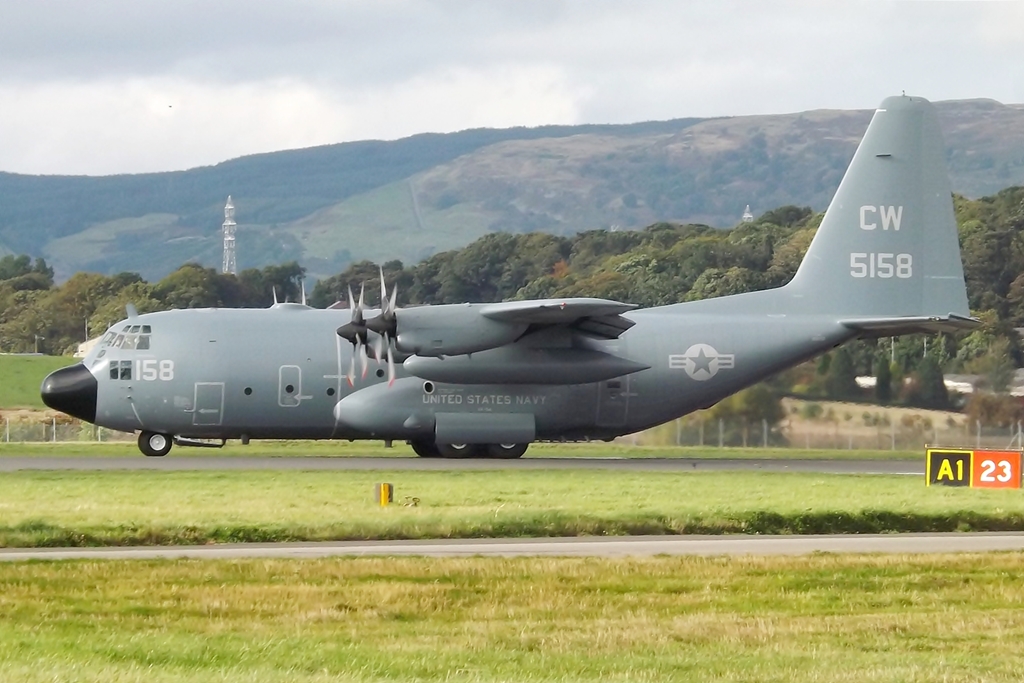
The C-130R and C-130T are U.S. Navy and USMC models, both equipped with underwing external fuel tanks. The USN C-130T is similar but has additional avionics improvements. In both models, aircraft are equipped with Allison T56-A-16 engines. The USMC versions are designated KC-130R or KC-130T when equipped with underwing refueling pods and pylons and are fully night vision system compatible.
The RC-130 is a reconnaissance version developed during the Cold War. Sometimes called "ferret" aircraft, these planes were initially retrofitted standard C-130s.
The Lockheed L-100 (L-382) is a civilian variant, equivalent to a C-130E model without military equipment. The L-100 also has two stretched versions.
Next generation
In the 1970s, Lockheed proposed a C-130 variant with turbofan engines rather than turboprops, but the U.S. Air Force preferred the takeoff performance of the existing aircraft. In the 1980s, the C-130 was intended to be replaced by the Advanced Medium STOL Transport project. The project was canceled and the C-130 has remained in production.
Building on lessons learned, Lockheed Martin modified a commercial variant of the C-130 into a High Technology Test Bed (HTTB). This test aircraft set numerous short takeoff and landing performance records and significantly expanded the database for future derivatives of the C-130. Modifications made to the HTTB included extended chord ailerons, a long chord rudder, fast-acting double-slotted trailing edge flaps, a high-camber wing leading edge extension, a larger dorsal fin and dorsal fins, the addition of three spoiler panels to each wing upper surface, a long-stroke main and nose landing gear system, and changes to the flight controls and a change from direct mechanical linkages assisted by hydraulic boost, to fully powered controls, in which the mechanical linkages from the flight station controls operated only the hydraulic control valves of the appropriate boost unit.
The HTTB first flew on 19 June 1984, with civil registration of N130X. After demonstrating many new technologies, some of which were applied to the C-130J, the HTTB was lost in a fatal accident on 3 February 1993, at Dobbins Air Reserve Base, in Marietta, Georgia. The crash was attributed to disengagement of the rudder fly-by-wire flight control system, resulting in a total loss of rudder control capability while conducting ground minimum control speed tests (Vmcg). The disengagement was a result of the inadequate design of the rudder's integrated actuator package by its manufacturer; the operator's insufficient system safety review failed to consider the consequences of the inadequate design to all operating regimes. A factor that contributed to the accident was the flight crew's lack of engineering flight test training.
In the 1990s, the improved C-130J Super Hercules was developed by Lockheed (later Lockheed Martin). This model is the newest version and the only model in production. Externally similar to the classic Hercules in general appearance, the J model has new turboprop engines, six-bladed propellers, digital avionics, and other new systems.
Upgrades and changes
In 2000, Boeing was awarded a US$1.4 billion contract to develop an Avionics Modernization Program kit for the C-130. The program was hindered with delays and cost overruns until project restructuring in 2007. In September 2009, it was reported that the planned Avionics Modernization Program (AMP) upgrade to the older C-130s would be dropped to provide more funds for the F-35, CV-22 and airborne tanker replacement programs. However, in June 2010, Department of Defense approved funding for the initial production of the AMP upgrade kits. Under the terms of this agreement, the USAF has cleared Boeing to begin low-rate initial production (LRIP) for the C-130 AMP. A total of 198 aircraft are expected to feature the AMP upgrade. The current cost per aircraft is US$14 million, although Boeing expects that this price will drop to US$7 million for the 69th aircraft.
In the 2000s, Lockheed Martin and the U.S. Air Force began outfitting and retrofitting C-130s with the eight-blade UTC Aerospace Systems NP2000 propellers. An engine enhancement program saving fuel and providing lower temperatures in the T56 engine has been approved, and the US Air Force expects to save $2 billion (~$2.65 billion in 2024) and extend the fleet life.
In 2021, the Air Force Research Laboratory demonstrated the Rapid Dragon system which transforms the C-130 into a lethal strike platform capable of launching 12 JASSM-ER with 500 kg warheads from a standoff distance of 925 km (575 mi). Future anticipated improvements support includes support for JDAM-ER, mine laying, drone dispersal as well as improved standoff range when 1,900 km (1,200 mi) JASSM-XR become available in 2024.
Replacement
In October 2010, the U.S. Air Force released a capability request for information (CRFI) for the development of a new airlifter to replace the C-130. The new aircraft was to carry a 190% greater payload and assume the mission of mounted vertical maneuver (MVM). The greater payload and mission would enable it to carry medium-weight armored vehicles and unload them at locations without long runways. Various options were under consideration, including new or upgraded fixed-wing designs, rotorcraft, tiltrotors, or even an airship. The C-130 fleet of around 450 planes would be replaced by only 250 aircraft. The Air Force had attempted to replace the C-130 in the 1970s through the Advanced Medium STOL Transport project, which resulted in the C-17 Globemaster III that instead replaced the C-141 Starlifter.
The Air Force Research Laboratory funded Lockheed Martin and Boeing demonstrators for the Speed Agile concept, which had the goal of making a STOL aircraft that could take off and land at speeds as low as 70 kn (130 km/h; 81 mph) on airfields less than 2,000 ft (610 m) long and cruise at Mach 0.8-plus. Boeing's design used upper-surface blowing from embedded engines on the inboard wing and blown flaps for circulation control on the outboard wing. Lockheed's design also used blown flaps outboard, but inboard used patented reversing ejector nozzles.
Boeing's design completed over 2,000 hours of wind tunnel tests in late 2009. It was a 5 percent-scale model of a narrow body design with a 55,000 lb (25,000 kg) payload. When the AFRL increased the payload requirement to 65,000 lb (29,000 kg), they tested a 5 percent-scale model of a widebody design with a 303,000 lb (137,000 kg) take-off gross weight and an "A400M-size" 158 in (4.0 m) wide cargo box. It would be powered by four IAE V2533 turbofans.
In August 2011, the AFRL released pictures of the Lockheed Speed Agile concept demonstrator. A 23% scale model went through wind tunnel tests to demonstrate its hybrid powered lift, which combined a low drag airframe with simple mechanical assembly to reduce weight and improve aerodynamics. The model had four engines, including two Williams FJ44 turbofans. On 26 March 2013, Boeing was granted a patent for its swept-wing powered lift aircraft.
In January 2014, Air Mobility Command, Air Force Materiel Command and the Air Force Research Lab were in the early stages of defining requirements for the C-X next generation airlifter program to replace both the C-130 and C-17. The aircraft would be produced from the early 2030s to the 2040s.
Operational history
Military
The first production batch of C-130A aircraft were delivered beginning in 1956 to the 463d Troop Carrier Wing at Ardmore AFB, Oklahoma, and the 314th Troop Carrier Wing at Sewart AFB, Tennessee. Six additional squadrons were assigned to the 322d Air Division in Europe and the 315th Air Division in the Far East. Additional aircraft were modified for electronics intelligence work and assigned to Rhein-Main Air Base, Germany while modified RC-130As were assigned to the Military Air Transport Service (MATS) photo-mapping division. The C-130A entered service with the U.S. Air Force in December 1956.
In January 1957, Lockheed conducted the first flight of a C-130A (S/N 55-0021) modified with a ski-wheel configuration that could operate from conventional runways and snow or ice-covered surfaces. In February, Task Force Slide began in Bemidji, Minnesota, to develop, test, and validate procedures for what would become the C-130D. Flights were conducted on the frozen surface of nearby lakes and included Rocket Assisted Takeoff (RATO). Task Force Slide continued into 1958 and by the end of the year 12 modified C-130As, now designated C-130Ds had been delivered to the 61st Troop Carrier Squadron to support construction of two DEW Line radar sites on the Greenland ice cap. The LC-130H variant remains the largest aircraft in the world capable of landing on snow and ice using skis.
In 1958, a U.S. reconnaissance C-130A-II of the 7406th Support Squadron was shot down over Armenia by four Soviet MiG-17s along the Turkish-Armenian border during a routine mission.
Australia became the first non-American operator of the Hercules with 12 planes being delivered from late 1958. The Royal Canadian Air Force became another early user with the delivery of four B-models (Canadian designation CC-130 Mk I) in October / November 1960.
In 1963, a Hercules achieved and still holds the record to this day, for the largest and heaviest aircraft to land on an aircraft carrier. During October and November that year, a USMC KC-130F (BuNo 149798), loaned to the U.S. Naval Air Test Center, made 29 touch-and-go landings, 21 unarrested full-stop landings and 21 unassisted take-offs on Forrestal at a number of different weights. The pilot, Lieutenant (later Rear Admiral) James H. Flatley III, USN, was awarded the Distinguished Flying Cross for his role in this test series. The tests were highly successful, but the aircraft was not deployed this way. Flatley denied that C-130 was tested for carrier onboard delivery (COD) operations, or for delivering nuclear weapons. He said that the intention was to support the Lockheed U-2, also being tested on carriers. The Hercules used in the test, most recently in service with Marine Aerial Refueler Squadron 352 (VMGR-352) until 2005, is now part of the collection of the National Museum of Naval Aviation at NAS Pensacola, Florida.
In 1964, C-130 crews from the 6315th Operations Group at Naha Air Base, Okinawa commenced forward air control (FAC; "Flare") missions over the Ho Chi Minh Trail in Laos supporting USAF strike aircraft. In April 1965 the mission was expanded to North Vietnam where C-130 crews led formations of Martin B-57 Canberra bombers on night reconnaissance/strike missions against communist supply routes leading to South Vietnam. In early 1966 Project Blind Bat/Lamplighter was established at Ubon Royal Thai Air Force Base, Thailand. After the move to Ubon, the mission became a four-engine FAC mission with the C-130 crew searching for targets and then calling in strike aircraft. Another little-known C-130 mission flown by Naha-based crews was Operation Commando Scarf (or Operation Commando Lava), which involved the delivery of chemicals onto sections of the Ho Chi Minh Trail in Laos that were designed to produce mud and landslides in hopes of making the truck routes impassable.
In November 1964, on the other side of the globe, C-130Es from the 464th Troop Carrier Wing but loaned to 322d Air Division in France, took part in Operation Dragon Rouge, one of the most dramatic missions in history in the former Belgian Congo. After communist Simba rebels took white residents of the city of Stanleyville hostage, the U.S. and Belgium developed a joint rescue mission that used the C-130s to drop, air-land, and air-lift a force of Belgian paratroopers to rescue the hostages. Two missions were flown, one over Stanleyville and another over Paulis during Thanksgiving week. The headline-making mission resulted in the first award of the prestigious MacKay Trophy to C-130 crews.
In the Indo-Pakistani War of 1965, the No. 6 Transport Squadron of the Pakistan Air Force modified its C-130Bs for use as bombers to carry up to 20,000 pounds (9,100 kg) of bombs on pallets. These improvised bombers were used to hit Indian targets such as bridges, heavy artillery positions, tank formations, and troop concentrations, though they were largely unsuccessful.