
Lend-Lease, formally the Lend-Lease Act and introduced as An Act to Promote the Defense of the United States (Pub. L. 77–11, H.R. 1776, 55 Stat. 31, enacted March 11, 1941), was a policy under which the United States supplied the United Kingdom, the Soviet Union, France, the Republic of China, and other Allied nations of the Second World War with food, oil, and materiel between 1941 and 1945. The aid was given free of charge on the basis that such help was essential for the defense of the United States.
The Lend-Lease Act was signed into law on March 11, 1941, and ended on September 20, 1945. A total of $50.1 billion (equivalent to $690 billion in 2024 when accounting for inflation) worth of supplies was shipped, or 17 per cent of the total war expenditures of the US. In all, $31.4 billion went to the United Kingdom, $11.3 billion to the Soviet Union, $3.2 billion to France, $1.6 billion to China, and the remaining $2.6 billion to other Allies. Roosevelt's top foreign policy advisor Harry Hopkins had effective control over Lend-Lease, ensuring it was in alignment with Roosevelt's foreign policy goals.
Materiel delivered under the act was supplied at no cost, to be used until returned or destroyed. In practice, most equipment was destroyed, although some hardware (such as ships) was returned after the war. Supplies that arrived after the termination date were sold to the United Kingdom at a large discount for £1.075 billion, using long-term loans from the United States, which were finally repaid in 2006. Similarly, the Soviet Union repaid $722 million in 1971, with the remainder of the debt written off.

Reverse Lend-Lease to the United States totalled $7.8 billion. Of this, $6.8 billion came from the British and the Commonwealth. Canada also aided the United Kingdom and other Allies with the Billion Dollar Gift and Mutual Aid totalling $3.4 billion in supplies and services (equivalent to $61 billion in 2020).
Lend-Lease ended the United States' neutrality which had been enshrined in the Neutrality Acts of the 1930s. It was a decisive step away from non-interventionist policy and toward open support for the Allies. Lend-Lease's precise significance to Allied victory in World War II is debated.
History
Non-interventionism and neutrality
The 1930s began with one of the world's greatest economic depressions, and the later recession of 1937–1938 (although minor relative to the Great Depression) was otherwise also one of the worst of the 20th century. In 1934, following the Nye Committee hearings, as well as the publication of influential books such as Merchants of Death, the United States Congress adopted several Neutrality Acts in the 1930s, motivated by non-interventionism—following the aftermath of its costly involvement in World War I (the war debts were still not paid off), and seeking to ensure that the country would not become entangled in foreign conflicts again. The Neutrality Acts of 1935, 1936, and 1937 intended to keep the United States out of war by making it illegal for Americans to sell or transport arms or other war materials to warring nations, be they aggressors or defenders.
Cash and carry
In 1939, however—as Germany, Japan, and Italy pursued aggressive, militaristic policies—President Roosevelt wanted more flexibility to help contain Axis aggression. He suggested amending the act to allow warring nations to purchase military goods, arms and munitions if they paid cash and bore the risks of transporting the goods on non-American ships, a policy that would favor Britain and France. Initially, this proposal failed, but after Germany and the Soviet Union invaded Poland in September, Congress passed the Neutrality Act of 1939 ending the munitions embargo on a "cash and carry" basis. The passage of the 1939 amendment to the previous Neutrality Acts marked the beginning of a congressional shift away from isolationism, making a first step toward interventionism.
After the Fall of France during June 1940, the British Commonwealth and Empire were the only forces engaged in war against Germany and Italy, until the Italian invasion of Greece. Britain had been paying for its materiel with gold as part of the "cash and carry" program, as required by the U.S. Neutrality Acts of the 1930s, but by 1941 it had liquidated a large part of its overseas holdings and its gold reserves were becoming depleted in paying for materiel from the United States.
During this same period, the U.S. government began to mobilize for total war, instituting the first-ever peacetime draft and a fivefold increase in the defense budget (from $2 billion to $10 billion). The Two-Ocean Navy Act of July 1940 set in motion a rapid expansion of the United States Navy. In the meantime, Great Britain was running out of liquid currency and asked not to be forced to sell off British assets. Hampered by public opinion and the Neutrality Acts, which forbade arms sales on credit or the lending of money to belligerent nations, Roosevelt eventually came up with the idea of "lend–lease". As one Roosevelt biographer has characterized it: "If there was no practical alternative, there was certainly no moral one either. Britain and the Commonwealth were carrying the battle for all civilization, and the overwhelming majority of Americans, led in the late election by their president, wished to help them." As the President himself put it, "There can be no reasoning with incendiary bombs."

In September 1940, during the Battle of Britain the British government sent the Tizard Mission to the United States. The aim of the British Technical and Scientific Mission was to obtain the industrial resources to exploit the military potential of the research and development work completed by the UK up to the beginning of World War II, but that Britain itself could not exploit due to the immediate requirements of war-related production. The British shared technology included the cavity magnetron (key technology at the time for highly effective radar; the American historian James Phinney Baxter III later called "the most valuable cargo ever brought to our shores"), the design for the VT fuze, details of Frank Whittle's jet engine and the Frisch–Peierls memorandum describing the feasibility of an atomic bomb. Though these may be considered the most significant, many other items were also transported, including designs for rockets, superchargers, gyroscopic gunsights, submarine detection devices, self-sealing fuel tanks and plastic explosives.
On December 7, 1940, British Prime Minister Winston Churchill pressed Roosevelt in a 15-page letter for American help. In his December 29, 1940 Fireside Chat radio broadcast, President Roosevelt proclaimed the United States would be the "Arsenal of Democracy" and proposed selling munitions to Britain and Canada. Isolationists were strongly opposed, warning it would result in American involvement with what was considered by most Americans as an essentially European conflict. In time, opinion shifted as increasing numbers of Americans began to consider the advantage of funding the British war against Germany, while staying free of the hostilities themselves. Propaganda showing the devastation of British cities during The Blitz, as well as popular depictions of Germans as savage also rallied public opinion to the Allies, especially after Germany conquered France.
Lend-Lease proposal
After a decade of neutrality, Roosevelt knew that the change to Allied support had to be gradual, given the support for isolationism in the country. Originally, the American policy was to help the British but not join the war. During early February 1941, a Gallup poll revealed that 54% of Americans were in favor of giving aid to the British without qualifications of Lend-Lease. A further 15% were in favor of qualifications such as: "If it doesn't get us into war", or "If the British can give us some security for what we give them". Only 22% were unequivocally against the President's proposal. When poll participants were asked their party affiliation, the poll revealed a political divide: 69% of Democrats were unequivocally in favor of Lend-Lease, whereas only 38% of Republicans favored the bill without qualification. At least one poll spokesperson also noted that "approximately twice as many Republicans" gave "qualified answers as ... Democrats".

Opposition to the Lend-Lease bill was strongest among isolationist Republicans in Congress, who feared the measure would be "the longest single step this nation has yet taken toward direct involvement in the war abroad". When the House of Representatives finally took a roll call vote on February 8, 1941, the 260 to 165 vote was largely along party lines. Democrats voted 236 to 25 in favor and Republicans 24 in favor and 135 against.
The vote in the Senate, which occurred on March 8, revealed a similar partisan difference: 49 Democrats (79 percent) voted "aye" with only 13 Democrats (21 percent) voting "nay". In contrast, 17 Republicans (63 percent) voted "nay" while 10 Senate Republicans (37 percent) sided with the Democrats to pass the bill.
President Roosevelt signed the Lend-Lease bill into law on March 11, 1941. It permitted him to "sell, transfer title to, exchange, lease, lend, or otherwise dispose of, to any such government [whose defense the President deems vital to the defense of the United States] any defense article." In April, this policy was extended to China, and in October to the Soviet Union, which was attacked by Germany on 22 June 1941. Roosevelt approved $1 billion in Lend-Lease aid to Britain at the end of October 1941.

This followed the 1940 Destroyers for Bases Agreement, whereby 50 US Navy destroyers were transferred to the Royal Navy and the Royal Canadian Navy in exchange for basing rights in the Caribbean. Churchill also granted the US base rights in Bermuda and Newfoundland for free; this act allowed their British garrison to be redeployed to more crucial theatres. In 1944, Britain transferred several of the US-made destroyers to the USSR.
After the attack on Pearl Harbor and the United States entering the war in December 1941, foreign policy was rarely discussed by Congress, and there was very little demand to cut Lend-Lease spending. In spring 1944, the House passed a bill to renew the Lend-Lease program by a vote of 334 to 21. The Senate passed it by a vote of 63 to 1.
Multilateral Allied support
In February 1942, the U.S. and Britain signed the Anglo-American Mutual Aid Agreement as part of a greater multilateral system, developed by the Allies during the war, to provide each other with goods, services, and mutual aid in the widest sense, without charging commercial payments.

Scale, value and economics
A total of $50.1 billion (equivalent to $690 billion in 2024) was involved, or 17% of the total war expenditures of the U.S. Most, $31.4 billion ($433 billion), went to Britain and its empire. Other recipients were led by $11.3 billion ($156 billion) to the Soviet Union, $3.2 billion ($44.1 billion) to France, $1.6 billion ($22 billion) to China, and the remaining $2.6 billion to the other Allies. Reverse Lend-Lease policies comprised services such as rent on bases used by the U.S., and totaled $7.8 billion; of this, $6.8 billion came from the British and the Commonwealth, mostly Australia and India.
The terms of the agreement provided that the U.S. materiel was to be used until returned or destroyed. In practice, very little equipment was in usable shape for peacetime uses. Supplies that arrived after the termination date were sold to Britain at a large discount for £1.075 billion, using long-term loans from the United States. Canada was not a direct recipient of Lend-Lease aid. To address balance of payment issues between the US and Canada, and to prevent the U.S monopolizing British orders, the Hyde Park Declaration of 20 April 1941 made weapons and components manufactured in Canada for Britain eligible for Lend-Lease financing as if they had been manufactured in the US. Canada operated a program similar to Lend-Lease called Mutual Aid that sent a loan of C$1 billion (equivalent to C$17.8 billion in 2025) and C$3.4 billion (C$60.7 billion) in supplies and services to Britain and other Allies.
Administration
Roosevelt made sure that Lend-Lease policies were supportive of his foreign policy goals by putting his top aide Harry Hopkins in effective control of the program. In terms of administration, the president established the Office of Lend-Lease Administration during 1941, headed by steel executive Edward R. Stettinius. In September 1943, he was promoted to Undersecretary of State, and Leo Crowley became director of the Foreign Economic Administration, which was given responsibility for Lend-Lease.
Lend-Lease aid to the USSR was nominally managed by Stettinius. Roosevelt's Soviet Protocol Committee was dominated by Harry Hopkins and General John York, who were totally sympathetic to the provision of "unconditional aid". Few Americans objected to Soviet aid until 1943.
The program was gradually terminated after V-E Day. In April 1945, Congress voted that it should not be used for post-conflict purposes, and in August 1945, after Japan surrendered, the program was ended.
Significance
Even after the United States forces in Europe and the Pacific began to attain full strength during 1943–1944, Lend-Lease continued. Most remaining Allies were largely self-sufficient in frontline equipment (such as tanks and fighter aircraft) by this time – though arms shipments continued – but Lend-Lease logistical supplies (including motor vehicles and railroad equipment) remained of enormous assistance.
WWII was the first major war in which whole formations were routinely motorized; soldiers were supported with large numbers of all kinds of vehicles, not just for direct combat roles, but for transport and logistics as well. In spite of this, belligerent powers massively decreased production of non-lethal materiel to focus on weapons production; this inevitably produced shortages of products required for industrial or logistical uses, particularly unarmored vehicles. Thus, the Allies were almost totally reliant on American industrial production for unarmored vehicles, including ones purpose-built for military use.
For example, the USSR was very dependent on rail transport, and starting during the latter half of the 1920s but accelerating during the 1930s, hundreds of foreign industrial giants such as Ford were commissioned to construct modern dual-purpose factories in the USSR, 16 alone within a week of May 31, 1929. However, with the outbreak of war these plants switched from civilian to military production, and locomotive production dropped dramatically. Just 446 locomotives were produced during the war, with only 92 of those being built between 1942 and 1945. In total, 92.7% of the wartime procurement of railroad equipment by the USSR came from Lend-Lease, including 1,911 locomotives and 11,225 railcars. (At the beginning of the war, the USSR had at least 20,000 locomotives and 500,000 railcars. Davie put the initial number at 24,200 locomotives.) The Soviets lost 15% of their locomotives but also lost around 40% of their rail network, which resulted in an abundance of locomotives relative to requirements for the duration of the war. This, combined with the reduction in passenger traffic caused by the wartime economy, could explain why so few locomotives were produced. Trucks were also vital; by 1945, nearly a third of the trucks used by the Red Army were U.S.-built. Trucks such as the Dodge 3⁄4-ton and Studebaker 2+1⁄2-ton were easily the best trucks available in their class on either side on the Eastern Front. American shipments of telephone cable, aluminum, canned rations and clothing were also critical.
Lend-Lease also supplied significant amounts of weapons and ammunition. The Soviet air force received 18,200 aircraft, which amounted to about 30 percent of Soviet wartime fighter and bomber production over the course of the war. Most tank units were Soviet-built models but about 7,000 Lend-Lease tanks (plus more than 5,000 British tanks) were used by the Red Army, eight percent of Soviet war-time production.
A critical aspect of Lend-Lease was the supply of food. The invasion had cost the USSR a huge amount of its agricultural base; during the initial Axis offensive of 1941–42, the total sown area of the USSR fell by 41.9% and the number of collective and state farms by 40%. The Soviets lost a substantial number of draft and farm animals, the Soviets had lost 7 million of out of 11.6 million horses, 17 million out of 31 million cows, 20 million of 23.6 million pigs and 27 million out of 43 million sheep and goats. Tens of thousands of agricultural machines, such as tractors and threshers, were destroyed or captured. Agriculture also suffered a loss of labour; between 1941 and 1945, 19.5 million working-age men had to leave their farms to work in the military and industry. Agricultural issues were also compounded when the Soviets were on the offensive, as areas liberated from the Axis had been devastated and contained millions of people who needed to be fed. Lend-Lease thus provided a massive quantity of foodstuffs and agricultural products. Yet the real significance of this aid remains unclear without considering the scale of Soviet economic needs and the timing of deliveries. Using Soviet archival data, David M. Suadicani shows that Lend-Lease food accounted for less than 1% of total food available and mostly arrived after the Battle of Kursk 1943. Thus, its overall impact was limited, though industrial foodstuffs were more consequential for the Soviet Army.
According to the Russian historian Boris Vadimovich Sokolov, Lend-Lease had a crucial role in winning the war:
On the whole the following conclusion can be drawn: that without these Western shipments under Lend-Lease the Soviet Union not only would not have been able to win the Great Patriotic War, it would not have been able even to oppose the German invaders, since it could not itself produce sufficient quantities of arms and military equipment or adequate supplies of fuel and ammunition. The Soviet authorities were well aware of this dependency on Lend-Lease. Thus, Stalin told Harry Hopkins [FDR's emissary to Moscow in July 1941] that the U.S.S.R. could not match Germany's might as an occupier of Europe and its resources.
Nikita Khrushchev, having served as a military commissar and intermediary between Stalin and his generals during the war, addressed directly the significance of Lend-Lease aid in his memoirs:
I would like to express my candid opinion about Stalin's views on whether the Red Army and the Soviet Union could have coped with Nazi Germany and survived the war without aid from the United States and Britain. First, I would like to tell about some remarks Stalin made and repeated several times when we were "discussing freely" among ourselves. He stated bluntly that if the United States had not helped us, we would not have won the war. If we had had to fight Nazi Germany one on one, we could not have stood up against Germany's pressure, and we would have lost the war. No one ever discussed this subject officially, and I don't think Stalin left any written evidence of his opinion, but I will state here that several times in conversations with me he noted that these were the actual circumstances. He never made a special point of holding a conversation on the subject, but when we were engaged in some kind of relaxed conversation, going over international questions of the past and present, and when we would return to the subject of the path we had traveled during the war, that is what he said. When I listened to his remarks, I was fully in agreement with him, and today I am even more so.
In a confidential interview with the wartime correspondent Konstantin Simonov, the Soviet Marshal Georgy Zhukov was secretly recorded by the KGB saying:
Today [1963] some say the Allies didn't really help us ... But listen, one cannot deny that the Americans shipped over to us material without which we could not have equipped our armies held in reserve or been able to continue the war. We did not have explosives, gunpowder. There was nothing to load rifle cartridges with. The Americans really helped us out with gunpowder and explosives. And how much sheet steel they drove to us! Would we have been able to quickly establish the production of tanks if it had not been for American steel aid? And now they imagine that we had all this in abundance.
David Glantz, an American military historian known for his books on the Eastern front, offers a somewhat different view. Without the Lend-Lease, Soviet would still win, but they might have taken 12 to 18 months longer to finish off the Wehrmacht:
Although Soviet accounts have routinely belittled the significance of Lend-Lease in the sustainment of the Soviet war effort, the overall importance of the assistance cannot be understated. Lend-Lease aid did not arrive in sufficient quantities to make the difference between defeat and victory in 1941–1942; that achievement must be attributed solely to the Soviet people and to the iron nerve of Stalin, Zhukov, Shaposhnikov, Vasilevsky, and their subordinates. As the war continued, however, the United States and Great Britain provided many of the implements of war and strategic raw materials necessary for Soviet victory. Without Lend-Lease food, clothing, and raw materials (especially metals), the Soviet economy would have been even more heavily burdened by the war effort. Perhaps most directly, without Lend-Lease trucks, rail engines, and railroad cars, every Soviet offensive would have stalled at an earlier stage, outrunning its logistical tail in a matter of days. In turn, this would have allowed the German commanders to escape at least some encirclements, while forcing the Red Army to prepare and conduct many more deliberate penetration attacks in order to advance the same distance. Left to their own devices, Stalin and his commanders might have taken twelve to eighteen months longer to finish off the Wehrmacht; the ultimate result would probably have been the same, except that Soviet soldiers could have waded at France's Atlantic beaches.
Returning goods after the war
Roosevelt, eager to ensure public consent for this controversial plan, explained to the public and the press that his plan was comparable to lending a garden hose to a neighbor whose house is on fire. "What do I do in such a crisis?" the president asked at a press conference. "I don't say ... 'Neighbor, my garden hose cost me $15; you have to pay me $15 for it' ... I don't want $15—I want my garden hose back after the fire is over." To which Senator Robert Taft (R-Ohio), responded: "Lending war equipment is a good deal like lending chewing gum—you certainly don't want the same gum back."
In practice, very little was returned except for a few unarmed transport ships. Surplus military equipment was of no value in peacetime. The Lend-Lease agreements with 30 countries provided for repayment not in terms of money or returned goods, but in "joint action directed towards the creation of a liberalized international economic order in the postwar world." That is, the U.S. would be "repaid" when the recipient fought the common enemy and joined the world trade and diplomatic agencies, such as the United Nations.
Deliveries to the Soviet Union
United States
If Germany defeated the Soviet Union, the most significant front in Europe would be closed. Roosevelt believed that if the Soviets were defeated the Allies would be far more likely to lose. Roosevelt concluded that the United States needed to help the Soviets fight against the Germans. Because of its utmost importance, Roosevelt directed his subordinates to emphasize shipments of aid to the Soviet Union above most other shipping destinations. The Soviet Ambassador, Maxim Litvinov, significantly contributed to the Lend-Lease agreement of 1941. In the fall of 1941, the US Army set up the United States Military Mission to Moscow to help the flow of Lend-Lease material into Russia. In 1943, Major General John R. Deane was made commander of the Moscow Mission and to brief Joseph Stalin on Operation Overlord. American deliveries to the Soviet Union can be divided into the following phases:
"Pre-Lend-Lease" June 22, 1941, to September 30, 1941 (paid for in gold and other minerals)
First protocol period from October 1, 1941, to June 30, 1942 (signed October 7, 1941). A significant proportion of the equipment and raw materials was to be supplied by Great Britain with US credit financing.
Second protocol period from July 1, 1942, to June 30, 1943 (signed October 6, 1942)
Third protocol period from July 1, 1943, to June 30, 1944 (signed October 19, 1943)
Fourth protocol period from July 1, 1944 (signed April 17, 1945), formally ended May 12, 1945, but deliveries continued for the duration of the war with Japan (which the Soviet Union entered on August 8, 1945) under the "Milepost" agreement until September 2, 1945, when Japan capitulated. On September 20, 1945, all Lend-Lease to the Soviet Union was terminated.
Delivery was via the Arctic Convoys, the Persian Corridor, and the Pacific Route.
The Arctic route was the shortest and most direct route for Lend-Lease aid to the USSR, though it was also the most dangerous as it involved sailing past German-occupied Norway. Some 3,964,000 tons of goods were shipped by the Arctic route; 7% was lost, while 93% arrived safely.
The Persian Corridor was the longest route, and was not fully operational until mid-1942. Thereafter it saw the passage of 4,160,000 tons of goods, 27% of the total.
The Pacific Route opened in August 1941, but was affected by the start of hostilities between Japan and the U.S.; after December 1941, only Soviet ships could be used, and, as Japan and the USSR observed a strict neutrality towards each other, only non-military goods could be transported. Nevertheless, some 8,244,000 tons of goods went by this route, 50% of the total.
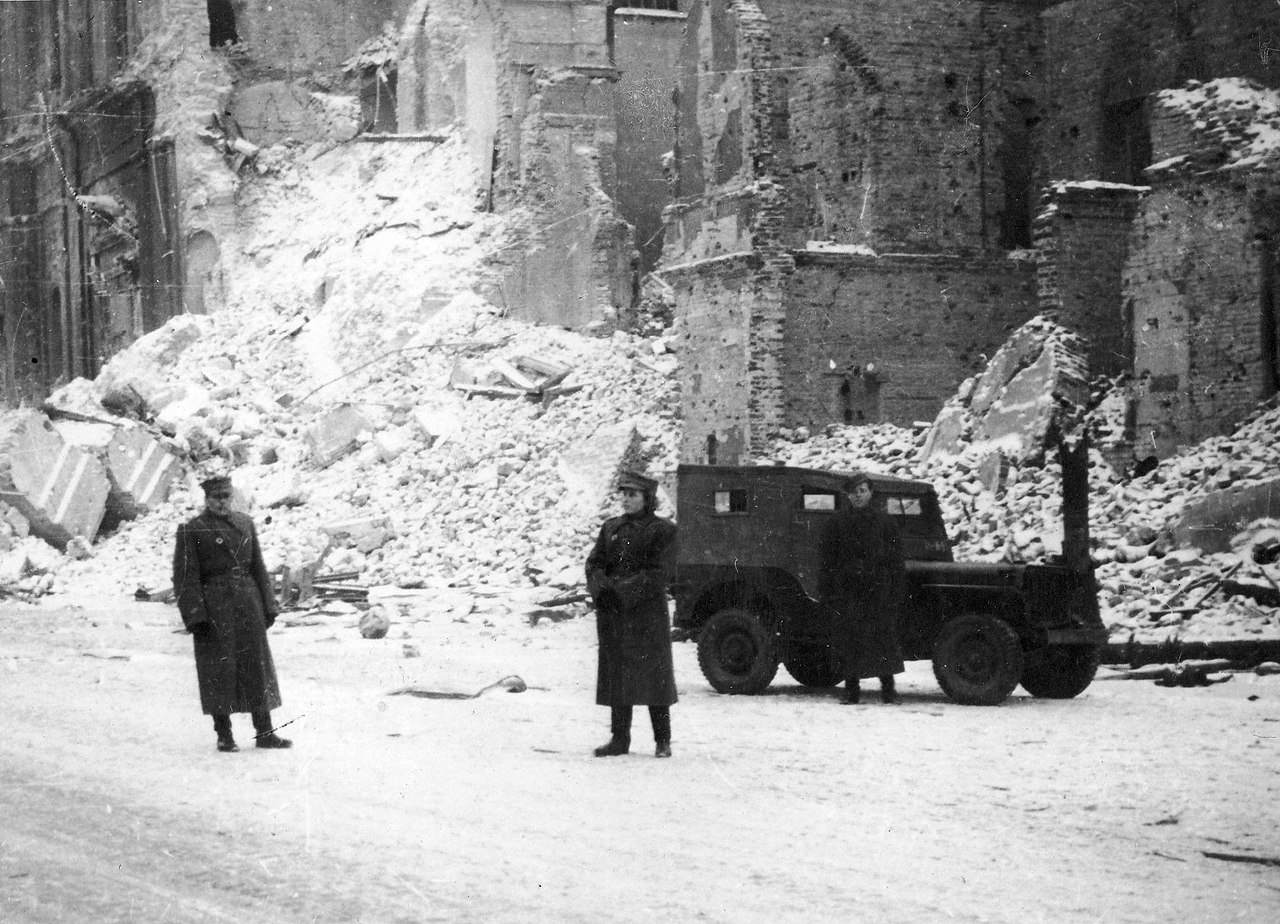
In total, the U.S. deliveries to the USSR through Lend-Lease amounted to $11 billion in materials (equivalent to $205 billion in 2025): over 400,000 jeeps and trucks; 12,000 armored vehicles (including 7,000 tanks, about 1,386 of which were M3 Lees and 4,102 M4 Shermans); 11,400 aircraft (of which 4,719 were Bell P-39 Airacobras, 3,414 were Douglas A-20 Havocs and 2,397 were Bell P-63 Kingcobras) and 1.75 million tons of food.