
Lawrence Henry Summers (born November 30, 1954) is an American economist. He served as the 71st United States Secretary of the Treasury from 1999 to 2001, the 27th president of Harvard University from 2001 to 2006, and the eighth director of the National Economic Council from 2009 to 2010. He was the Charles W. Eliot University Professor at Harvard Kennedy School until his resignation in February 2026.
Summers became a professor of economics at Harvard University in 1983. He left Harvard in 1991, working as the chief economist of the World Bank from 1991 to 1993. In 1993, Summers was appointed Under Secretary for International Affairs of the United States Department of the Treasury under President Bill Clinton's administration. In 1995, he was promoted to Deputy Secretary of the Treasury under his long-time political mentor Robert Rubin. In 1999, he succeeded Rubin as Secretary of the Treasury. While working for the Clinton administration, Summers played a leading role in the American response to the 1994 economic crisis in Mexico, the 1997 Asian financial crisis, and the 1998 Russian financial crisis. He was also influential in the Harvard Institute for International Development and American-advised privatization of the economies of the post-Soviet states, and in the deregulation of the U.S. financial system, including the repeal of the Glass–Steagall Act.
Following the end of Clinton's term, Summers served as the 27th president of Harvard University from 2001 to 2006. Summers resigned as Harvard's president in the wake of a no-confidence vote by Harvard faculty, which resulted in large part from Summers's conflict with Cornel West, financial conflict of interest questions regarding his relationship with Andrei Shleifer, and a 2005 speech in which he offered three reasons for the under-representation of women in science and engineering, including the possibility that there exists a "different availability of aptitude at the high end", in addition to patterns of discrimination and socialization.

After his first departure from Harvard, Summers worked as a managing director at the hedge fund D. E. Shaw & Co. Summers rejoined public service during the Obama administration, serving as the director of the White House United States National Economic Council for President Barack Obama from January 2009 until November 2010, where he emerged as a key economic decision-maker in the Obama administration's response to the Great Recession.
He went on leave from his teaching responsibilities at Harvard and his role as the director of the Mossavar-Rahmani Center for Business and Government in November 2025 due to an investigation into his ties to Jeffrey Epstein.
Early life and education
Summers was born in New Haven, Connecticut, on November 30, 1954, into a Jewish family. He was the son of two economists, Robert Summers (who changed the family surname from Samuelson) and Anita Summers (of Romanian-Jewish ancestry), who were both professors at the University of Pennsylvania. He is also the nephew of two Nobel laureates in economics: Paul Samuelson (brother of Robert Summers) and Kenneth Arrow (brother of Anita Arrow Summers). He spent most of his childhood in Penn Valley, Pennsylvania, a suburb of Philadelphia, where he attended Harriton High School.

At age 16, he entered the Massachusetts Institute of Technology (MIT), where he originally intended to study mathematics but soon switched to economics, graduating in 1975. He was also an active member of the MIT debating team and qualified for participation in the annual National Debate Tournament three times. He attended Harvard University as a graduate student, receiving his Ph.D. in 1982.
Early career (1983–2001)
Harvard (1983–1987)
In 1983, at age 28, Summers became one of the youngest tenured professors in Harvard's history. He was a visiting academic at the London School of Economics in 1987.
As a researcher, Summers has made important contributions in many areas of economics, primarily public finance, labor economics, financial economics, and macroeconomics. Summers has also worked in international economics, economic demography, economic history and development economics. He received the John Bates Clark Medal in 1993 from the American Economic Association. In 1987, he was the first social scientist to win the Alan T. Waterman Award from the National Science Foundation. Summers is also a member of the National Academy of Sciences. Some of his popular courses, as Charles W. Eliot University Professor at Harvard University, were American Economic Policy and The Political Economy of Globalization.
Summers was on the staff of the Council of Economic Advisers under President Reagan in 1982–1983. He also served as an economics adviser to the Dukakis Presidential campaign in 1988.
World Bank (1991–1993)
Summers left Harvard in 1991 and served as the Vice President of Development Economics and Chief Economist for the World Bank until 1993.
According to the World Bank's Data & Research office, Summers returned to Washington, D.C., in 1991 as the World Bank's Vice President of Development Economics and Chief Economist. As such, Summers played a "key role" in designing strategies to aid developing countries, worked on the bank's loan committee, guided the bank's research and statistics operations, and guided external training programs. The World Bank's official site also reports that Summers's research included an "influential" report that demonstrated a very high return from investments in educating girls in developing nations.

According to The Economist, Summers was "often at the centre of heated debates" about economic policy, as he was considered a "famous contrarian".
"Dirty industries" controversy
In December 1991, while at the World Bank, Summers signed a memo that was leaked to the press. Lant Pritchett has claimed authorship of the private memo, which both he and Summers say was intended as sarcasm. The memo stated that "the economic logic behind dumping a load of toxic waste in the lowest wage country is impeccable and we should face up to that. [...] I've always thought that under-populated countries in Africa are vastly underpolluted." According to Pritchett, the memo, as leaked, was doctored to remove context and intended irony.
Clinton Administration (1993–2001)
Treasury Department
In 1993, Summers was appointed Undersecretary for International Affairs and later in the United States Department of the Treasury under the Clinton Administration. In 1995, he was promoted to Deputy Secretary of the Treasury under his long-time political mentor Robert Rubin.

Much of Summers's tenure at the Treasury Department was focused on international economic issues. He was deeply involved in the Clinton administration's effort to bail out Mexico and Russia when those nations had currency crises. Summers set up a project through which the Harvard Institute for International Development provided advice to the Russian government between 1992 and 1997. Later there was a scandal when it emerged that some of the Harvard project members had invested in Russia and were therefore not impartial advisors. Summers encouraged then-Russian leader Boris Yeltsin to use the same "three-'ations'" of policy he advocated in the Clinton Administration – "privatization, stabilization, and liberalization".
During the 1997 Asian financial crisis, Summers pressured the Korean government to raise its interest rates and balance its budget in the midst of a recession, policies criticized by Paul Krugman and Joseph Stiglitz. According to the book The Chastening by Paul Blustein during this crisis, Summers, along with Paul Wolfowitz, pushed for regime change in Indonesia.
Views on financial regulation
On May 7, 1998, the United States Commodity Futures Trading Commission (CFTC) issued a Concept Release soliciting input from regulators, academics, and practitioners to determine "how best to maintain adequate regulatory safeguards without impairing the ability of the OTC (over-the-counter) derivatives market to grow and the ability of U.S. entities to remain competitive in the global financial marketplace." On July 30, 1998, then-Deputy Secretary of the Treasury Summers testified before the U.S. Congress that "the parties to these kinds of contract are largely sophisticated financial institutions that would appear to be eminently capable of protecting themselves from fraud and counterparty insolvencies." At the time Summers stated that "to date there has been no clear evidence of a need for additional regulation of the institutional OTC derivatives market, and we would submit that proponents of such regulation must bear the burden of demonstrating that need." In 1999, Summers endorsed the Gramm–Leach–Bliley Act which removed the separation between investment and commercial banks, saying "With this bill, the American financial system takes a major step forward towards the 21st Century."
Treasury Secretary
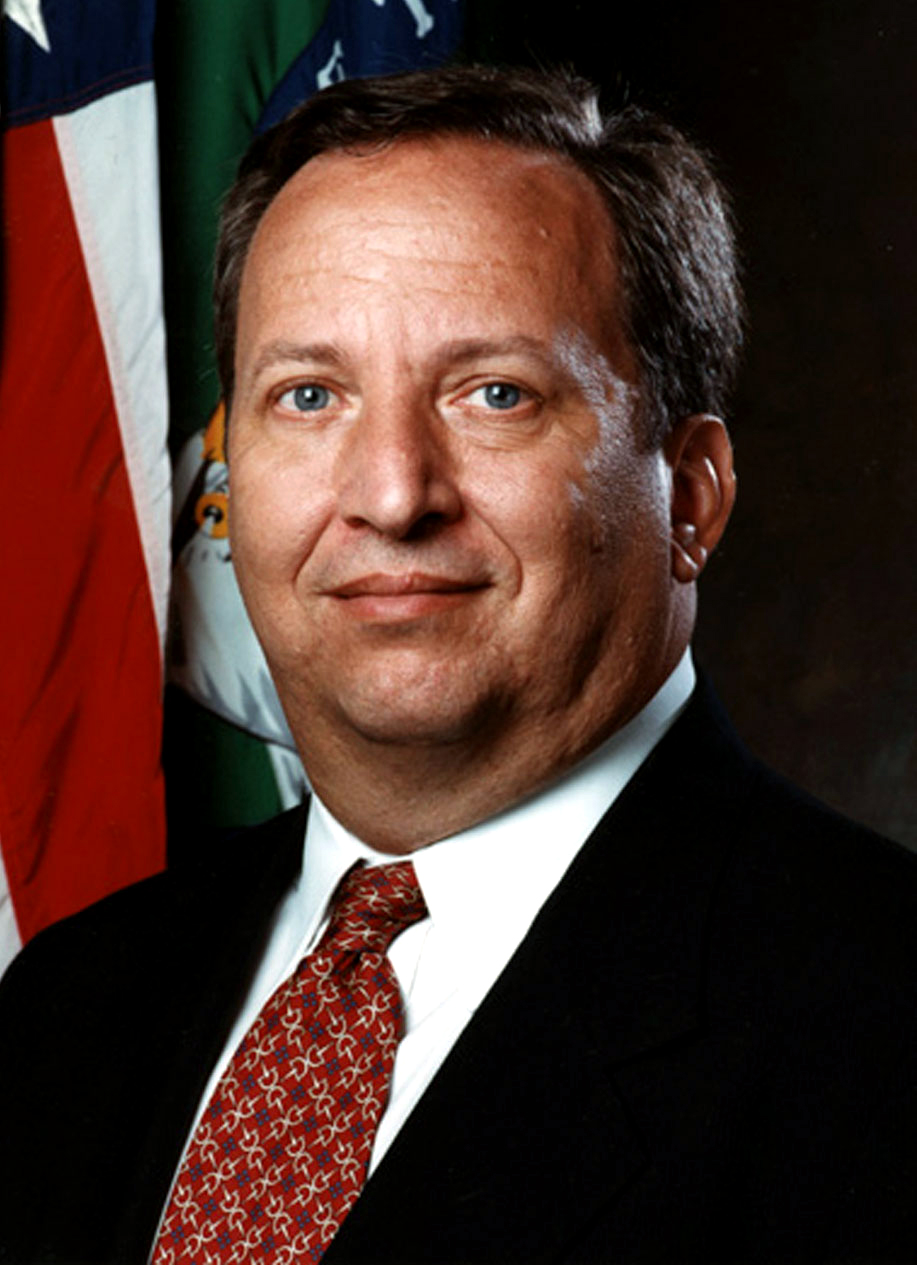
In 1999, he succeeded Robert Rubin as Secretary of the Treasury.
Summers was a leading voice within the Clinton Administration arguing against American leadership in greenhouse gas reductions and against US participation in the Kyoto Protocol, according to internal documents made public in 2009.
As Treasury Secretary, Summers led the Clinton Administration's opposition to tax cuts proposed by the Republican Congress in 1999.
During the 2000 California energy crisis, then-Treasury Secretary Summers teamed with Alan Greenspan and Enron executive Kenneth Lay to lecture California Governor Gray Davis on the causes of the crisis, explaining that the problem was excessive government regulation. Under the advice of Kenneth Lay, Summers urged Davis to relax California's environmental standards in order to reassure the markets.
Glass–Steagall repeal
Summers hailed the Gramm–Leach–Bliley Act in 1999, which lifted more than six decades of restrictions against banks offering commercial banking, insurance, and investment services (by repealing key provisions in the 1933 Glass–Steagall Act): "Today Congress voted to update the rules that have governed financial services since the Great Depression and replace them with a system for the 21st century," Summers said. "This historic legislation will better enable American companies to compete in the new economy." Many critics, including President Barack Obama, have suggested the subprime mortgage crisis of 2007-2010 was caused by the partial repeal of the 1933 Glass–Steagall Act.
As a member of President Clinton's Working Group on Financial Markets, Summers, along with U.S. Securities and Exchange Commission (SEC) Chairman Arthur Levitt, Fed Chairman Greenspan, and Secretary Rubin, torpedoed an effort to regulate the financial derivatives that many blame for bringing the financial market down in Fall 2008.
Career after White House (2001– )
President of Harvard (2001–2006)
In 2001, when George W. Bush became President, Summers left the Treasury Department and returned to Harvard as its 27th president, serving from July 2001 until June 2006. He was Harvard's first Jewish president, though his predecessor Neil Rudenstine's father was Jewish.
A number of Summers's decisions at Harvard have attracted public controversy, either at the time or since his resignation.
Cornel West
In an October 2001 meeting, Summers criticized African American Studies department head Cornel West for allegedly missing three weeks of classes to work on the Bill Bradley presidential campaign and complained that West was contributing to grade inflation. West pushed back strongly against the accusations. West, who later called Summers both "uninformed" and "an unprincipled power player" in describing this encounter in his book Democracy Matters (2004), subsequently returned to Princeton University, where he had taught prior to Harvard University.
Differences between the sexes controversy
In January 2005, at a Conference on Diversifying the Science & Engineering Workforce sponsored by the National Bureau of Economic Research, Summers sparked controversy with his discussion of why women may have been underrepresented "in tenured positions in science and engineering at top universities and research institutions". The conference was designed to be off-the-record so that participants could speak candidly without fear of public misunderstanding or disclosure later.
Summers had prefaced his talk, saying he was adopting an "entirely positive, rather than normative approach" and that his remarks were intended to be an "attempt at provocation". Summers then began by identifying three hypotheses for the higher proportion of men in high-end science and engineering positions:
The high-powered job hypothesis
Different availability of aptitude at the high end
Different socialization and patterns of discrimination in a search
The second hypothesis, the generally greater variability among men (compared to women) in tests of cognitive abilities, leading to proportionally more males than females at both the lower and upper tails of the test score distributions, caused the most controversy. In his discussion of this hypothesis, Summers said that "even small differences in the standard deviation [between genders] will translate into very large differences in the available pool substantially out [from the mean]". Summers referenced research that implied differences between the standard deviations of males and females in the top 5% of twelfth graders under various tests.
Summers then concluded his discussion of the three hypotheses by saying:
...in the special case of science and engineering, there are issues of intrinsic aptitude, and particularly of the variability of aptitude, and that those considerations are reinforced by what are in fact lesser factors involving socialization and continuing discrimination. I would like nothing better than to be proved wrong, because I would like nothing better than for these problems to be addressable simply by everybody understanding what they are, and working very hard to address them.
Summers then went on to discuss approaches to remedying the shortage of women in high-end science and engineering positions.
This lunch-time talk drew accusations of sexism and careless scholarship, and an intense negative response followed, both nationally and at Harvard; Summers' repeated apologies were to no avail.
Summers's protégée Sheryl Sandberg defended him, saying that "Larry has been a true advocate for women throughout his career" at the World Bank and Treasury.
Summers's opposition and support at Harvard
On March 15, 2005, members of the Harvard Faculty of Arts and Sciences, which instructs graduate students in Harvard Graduate School of Arts and Sciences and undergraduates in Harvard College, passed 218–185 a motion of "lack of confidence" in the leadership of Summers, with 18 abstentions. A second motion that offered a milder censure of the president passed 253 to 137, also with 18 abstentions.
The members of the Harvard Corporation, the university's highest governing body, are in charge of the selection of the president and issued statements strongly supporting Summers.
FAS faculty were not unanimous in their comments against Summers. Also, Summers had stronger support among Harvard College students than among the college faculty. One poll by The Harvard Crimson indicated that students opposed his resignation by a three-to-one margin, with 57% of responding students opposing his resignation and 19% supporting it.
Support of economist Andrei Shleifer
Harvard and Andrei Shleifer, a close friend and protégé of Summers, controversially paid $28.5 million to settle a lawsuit by the U.S. government over the conflict of interest Shleifer had while advising Russia's privatization program. The US government had sued Shleifer under the False Claims Act, as he bought Russian stocks while designing the country's privatization. In 2004, a federal judge ruled that while Harvard had violated the contract, Shleifer and his associate alone were liable for treble damages.
In June 2005, Harvard and Shleifer announced that they had reached a tentative settlement with the US government. In August, Harvard, Shleifer, and the Department of Justice reached an agreement under which the university paid $26.5 million to settle the five-year-old lawsuit. Shleifer was also responsible for paying $2 million worth of damages.
Because Harvard paid almost all of the damages and allowed Shleifer to retain his faculty position, the settlement provoked allegations of favoritism on the part of Summers. His continued support for Shleifer weakened Summers's popularity with other professors, as reported in The Harvard Crimson: Frederick H. Abernathy, the McKay professor of mechanical engineering, stated, "I was deeply shocked and disappointed by the actions of this University" in the Shleifer affair.