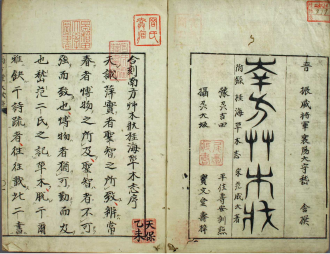
The (c. 304 CE) Nanfang caomu zhuang (南方草木狀 Plants of the Southern Regions), attributed to the Western Jin dynasty scholar and botanist Ji Han (嵇含, 263-307), is a Flora describing the plants of Nanyue and Jiaozhi, present-day South China and northern Vietnam. The Nanfang caomu zhuang is the oldest work extant in any language on subtropical botany. The book contains the first descriptions of several economic plants, for instance jasmine and black pepper, as well as the earliest accounts of some agricultural techniques such as biological pest control (using "citrus ants" to protect orange crops), and the cultivation of vegetables on floating gardens (centuries before the earliest recorded Mesoamerican chinampa).
Since 1273, when the Nanfang caomu zhuang was first printed in the Song dynasty, it was frequently quoted by Chinese authors, both in literature and technical books on horticulture, agriculture, and Chinese herbology. Since the 19th century (e.g., Hirth and Bretschneider, many Western sinologists, botanists, and historians of plant cultivation have studied it.
Ji Han
The Nanfang caomu zhuang author Ji Han was "one of the greatest of all Chinese botanists".
The primary source of information about Ji Han's life is the Book of Jin biography of his uncle Ji Shao, who was the son of the poet-musician Ji Kang (223–262), one of the Seven Worthies of the Bamboo Grove. Ji Han was born in 263 in Zhixian (銍縣, in present-day Anhui province). His courtesy name was Jun Dao (君道; "Gentleman's Way"), and his pen name Boqiuzi (亳丘子 "Master of Boqiu") refers to his residence at Boqiu (present-day Henan) near the capital Luoyang. He served as a scholar-administrator and poet on the staff of several princes.
In 300, during the War of the Eight Princes, Ji Han was a military commander under the future Emperor Huai of Jin (r. 307-313), whose army suffered a defeat at Dangyin (蕩陰), in which his uncle Ji Shao was killed protecting the emperor. Ji Han was made prefect of Xiangcheng in 304, but when it was conquered, he had to escape south to Xiangyang (present-day Hebei), and at the recommendation of the official Liu Hong, he was appointed governor of Guangdong in 306. However, before he could leave, Ji Han was assassinated at Xiangyang in 307 after Liu Hong's death. When Ji Han was made Governor, he appointed his friend Ge Hong, the alchemist and author of the Shenxian zhuan and Baopuzi, as aide-de-camp. Ge Hong went to Guangdong ahead of Ji, and remained there afterwards for several years, probably because he was interested in the exotic plants and unusual mineral substances of the south.
In addition to writing the Nanfang caomu zhuang, the "first botanical treatise of all time", Ji Han was a prolific poet, particularly fu "rhapsody; poetic exposition", and deeply interested in botany. While most of his ten-volume collected works were lost, later texts quote the prefaces to Ji's poetical fu essays on the daylily, hibiscus, Platycarya tree, evergreen tree, and sweet melon. Ji Han also wrote a fu on the fashionable "Cold-Food Powder" mixture of mineral and plant drugs, which says "it cured his ailing son when other treatments had failed".

Title
The title uses three common Chinese words.
Nánfāng (南方, lit. "south direction/region") "south; southern part of a country"
Cǎomù (草木, lit. grass/herb [and] tree") "vegetation; plants (in general)"

Zhuàng (狀) "form, shape; state, condition; account, record; description, narrative"
The title Nanfang caomu zhuang does not have a standard English translation. For instance, the Science and Civilisation in China series of books, edited by Joseph Needham and his international collaborators, gives six variant versions.
"Plants and Trees of the Southern Regions"

"Records of the Plants and Trees of the Southern Regions"
"Prospect of the Plants and Trees of the Southern Regions"
"Appearances of Plants and Trees in the Southern Regions"
"Herbs and Trees of the South"
"Flora of the South"
Content
The Nanfang caomu zhuang text is divided into three chapters, with a total of 80 botanical entries. The first (cǎolèi 草類 "Herbs", 1-29) consists of 29 herbs and plants, the second (mùlèi 木類 "Trees", 30-57) 28 forest trees, and the third consists of (guǒlèi 果類 "Fruits", 58-74) 17 fruit trees, and (zhúlèi 竹類 "Bamboos", 75-80) 6 bamboos.
The Preface explains Ji Han's motive in writing the book.
The plants of Nan-yueh and Chiao-chih are the most interesting of the four borderlands. They were not known before the Chou and Ch'in dynasties. Since the expansion territories undertaken by Wu Ti of Han, the rare and precious kinds were sought and brought in and the best were used as tributes. As people of the central regions are often unfamiliar with their nature, I hereby record and describe these from what I have heard for the benefit of future generations.
The ancient kingdom of Nanyue ("southern Yue") was located in parts of the present-day Chinese provinces of Guangdong, Guangxi, and Yunnan; Jiaozhi was in northern Vietnam. The pre-Han dynasties were the Zhou (c. 1046–256 BCE) and Qin (221–206 BCE). Emperor Wu of Han (r. 141–87 BCE) led the Southward expansion of the Han dynasty.
Among six proposed categories of Chinese authors who wrote botanical books, Ji Han and the exotic botanical Nanfang caomu zhuiang exemplify the first, "scholar-officials, physicians and others whose duties took them to those places within or on the borders of the empire where special plants flourished".
Genre
The Nanfang caomu zhuang is considered the type-specimen for the "strange plants of the south" genre of Chinese botanical writings. Within the traditional Sinocentric world-view, China's "south" (nan 南) referred to the seaward-facing regions of present-day Zhejiang, Fujian, Guangdong, Guangxi, and Hainan provinces, all subtropical or tropical in climate are distinctly separate from the rest of China, which is borne out by their affiliation to a different floristic region. The Nan Mountains or Wuling (五岭 "five mountain ranges") geographically and climatically separate Northern and Southern China, and Lingnan ("south of the mountain ranges") is another name for the subtropical area that Ji Han called Nanyue and Jiaozhi.
The first book in the "strange plants of the south" genre was the (early 3rd century) Yiwu zhi ("Record of Strange/Foreign Things"), by the Eastern Han official Yang Fu. It is also known as the Nanyi yiwu zhi (南裔異物志, "Record of Strange Things of the Southern Borders").
The (c. 3rd century) Nanzhou yiwu zhi (南洲異物志, "Record of Strange Things of the Southern Continent") or Nanfang yiwu zhi (南方異物志, "Record of Strange Things of the South") was written by Wan Zhen (萬震), and may have been one of Ji Han's sources for his book.
Ji Han's Nanfang caomu zhi ("Record of Southern Plants and Trees") title is sometimes confused with the (c. 3rd-4th century) Nanfang caowu zhi (南方草物狀, "Record of Southern Plants and Products"), which was written by a less well-known person, whose name is written Xu Zhong (徐衷) or Xu Biao (徐表). In order to explain the confusion of these caomu ("plants and trees") and caowu ("plants and products") titles, Needham, Lu, and Huang compare this almost-identically named parallel work with noise in communication systems. For instance, an early Chinese book on agriculture, Jia Sixie's (賈思勰, c. 540) Qimin Yaoshu was fond of quoting the Nanfang caowu zhi, as were others later, often giving Nanfang caomu zhi as the title. But since none of the Xu Zhong quotations can be found in the work of Ji Han as it has come down to us, some scholars supposed the two books to have been one and the same. Modern scholarship has shown that the two books were quite distinct. In contrast to Ji Han's "refinement", Xu Zhong's style is "plain and rather repetitive". There are five cases of the same plant being described by both authors, and then the entries are generally quite different; but the Nanfang caowu zhi was never a flora, for it included marine animals and all kinds of natural products.
The (early 19th century) Xu nanfang caomu zhi (續南方草木狀 "Supplement to the Record of Southern Plants and Trees"), written by Jiang Fan (江藩), is an independent study rather than a supplement to Ji Han's book. It contains brief notes on 42 plants in Guangdong.
Sample entries
The best way to elucidate the Nanfang caomu zhuang text is to provide some noteworthy entries for bananas, Chinese spinach, oranges, and "herb ferment".
Banana
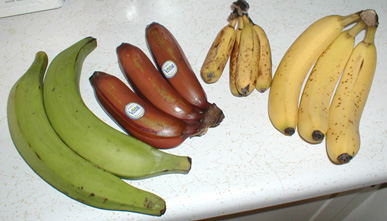
The Gānjiāo (甘蕉, lit. "sweet banana/plantain") "banana, Musa paradisiaca, Musa sapientum" entry distinguishes two kinds of dessert-banana plants and one fiber-banana plant.
The Kan-chiao, seen from afar, resembles a tree. The larger plants are over one armspan in circumference. The leaves are ten feet long, or sometimes seven to eight feet and over one to almost two feet broad. The flowers are as big as a wine cup, with the shape and color of a lotus. Over one hundred pods are attached together at the end of the stem, called a fang (房, spathe). They are sweet and palatable and can also be preserved in honey. The roots resemble taro, the largest as big as a carriage wheel. Fruiting follows flowering, and the flowers, which have a cluster of six pods each, develop successively. The pods are not formed simultaneously and the flowers do not drop at the same time. It is also called Pa-chiao 芭蕉 or Pa-chü 巴苴. Removing the peel of the pod, the yellowish-white interior with a taste like the grape appears, sweet and soft. It satisfies hunger also.
There are three kinds. The kind with pods the size of a thumb, long and pointed, resembling a sheep's horn in shape, is called Yang-chiao-chiao 羊角蕉 (sheep's horn banana), and is the sweetest and most delicious in taste. Another kind with pods the size of a hen's egg and resembling a cow's udder is called Niu-ju-chiao 牛乳蕉 (cow's udder banana), and is slightly inferior to Yang-chiao-chiao. A third kind is the size of a lotus rootstock; the pods are six to seven inches in length, squarish in shape, not sweet, and considered the most inferior. The stem is separable into fibers, and when treated with lime, can be woven into thin cloth, called Chiao-ko 蕉葛 (banana linen). Although the cloth is soft and good and yellowish-white in color, it is not comparable to the reddish linen. The plant grows in both Chiao and Kuang. According to the San-fu huang-t'u 三輔黃圖, "Wu Ti of Han, in the sixth year of the Yüan-ting period (111 B.C.), conquered Nan-yüeh and built the Fu-Ii Palace to plant the rare plants and strange trees obtained. There are two plants Kan-chiao." (1)
This detailed description is of great interest for botanists, but closer observation would have shown that the six fruits in a half-spiral did not come from one ovary. Since banana plants are all sterile hybrid cultigens, species differentiation is problematic. Musa × paradisiaca includes the previously differentiated M. paradisiaca "cooking/fiber banana; plantain" and M. sapientum " dessert banana". Judging from the Nanfang caomu zhuang account, the two yángjiǎojiāo (羊角蕉 "ram's horn banana") and niúrǔjiāo (牛乳蕉 "cow's milk banana") were of the edible sapientum type, and the unnamed third was of the fibrous paradisiaca type. Xiāngjiāo (香蕉 "fragrant banana") is the common name in Modern Standard Chinese usage.
The most surprising thing is the emphasis placed on the banana as a fiber plant, and the oldest occurrences of the word jiao mention no fruit, but only the value of the fiber and the cloth. The (121 CE) Shuowen jiezi first recorded the Chinese character jiāo (蕉 "plantain; banana"), which combines the "plant radical" (艸) and a jiāo (焦 "burnt; scorched") phonetic, defined as (生枲, lit. "living/raw male hemp-nettle") translated "raw plant fiber" or "natural nettle-hemp". Zuo Si's (c. 270) "Wudu fu" (吳都賦 "Rhapsody on the Wu capital", i.e., Suzhou) mentions jiāogé (蕉葛 "linen made from banana/plantain fibers") but not the fruit. Needham, Lu, and Huang say that the banana was primarily a textile-producer, rather than cultivated for fruit, which could reasonably explain the origin of the name, for jiāo (焦) means "heat; burning; boiling", which was how the stems had to be treated with lime water to get the fibers.
This entry quotes the Sanfu huangtu (三輔黃圖 "Description of palace buildings in [the Han capital] Chang'an"), which is an anonymous text of uncertain date, estimated at from the 3rd century to the 8th century, says:
In the sixth year of Yüan-ting [i.e., 111 B. C.] of the reign of Emperor Wu of the Han Dynasty, Annam was vanquished. The palace Fu-li kung 扶荔宮 [so named on account of its lichee plants] was built [in Ch'ang-an, the national capital] for transplanting the newly acquired plants ... among which were ... twelve plants of the kan-chiao, etc. ... Because the climates of the North and the South are different, most of the plants soon died.
Parts of this Nanfang caomu zhuang banana entry are almost identical with passages in earlier and later texts. The Nanfang caomu zhuang source could have been the (2nd-3rd century) Yiwu zhi or (3rd century) Nanzhou yiwu zhi; and it could have been copied into the (3rd-4th century) Nanfang caowu zhi and (4th-5th century) Guang zhi (廣志). Yang Fu's Yiwu zhi gives this description.
Pa-chiao has leaves as large as mats. Its stem is like a [bamboo] shoot. After boiling, the stem breaks into fibres and can be used for weaving cloth. Women weavers make this fibre into fine or coarse linen which is known now as chiao-chih [Cochin-China] linen. The center of the plant is shaped like a garlic-bulb and is as large as a plate[?]. There the fruit grows and holds the 'stem.' One stem bears several tens of fruits. The fruit has a reddish skin like the color of fire and when peeled the inside pulp is dark. The pulp is edible and is very sweet, like sugar or honey. Four or five of these fruits are enough for a meal. After eating, the flavor lingers on among the teeth. Kan-chiao is another name for it.
The Nanfang caomu zhuang has another entry (9) for an unidentified shuijiao (水蕉 "water banana") that "resembles the day-lily, and is either purple or yellow", which Li suggests might be Lycoris.
Chinese spinach
The Nanfangcao mu zhuang entry for yongcai (蕹葉 "Ipomoea aquatica; Chinese spinach; water spinach; swamp cabbage") is the first record of both this vegetable and of floating gardens.
Chinese spinach is a semi-aquatic tropical plant grown, either in water or on wet ground, as a vegetable for its tender shoots and leaves. In southern China it is a very common and popular vegetable, and often escapes from cultivation.
The Yung has leaves resembling the Lo-k'uei 落葵 but smaller in size. The nature is cold and the taste sweet. The southerners make rafts by weaving reeds, cutting into the raft small holes and floating it above the water. When seeds are planted in the water, they float above the water like duckweeds. When grown, the stems and leaves rise above the holes in the raft, which undulates with the water. This is a strange vegetable of the south. Yeh-ko 冶葛 has deadly poison. If juice of the Yung is dropped on the shoot of the latter, it withers instantly. According to traditions, Wei-wu 魏武 could eat Yeh-ko up to one foot in length. It is said that this is possible because he ate the vegetable first. (25)
Wei Wu (魏武 "[Emperor] Wu of Wei") is the posthumous name of Cao Cao (155-220), the penultimate Chancellor of the Eastern Han dynasty and founder of the Cao Wei dynasty (220-265). These plant references are luòkuí (落葵 lit. "falling malva") Basella alba or redvine spinach and yěgé (冶葛 lit. "smelting kudzu") Gelsemium elegans or heartbreak grass. Gelsemium is the subsequent Nanfang caomu zhuang entry (26), which says, "Those who use this to poison people often give it mixed with other raw vegetables. If not discovered quickly and treated with an antidote, the one poisoned will die within half a day." Gelsemium roots contain the highly toxic alkaloid gelsemine, which acts as a paralytic and often results in death. Later Chinese works repeatedly mention using Chinese spinach as an antidote for Gelsemium, and in India, the juice of this plant is believed to have emetic properties and is used in opium poisoning.
Chinese floating gardens are called fēngtián (葑田 "wild-rice fields") or jiàtián (架田 "frame fields"). Many texts, such as Xu Guangqi's (1693) Nongzheng chuanshu (農政全書 "Complete Treatise on Agricultural Administration"), refer to floating gardens. Wang Zhen's (1313) Nongshu (農書 "Treatise on Agriculture") describes wooden instead of reed rafts as Ji Han mentions. Wang Zhen explains that the frame is like a fá (筏 "[bamboo] raft"), and that fēng means the roots of the aquatic plant gū (箛 Zizania latifolia, Manchurian wild rice). He says that floating fields are found more or less everywhere in Southeast China, and quotes a poem by Su Dongpo that describes floating fields on the West Lake at Hangzhou: "'The water drains away, the wild grass sprouts, and gradually a [fengtian] appears".
The chinampas, which have been used by the Aztecs on shallow lakes in the Valley of Mexico since the Middle Postclassic period (1150-1350), are the best-known floating gardens (technically, artificial islands separated by canoe-width channels). Several countries in Asia have actual floating gardens. In China, they are found not only in the Huai and Yangtze River area but also on Dian Lake in the Yunnan–Guizhou Plateau. Floating fields are also found on Kasumigaura, Ibaraki in Japan, Dal Lake in Kashmir, and Inle Lake in Myanmar.
Oranges
The Nanfang caomu zhuang has two entries (62 and 63) for Citrus trees: Jú (橘 Citrus × sinensis, Sweet Orange) and Gān (柑 Citrus reticulata, Mandarin Orange).
The Chü has white flowers and reddish fruits which have fragrant petals and a delicious taste. Since the time of Wu Ti of Han, there was a Minister of Oranges with a salary of two hundred shih [of rice], responsible for presenting oranges to the royal court. In the Huang-wu period of Wu (A.D. 222-229), Shih Hsieh 士燮, the Governor of Chiao-chih, once presented an orange specimen with seventeen fruits to one stalk, considered as a symbol of auspiciousness. The entire court entourage presented their congratulations. (62)
Shi Xie (137-226) was a Han dynasty Administrator of Jiaozhi commandery (present-day northern Vietnam). This story about Shi Xie sending as tribute a sweet orange plant with seventeen fruits to Sun Quan (r. 229-252), the founder of the Eastern Wu dynasty, is not recorded elsewhere, and Ma believes it is a forgery based on the (492-493) Songshu history record that in 33I Yu Liang sent a sweet orange plant with twelve fruits to the Jin dynasty court.
Li notes that the Yiwu Zhi (quoted in the Qimin yaoshu) may possibly be the original source for this Nanfang caomu zhuang entry: "the orange tree has white flowers and reddish fruits, which have fragrant peels and also sweet taste. It is produced in Kiangnan and not elsewhere". The Taiping Yulan quotes this same passage followed by an additional sentence: "There is an orange grove in Chiao-chih, where an administrative officer is installed, with a salary of 300 shih (picul) [of rice], who is responsible for presenting an annual tribute of oranges to the royal court."
The Kan is a kind of orange with an exceptionally sweet and delicious taste. There are yellow and red kinds. The red ones are called Hu-kan 壺柑 (jar orange). In the market, the natives of Chiao-chih sell ants stored in bags of rush mats. The nests are like thin silk. The bags are all attached to twigs and leaves, which, with the ants inside the nests, are for sale. The ants are reddish-yellow in color, bigger than ordinary ants. In the south, if the Kan trees do not have this kind of ant, the fruits will all be damaged by many harmful insects and not a single fruit will be perfect. There are now two trees of Kan in the Hua-lin Garden. When in fruit, the Emperor has the court entourage wine and dine by their side and the fruits are picked and given to all. (63)
Húgān (壺柑) is now called pènggān (椪柑 Citrus poonensis, ponkan, Chinese honey orange"). Ma says the first few sentences appear Zhou Chu's (236-297) Fengtuji (風土記 "Record of Local Conditions"), which is the likely source for this Nanfang caomu zhuang entry. Both Duan Chengshi's (9th century) Yuyang zalu (酉陽雜俎) and the (early 10th century) Lingbiao luyi (嶺表錄異) retell the citrus ant story.
A number of scholars say this Nanfang caomu zhuang mandarin orange entry is the first reference in any literature to the entomological control of plant pests, as well as the earliest example of a biological control agent as an article of commerce.
The arboreal "citrus ant", Oecophylla smaragdina, Chinese huángjīngyǐ (黃猄蟻 "yellow fear ant"), is a weaver ant that binds leaves and twigs together with silk to form tight nests in a tree. At night, the citrus ants retire into these nests, and during the day, they leave the nests and forage for various insects that attack the orange trees and their fruit. To take advantage of these ants, a citrus grower secures a nest on one tree, then connects it to adjacent trees with bamboo strips for bridges, enabling the citrus ants to travel to and build new nests in neighboring trees, and eventually colonize the whole orchard. In 1915, the United States Department of Agriculture sent plant physiologist Walter Tennyson Swingle to China for research in varieties of orange resistant to citrus canker. In collaboration with George W. Groff and his students at Lingnan University in Guangzhou, they became the first Western scientists to encounter the cultivated citrus ant of southern China.