Israeli Jews or Jewish Israelis (Hebrew: יהודים ישראלים Yêhūdīm Yīśrāʾēlīm) comprise Israel's largest ethnoreligious community. The core of their demographic consists of Jews and their descendants. About 46% of the global Jewish population resides in Israel; yerida is historically uncommon and offset by aliyah, (although in 2024 and 2025 Israel experienced net negative migration: yerida was higher than aliyah.); those who do emigrate from the country typically move to the Western world. As such, the Israeli diaspora is closely tied to the broader Jewish diaspora.
Israel is widely described as a melting pot for the various Jewish ethnic divisions, primarily consisting of Ashkenazi Jews, Sephardic Jews, and Mizrahi Jews, as well as many smaller Jewish communities, such as the Beta Israel, the Cochin Jews, the Bene Israel, and the Karaite Jews, among others. Over 25% of Jewish children and 35% of Jewish newborns in Israel are of mixed Ashkenazi and Sephardic or Mizrahi descent, and these figures have been increasing by approximately 0.5% annually: over 50% of Israel's entire Jewish population identifies as having Ashkenazi, Sephardic, and Mizrahi admixture. The integration of Judaism in Israeli Jewish life is split along four categories: the secularists (33%), the traditionalists (24%), the Orthodox (9%), and the Ultra-Orthodox (7%). In addition to religious influences, both Jewish history and Jewish culture serve as important aspects defining Israel's Jewish society, thereby contributing significantly to Israel's identity as the world's only Jewish-majority country.
In 2018, Israel's Knesset narrowly voted in favour of Basic Law: Israel as the Nation-State of the Jewish People. As the Israeli government considers a person's Jewish status to be a matter of nationality and citizenship, the definition of Jewishness in the Israeli Law of Return includes patrilineal Jewish descent; this does not align with the stipulations of Judaism's halakha, which defines Jewishness through matrilineality. As of 1970, all Jews by blood and their spouses automatically qualify for the right to immigrate to the country and acquire Israeli citizenship.
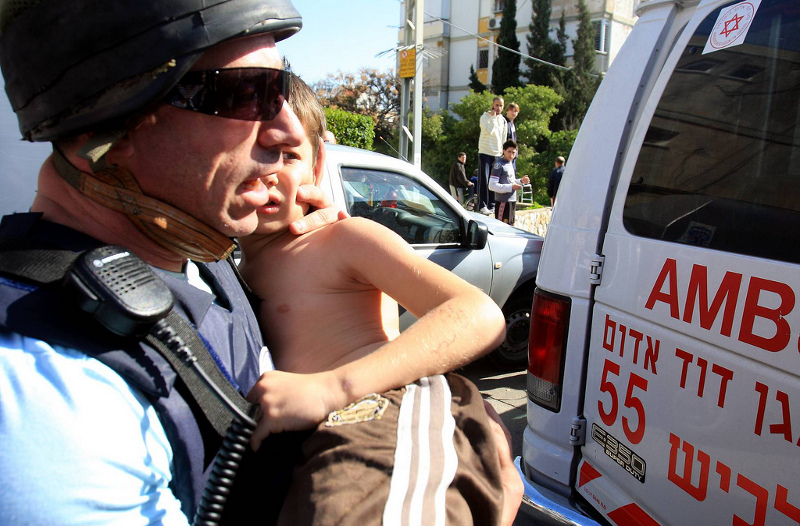
According to the Israel Central Bureau of Statistics, the Israeli Jewish population stood at 7,208,000 in 2023, comprising about 73% of the country's total population. Including non-Jewish relatives (e.g., spouses) raises this figure to 7,762,000, about 79% of the country's population. A 2008 Israel Democracy Institute study found that a plurality of Israeli Jews (47%) identify as Jews first and as Israelis second, and that 39% consider themselves Israelis first and foremost.
Upon the Israeli Declaration of Independence in 1948, the Palestinian Jews of the Yishuv in the British Mandate for Palestine became known as Israeli Jews due to their adoption of a new national identity. The former term has since fallen out of common use.
History
Origins
Jews have long considered the Land of Israel to be their homeland, even while living in the diaspora. According to the Hebrew Bible the connection to the Land of Israel began in the covenant of the pieces when the region, which is called the land of Canaan, was promised to Abraham by God. Abraham settled in the region, where his son Isaac and grandson Jacob grew up with their families. Later on, Jacob and his sons went to Egypt. Decades later their descendants were led out of Egypt by Moses and Aaron, given the Tablets of Stone, returned to the land of Canaan and conquered it under the leadership of Joshua. After the period of the judges, in which the Israelites did not have an organized leadership, the Kingdom of Israel was established, which constructed the First Temple. This kingdom was soon split into two—the Kingdom of Judah and the Kingdom of Israel. After the destruction of these kingdoms and the destruction of the First Temple, the Israelites were exiled to Babylon. After about 70 years parts of the Israelites were permitted to return to the region and soon thereafter they built the Second Temple. Later they established the Hasmonean Kingdom. The region was conquered by the Roman Empire in 63 BCE. During the first couple of centuries in the common era during a series of rebellions against the Roman Empire the Second Temple was destroyed and there was a general expulsion of Jews from their homeland.
The area was later conquered by migrant Arabs who invaded the Byzantine Empire and established a Muslim Caliphate in the 7th century during the rise of Islam. Throughout the centuries the size of the Jewish population in the land fluctuated. Before the birth of modern Zionism in the 1880s, by the early 19th century, more than 10,000 Jews were still living in the area that is today modern Israel.
Following centuries of Jewish diaspora, the 19th century saw the rise of Zionism, a Jewish nationalist movement that had a desire to see the self-determination of the Jewish people through the creation of a homeland for the Jews in Palestine. Significant numbers of Jews have immigrated to Palestine since the 1880s. Zionism remained a minority movement until the rise of Nazism in 1933 and the subsequently attempted extermination of the Jewish people in Nazi-occupied areas of Europe in the Holocaust. In the late 19th century large numbers of Jews began moving to the Ottoman and later British-controlled region. In 1917, the British endorsed a National Home for Jews in Mandate Palestine by issuing the Balfour Declaration. The Jewish population in the region increased from 11% of the population in 1922 to 30% by 1940.
In 1937, following the Great Arab Revolt, the partition plan proposed by the Peel Commission was rejected by both the Palestinian Arab leadership and the Zionist Congress. As a result, believing that their position in the Middle East in the event of a war depended on the support of the Arab states, Britain abandoned the idea of a Jewish state in 1939 in favour of a unitary state with a Jewish minority. The White Paper of 1939 capped Jewish immigration for five years, with further immigration dependent on the agreement of the Arabs. In the event, limited Jewish immigration was permitted until the end of the mandate.

In 1947, following increasing levels of violence, the British government decided to withdraw from Mandatory Palestine. The 1947 UN Partition Plan split the mandate (apart from Jerusalem) into two states, Jewish and Arab, giving about 56% of Mandatory Palestine to the Jewish state. Immediately following the adoption of the Partition Plan by the United Nations General Assembly, the Palestinian Arab leadership rejected the plan to create the as-yet-unnamed Jewish State and launched a guerrilla war.
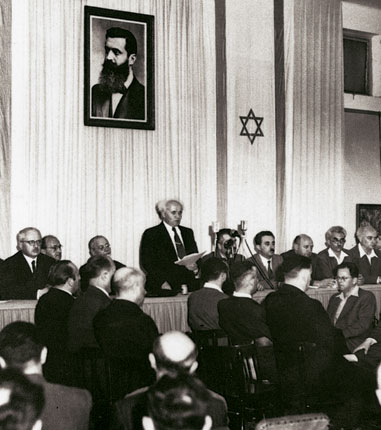
On 14 May 1948, one day before the end of the British Mandate of Palestine, the leaders of the Jewish community in Palestine led by prime minister David Ben-Gurion, made a declaration of independence, of the State of Israel though without any reference to defined borders.
1948 Arab–Israeli War
The armies of Egypt, Lebanon, Syria, Jordan, and Iraq invaded the former mandate, thus starting the 1948 Arab–Israeli War. The nascent Israeli Defense Force repulsed the Arab nations from much of the former mandate, thus extending its borders beyond the original UNSCOP partition. By December 1948, Israel controlled much of Mandate Palestine west of the Jordan River. The remainder of the Mandate consisted of Jordan, the area that came to be called the West Bank (controlled by Jordan), and the Gaza Strip (controlled by Egypt). Prior to and during this conflict, 711,000 Palestinians Arabs fled their original lands to become Palestinian refugees. The reasons for this are disputed, and range from claims that the major cause of Palestinian flight was military actions by the Israel Defense Forces and fear of events such as the Deir Yassin massacre to an encouragement to leave by Arab leaders so that they could return when the war was won.

1949–present
Immigration of Holocaust survivors and Jewish refugees from Arab lands doubled Israel's population within one year of its independence. Over the following years approximately 850,000 Sephardi and Mizrahi Jews fled or were expelled from surrounding mostly due persecution in Arab countries, and in smaller numbers from Turkey, India, Afghanistan, and Iran. Of these, about 680,000 settled in Israel.
Israel's Jewish population continued to grow at a very high rate for years, fed by waves of Jewish immigration from round the world, most notably the massive immigration wave of Soviet Jews, which arrived in Israel in the early 1990s following the dissolution of the USSR, who, according to the Law of Return, were entitled to become Israeli citizens upon arrival. About 380,000 arrived in 1990–1991 alone. Some 80,000–100,000 Ethiopian Jews have immigrated to Israel since the early 1980s.
Since 1948, Israel has been involved in a series of major military conflicts, including the 1956 Suez War, 1967 Six-Day War, 1973 Yom Kippur War, 1982 Lebanon War, and 2006 Lebanon War, as well as a nearly constant series of ongoing minor conflicts. Israel has been also embroiled in an ongoing conflict with the Palestinians in the Israeli-occupied territories, which have been under Israeli control since the Six-Day War, despite the signing of the Oslo Accords on 13 September 1993, and the ongoing efforts of Israeli, Palestinian and global peacemakers.

Population
According to Israel's Central Bureau of Statistics, as of January 1, 2020, of Israel's 9.136 million people, 74.1% were Jews of any background. Among them, 68% were Sabras (Israeli-born), mostly second- or third-generation Israelis, and the rest are olim (Jewish immigrants to Israel)—22% from Europe and the Americas, and 10% from Asia and Africa, including the Arab countries. Nearly half of all Israeli Jews are descended from Jews who made aliyah from Europe, while around the same number are descended from Jews who made aliyah from Arab countries, Iran, Turkey, and Central Asia. Over two hundred thousand are, or are descended from, Ethiopian and Indian Jews.
Growth
Israel is the only country in the world with a consistently growing Jewish population due to natural population increase. Jewish communities in the Diaspora feature a population declining or steady, with the exception of the Orthodox and Haredi Jewish communities around the world, whose members often shun birth control for religious reasons, who have experienced rapid population growth. The growth of the Orthodox and Haredi sector has partly balanced out negative population growth amongst other Jewish denominations. Haredi women have 7.7 children on average while the average Israeli Jewish woman has over 3 children.
When Israel was first established in 1948, it had the third-largest Jewish population in the world, after the United States and Soviet Union. In the 1970s, Israel surpassed the Soviet Union as having the second-largest Jewish population. In 2003, the Israeli Central Bureau of Statistics reported that Israel had surpassed the United States as the nation with the world's largest Jewish population. The report was contested by Professor Sergio Della Pergola of the Hebrew University of Jerusalem. Considered the greatest demographic expert on Jews, Della Pergola said it would take another three years to close the gap. In January 2006, Della Pergola stated that Israel now had more Jews than the United States, and Tel Aviv had replaced New York as the metropolitan area with the largest Jewish population in the world, while a major demographic study found that Israel's Jewish population surpassed that of the United States in 2008. Due to the decline of Diaspora Jewry as a result of intermarriage and assimilation, along with the steady growth of the Israeli Jewish population, it has been projected by the Pew Research Center that by the mid 2050s a majority of the world's Jews will live in Israel. In March 2012, the Israeli Census Bureau of Statistics reported on behalf of Ynet has forecast that in 2019, Israel will be home to 6,940,000 Jews, 5.84 million which are non-Haredi Jews living in Israel, compared with 5.27 million in 2009. The number is expected to grow to anywhere between 6.09 million and 9.95 million by 2059, marking a 16%–89% increase with the 2011 population. The Bureau also forecasts that the ultra-Orthodox population will number 1.1 million people by 2019, compared with 750,000 in 2009. By 2059, the projected Haredi Jewish population is estimated to be between 2.73 million and 5.84 million, marking a 264%–686% increase. Thus the total projected Israeli Jewish population by 2059 is estimated to be between 8.82 million and 15.790 million. In January 2014, it was reported by demographer Joseph Chamie that the projected population of Israeli Jews is expected to reach between 9.84 million by the year 2025 and 11.40 million by 2035.

Significant Jewish population centers
For statistical purposes, there are three main metropolitan areas in Israel. The majority of the Jewish population in Israel is located in the central area of Israel within the Metropolitan area of Tel Aviv. The Metropolitan area of Tel Aviv is currently the largest Jewish population center in the world.
It has been argued that Jerusalem, Israel's proclaimed capital and largest city with a population of 732,100, and an urban area with a population of over 1,000,000 (including 280,000 Palestinian East Jerusalemites who are not Israeli citizens), with over 700,000 Israeli Jews and Nazareth with a population of 65,500, and an urban area of nearly 200,000 people of which over 110,000 are Israeli Jews should also be classified as metropolitan areas.
Jewish communities in Israel
By the time the State of Israel was proclaimed, the majority of Jews in the state and the region were Ashkenazi. Following the declaration of the state, a flood of Jewish migrants and refugees entered Israel—both from Europe and America and also from Arab and Muslim countries. Most of the Jewish immigrants in the 1950s and 1960s were Jewish Holocaust survivors, as well as Sephardic Jews and Mizrahi Jews (mostly Moroccan Jews, Algerian Jews, Tunisian Jews, Yemenite Jews, Bukharan Jews, Iranian Jews, Iraqi Jews, Kurdish Jews, and smaller communities, principally from Lebanon, Syria, Libya, Egypt, India, Turkey and Afghanistan). In recent decades other Jewish communities have also immigrated to Israel including Ethiopian Jews, Russian Jews and Bnei Menashe.
Among Israeli Jews, 75% are Sabras (Israeli-born), mostly second- or third-generation Israelis, and the rest are olim (Jewish immigrants to Israel)—19% from Europe, Americas and Oceania, and 9% from Asia and Africa, mostly the Muslim world.
The Israeli government does not trace the diaspora origin of Israeli Jews.
Paternal country of diaspora origin
The CBS traces the paternal country of diaspora origin of Israeli Jews (including non–Halachically Jewish immigrants who arrived on the Law of Return) as of 2010 is as follows.
In Israel there are approximately 300,000 citizens with Jewish ancestry who are not Jewish according to Orthodox interpretations of Jewish law. Of this number approximately 10% are Christian and 89% are either Jewish or non-religious. The total number of conversions under the Nativ program of IDF was 640 in 2005 and 450 in 2006. From 2002 to 1 October 2007, a total of 2,213 soldiers have converted under Nativ. In 2003, 437 Christians converted to Judaism; in 2004, 884; and in 2005, 733. Recently several thousand conversions conducted by the Chief Rabbinate under the leadership of Rabbi Chaim Drukman have been annulled, and the official Jewish status over several thousand people who converted through the conversion court of the Chief Rabbinate since 1999 hangs in limbo as the proceedings continue regarding these individuals Jewish status. The vast majority of these individuals are former Soviet Union immigrants.
In his book from 2001 "The Invention and Decline of Israeliness: State, Culture and Military in Israel", the Israeli sociologist Baruch Kimmerling identified and divided the modern Israeli society into seven population groups (seven subcultures): The secular upper-middle class group, the national religious group, the traditionalist Mizrahim group, the Orthodox religious group, the Arab citizens of Israel, the Russian immigrants group and the Ethiopian immigrants group. According to Kimmerling, each of these population groups have distinctive characteristics, such as place of resident, consumption patterns, education systems, communications media and more.
Israeli Jews who emigrated from European and American countries
Today, Jews whose family emigrated from European countries and the Americas, on their paternal line, constitute the largest single group among Israeli Jews and consist of about 3,000,000 people living in Israel. About 1,200,000 of them are descended from or are immigrants from the former Soviet Union who returned from the diaspora after the fall of the Former Soviet Union 1991 (about 300,000 of them are not considered to be Jewish under Jewish law). Most of the other 1,800,000 are descended from the first Zionist settlers in the Land of Israel, as well as Holocaust survivors and their descendants, with an additional 200,000 having immigrated or descended from immigrants from English-speaking countries and South America. They have played a prominent role in various fields including the arts, entertainment, literature, sports, science and technology, business and economy, media, and politics of Israel since its founding, and tend to be the most affluent of Israeli Jews.
Not all Jews immigrating to Israel from European countries are of Ashkenazi origin (the majority of French Jews are of Sephardic, and some Jews from the Asian Republics of the USSR are Mizrahi), and the Israeli government does not distinguish between Jewish communities in its census.
During the first decades of Israel as a state, strong cultural conflict existed between Mizrahi, Sephardic and Ashkenazi Jews (mainly east European Ashkenazim). The roots of this conflict, which still exists to a much smaller extent in present-day Israeli society, stem from the many cultural differences between the various Jewish communities, despite the government's encouragement of the "melting pot". That is to say, all Jewish immigrants in Israel were strongly encouraged to "melt down" their own particular exile identities within the general social "pot" in order to become Israeli.
The current most prominent European countries of origin of the Israeli Jews are as follows:
Israeli Jews who emigrated from North African and Asian countries
The majority of Israeli Jews are Mizrahi. The exact proportion of Mizrahi and Sephardic Jewish populations in Israel is unknown (since it is not included in the census); some estimates place Jews of Mizrahi origin at up to 61% of the Israeli Jewish population, with hundreds of thousands more having mixed Ashkenazi heritage due to cross-cultural intermarriage. In a survey that attempted to be representative, 44.9% percent of the Israeli Jewish sample identified as either Mizrahi or Sephardi, 44.2% as Ashkenazi or Russian Jews, about 3% as Beta Israel and 7.9% as mixed or other.
Jews from North Africa and Asia have come to be called "Mizrahi Jews".
Most African and Asian Jewish communities use the Sephardic prayer ritual and abide by the rulings of Sephardic rabbinic authorities, and therefore consider themselves to be "Sephardim" in the broader sense of "Jews of the Spanish rite", though not in the narrower sense of "Spanish Jews". Of late, the term Mizrahi has come to be associated with all Jews in Israel with backgrounds in Islamic lands.
Cultural and/or racial biases against the newcomers were compounded by the fledgling state's lack of financial resources and inadequate housing to handle the massive population influx. Austerity was the law of the land during the country's first decade of existence. Thus, hundreds of thousands of new Sephardic immigrants were sent to live in tent cities in outlying areas. Sephardim (in its wider meaning) were often victims of discrimination, and were sometimes called schwartze (meaning "black" in Yiddish). The most egregious effects of racism were documented in the Yemenite children affair, in which Yemenite children were placed in the foster care of Ashkenazim families, their families being told that their children had died.
Some believe that even worse than the housing discrimination was the differential treatment accorded the children of these immigrants, many of whom were tracked by the largely European education establishment into dead-end "vocational" high schools, without any real assessment of their intellectual capacities. Mizrahi Jews protested their unfair treatment, and even established the Israeli Black Panthers movement with the mission of working for social justice.
The effects of this early discrimination still linger a half-century later, as documented by the studies of the Adva Center, a think tank on social equality, and by other Israeli academic research (cf., for example, Tel Aviv University Professor Yehuda Shenhav's article in Hebrew documenting the gross under-representation of Sephardic Jewry in Israeli high school history textbooks.) All Israeli Prime Ministers have been Ashkenazi, although Sephardim and Mizrahim have attained high positions including ministerial positions, chief of staffs and presidency. The student bodies of Israel's universities remain overwhelmingly Ashkenazi in origin, despite the fact that roughly half the country's population is non-Ashkenazi. The tent cities of the 1950s morphed into so-called "development towns". Scattered over border areas of the Negev Desert and the Galilee, far from the bright lights of Israel's major cities, most of these towns never had the critical mass or ingredients to succeed as places to live, and they continue to suffer from high unemployment, inferior schools, and chronic brain drain.
While the Israeli Black Panthers no longer exist, the Mizrahi Democratic Rainbow Coalition and many other NGOs carry on the struggle for equal access and opportunity in housing, education, and employment for the country's underprivileged populace—still largely composed of Sephardim and Mizrahim, joined now by newer immigrants from Ethiopia and the Caucasus Mountains.
Today over 2,500,000 Mizrahi Jews, and Sephardic Jews live in Israel with the majority of them being descendants of the 680,000 Jews who fled Arab countries due to expulsions and antisemitism, with smaller numbers having emigrated from the Islamic Republics of the Former Soviet Union (c.250,000), India (70,000), Iran (200,000–250,000), and Turkey (80,000). Before the immigration of over 1,000,000 Russian, mainly Ashkenazi Jews to Israel after to collapse of the Soviet Union, 70% of Israeli Jews were Sephardic or Mizrahi Jews.
The current most prominent countries of diaspora origin of these Jewish communities are as follows:
Italian rite and Romaniote Jews
Israel also has small populations of Italian (rite) Jews from Italy and Romaniote Jews from Greece, Cyprus and Turkey. Both groups are considered distinct from the Sephardim and the Ashkenazim. Jews from both communities made aliyah in relatively large numbers during the 20th century, especially after the Holocaust. Both came in relatively small numbers as compared to other Jewish groups. Despite their small numbers, the Italian have been prominent in the economy and academia. Most Italian and Romaniote Israelis and their descendants live in the Tel Aviv area.
Argentine Jews
Argentines in Israel are the largest immigrant group from Latin America and one of the fastest growing groups. The vast majority of Argentines in Israel are Jewish Argentines who make Aliyah but there is also an important group of non-Jewish Argentines, having, or being married to somebody who has, at least one Jewish grandparent, who choose Israel as their new home. There are about 50,000 Argentines residing in Israel although some estimates put the figure at 70,000.
Most Jewish Argentines are Ashkenazi Jews.
Ethiopian Beta Israel
Nearly all of the Ethiopian Beta Israel community today lives in Israel, comprising more than 121,000 people. Most of this population are the descendants and the immigrants who immigrated to Israel during two massive waves of immigration mounted by the Israeli government—"Operation Moses" (1984) and during "Operation Solomon" (1991). Civil war and famine in Ethiopia prompted the Israeli government to mount these dramatic rescue operations. The rescues were within the context of Israel's national mission to gather Diaspora Jews and bring them to the Jewish homeland. Some immigration has continued up until the present day. Today 81,000 Ethiopian Israelis were born in Ethiopia, while 38,500 or 32% of the community are native born Israelis.
Over time, the Ethiopian Jews in Israel moved out of the government-owned mobile home camps that they initially lived in and settled mainly in the various cities and towns throughout Israel, mainly with the encouragement of the Israeli authorities who granted the new immigrants generous government loans or low-interest mortgages.
Similarly to other groups of immigrant Jews who made aliyah to Israel, the Ethiopian Jews have faced obstacles in their integration to Israeli society. Initially the main challenges of the Ethiopian Jewish community in Israel were due in part to communication difficulties (most of the population could not read or write in Hebrew, and much of the veteran population could not hold a simple conversation in the Hebrew language), and discrimination in certain areas of the Israeli society. Unlike Russian immigrants, many of whom arrive with job skills, Ethiopians came from a subsistence economy and were ill-prepared to work in an industrialized society.
Over the years there has been significant progress in the integration of this population group in the Israeli society, primarily due to the fact that most of the young Ethiopian population is conscripted into the military service (mandatory for all Israelis at 18), where most Ethiopian Jews have been able to increase their chances for better opportunities.