
The Information Age is a historical period that began in the mid-20th century. It is characterized by a rapid shift from traditional industries, as established during the Industrial Revolution, to an economy centered on information technology. The onset of the Information Age has been linked to the development of the transistor in 1947. This technological advance has had a significant impact on the way information is processed and transmitted.
According to the United Nations Public Administration Network, the Information Age was formed by capitalizing on computer miniaturization advances, which led to modernized information systems and internet communications as the driving force of social evolution.
There is ongoing debate concerning whether the Third Industrial Revolution has already ended and recent breakthroughs in areas such as artificial intelligence and biotechnology have spawned a Fourth Industrial Revolution. This next transition has been theorized to harken the advent of the Imagination Age, the Internet of things (IoT), and rapid advances in machine learning.
History
The digital revolution converted technology from analog format to digital format. By doing this, it became possible to make copies that were identical to the original. In digital communications, for example, repeating hardware was able to amplify the digital signal and pass it on with no loss of information in the signal. Of equal importance to the revolution was the ability to easily move the digital information between media and to access or distribute it remotely. One turning point of the revolution was the change from analog to digitally recorded music. During the 1980s, the digital format of optical compact discs gradually replaced analog formats, such as vinyl records and cassette tapes, as the popular medium of choice.
Previous inventions
Humans have manufactured tools for counting and calculating since ancient times, such as the abacus, astrolabe, equatorium, and mechanical timekeeping devices. More complicated devices started appearing in the 1600s, including the slide rule and mechanical calculators. By the early 1800s, the Industrial Revolution had produced mass-market calculators like the arithmometer and the enabling technology of the punch card. Charles Babbage proposed a mechanical general-purpose computer called the Analytical Engine, but it was never successfully built, and was largely forgotten by the 20th century, and unknown to most of the inventors of modern computers.
The Second Industrial Revolution, in the last quarter of the 19th century, developed useful electrical circuits and the telegraph. In the 1880s, Herman Hollerith developed electromechanical tabulating and calculating devices using punch cards and unit record equipment, which became widespread in business and government.

Meanwhile, various analog computer systems used electrical, mechanical, or hydraulic systems to model problems and calculate answers. These included an 1872 tide-predicting machine, differential analysers, perpetual calendar machines, the Deltar for water management in the Netherlands, network analyzers for electrical systems, and various machines for aiming military guns and bombs. The construction of problem-specific analog computers continued in the late 1940s and beyond, with FERMIAC for neutron transport, Project Cyclone for various military applications, and the Phillips Machine for economic modeling.
Building on the complexity of the Z1 and Z2, German inventor Konrad Zuse used electromechanical systems to complete in 1941 the Z3, the world's first working programmable, fully automatic digital computer. Also, during World War II, Allied engineers constructed electromechanical bombes to break the German Enigma machine encoding. The base-10 electromechanical Harvard Mark I was completed in 1944, and was to some degree improved with inspiration from Charles Babbage's designs.
1947–1969: Origins
In 1947, the first working transistor, the germanium-based point-contact transistor, was invented by John Bardeen and Walter Houser Brattain while working under William Shockley at Bell Labs. This led the way to more advanced digital computers. From the late 1940s, universities, the military, and businesses developed computer systems to digitally replicate and automate previously manually performed mathematical calculations, with the LEO being the first commercially available general-purpose computer.
Digital communication became economical for widespread adoption after the invention of the personal computer in the 1970s. Claude Shannon, a Bell Labs mathematician, is generally credited with laying the foundations of digitalization in his pioneering 1948 article, A Mathematical Theory of Communication.
In 1948, Bardeen and Brattain patented an insulated-gate transistor (IGFET) with an inversion layer. Their concept forms the basis of CMOS and DRAM technology today. In 1957, at Bell Labs, Frosch and Derick were able to manufacture planar silicon dioxide transistors, later a team at Bell Labs demonstrated a working MOSFET. The first integrated circuit milestone was achieved by Jack Kilby in 1958.
Other important technological developments included the invention of the monolithic integrated circuit chip by Robert Noyce at Fairchild Semiconductor in 1959, made possible by the planar process developed by Jean Hoerni. In 1963, complementary MOS (CMOS) was developed by Chih-Tang Sah and Frank Wanlass at Fairchild Semiconductor. The self-aligned gate transistor, which further facilitated mass production, was invented in 1966 by Robert Bower at Hughes Aircraft and independently by Robert Kerwin, Donald Klein, and John Sarace at Bell Labs.
In 1962, AT&T deployed the T-carrier for long-haul pulse-code modulation (PCM) digital voice transmission. The T1 format carried 24 pulse-code modulated, time-division multiplexed speech signals, each encoded in 64 kbit/s streams, leaving 8 kbit/s of framing information, which facilitated the synchronization and demultiplexing at the receiver. Over the subsequent decades, the digitisation of voice became the norm for all but the last mile (where analogue continued to be the norm right into the late 1990s).
Following the development of MOS integrated circuit chips in the early 1960s, MOS chips reached higher transistor density and lower manufacturing costs than bipolar integrated circuits by 1964. MOS chips further increased in complexity at a rate predicted by Moore's law, leading to large-scale integration (LSI) with hundreds of transistors on a single MOS chip by the late 1960s. The application of MOS LSI chips to computing was the basis for the first microprocessors, as engineers began recognizing that a complete computer processor could be contained on a single MOS LSI chip. In 1968, Fairchild engineer Federico Faggin improved MOS technology with his development of the silicon-gate MOS chip, which he later used to develop the Intel 4004, the first single-chip microprocessor. It was released by Intel in 1971 and laid the foundations for the microcomputer revolution that began in the 1970s.
MOS technology also led to the development of semiconductor image sensors suitable for digital cameras. The first such image sensor was the charge-coupled device, developed by Willard S. Boyle and George E. Smith at Bell Labs in 1969, based on MOS capacitor technology.

1969–1989: Invention of the internet, rise of home computers
The public was first introduced to the concepts that led to the Internet when a message was sent over the ARPANET in 1969. Packet switched networks such as ARPANET, Mark I, CYCLADES, Merit Network, Tymnet, and Telenet, were developed in the late 1960s and early 1970s using a variety of protocols. The ARPANET in particular led to the development of protocols for internetworking, in which multiple separate networks could be joined into a network of networks.
The Whole Earth movement of the 1960s advocated the use of new technology.
In the 1970s, the home computer was introduced, time-sharing computers, the video game console, the first coin-op video games, and the golden age of arcade video games began with Space Invaders. As digital technology proliferated, and the switch from analog to digital record keeping became the new standard in business, a relatively new job description was popularized, the data entry clerk. Culled from the ranks of secretaries and typists from earlier decades, the data entry clerk's job was to convert analog data (customer records, invoices, etc.) into digital data.

In developed nations, computers achieved semi-ubiquity during the 1980s as they made their way into schools, homes, businesses, and industry. Automated teller machines, industrial robots, CGI in film and television, electronic music, bulletin board systems, and video games all fueled what became the zeitgeist of the 1980s. Millions of people purchased home computers, making household names of early personal computer manufacturers such as Apple, Commodore, and Tandy. To this day, the Commodore 64 is often cited as the best-selling computer of all time, having sold 17 million units (by some accounts) between 1982 and 1994.
In 1984, the U.S. Census Bureau began collecting data on computer and Internet use in the United States; their first survey showed that 8.2% of all U.S. households owned a personal computer in 1984, and that households with children under the age of 18 were nearly twice as likely to own one at 15.3% (middle and upper middle class households were the most likely to own one, at 22.9%). By 1989, 15% of all U.S. households owned a computer, and nearly 30% of households with children under the age of 18 owned one. By the late 1980s, many businesses were dependent on computers and digital technology.
Motorola created the first mobile phone, the Motorola DynaTac, in 1983. However, this device used analog communication – digital cell phones were not sold commercially until 1991, when the 2G network started to be opened in Finland to accommodate the unexpected demand for cell phones that was becoming apparent in the late 1980s.
Compute! magazine predicted that CD-ROM would be the centerpiece of the revolution, with multiple household devices reading the discs.
The first true digital camera was created in 1988, and the first were marketed in December 1989 in Japan and in 1990 in the United States. By the early 2000s, digital cameras had eclipsed traditional film in popularity.
Digital ink and paint were also invented in the late 1980s. Disney's CAPS system (created in 1988) was used for a scene in 1989's The Little Mermaid and for all their animation films between 1990's The Rescuers Down Under and 2004's Home on the Range.
1989–2005: Invention of the World Wide Web, mainstreaming of the Internet, Web 1.0
Tim Berners-Lee invented the World Wide Web in 1989. The "Web 1.0 era" ended in 2005, coinciding with the development of further advanced technologies at the beginning of the 21st century.
The first public digital HDTV broadcast was of the 1990 FIFA World Cup that June; it was played in 10 theaters in Spain and Italy. However, HDTV did not become a standard until the mid-2000s outside Japan.
The World Wide Web became publicly accessible in 1991, which had been available only to government and universities. In 1993, Marc Andreessen and Eric Bina introduced Mosaic, the first web browser capable of displaying inline images and the basis for later browsers such as Netscape Navigator and Internet Explorer. Stanford Federal Credit Union was the first financial institution to offer online internet banking services to all of its members in October 1994. In 1996, OP Financial Group, also a cooperative bank, became the second online bank in the world and the first in Europe. The Internet expanded rapidly worldwide, and by 1996, it was part of mass culture, with many businesses listing websites in their ads. By 1999, almost every country had a connection, and nearly half of Americans and people in several other countries used the internet on a regular basis. However, throughout the 1990s, "getting online" entailed complicated configuration, and dial-up was the only connection type affordable by individual users; the present-day mass internet culture was not possible.
In 1989, about 15% of all households in the United States owned a personal computer.
For households with children, nearly 30% owned a computer in 1989, and in 2000, 65% owned one.
Cell phones became as ubiquitous as computers by the early 2000s, with movie theaters beginning to show ads telling people to silence their phones. They also became much more advanced than phones of the 1990s, most of which only took calls or at most allowed for the playing of simple games.
Text messaging became widely used worldwide in the late 1990s, except in the United States, where it didn't become commonplace until the early 2000s.
The digital revolution became truly global at this time as well – after revolutionizing society in the developed world in the 1990s, the digital revolution spread to the masses in the developing world in the 2000s.
By 2000, the majority of U.S. households had at least one personal computer and internet access the following year. In 2002, a majority of U.S. survey respondents reported having a mobile phone.
2005–2020: Web 2.0, social media, smartphones, digital TV
In late 2005, the number of people with internet access reached 1 billion, and 3 billion people worldwide used cell phones by the end of the decade. High-definition television became the standard television broadcasting format in many countries by the end of the decade. In September and December 2006, respectively, Luxembourg and the Netherlands became the first countries to completely transition from analog to digital television. In September 2007, a majority of U.S. survey respondents reported having broadband internet at home. According to estimates from the Nielsen Media Research, approximately 45.7 million U.S. households in 2006 (or approximately 40 percent of approximately 114.4 million) owned a dedicated home video game console, and by 2015, 51 percent of U.S. households owned a dedicated home video game console according to an Entertainment Software Association annual industry report. By 2012, over 2 billion people used the Internet, twice the number using it in 2007. Cloud computing had entered the mainstream by the early 2010s. In January 2013, a majority of U.S. survey respondents reported owning a smartphone. By 2016, half of the world's population was connected, and as of 2020, that number has risen to 67%.
Rise in digital technology and commercialization of computers
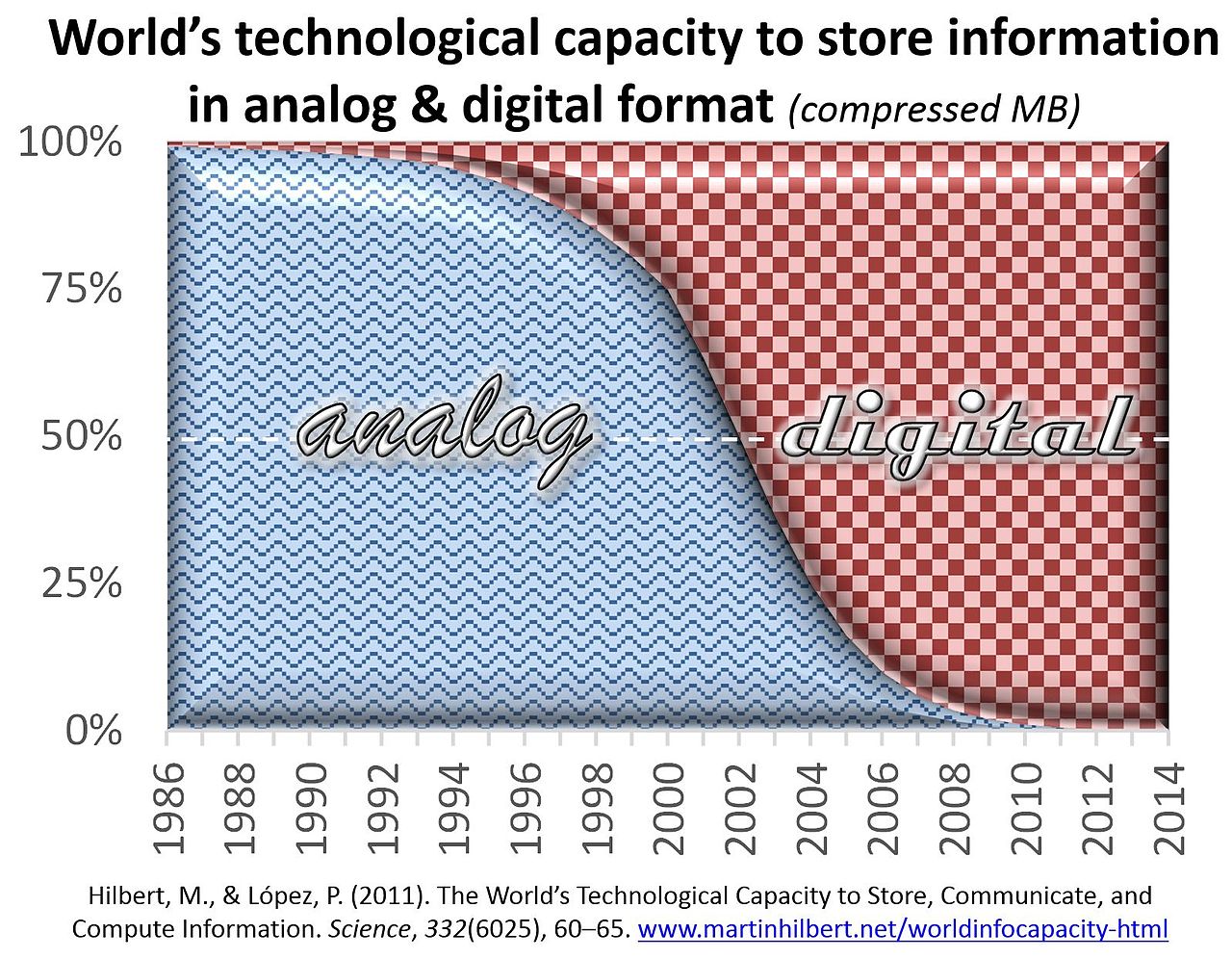
In the late 1980s, less than 1% of the world's technologically stored information was in digital format. By 2007, this number increased to 94%, and to more than 99% by 2014.
Moreover, it is estimated that the world's capacity to store information in a digital form has increased from 2.6 (optimally compressed) exabytes in 1986 to approximately 5,000 exabytes in 2014 (5 zettabytes).
Overview of early developments
Library expansion and Moore's law
Library expansion was calculated in 1945 by Fremont Rider to double in capacity every 16 years where sufficient space made available. He advocated replacing bulky, decaying printed works with miniaturized microform analog photographs, which could be duplicated on-demand for library patrons and other institutions.
Rider did not foresee, however, the digital technology that would follow decades later to replace analog microform with digital imaging, storage, and transmission media, whereby vast increases in the rapidity of information growth would be made possible through automated, potentially-lossless digital technologies. Accordingly, Moore's law, formulated around 1965, would calculate that the number of transistors in a dense integrated circuit doubles approximately every two years.
By the early 1980s, along with improvements in computing power, the proliferation of the smaller and less expensive personal computers allowed for immediate access to information and the ability to share and store it. Connectivity between computers within organizations enabled access to greater amounts of information.
Information storage and Kryder's law
The world's technological capacity to store information grew from 2.6 (optimally compressed) exabytes (EB) in 1986 to 15.8 EB in 1993; over 54.5 EB in 2000; and to 295 (optimally compressed) EB in 2007. This is the informational equivalent to less than one 730-megabyte (MB) CD-ROM per person in 1986 (539 MB per person); roughly four CD-ROM per person in 1993; twelve CD-ROM per person in the year 2000; and almost sixty-one CD-ROM per person in 2007. It is estimated that the world's capacity to store information has reached 5 zettabytes in 2014, the informational equivalent of 4,500 stacks of printed books from the earth to the sun.
The amount of digital data stored appears to be growing approximately exponentially, reminiscent of Moore's law. As such, Kryder's law prescribes that the amount of storage space available appears to be growing approximately exponentially.
Information transmission
The world's technological capacity to receive information through one-way broadcast networks was 432 exabytes of (optimally compressed) information in 1986; 715 (optimally compressed) exabytes in 1993; 1.2 (optimally compressed) zettabytes in 2000; and 1.9 zettabytes in 2007, the information equivalent of 174 newspapers per person daily.
The world's effective capacity to exchange information through two-way Telecommunications networks was 281 petabytes of (optimally compressed) information in 1986; 471 petabytes in 1993; 2.2 (optimally compressed) exabytes in 2000; and 65 (optimally compressed) exabytes in 2007, the information equivalent of six newspapers per person daily. In the 1990s, the spread of the Internet caused a sudden leap in access to and ability to share information in businesses and homes globally. A computer that cost $3000 in 1997 would cost $2000 two years later and $1000 the following year, due to the rapid advancement of technology.
Computation
The world's technological capacity to compute information with human-guided general-purpose computers grew from 3.0 × 10⁸ MIPS in 1986, to 4.4 × 10⁹ MIPS in 1993; to 2.9 × 10¹¹ MIPS in 2000; to 6.4 × 10¹² MIPS in 2007. An article featured in the journal Trends in Ecology and Evolution in 2016 reported that:
Digital technology has vastly exceeded the cognitive capacity of any single human being and has done so a decade earlier than predicted. In terms of capacity, there are two measures of importance: the number of operations a system can perform and the amount of information that can be stored. The number of synaptic operations per second in a human brain has been estimated to lie between 1015 and 1017. While this number is impressive, even in 2007 humanity's general-purpose computers were capable of performing well over 1018 instructions per second. Estimates suggest that the storage capacity of an individual human brain is about 1012 bytes. On a per capita basis, this is matched by current digital storage (5×1021 bytes per 7.2×10⁹ people).
Genetic information
Genetic code may also be considered part of the information revolution. Now that sequencing has been computerized, genome can be rendered and manipulated as data. This started with DNA sequencing, invented by Walter Gilbert and Allan Maxam in 1976–1977 and Frederick Sanger in 1977, grew steadily with the Human Genome Project, initially conceived by Gilbert and finally, the practical applications of sequencing, such as gene testing, after the discovery by Myriad Genetics of the BRCA1 breast cancer gene mutation. Sequence data in GenBank has grown from the 606 genome sequences registered in December 1982 to the 231 million genomes in August 2021. An additional 13 trillion incomplete sequences are registered in the Whole Genome Shotgun submission database as of August 2021. The information contained in these registered sequences has doubled every 18 months.
Different stage conceptualizations
During rare times in human history, there have been periods of innovation that have transformed human life. The Neolithic Age, the Scientific Revolution and the Industrial Age all, ultimately, induced discontinuous and irreversible changes in the economic, social and cultural elements of the daily life of most people. Traditionally, these epochs have taken place over hundreds, or in the case of the Neolithic Revolution, thousands of years, whereas the Information Age swept to all parts of the globe in just a few years, as a result of the rapidly advancing speed of information exchange.