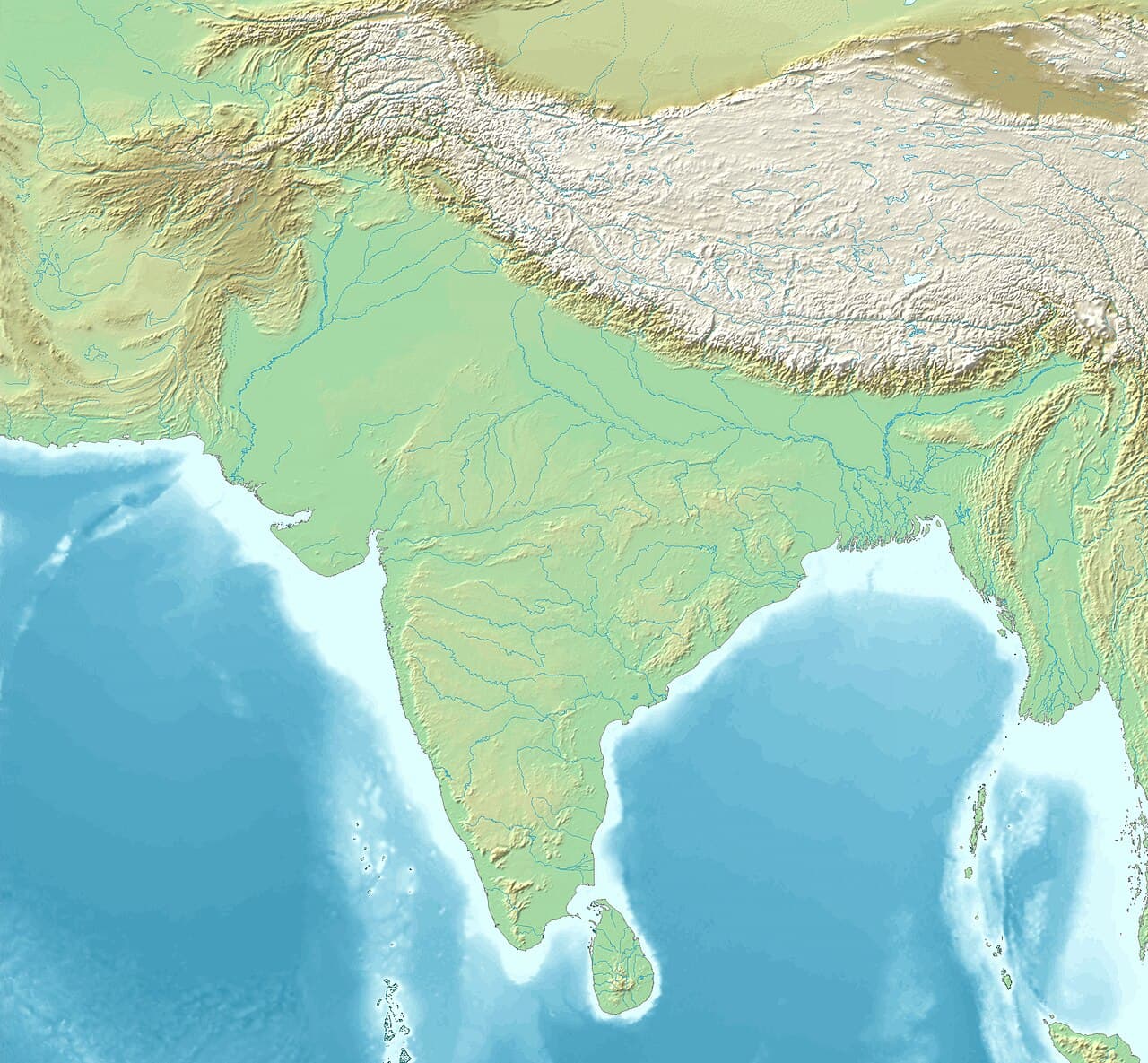
The Indian subcontinent is a physiographic region of Asia below the Himalayas which projects into the Indian Ocean between the Bay of Bengal to the east and the Arabian Sea to the west. It is now divided between Bangladesh, India, and Pakistan. Although the terms Indian subcontinent and South Asia are often also used interchangeably to denote a wider region which includes, in addition, Bhutan, the Maldives, Nepal and Sri Lanka, the Indian subcontinent term is more geophysical, whereas South Asia is more geopolitical. South Asia is also frequently defined to include Afghanistan, which is not considered part of the subcontinent even in extended usage.
Name
The region surrounding and southeast of the Indus River was often simply referred to as India in many historical sources. Even today, historians use India to denote the entire Indian subcontinent when discussing history up until the era of the British Raj. Over time, however, the term India evolved to refer to a distinct political entity that eventually became a nation-state.
According to the Oxford English Dictionary, the term subcontinent signifies a "subdivision of a continent which has a distinct geographical, political, or cultural identity" and also a "large land mass somewhat smaller than a continent". Its use to signify the Indian subcontinent is evidenced from the early twentieth century when most of the territory was either part of the British Empire or allied with them. It was a convenient term to refer to the region comprising both British India and the princely states.
The term has been particularly common in the British Empire and its successors, while the term South Asia is the more common usage in Europe and North America as well as in most countries in South Asia itself sometimes. According to historians Sugata Bose and Ayesha Jalal, the Indian subcontinent has come to be known as South Asia "in more recent and neutral parlance". Indologist Ronald B. Inden argues that the usage of the term South Asia is becoming more widespread since it clearly distinguishes the region from East Asia.