
Harpers Ferry is a historic town in Jefferson County, West Virginia, United States. The population was 269 at the 2020 United States census. Situated at the confluence of the Potomac and Shenandoah Rivers in the lower Shenandoah Valley, where Maryland, Virginia, and West Virginia meet, it is the easternmost town in West Virginia as well as its lowest point above sea level.
Originally named Harper's Ferry after an 18th-century ferry owner, the town lost its apostrophe in 1891 in an update by the United States Board on Geographic Names. It gained fame in 1859 when abolitionist John Brown led a raid on the Harpers Ferry Armory in a doomed effort to start a slave rebellion in Virginia and across the South. During the American Civil War, the town became the northernmost point of Confederate-controlled territory, and changed hands several times due to its strategic importance.
An antebellum manufacturing and transportation hub, Harpers Ferry has long since reoriented its economy around tourism after being largely destroyed during the Civil War. Harpers Ferry is home to John Brown's Fort (West Virginia's most visited tourist site), the headquarters of the Appalachian Trail, whose midpoint is nearby, the former campus of Storer College (a historically black college established during Reconstruction), and one of four national training centers of the National Park Service.

Much of the lower town, which was in ruins by the end of the Civil War and ravaged by subsequent floods, has been rebuilt and preserved by the National Park Service.
History
1700s
In 1733, squatter Peter Stephens settled on land near the confluence of the Potomac and Shenandoah Rivers and established a ferry across the Potomac from Virginia (now West Virginia) to Maryland.
Robert Harper, from whom the town takes its name, was born in 1718 in Oxford Township, Pennsylvania, now part of Philadelphia. Since he was a builder, Harper was asked by a group of Quakers in 1747 to build a meeting house in the Shenandoah Valley near the present site of Winchester, Virginia. Traveling through Maryland on his way to the Shenandoah Valley, Harper—who was also a millwright—realized the potential of the latent waterpower from the Shenandoah and Potomac Rivers at their confluence. He paid Stephens 30 guineas for his squatting rights to the ferry, since the land actually belonged to Lord Fairfax.

Harper then purchased 126 acres (0.51 km2) of land from Lord Fairfax in 1751. In 1761, the Virginia General Assembly granted him the right to establish and maintain a ferry across the Potomac. In 1763, the Virginia General Assembly established the town of "Shenandoah Falls at Mr. Harpers Ferry." Harper died in October 1782, and is buried in the Harper Cemetery.
On October 25, 1783, Thomas Jefferson visited Harpers Ferry as he was traveling to Philadelphia. Viewing "the passage of the Potomac through the Blue Ridge" from a rock that is now named for him as Jefferson's Rock, he called the site "perhaps one of the most stupendous scenes in nature" and stated, "This scene is worth a voyage across the Atlantic." The town was one of his favorite retreats, and tradition holds that much of his Notes on the State of Virginia was written there. Jefferson County, in which Harpers Ferry is located, was named for him on its creation in 1801.
George Washington, as president of the Potomac Company (which was formed to complete river improvements on the Potomac River and its tributaries), traveled to Harpers Ferry during summer 1785 to determine the need for bypass canals. Washington's familiarity with the area led him to propose the site in 1794 for a new armory. His brother, Charles Washington, who founded nearby Charles Town, and his great-great-nephew, Colonel Lewis Washington, both moved to the area.

1800s
The federal armory
In 1796, the federal government purchased a 125-acre (0.5 km2) parcel of land from the heirs of Robert Harper. Construction began on what would become the United States Armory and Arsenal at Harpers Ferry in 1799. It is referred to locally as both "the armory" and "the arsenal," but it is the same facility. This was the second of only two such facilities in the United States, the first being in Springfield, Massachusetts. Together they produced most of the small arms for the U.S. Army. The town was transformed into a water-powered industrial center. Between 1801 and 1861, when the armory was destroyed to prevent capture during the American Civil War, it produced more than 600,000 muskets, rifles, and pistols. Inventor Captain John H. Hall pioneered the use of interchangeable parts in firearms manufactured at his rifle works at the armory between 1820 and 1840. His M1819 Hall rifle was the first breech-loading weapon adopted by the U.S. Army.
Canals
Harpers Ferry's first man-made transportation facility was the Potomac Canal. The canal ceased transportation in 1828, but a portion of it in front of the town channeled river water to run machinery for the armory.
The Potomac Canal ran on the Virginia side of the river. On the Maryland side, the later Chesapeake and Ohio Canal and the Baltimore and Ohio Railroad competed for right-of-way on a very narrow patch of land downstream from Harpers Ferry.
Arrival of railroads
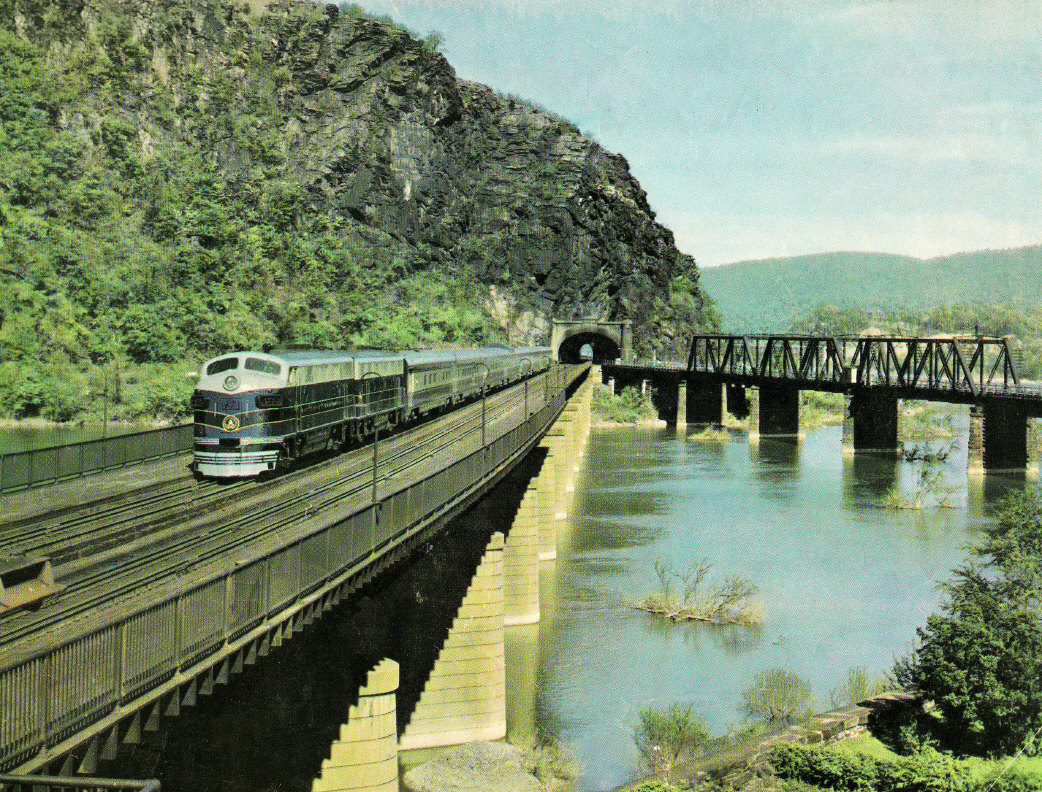
In 1833, the Chesapeake & Ohio Canal reached Harpers Ferry from Washington, D.C.; a planned western expansion to Ohio was never completed. A year later, the Baltimore and Ohio Railroad began service from Harpers Ferry via Wager Bridge, named for a family that later built the town's Wager Hotel. The bridge connected the town across the Potomac with Sandy Hook, Maryland, which for a few years in the 1830s was the railroad's western terminus. In 1837, the railroad crossed the Potomac into Harpers Ferry with the opening of the B & O Railroad Potomac River Crossing.
The first railroad junction in the country began service in 1836 when the Winchester and Potomac Railroad opened its line from Harpers Ferry southwest to Charles Town and then to Winchester, Virginia.
Virginius Island
Virginius Island, which connected the Shenandoah River to the lower part of Harpers Ferry, was created by happenstance in the early 1800s after debris floated down from upstream mills during the construction of the Shenandoah Canal. Cotton, flour mills, and other water-powered companies were developed on Virginius Island, taking advantage of the Shenandoah River's water power and good routes to markets. The island came to house all of Harpers Ferry's manufacturing, except for the armory, which used the Potomac River for power, and its rifle plant, some distance upstream using the Shenandoah's power.

At its antebellum peak, some 180 people lived on Virginius Island, including workers who lived in a boarding house and in row houses. Floods in the 20th century destroyed all structures on the island. Today, visitors can view Virginius Island's historic ruins and walk National Park Service trails.
John Brown's raid
On October 16, 1859, the abolitionist John Brown led a group of 22 men (counting himself) in a raid on the armory. Five of the men were black: three free black men, one freed slave, and one fugitive slave. Brown attacked and captured several buildings, hoping to secure the weapons depot and arm the slaves, starting a revolt across the South. Brown also brought 1,000 steel pikes, which were forged in Connecticut by a blacksmith and abolitionist sympathizer, Charles Blair; however, the pikes, a weapon that does not require training, were never used as Brown failed to rally the slaves to revolt. The first shot of the raid mortally wounded Heyward Shepherd, a free black man who was a baggage porter for the Baltimore and Ohio Railroad.
The noise from that shot alerted Dr. John Starry shortly after 1 am. He walked from his nearby home to investigate the shooting and was confronted by Brown's men. Starry stated that he was a doctor but could do nothing more for Shepherd, and the men allowed him to leave. Starry then went to the livery and rode to neighboring towns and villages, alerting residents to the raid. John Brown's men were quickly pinned down by shots fired by local citizens and militia, and forced to take refuge in the fire engine house (later called John Brown's Fort), at the entrance to the armory. The stout building served as their redoubt for more than two days.
The Secretary of War asked the Navy Department for a unit of United States Marines from the Washington Navy Yard, the nearest troops. Lieutenant Israel Greene was ordered to take a force of 86 Marines to the town. U.S. Army Lieutenant Colonel Robert E. Lee was found on leave at his home not far away in Arlington, Virginia, and was assigned as commander, along with Lt. J. E. B. Stuart as his aide-de-camp. Lee led the unit in civilian clothes, as none of his uniforms were available. The contingent arrived by train on October 18, and began negotiations of the abolitionists' surrender.
When negotiation failed to produce a result, the troops stormed the fire house and ended the siege. In the action, the troops killed a few abolitionists and suffered a single casualty (twenty-four-year-old Marine Private Luke Quinn). John Brown and the other surviving raiders were captured. Lee submitted a report on October 19.
Brown was quickly tried in Charles Town, the county seat of Jefferson County, for treason against the Commonwealth of Virginia, murder, and fomenting a slave insurrection. Convicted of all charges, with Starry's testimony integral to the conviction, he was hanged on December 2. (See Virginia v. John Brown.)
John Brown's words, both from his interview by Virginia Governor Henry A. Wise and his famous last speech, "captured the attention of the nation like no other abolitionist or slave owner before or since."
American Civil War
The American Civil War was disastrous for Harpers Ferry, where five battles took place; it changed hands eight times between 1861 and 1865. (Another article says it changed hands twelve times.) One of the first military actions by secessionists in Virginia was taken on April 18, 1861, when they wrested control of the Federal arsenal at Harpers Ferry from the Union Army, even before the convention which would consider whether or not the state should secede had been called together.
Because of the town's strategic location on the Baltimore and Ohio Railroad and at the northern end of the Shenandoah Valley, both Union and Confederate troops moved through Harpers Ferry frequently. It was said that "Jefferson County is where the North and South met." It was a natural conduit for Confederate invasions of the North, as in General Robert E. Lee's Maryland campaign of 1862 and Gettysburg campaign of 1863, and for Union troops heading south in their attempts to thwart Rebel forces in the Valley.
The town was "easy to seize, and hard to hold", because of its topography: surrounded on three sides by high ground (Bolivar Heights to the west, Loudoun Heights to the south, and Maryland Heights to the east) and the Potomac and Shenandoah Rivers, anyone who controlled the heights controlled the city.
The war's effect on the town was devastating. It was described in March 1862:
Harper's Ferry presents quite a gloomy picture. The best buildings have been shelled to the ground, and nothing now remains but their foundations to mark the spot where they once stood. The old Arsenal has been burnt to the ground; that part of the building where old John Brown made such a fatal stand, still stands as a monument to his memory. Before the destruction of the town, it contained near 3000 inhabitants, but at the present time there are not more than 300 or 400 families there.
In the account of Joseph George Rosengarten, Harpers Ferry and nearby Bolivar, in 1859 "a blooming garden-spot, full of thrift and industry and comfort," had been reduced to "waste and desolation" by 1862.
The town's garrison of federal troops attracted 1,500 contrabands by the summer of 1862. They were returned to slavery, however, when Confederate General Stonewall Jackson took Harpers Ferry in September 1862. Lee needed to control Harpers Ferry because it was on his supply line and could cut off his possible routes of retreat if captured. Therefore, Lee divided his army of approximately 40,000 into four sections, sending three columns under Jackson to surround and capture the town.
The Battle of Harpers Ferry started with light fighting September 13 as the Confederates tried to capture the Maryland Heights to the northeast, while John Walker moved back over the Potomac to capture Loudoun Heights south of town. After a Confederate artillery bombardment on September 14 and 15, the federal garrison surrendered. With Jackson's capture of 12,419 federal troops, the surrender at Harpers Ferry was the largest surrender of U.S. military personnel until the Battle of Bataan in 1942.
Because of the delay in capturing the town and the movement of federal forces to the west, Lee was forced to regroup at the town of Sharpsburg, Maryland. Two days later he commanded troops in the Battle of Antietam, which had the highest number of deaths among troops of any single day in United States military history.
By July 1864, the Union again had control of Harpers Ferry. On July 4, 1864, Union general Franz Sigel withdrew his troops to Maryland Heights, from which he resisted Jubal Early's attempt to enter the town and drive out the federal garrison.
Post-Civil War
Inspired by John Brown's raid, both runaway and freed slaves came to Harpers Ferry during and after the American Civil War. This created social tensions between white and black residents of the community and generated a growing need for services for the increasing African-American population. Accordingly, a freedman's school was opened on Camp Hill by Freewill Baptist missionaries following the American Civil War.
The town and the armory, with the exception of John Brown's Fort, were destroyed during the war. "The larger portion of the houses all lie in ruins and the whole place is not actually worth $10," wrote a Massachusetts soldier to his mother in 1863. A visitor in 1878 found the town "antiquated, dingy, and rather squalid"; another, in 1879, described it as "shabby and ruined." Since the Arsenal, Harpers Ferry's largest employer before the war, was never rebuilt, the town's population never recovered to antebellum levels.
Storer College
Storer College, devoted to training teachers for freedmen, opened in 1868, much to the displeasure of many residents of Harpers Ferry who petitioned the Legislature to revoke its charter. The War Department gave the Freedmen's Bureau its remaining assets in Harpers Ferry, principally four sturdy residences for the managers of the Armory, structurally sound but in need of repairs from damage during the war, and the Bureau gave them to Storer College. A one-room school for Blacks was already operating in one of them.
African-American tourism
As early as 1878, the Baltimore and Ohio Railroad ran excursion trains to Harpers Ferry from Baltimore and Washington. As described in a newspaper in 1873: "One need only to alight from the train and look a little envious toward the old Engine House or the ruined walls of the old Arsenal in order to have a score of persons offering to become a kind of guide or to point out to your whatever you may desire to know about the great struggle which ended in the 'opening of the prison doors, the breaking of every yoke, the undoing of heavy burdens, and letting the oppressed go free."
Storer, the only Black college at a location historically important to African-Americans, became a center of the civil rights movement and built the town's importance as a destination for Black tourists and excursionists. Douglass spoke there in 1881, as part of an unsuccessful campaign to fund a "John Brown professorship" to be held by an African-American. In 1906, Storer hosted the first U.S. meeting of the Niagara Movement, the predecessor of the NAACP, after its organizational meeting in Fort Erie, Ontario.
In the late 1890s, the Baltimore and Ohio Railroad wanted the land where the fort was located to make its line less vulnerable to flooding. Some white townspeople were eager to get rid of the fort. It was dismantled and moved to Chicago for display at the 1893 Columbian Exposition. Abandoned there, it was rescued and moved back to Harpers Ferry by the Baltimore and Ohio without charge, motivated by their expectation that having the fort back in Harpers Ferry would be a tourist attraction and a way to build ridership on the railroad. But most whites were opposed to any commemoration of John Brown, and it was placed on a nearby farm.
Visits by tourists, many of them Black, now began to slowly turn the town into a real tourist center and return it to growth. "Harpers Ferry proved to be one of the most visited places of leisure for nineteenth-century African Americans." There was a Black-owned hotel, the Hill Top House, built and run by a Storer graduate, Thomas Lovett, but it catered only to white clientele. In the summer Storer rented rooms to Black vacationers until 1896. The fort was the great monument where the end of slavery began. There were so many tourists that they were a nuisance to the farmer on whose lands the fort sat, and so it was moved to Storer in 1909. There it would remain until several years after the college closed in 1955, functioning as the College Museum. Male students practiced their public-speaking skills by giving tours of it.
Island Park Resort and Amusement Park
To increase ridership, the B&O in 1879 built Island Park Resort and Amusement Park on Byrne Island in the Potomac, which the railroad bought and built a footbridge to reach it. One had to pay 5¢ ($5 in 2021 value) to cross and enter, after which rides and other activities were free. Access to the park was also a benefit for B&O employees, as it had done in Relay, Maryland. Among the many events held there were a reunion of 4,000 Odd Fellows in 1880 and a "Grand Tri-State Democratic Mass Meeting" 1892.
Thomas Wentworth Higginson, one of the Secret Six who assisted John Brown, chose Harpers Ferry for his honeymoon.
The park was large enough that parades could be held. There were a steam-powered ferris wheel and carousel, a midway, a pavilion for dancing or roller skating, swings, a merry-go-round, and a bandstand. Visitors could also play croquet, tennis, rent boats, fish, or wade in the river. Later there were baseball games. Blacks and whites attended on different days. In 1883, there were an estimated 100,000 visitors. There were six special trains to Harpers Ferry from various points.
The amusement park was kept open despite periodic flooding and repairs until 1909. The B&O kept the site open after that for picnicking.
The bandstand, the only surviving structure, has been moved twice. At the park's closing, it was moved to Arsenal Square (the current location of John Brown's Fort), then later to the park at Washington and Gilmore Streets. It is referred to as The Bandstand or the Town Gazebo, and many civic, cultural, and recreational activities take place there.
The bridge was destroyed by flooding in 1896, as was a replacement bridge in 1924. The remaining structures on the island were destroyed in a 1942 flood.
20th century
2nd Niagara Movement Conference
On August 15, 1906, Black author and scholar W. E. B. Du Bois led the first meeting on American soil of the new Niagara Movement. Named after the site of its initial meeting in Fort Erie, Ontario, Canada on the Niagara River, the movement met on the campus of Storer College, a primarily Black college that operated until 1955. (After it closed, the campus became part of Harpers Ferry National Historical Park). The three-day gathering, which was held to work for civil rights for African Americans, was later described by DuBois as "one of the greatest meetings that American Negroes ever held". Attendees walked from Storer College to the farm of the Murphy family, the location at the time of John Brown's historic "fort," the armory's firehouse. As a result, the fort was soon moved to the Storer campus, where it became the college's central icon. After the college closed in 1955, the National Park Service moved it back to as close as possible to its original location.