
Harlem is a neighborhood in Upper Manhattan, New York City. It is bounded roughly by the Hudson River on the west; the Harlem River and 155th Street on the north; Fifth Avenue on the east; and 110th Street on the south. The greater Harlem area encompasses several other neighborhoods and extends west and north to 155th Street, east to the East River, and south to Martin Luther King Jr. Boulevard, Central Park, and East 96th Street.
Originally a Dutch village, formally organized in 1658, it is named after the city of Haarlem in the Netherlands. Harlem's history has been defined by a series of economic boom-and-bust cycles, with significant population shifts accompanying each cycle. Harlem was predominantly occupied by Jewish and Italian Americans in the late 19th century, while African-American residents began to arrive in large numbers during the Great Migration in the early 20th century. In the 1920s and 1930s, Central and West Harlem were the center of the Harlem Renaissance, a major African-American cultural movement. With job losses during the Great Depression of the 1930s and the deindustrialization of New York City after World War II, rates of crime and poverty increased significantly. In the 21st century, crime rates decreased significantly, and Harlem started to gentrify.
The area is served by the New York City Subway and local bus routes. It contains several public elementary, middle, and high schools, and is close to several colleges, including Columbia University, the Manhattan School of Music, and the City College of New York. Central Harlem is part of Manhattan Community District 10. It is patrolled by the 28th and 32nd Precincts of the New York City Police Department. The greater Harlem area also includes Manhattan Community Districts 9 and 11 and several police precincts, while fire services are provided by four New York City Fire Department stations.

Geography
Harlem is located in Upper Manhattan. The three neighborhoods comprising the greater Harlem area—West, Central, and East Harlem—stretch from the Harlem River and East River to the east, to the Hudson River to the west; and between 155th Street in the north, where it meets Washington Heights, and an uneven boundary along the south that runs along 96th Street east of Fifth Avenue, 110th Street between Fifth Avenue to Morningside Park, and 125th Street west of Morningside Park to the Hudson River. Encyclopædia Britannica references these boundaries, though the Encyclopedia of New York City takes a much more conservative view of Harlem's boundaries, regarding only central Harlem as part of Harlem proper.
Central Harlem is the name of Harlem proper; it falls under Manhattan Community District 10. This section is bounded by Central Park North 110th Street on the south; 155th Street on the north; Fifth Avenue on the east; and Morningside Park, St. Nicholas Avenue, and Edgecombe Avenue on the west. A chain of large linear parks includes Morningside Park, St. Nicholas Park, Jackie Robinson Park, Rucker Park, and Marcus Garvey Park (also known as Mount Morris Park) which separates this area from East Harlem to the east. Central Harlem includes the Mount Morris Park Historic District.
West Harlem (Manhattanville, Hamilton Heights, and Sugar Hill) comprises Manhattan Community District 9. The three neighborhoods' area is bounded by Cathedral Parkway/110th Street on the south; 155th Street on the north; Manhattan/Morningside Ave/St. Nicholas/Bradhurst/Edgecombe Avenues on the east; and Riverside Park/the Hudson River on the west. Manhattanville begins at roughly 123rd Street and extends northward to 135th Street. The northernmost section of West Harlem is Hamilton Heights. A chain of large linear parks includes West Harlem Piers, Riverbank State Park, St. Nicholas Park, and Jackie Robinson Park.

East Harlem, also called Spanish Harlem or El Barrio, is located within Manhattan Community District 11, which is bounded by East 96th Street on the south, East 138th Street on the north, Fifth Avenue on the west, and the Harlem River on the east. A chain of parks includes Thomas Jefferson Park and Marcus Garvey Park.
SoHa controversy
In the 2010s some real estate professionals started rebranding south Harlem as "SoHa" (a name standing for "South Harlem," in the style of SoHo or NoHo) in an attempt to accelerate gentrification of the neighborhoods. "SoHa," applied to the area between West 110th and 125th Streets, became a controversial name. Residents and other critics seeking to prevent this renaming of the area labelled the SoHa brand as "insulting and another sign of gentrification run amok," and said that "the rebranding not only places their neighborhood's rich history under erasure but also appears to be intent on attracting new tenants, including students from nearby Columbia University."
Three New York City politicians initiated legislative efforts to curtail this practice of neighborhood rebranding, which when introduced in other New York City neighborhoods led to increases in rents and real estate values, as well as "shifting demographics." In 2011, New York Assemblyman Hakeem Jeffries attempted but failed to implement legislation "that would punish real estate agents for inventing false neighborhoods and redrawing neighborhood boundaries without city approval."

In June 2017, U.S. Representative Adriano Espaillat, who represents Harlem, introduced a resolution in the U.S. Congress that would, as he put it, “keep Harlem Harlem.’’ Espaillat said: “Harlem is about an attitude, a personality, a legacy. It is the capital of the African diaspora in the world.” That same month, New York State Senator Brian Benjamin also worked, at the state level, to render the practice of rebranding historically recognized neighborhoods illegal. In the wake of the backlash against the renaming effort, in July 2017 the real estate company that had pushed the rebranding dropped its effort.
The name originally referred to a bar by the name "SoHa" that was opened in October 1997 on Amsterdam Avenue near 108th Street by Matt Olds, who opened several other restaurants in the neighborhood around the same time. Susanne Cipolla, the manager of the restaurants owned by Olds, said "We're trying to create a hip alternative to downtown … Casual, hip, young, downtown-type places."
Political representation
Politically, central Harlem is in New York's 13th congressional district for the U.S. House of Representatives, represented by Democrat U.S. Congressman Adriano Espaillat since 2017. On the state level, it is in the New York State Senate's 30th district, represented by Democrat Cordell Cleare since 2021, and the New York State Assembly's 68th and 70th districts, represented by Democrats Edward "Eddie" Gibbs (since 2022) and Jordan J.G. Wright (since 2025), respectively. On the city level, it is in the New York City Council's 7th, 8th, and 9th districts, represented by Democrats Shaun Abreu (since 2026), Elsie Encarnacion (since 2026), and Yusef Salaam (since 2024), respectively..
Harlem has had black political representation since the 1910s; Edward A. Johnson was elected to the State Assembly in 1917, becoming the body's first African American member, and Charles H. Roberts and George W. Harris were elected to the Board of Aldermen in 1919, also becoming the body's first African American members. After the Board was replaced by the City Council in 1938, Adam Clayton Powell Jr. was elected its first African American member in 1941; he was later elected New York's first African American congressman in 1944.
History
Before the arrival of European settlers, the area that would become Harlem (originally Haarlem) was inhabited by a Native American band, the Wecquaesgeek, dubbed Manhattans or Manhattoe by Dutch settlers, who along with other Native Americans, most likely Lenape, occupied the area on a semi-nomadic basis. As many as several hundred farmed the Harlem flatlands. Between 1637 and 1639, a few colonial settlements were established. The settlement of Harlem was formally incorporated in 1660 under the leadership of Peter Stuyvesant.
During the American Revolution, the British burned Harlem to the ground. It took a long time to rebuild, as Harlem grew more slowly than the rest of Manhattan during the late 18th century.

After the American Civil War, Harlem experienced an economic boom starting in 1868. The neighborhood continued to serve as a refuge for New Yorkers, but increasingly those coming north were poor and Jewish or Italian. The New York and Harlem Railroad, as well as the Interborough Rapid Transit and elevated railway lines, helped Harlem's economic growth, as they connected Harlem to lower and midtown Manhattan. The Jewish and Italian demographics decreased, while the black and Puerto Rican population increased in this time.
The early-20th century Great Migration of black people to northern industrial cities was fueled by their desire to leave behind the Jim Crow South, seek better jobs and education for their children, and escape a culture of lynching violence. Starting around the time of the end of World War I, Harlem became associated with the New Negro movement, a phrase implying a more outspoken advocacy of dignity and a refusal to submit quietly to the practices and laws of Jim Crow racial segregation. During World War I, expanding industries recruited black laborers to fill new jobs, thinly staffed after the draft began to take young men. In 1910, the Central Harlem population was about 10% black people. By 1920, central Harlem was 32.4% black. By 1930, it had reached 70%.
Harlem then became associated with the artistic outpouring known as the Harlem Renaissance, which extended to poetry, novels, theater, and the visual arts. So many black people came that it "threaten[ed] the very existence of some of the leading industries of Georgia, Florida, Tennessee and Alabama." Many settled in Harlem. The 1930 census revealed that 70.18% of central Harlem's residents were black and lived as far south as Central Park, at 110th Street.

However, by the 1930s, the neighborhood was hit hard by job losses in the Great Depression. In the early 1930s, 25% of Harlemites were out of work, and employment prospects for Harlemites stayed poor for decades. Employment among black New Yorkers fell as some traditionally black businesses, including domestic service and some types of manual labor, were taken over by other ethnic groups. Major industries left New York City altogether, especially after 1950. Several riots happened in this period, including the 1935 Harlem riot and the Harlem riot of 1943.
There were major changes following World War II. In the late 1950s and early 1960s, Harlem was the scene of a series of rent strikes by neighborhood tenants, led by local activist Jesse Gray, together with the Congress of Racial Equality, Harlem Youth Opportunities Unlimited (HARYOU), and other groups. These groups wanted the city to force landlords to improve the quality of housing by bringing them up to code, to take action against rats and roaches, to provide heat during the winter, and to keep prices in line with existing rent control regulations.
The largest public works projects in Harlem in these years were public housing, with the largest concentration built in East Harlem. Typically, existing structures were torn down and replaced with city-designed and managed properties that would, in theory, present a safer and more pleasant environment than those available from private landlords. Ultimately, community objections halted the construction of new projects.
From the mid-20th century, the low quality of education in Harlem has been a source of distress. In the 1960s, about 75% of Harlem students tested under grade levels in reading skills, and 80% tested under grade level in math. In 1964, residents of Harlem staged two school boycotts to call attention to the problem. In central Harlem, 92% of students stayed home. In the post-World War II era, Harlem ceased to be home to a majority of the city's black people, but it remained the cultural and political capital of black New York, and possibly black America.
By the 1970s, many of those Harlemites who were able to escape from poverty left the neighborhood in search of better schools and homes, and safer streets. Those who remained were the poorest and least skilled, with the fewest opportunities for success. Though the federal government's Model Cities Program spent $100 million on job training, health care, education, public safety, sanitation, housing, and other projects over a ten-year period, Harlem showed no improvement. The city began auctioning its enormous portfolio of Harlem properties to the public in 1985. This was intended to improve the community by placing property in the hands of people who would live in them and maintain them. In many cases, the city would even pay to completely renovate a property before selling it (by lottery) below market value.
After the 1990s, Harlem began to grow again. Between 1990 and 2006 the neighborhood's population grew by 16.9%, with the percentage of black people decreasing from 87.6% to 69.3%, then dropping to 54.4% by 2010, and the percentage of whites increasing from 1.5% to 6.6% by 2006, and to "almost 10%" by 2010. A renovation of 125th Street and new properties along the thoroughfare also helped to revitalize Harlem.
Culture
In the 1920s and 1930s, Central and West Harlem was the focus of the "Harlem Renaissance," an outpouring of artistic work without precedent in the American Black community. Though Harlem musicians and writers are particularly well remembered, the community has also hosted numerous actors and theater companies, including the New Heritage Repertory Theater, National Black Theater, Lafayette Players, Harlem Suitcase Theater, The Negro Playwrights, American Negro Theater, and the Rose McClendon Players.
The Apollo Theater opened on 125th Street on January 26, 1934, in a former burlesque house. The Savoy Ballroom, on Lenox Avenue, was a renowned venue for swing dancing, and was immortalized in a popular song of the era, "Stompin' at the Savoy." In the 1920s and 1930s, between Lenox and Seventh Avenues in central Harlem, over 125 entertainment venues were in operation, including speakeasies, cellars, lounges, cafes, taverns, supper clubs, rib joints, theaters, dance halls, and bars and grills.
133rd Street, known as "Swing Street," became known for its cabarets, speakeasies and jazz scene during the Prohibition era, and was dubbed "Jungle Alley" because of "inter-racial mingling" on the street. Some jazz venues, including the Cotton Club, where Duke Ellington played, and Connie's Inn, were restricted to whites only. Others were integrated, including the Renaissance Ballroom and the Savoy Ballroom.
In 1936, Orson Welles produced his black Macbeth at the Lafayette Theater in Harlem. Grand theaters from the late 19th and early 20th centuries were torn down or converted to churches. Harlem lacked any permanent performance space until the creation of the Gatehouse Theater in an old Croton aqueduct building on 135th Street in 2006.
From 1965 until 2007, the community was home to the Harlem Boys Choir, a touring choir and education program for young boys, most of whom are black. The Girls Choir of Harlem was founded in 1989, and closed with the Boys Choir.
From 1967 to 1969, the Harlem Cultural Festival took place in Mount Morris Park. Another name for this festival is "Black Woodstock." Artists like Stevie Wonder, The 5th Dimension, and Gladys Knight performed here.
Harlem is also home to the largest African American Day Parade, which celebrates the culture of African diaspora in America. The parade was started up in the spring of 1969 with Congressman Adam Clayton Powell Jr. as the Grand Marshal of the first celebration.
Arthur Mitchell, a former dancer with the New York City Ballet, established Dance Theatre of Harlem as a school and company of classical ballet and theater training in the late 1960s. The company has toured nationally and internationally. Generations of theater artists have gotten a start at the school.
By the 2010s, new dining hotspots were opening in Harlem around Frederick Douglass Boulevard. At the same time, some residents fought back against the powerful waves of gentrification the neighborhood is experiencing. In 2013, residents staged a sidewalk sit-in to protest a five-days-a-week farmers market that would shut down Macombs Place at 150th Street.
Uptown Night Market was founded in 2021 to celebrate cuisine, community, and culture. It is one of the largest night markets in Manhattan. The main attractions include musical performances, arts and crafts shows, and food.
Music
Many R&B/Soul groups and artists formed in Harlem. The Main Ingredient, Frankie Lymon & The Teenagers, Black Ivory, Cameo, Keith Sweat, Freddie Jackson, Alyson Williams, Johnny Kemp, Teddy Riley, Dave Wooley, and others got their start in Harlem.
Manhattan's contributions to hip-hop stems largely from artists with Harlem roots such as Doug E. Fresh, Big L, Kurtis Blow, The Diplomats, ASAP Ferg, Mase or Immortal Technique. Harlem is also the birthplace of popular hip-hop dances such as the Harlem shake, toe wop, and Chicken Noodle Soup.
Harlem's classical music birthed organizations and chamber ensembles such as Roberta Guaspari's Opus 118, Harlem Chamber Players, Omnipresent Music Festival BIPOC Musicians Festival, Harlem Quartet, and musicians such as violinist Edward W. Hardy.
In the 1920s, African-American pianists who lived in Harlem invented their own style of jazz piano, called stride, which was heavily influenced by ragtime. This style played a very important role in early jazz piano.
Language
In 1938, jazz bandleader and singer Cab Calloway published the first dictionary by an African-American, Cab Calloway's Cat-ologue: A "Hepster's" Dictionary, which became the official jive language reference book of the New York Public Library. In 1939, Calloway published an accompanying book titled Professor Cab Calloway's Swingformation Bureau, which instructed readers how to apply the words and phrases from the dictionary. He released several editions until 1944, the last being The New Cab Calloway's Hepsters Dictionary: Language of Jive. Poet Lemn Sissay observed that "Cab Calloway was taking ownership of language for a people who, just a few generations before, had their own languages taken away."
Religious life
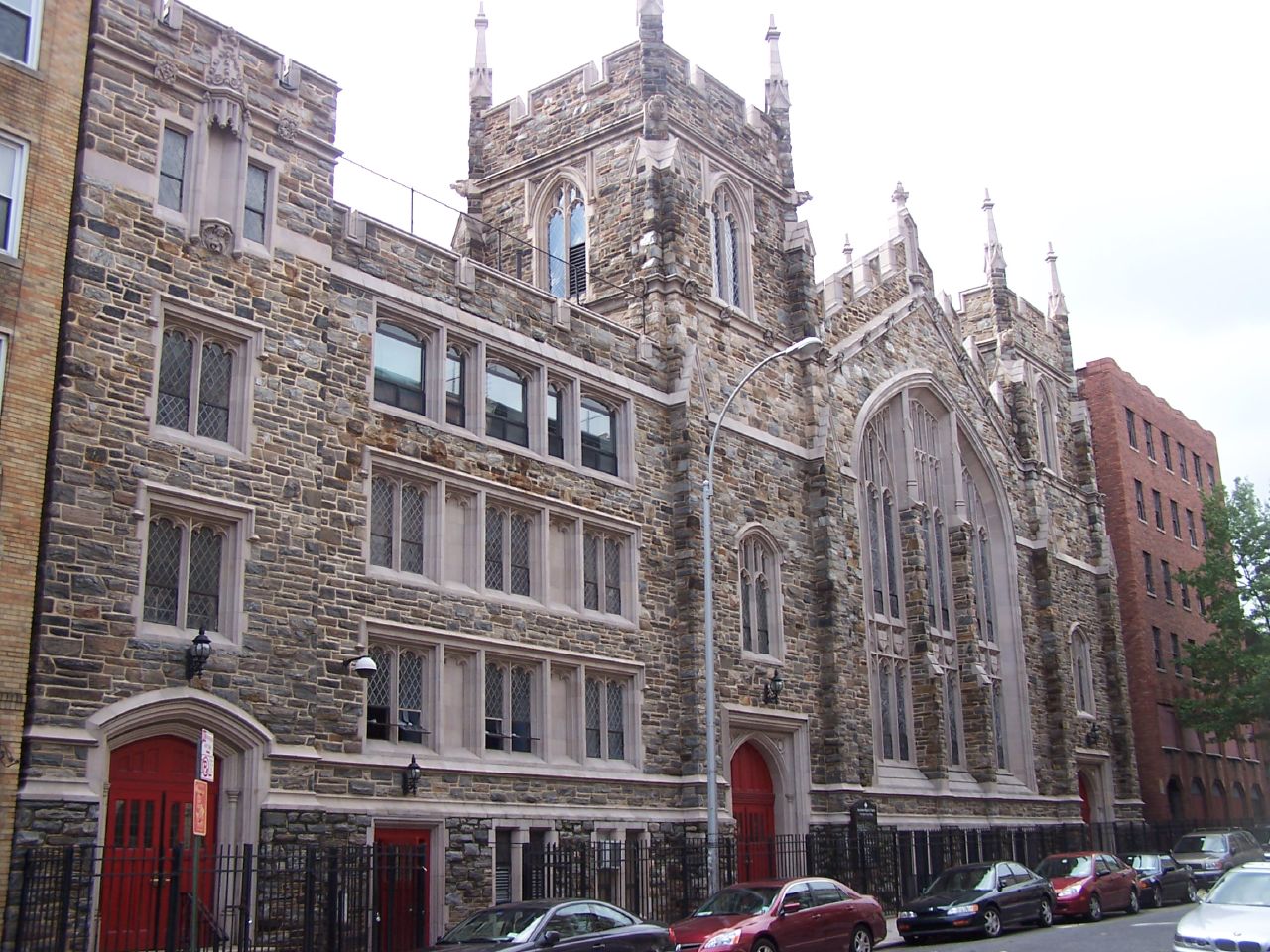
Religious life has historically had a strong presence in Black Harlem. The area is home to over 400 churches, some of which are official city or national landmarks. Major Christian denominations include Baptists, Pentecostals, Methodists (generally African Methodist Episcopal Zionist, or "AMEZ" and African Methodist Episcopalian, or "AME"), Episcopalians, and Roman Catholic. The Abyssinian Baptist Church has long been influential because of its large congregation. The Church of Jesus Christ of Latter-day Saints built a chapel on 128th Street in 2005.
Many of the area's churches are "storefront churches," which operate in an empty store, or a basement, or a converted brownstone townhouse. These congregations may have fewer than 30–50 members each, but there are hundreds of them. Others are old, large, and designated landmarks. Especially in the years before World War II, Harlem produced popular Christian charismatic "cult" leaders, including George Wilson Becton and Father Divine.
Mosques in Harlem include the Masjid Malcolm Shabazz (formerly Mosque No. 7 Nation of Islam, and the location of the 1972 Harlem mosque incident), the Mosque of Islamic Brotherhood and Masjid Aqsa. Judaism, too, maintains a presence in Harlem through the Old Broadway Synagogue. A non-mainstream synagogue of Black Hebrews, known as Commandment Keepers, was based in a synagogue at 1 West 123rd Street until 2008.
Landmarks
Officially designated landmarks
Many places in Harlem are official city landmarks labeled by the New York City Landmarks Preservation Commission or are listed on the National Register of Historic Places:
Other points of interest
Other prominent points of interest include:
Demographics
The demographics of Harlem's communities have changed throughout its history. In 1910, black residents formed 10% of Harlem's population, but by 1930, they had become a 70% majority. The period between 1910 and 1930 was marked by the Great Migration of African Americans from the South to northern cities, including New York. Within the city, this era also witnessed an influx of black residents from downtown Manhattan neighborhoods, where black people were feeling less welcome, to the Harlem area.
The black population in Harlem peaked in 1950, with a 98% share of the population of 233,000. In 2000, central Harlem's Black residents were 77% of the population of that area. The black population has declined as many African Americans move out. In 2020, central Harlem (consisting of the Harlem (South) and Harlem (North) neighborhood tabulation areas) was 23.7% (30,904) Hispanic, 15.2% (19,778) White, 51.8% (67,610) Black, 3.9% (5,048) Asian, 1.1% (1,492) some other non-Hispanic race, and 4.3% (5,608) Non-Hispanic of two or more races.
Harlem suffers from unemployment rates generally more than twice the citywide average, as well as high poverty rates, and the numbers for men have been consistently worse than the numbers for women. Private and governmental initiatives to ameliorate unemployment and poverty have not been successful. During the Great Depression, unemployment in Harlem went past 20% and people were being evicted from their homes.
In the 1960s, land owners took advantage of the neighborhood and offered apartments to the lower-class families for cheaper rent but in lower-class conditions. By 1999 there were 179,000 housing units available in Harlem. Housing activists in Harlem state that, even after residents were given vouchers for the Section 8 housing that was being placed, many were not able to live there and had to find homes elsewhere or become homeless. These policies are examples of societal racism, a key social determinant of health disparities between racial and ethnic minorities.