The Great Leap Forward was an industrialization campaign within China from 1958 to 1962, led by the Chinese Communist Party (CCP). CCP Chairman Mao Zedong launched the campaign to transform the country from an agrarian society into an industrialized society through the formation of people's communes. The Great Leap Forward led to between 15 and 55 million deaths in mainland China during the 1959–1961 Great Chinese Famine it caused, making it the largest or second-largest famine in human history.
The Great Leap Forward grew out of Mao's push for rapid development through mass mobilization and a reaction against the Soviet development strategy. Anti-intellectual politics and the surge of less-educated radicals helped sideline technical constraints and dissent. The strategy relied on mobilizing peasants to sustain themselves while supplying grain, cash crops, and even steel for urban industry, without major new state investment. Famine worsened when procurement quotas were set using false reports from the countryside. After the 1959 Lushan Conference, anti-"rightist" campaigns intensified misreporting and coercive collection even as output fell, deepening rural famine.
In rural China, the campaign expanded mandatory collectivization and banned private farming; those who resisted were punished as "counterrevolutionaries". Authorities enforced restrictions through public struggle sessions, social pressure, and forced labor. Although rural industrialization was an official priority, its development was derailed by Great Leap policies. Economist Dwight Perkins argues that heavy investment produced little gain, calling the Great Leap Forward an expensive disaster.
The CCP studied the damage that was done at various conferences from 1960 to 1962, especially at the Seven Thousand Cadres Conference in 1962, during which Mao Zedong ceded day-to-day leadership to pragmatic moderates like Chinese President Liu Shaoqi and Vice Premier Deng Xiaoping. In the early 1960s, Mao endorsed a period of economic "readjustment" and acknowledged responsibility for mistakes, while maintaining that the "three red flags" could not be challenged. From 1961 to 1965, official propaganda portrayed Mao as virtually infallible and shifted blame for the Great Leap Forward disaster onto lower-level officials. He initiated the Socialist Education Movement in 1963 and the Cultural Revolution in 1966 in order to remove opposition and re-consolidate his power. In addition, dozens of dams constructed in Zhumadian, Henan, during the Great Leap Forward collapsed in 1975 (under the influence of Typhoon Nina) and resulted in the 1975 Banqiao Dam failure, with estimates of its death toll ranging from tens of thousands to 240,000.
Background
The core goal of the Great Leap Forward was to increase industrial and agricultural outputs by using mass mobilization to raise labor inputs and therefore overcome China's lack of material, technological and monetary inputs. The Great Leap Forward also sought to address imbalances between rural China and urban China that existed in the prerevolutionary period and continued into the 1950s.
Classical Marxist theory hypothesized a relatively linear progression of development and a worldwide revolution beginning with the most developed countries. At the founding of the People's Republic of China in 1949, the country was one of the poorest in the world. The Great Leap Forward attempted to defy the conventional understanding of the time required for economic development. Through rapid industrialization, it aimed to close the gap between China's developmental stage and its political aspirations. In March 1955, at a national conference of the Party, Mao declared that China "would catch up with and surpass the most powerful capitalist countries in several dozen years", and in October, Mao announced that he would complete the building of a socialist state in 15 years.

In the late 1950s, China's socio-political landscape experienced significant rural reforms and the aftermath of previous policies aimed at collectivization rather than individualism. Before the Great Leap Forward, the Chinese government initiated land reforms that redistributed land from landlords to peasants, but these reforms still needed to attain the expected agricultural productivity. The early 1950s saw the establishment of agricultural cooperatives, yet these changes brought mixed outcomes. However, the push towards rapid industrialization and the establishment of people's communes in rural areas were central to the Great Leap Forward, reflecting the government's belief that collectivization and large-scale projects would boost agricultural and industrial outputs. The communes were meant to centralize farming and labor, supposedly leading to increased efficiency and output; still, in reality, and practice, these measures often disrupted traditional farming practices and led to decreased productivity. Dali Yang stated, "The initial stages of collectivization brought chaos and inefficiency, with agricultural productivity often declining".
By the time of the Great Leap Forward, increased Sino-Soviet tensions meant that China could not depend on Soviet technological assistance. Mao emphasized China's self-reliance in technology and industry and discouraged reliance on foreign technology.
Agricultural collectives and other social changes
Before 1949, peasants had farmed their own small pockets of land and observed traditional practices—festivals, banquets, and paying homage to ancestors. It was realized that Mao's policy of using a state monopoly on agriculture to finance industrialization would be unpopular with the peasants. Therefore, it was proposed that the peasants should be brought under Party control by the establishment of agricultural collectives which would also facilitate the sharing of tools and draft animals.

This policy was gradually pushed through between 1949 and 1958 in response to immediate policy needs, first by establishing "mutual aid teams" of 5–15 households, then in 1953 "elementary agricultural cooperatives" of 20–40 households, then from 1956 in "higher co-operatives" of 100–300 families. From 1954 onward peasants were encouraged to form and join collective-farming associations, which would supposedly increase their efficiency without robbing them of their own land or restricting their livelihoods.
By 1958, private ownership was abolished and all households were forced into state-operated communes. Mao demanded that the communes increase grain production to feed the cities and to earn foreign exchange through exports. China must follow a different path to socialism from the Soviet Union, Mao told delegates, by allowing its peasants to participate in economic modernisation and making more use of their labour.
Apart from progressive taxation on each household's harvest, the state introduced a system of compulsory state purchases of grain at fixed prices to build up stockpiles for famine-relief and meet the terms of its trade agreements with the Soviet Union. Together, taxation and compulsory purchases accounted for 30% of the harvest by 1957, leaving very little surplus. Rationing was also introduced in the cities to curb 'wasteful consumption' and encourage savings (which were deposited in state-owned banks and thus became available for investment), and although food could be purchased from state-owned retailers the market price was higher than that for which it had been purchased. This too was done in the name of discouraging excessive consumption.
Besides these economic changes, the CCP implemented major social changes in the countryside including the banishing of all religious and mystic institutions and ceremonies, replacing them with political meetings and propaganda sessions. Attempts were made to enhance rural education and the status of women (allowing them to initiate divorce if they desired) and ending foot-binding, child marriage and opium addiction. The old system of internal passports (the hukou) was introduced in 1956, preventing inter-county travel without appropriate authorization. Highest priority was given to the urban proletariat for whom a welfare state was created.
The first phase of collectivization resulted in modest improvements in output. Famine along the mid-Yangzi was averted in 1956 through the timely allocation of food-aid, but in 1957 the Party's response was to increase the proportion of the harvest collected by the state to insure against further disasters. Moderates within the Party, including Zhou Enlai, argued for a reversal of collectivization on the grounds that claiming the bulk of the harvest for the state had made the people's food-security dependent upon the constant, efficient, and transparent functioning of the government.
Hundred Flowers Campaign and Anti-Rightist Campaign
In 1957, Mao responded to the tensions which existed in the Party by launching the Hundred Flowers Campaign as a way to promote free speech and criticism. Some scholars have retrospectively concluded that this campaign was a ploy designed to allow critics of the regime, primarily intellectuals but also low ranking members of the party who were critical of the agricultural policies, to identify themselves.

By the time of the completion of the first 5 Year Economic Plan in 1957, Mao had come to believe that the path to socialism that had been followed by the Soviet Union was not appropriate for China. He was critical of Khrushchev's reversal of Stalinist policies and he was also alarmed by the uprisings that had taken place in East Germany, Poland and Hungary, and the perception that the USSR was seeking "peaceful coexistence" with the Western powers. Mao had become convinced that China should follow its own path to communism. According to Jonathan Mirsky, a historian and a journalist who specialized in Chinese affairs, China's isolation from most of the rest of the world, along with the Korean War, had accelerated Mao's attacks on his perceived domestic enemies. It led him to accelerate his designs to develop an economy where the regime would get maximum benefit from rural taxation.
The Anti-Rightist Campaign started on 8 June 1957. The main goal was to purge "rightists" from the CCP and China altogether. It was believed that approximately 5 percent of the population was still "rightists" (Political conservatives sabotaging the revolution).
Rash advance movement and anti-rash advance movement
In the early years of the New China, due to the lack of experience in financial and economic work, it was a common practice to include the fiscal surplus of the previous year in the budget of the current year. Because of the low level of budgeting in the fiscal sector and inaccurate estimates of economic development, revenues and expenditures were underestimated. However, no problems arose because the government usually managed to end the fiscal year with a surplus. In 1953, when China entered the first five-year plan period, the Chinese economy had improved and the Ministry of Finance still decided to include the fiscal surplus of the previous fiscal year as credit funds in the 1953 budget revenue to cover the current year's expenditures. As a result, budget expenditures were expanded and so was the size of the budget. At that time, only the Soviet expert Kutuzov warned the Chinese fiscal authorities not to use the fiscal surplus of the previous year, however, it was not heeded by the Ministry of Finance. In that year, the gross industrial and agricultural output grew by 21.3%, while the capital construction budget increased by 50% compared to the previous year, which led to an imbalance between production and demand. Such was the "small rash advance" (小冒進) at the start of the first five-year plan period. The issue had caused widespread social controversy. This marked one of the first times people questioned Mao's authority. The faction of Li Xiannian, Chen Yun and others did not think it was appropriate to continue this practice, but they also had opponents. Li Xiannian finally decided to hold a collective meeting to discuss the issue, and after listening to the views of all parties, he decided to abolish the practice.

Nevertheless, the controversy over the use of the fiscal surplus persisted, which brought another reckless "rash advance" to China's economic development in 1956. At that time, China lacked consideration in three areas: capital construction, employee wages, and agricultural loans. This made the central treasury "tight" again. This drew the attention of Zhou Enlai, Li Xiannian, and others. At a state meeting held on 5 June 1956, proposals were made to curb impetuousness and rash advances, revise the 1956 national economic plan, and cut capital construction investment. Such was the anti-"rash advance" movement.
The excess of the first five-year plan gave the nation great confidence, and at the Second Plenary Session of the 8th Central Committee, "go all out, aim high, and build socialism with greater, faster, better, and more economical results" (simplified Chinese: 鼓足干劲、力争上游、多快好省地建设社会主义; traditional Chinese: 鼓足幹勁、力爭上游、多快好省地建設社會主義) was adopted as the "General Line for Socialist Construction" in China. In 1955, Mao had already expressed his belief that socialist construction should achieve "greater, faster, better, and more economical" results. These led to the re-emergence of "rash advances", which further led to the reintroduction of policies and tendencies that had previously been overturned. Those who opposed Mao's policies were accused of not upholding the tenets of the "class struggle" under the people's cult of Mao.
Initial phase and resistance
Initial goals
Regarding agriculture, the Chinese government recognized the country's dilemma of feeding its rapidly growing population without the means to make significant capital improvements in agriculture. Viewing human labor as an underutilized factor of production, the government intensified the mobilization of masses of people to increase labor inputs in agriculture.
In November 1957, party leaders of communist countries gathered in Moscow to celebrate the 40th anniversary of the October Revolution. Soviet Communist Party First Secretary Nikita Khrushchev proposed not only to catch up with but exceed the United States in industrial output in the next 15 years through peaceful competition. Mao Zedong was so inspired by the slogan that China put forward its own one: to catch up with and surpass the United Kingdom in 15 years. As with its approach to agriculture, the Chinese government attempted to compensate for its inability to invest in industry with mass mobilizations to increase human labor inputs.
During the Great Leap Forward, architectural projects were managed according to the strategy of the Three Simultaneities, a process that involved designing, preparing materials, and building at the same time.
The initial projects of the Great Leap Forward were accelerating the construction of waterworks on the North China Plain during the 1957-1958 winter and next the development of people's communes and crude forms of rural industrialization. Some Great Leap Projects had lots of long-term value to China's economy and continued to benefit China after The Great Leap Forward ended. Some of the projects included bridges, railroads, canals and reservoirs. However, some of these projects were completed quickly, resulting in errors and delays that did more harm than good.
The Great Leap Forward partially socialized reproductive labor though collective housework, childcare, and the collective canteens which included free or partially free food distribution.
Lushan Conference and the Anti-Right Deviation Struggle
The initial impact of the Great Leap Forward was discussed at the Lushan Conference in July–August 1959. Although many of the more moderate leaders had reservations about the new policy, the only senior leader to speak out openly was Marshal Peng Dehuai. Mao responded to Peng's criticism of the Great Leap by dismissing Peng from his post as the Minister of National Defense, denouncing Peng (who came from a poor peasant family) and his supporters as "bourgeois", subsequently launching a nationwide campaign against "rightist opportunism" known as the "Anti-Right Deviation Struggle". Peng was replaced by Lin Biao, who began a systematic purge of Peng's supporters from the military. In total, over 3 million CCP members were purged or penalized during the campaign.
Organizational and operational factors
The Great Leap Forward campaign began during the period of the Second Five Year Plan which was scheduled to run from 1958 to 1963, though the campaign itself was discontinued by 1961. Mao unveiled the Great Leap Forward at a meeting in January 1958 in Nanjing.
The Great Leap Forward was grounded in a logical theory of economic development and represented an unambiguous social invention. The central idea behind the Great Leap was that China should "walk on two legs", by rapidly developing both heavy and light industry, urban and rural areas, and large and small scale labor. The hope was to industrialize by making use of the massive supply of cheap labor and avoid having to import heavy machinery. The government also sought to avoid both social stratification and technical bottlenecks involved in the Soviet model of development, but sought political rather than technical solutions to do so. Distrusting technical experts, Mao and the party sought to replicate the strategies used in its 1930s regrouping in Yan'an following the Long March: "mass mobilization, social leveling, attacks on bureaucratism, [and] disdain for material obstacles". In the absence of material development inputs, Mao sought to increase development through voluntarism and organizational advantages brought about by socialism. Mao advocated that a further round of collectivization modeled on the USSR's Third Period was necessary in the countryside where the existing collectives would be merged into huge people's communes., since the country side was significantly poorer than the cities and the people were hands on workers.
People's communes
An experimental commune was established at Chayashan in Henan in April 1958. Here for the first time, private plots were entirely abolished and communal kitchens were introduced. At the Politburo meetings in August 1958, it was decided that these people's communes would become the new form of economic and political organization throughout rural China. By the end of the year, approximately 25,000 communes had been set up, with an average of 5,000 households each. The communes were relatively self-sufficient co-operatives where wages and money were replaced by work points.
The commune system was aimed at maximizing production for provisioning the cities and constructing offices, factories, schools, and social insurance systems for urban-dwelling workers, cadres, and officials. Citizens in rural areas who criticized the system were labeled "dangerous". Later on, as more and more families linked together to form people's communes, peasants started to lose individual identities, since families were from vastly different communities with different cultural views, political views, family structures, and financial backgrounds, which created conflict regarding the means and modes of production. Some wealthier families who refused to join a people's commune might be labeled as rightists. Escape was also difficult or impossible, and those who attempted were subjected to "party-orchestrated public struggle", which further jeopardized their survival. Besides agriculture, communes also incorporated some light industry and construction projects. Harvests did increase in 1958. However this was because of exceptional weather, not, which a lot of officials mistook, as the result of hard work of the peasants (collectivization lowered the efficiency of labour and increased overconsumption), causing officials to raise the projected quota. This led to famine in the countryside since they were required to reach set harvest goals, leaving not enough food for themselves.
Industrialization
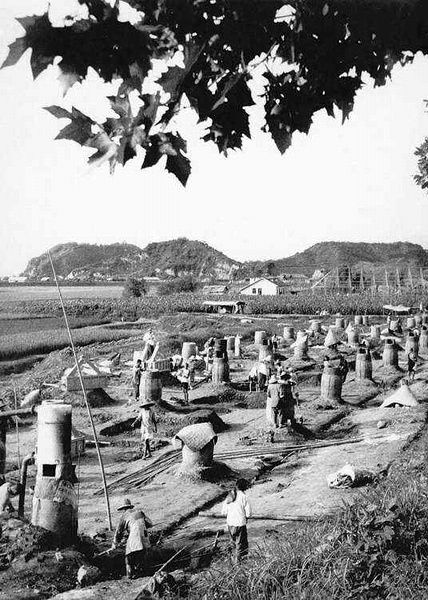
Mao saw grain and steel production as the key pillars of economic development. He forecast that within 15 years of the start of the Great Leap, China's industrial output would surpass that of the UK. In the August 1958 Politburo meetings, it was decided that steel production would be set to double within the year, most of the increase coming through backyard steel furnaces. Major investments in larger state enterprises were made: 1,587, 1,361 and 1,815 medium and large-scale state projects were started in 1958, 1959 and 1960 respectively, more in each year than in the first Five Year Plan.
Millions of Chinese became state workers as a consequence of this industrial investment: in 1958, 21 million were added to non-agricultural state payrolls, and total state employment reached a peak of 50.44 million in 1960, more than doubling the 1957 level; the urban population swelled by 31.24 million people. These new workers placed major stress on China's food-rationing system, which led to increased and unsustainable demands on rural food production. Those between the ages of sixteen and thirty were considered ideal candidates for the militia, within the broader goal that every peasant aged sixteen to sixty should serve in the People's Militia (minbing). Peasants were working long hours, all year round, even contributed their own cooking utensils to be melted as a source of production. Officials at multiple levels inflated production figures, leaving central leaders poorly informed about conditions and encouraging further unrealistic demands.
The consequences of the Great Leap Forward were devastating, leading to one of the most severe famines in human history. The policies that diverted labor from agriculture to industrial projects, such as backyard steel furnaces, resulted in a catastrophic drop in agricultural output; consequently, food shortages became widespread. According to demographic studies, the famine caused an estimated 15 to 45 million deaths, with rural areas being the hardest hit. Ashton et al. (1984) highlight: "During the period 1958-62, about 30 million premature deaths occurred in China: deaths that occurred earlier than they would have on the basis of mortality trends for more normal years."
During this rapid expansion, coordination suffered and material shortages were frequent, resulting in "a huge rise in the wage bill, largely for construction workers, but no corresponding increase in manufactured goods". Facing a massive deficit, the government cut industrial investment from CN¥38.9 billion to CN¥7.1 billion from 1960 to 1962 (an 82% decrease; the 1957 level was CN¥14.4 billion).
Backyard furnaces
The Great Leap Forward sought to revive folk technologies, including in the area of steel production. China's steel industry faced a shortage of imported iron and calls to increase production of "native iron" had begun in 1956. Efforts to improve steel production were a major focus of the Great Leap Forward. By mid-1958, the Chinese state began promoting indigenous metallurgical methods and the proliferation of "folk furnaces". This was an effort to increase steel production without increased investment costs.
Although the 1958 national mobilization effort to produce steel reached its target of 10.7 million tons, more than 3 million of it was unusable.
Crop production experiments
On the communes, a number of radical and controversial agricultural innovations were promoted at the behest of Mao. Many of these innovations were based on the ideas of now-discredited Soviet agronomist Trofim Lysenko and his followers. The policies included close cropping, whereby seeds were sown far more densely than normal on the incorrect assumption that seeds of the same class would not compete with each other. Yang provides data on the failure of close planting techniques, which reduced yields in Anhui from 400 jin per mu to less than 200 jin per mu due to overcrowded plants competing for nutrients and sunlight." Deep plowing was encouraged on the mistaken belief that this would yield plants with extra large root systems. Moderately productive land was left unplanted based on the belief that concentrating manure and effort on the most fertile land would lead to large productivity gains per-acre. Altogether, these untested innovations generally led to decreases in grain production rather than increases.
Meanwhile, local leaders were pressured into falsely reporting ever-higher grain production figures to their political superiors. Participants at political meetings remembered production figures being inflated up to 10 times their actual production amounts as the race to please superiors and win plaudits—like the chance to meet Mao himself—intensified. The state was later able to force many production groups to sell more grain than they could spare based on these false production figures.
Treatment of villagers
The ban on private holdings severely disrupted peasant life at its most basic level. Villagers were unable to secure enough food to go on living because they were deprived by the commune system of their traditional means of being able to rent, sell, or use their land as collateral for loans. In one village, once the commune was operational, the Party boss and his colleagues "swung into manic action, herding villagers into the fields to sleep and to work intolerable hours, and forcing them to walk, starving, to distant additional projects".
Edward Friedman, political scientist, Paul Pickowicz, historian, and Mark Selden, sociologist, wrote about the dynamic of interaction between the Party and villagers:
Beyond attack, beyond question, was the systemic and structured dynamic of the socialist state that intimidated and impoverished millions of patriotic and loyal villagers.
The authors present a similar picture to Thaxton in depicting the party's destruction of the traditions of Chinese villagers. Traditionally prized local customs were deemed signs of feudalism to be extinguished. "Among them were funerals, weddings, local markets, and festivals. The Party thus destroyed much that gave meaning to Chinese lives. These private bonds were social glue. To mourn and to celebrate is to be human. To share joy, grief, and pain is humanizing." Failure to participate in the CCP's political campaigns—though the aims of such campaigns were often conflicting—"could result in detention, torture, death, and the suffering of entire families".
Public struggle sessions were often used to intimidate the peasants into obeying local officials; they increased the death rate of the famine in several ways. "In the first case, blows to the body caused internal injuries that, in combination with physical emaciation and acute hunger, could induce death." In one case, after a peasant stole two cabbages from the common fields, the thief was publicly criticized for half a day. He collapsed, fell ill, and never recovered. Others were sent to labor camps.
About 7% of those who died during the Great Leap Forward were tortured to death or summarily killed. Benjamin Valentino notes that "communist officials sometimes tortured and killed those accused of failing to meet their grain quota".
However, J. G. Mahoney has said that "there is too much diversity and dynamism in the country for one work to capture ... rural China as if it were one place." Mahoney describes an elderly man in rural Shanxi who recalls Mao fondly, saying "Before Mao we sometimes ate leaves, after liberation we did not." Regardless, Mahoney points out that Da Fo villagers recall the Great Leap Forward as a period of famine and death, and among those who survived in Da Fo were precisely those who could digest leaves.
Direct consequences
The failure of agricultural policies, the movement of farmers from agricultural to industrial work, and weather conditions suppressed the food supply. The shortage of supply clashed with an explosion in demand, leading to millions of deaths from severe famine. The economy, which had improved since the end of the civil war, was devastated, and in response to the severe conditions, there was resistance among the populace.