
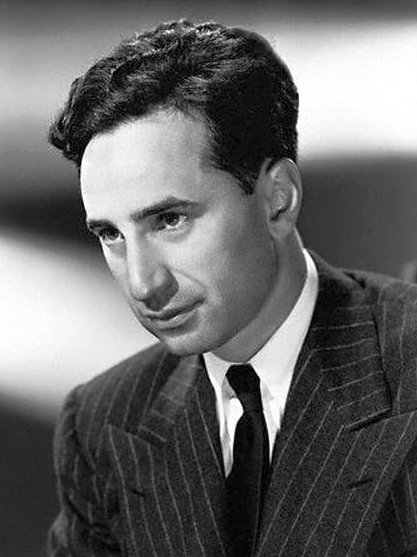
Elias Kazantzoglou (Greek: Ηλίας Καζαντζόγλου, IPA: [iˈli.as kazanˈdzoɣlu]; September 7, 1909 – September 28, 2003), known as Elia Kazan ( EE-lee-ə kə-ZAN), was a Greek-American film and theatre director, producer, screenwriter and actor, described by The New York Times as "one of the most honored and influential directors in Broadway and Hollywood history".
Born in Constantinople (now Istanbul) to Cappadocian Greek parents, his family came to the United States in 1913. After attending Williams College and then the Yale School of Drama, he acted professionally for eight years, later joining the Group Theatre in 1932, and co-founded the Actors Studio in 1947. With Robert Lewis and Cheryl Crawford, his actors' studio introduced "Method Acting" under the direction of Lee Strasberg. Kazan acted in a few films, including City for Conquest.
His films focused on personal or social issues that particularly concerned him. Kazan writes, "I don't move unless I have some empathy with the basic theme." His first such "issue" film was Gentleman's Agreement, with Gregory Peck, which dealt with antisemitism in the United States. It received eight Oscar nominations and three wins, including Kazan's first for Best Director. It was followed by Pinky, one of the first films in mainstream Hollywood to address racial prejudice against African Americans. A Streetcar Named Desire, an adaptation of the stage play which he had also directed, received twelve Oscar nominations, winning four, and was Marlon Brando's breakthrough role. Three years later, he directed Brando again in On the Waterfront, a film about union corruption on New York's waterfront. It also received twelve Oscar nominations, winning eight. In 1955, he directed John Steinbeck's East of Eden, starring James Dean.

A turning point in Kazan's career came with his testimony as a "friendly witness" before the House Un-American Activities Committee (HUAC) in 1952 at the height of the Hollywood blacklist. His decision to cooperate and name names brought him strong negative reactions from many friends and associates. His harshly anti-communist testimony "damaged if not shattered the careers of his former colleagues, Morris Carnovsky and Art Smith, both actors, and the playwright Clifford Odets". In his memoirs, Kazan writes that he and Odets had made a pact at the time to name each other in front of the committee. Kazan later justified his actions by saying he took "only the more tolerable of two alternatives that were either way painful and wrong". Nearly a half-century later, his 1952 HUAC testimony continued to cause controversy. When Kazan was awarded an honorary Oscar in 1999, dozens of actors chose not to applaud as 250 demonstrators picketed the event.
Kazan influenced the films of the 1950s and 1960s with his provocative, issue-driven subjects. Director Stanley Kubrick called him "without question, the best director we have in America, [and] capable of performing miracles with the actors he uses". Film author Ian Freer concludes that even "if his achievements are tainted by political controversy, the debt Hollywood—and actors everywhere—owes him is enormous". Orson Welles said "Kazan is a traitor ... [but] he is a very good director". In 2010, Martin Scorsese co-directed the documentary film A Letter to Elia as a personal tribute to Kazan.
Early life
Kazan was born Elias Kazantzoglou in the Chalcedon (now Kadıköy) district of Constantinople (now Istanbul), to Cappadocian Greek parents, originally from Kayseri in Anatolia. The family's surname comes from the Turkish Kazancı (Ottoman Turkish: قزانجی), meaning "pot maker", and oğlu, a patronymic meaning "son [of]". Surnames like these were given to or taken by Jewish people. Most of the rest of the Elias’ family also have Biblical, Jewish names. He arrived in the United States with his parents, Athena (née Shishmanoglou) and George Kazantzoglou, on July 8, 1913. He was named after his paternal grandfather, Elias Kazantzoglou. His maternal grandfather was Isaak Shishmanoglou. Elia's brother, Avraam, was born in Berlin and later became a psychiatrist.

Kazan was raised in the Greek Orthodox Church and attended Greek Orthodox services every Sunday, where he had to stand for several hours with his father. His mother read the Bible but did not go to church. When Kazan was about eight years old, the family moved to New Rochelle, New York, and his father sent him to a Catholic catechism school because there was no Orthodox church nearby. When meeting with the Turkish filmmaker Yılmaz Güney, it was revealed he had retained fluency in the Turkish language from childhood.
As a young boy, he was remembered as being shy, and his college classmates characterized him as more of a loner. Much of his early life was portrayed in his autobiographical book, America America, which he made into a 1963 film. In it, he describes his family as "alienated" from both their parents' Greek Orthodox values and from those of "mainstream America". His mother's family were cotton merchants who imported cotton from England and sold it wholesale. His father had become a rug merchant after immigrating to the US, and he expected his son to take over the family business someday.
After attending public schools through high school, Kazan enrolled at Williams College in Massachusetts, where he helped pay his way by waiting tables and washing dishes; he still graduated cum laude. He also worked as a bartender at various fraternities but never joined one. While a student at Williams, he earned the nickname "Gadg" (for Gadget) because, he said, "I was small, compact, and handy to have around." The nickname was eventually taken up by his stage and film stars. In America America, Kazan recounts how and why his family left Turkey for the United States. Kazan observes that much of it came from stories that he heard as a young boy. He says during an interview that "it's all true: the wealth of the family was put on the back of a donkey, and my uncle, really still a boy, went to Istanbul ... to gradually bring the family there to escape the oppressive circumstances. ... It's also true that he lost the money on the way, and when he got there he swept rugs in a little store."

Kazan noted some of the controversial aspects of what he put in the film: "I used to say to myself when I was making the film that America was a dream of total freedom in all areas." To make his point, the character who portrays Kazan's uncle Avraam kisses the ground when he gets through customs, while the Statue of Liberty and the American flag are in the background. Kazan had considered whether that kind of scene might be too much for American audiences:
I hesitated about that for a long time. A lot of people, who don't understand how desperate people can get, advised me to cut it. When I am accused of being excessive by the critics, they're talking about moments like that. But I wouldn't take it out for the world. It actually happened. Believe me, if a Turk could get out of Turkey and come here, even now, he would kiss the ground. To oppressed people, America is still a dream.
Before undertaking America America, Kazan wanted to confirm many of the details about his family's background. At one point, he sat his parents down and recorded their answers to his questions. He remembers eventually asking his father a "deeper question: 'Why America? What were you hoping for?'" His mother gave him the answer: "A.E. brought us here." Kazan states that "'A.E.' was my uncle Avraam Elia, the one who left the Anatolian village with the donkey. At twenty-eight, somehow—this was the wonder—he made his way to New York. He sent home money and in time brought my father over. Father sent for my mother and my baby brother and me when I was four." Kazan writes of America America, "It's my favorite of all the films I've made, the first film that was entirely mine."
Career
1930s: Stage career
In 1932, after spending two years at the Yale University School of Drama, he moved to New York City to become a professional stage actor. He continued his professional studies at the Juilliard School, where he studied singing with Lucia Dunham. His first opportunity came with a small group of actors engaged in presenting plays containing "social commentary". They were called the Group Theatre, which showcased many lesser-known plays with deep social or political messages. After struggling to be accepted by them, he discovered his first strong sense of self in America within the "family of the Group Theatre, and more loosely in the radical social and cultural movements of the time", writes film author Joanna E. Rapf.
In his autobiography, Kazan writes of the "lasting impact on him of the Group", noting in particular Lee Strasberg and Harold Clurman as "father figures", along with his close friendship with playwright Clifford Odets. During an interview with Michel Ciment, Kazan described the Group:
The Group was the best thing professionally that ever happened to me. I met two wonderful men. Lee Strasberg and Harold Clurman, both of whom were around thirty years old. They were magnetic, fearless leaders. During the summer I was an apprentice, they were entertaining in a Jewish summer camp. ... At the end of the summer they said to me: "You may have talent for something, but it's certainly not acting."

Kazan also praised Strasberg as a vital leader of the Group:
He carried with him the aura of a prophet, a magician, a witch doctor, a psychoanalyst, and a feared father of a Jewish home. ... [H]e was the force that held the thirty-odd members of the theatre together, and made them permanent.
Kazan's first national success came as a New York theatrical director. Although initially he worked as an actor on stage, and told early in his acting career that he had no acting ability, he surprised many critics by becoming one of the Group's most capable actors. In 1935 he played the role of a strike-leading taxi driver in a drama by Clifford Odets, Waiting for Lefty, and his performance was called "dynamic", leading some to label him the "proletarian thunderbolt". Among the themes that would run through all of his work were "personal alienation and an outrage over social injustice", writes film critic William Baer. Other critics have likewise noted his "strong commitment to the social and social psychological—rather than the purely political—implications of drama".

By the mid-1930s, when he was 26, Kazan began directing a number of the Group Theatre's plays, including Robert Ardrey's well-known play Thunder Rock. In 1942, he achieved his first notable success by directing a play by Thornton Wilder, The Skin of Our Teeth, starring Tallulah Bankhead and Fredric March. The play, though controversial, was a critical and commercial success and won Wilder a Pulitzer Prize. Kazan won the New York Drama Critics Award for Best Director and Bankhead for Best Actress. Kazan then went on to direct Death of a Salesman by Arthur Miller, and then directed A Streetcar Named Desire by Tennessee Williams, both of which were also successful. Kazan's wife, Molly Thacher, the reader for the Group, discovered Williams and awarded him a "prize that launched his career".
The Group Theatre's summer rehearsal headquarters was at Pine Brook Country Club, located in the countryside of Nichols, Connecticut, during the 1930s and early 1940s. Along with Kazan were numerous other artists, including Harry Morgan, John Garfield, Luise Rainer, Frances Farmer, Will Geer, Howard da Silva, Clifford Odets, Lee J. Cobb, and Irwin Shaw.
1940s: The Actors Studio, early films
In 1940, Kazan had a large supporting role as a flamboyantly dressed gangster in the boxing thriller City for Conquest starring James Cagney, Ann Sheridan, and Anthony Quinn. His stylishly distinctive but raffish clothing seems to have been copied by Frank Sinatra a decade and a half later, and his part is both sympathetic and extremely dramatic. In 1947, he founded the Actors Studio, a non-profit workshop, with actors Robert Lewis and Cheryl Crawford. In 1951, Lee Strasberg became its director after Kazan left for Hollywood to focus on his career as a movie director. It remained a non-profit enterprise. Strasberg introduced the "Method" to the Actors Studio, an umbrella term for a constellation of systems based on Konstantin Stanislavski's teachings. The "Method" school of acting became the predominant system of post-World War II Hollywood.
Among Strasberg's students were Montgomery Clift, Mildred Dunnock, Julie Harris, Karl Malden, Patricia Neal, Maureen Stapleton, Eli Wallach, and James Whitmore. Kazan directed two of the Studio's protégés, Karl Malden and Marlon Brando, in the Tennessee Williams play A Streetcar Named Desire. Although he was at the height of his stage success, Kazan turned to Hollywood to direct motion pictures. He first directed two short films, but his first feature film was A Tree Grows in Brooklyn, one of his first attempts to film dramas focused on contemporary concerns, which later became his forte. Two years later, he directed Gentleman's Agreement, in which he tackled a seldom-discussed topic in the United States, antisemitism, for which he won his first Oscar for Best Director. In 1947, he directed the courtroom drama Boomerang! In 1949, he again tackled a controversial subject when he directed Pinky, which explored issues of racism in the United States, and was nominated for three Academy Awards.
1950s: Rise to prominence
In 1950, Kazan directed Panic in the Streets, starring Richard Widmark, a thriller shot on the streets of New Orleans. In that film, Kazan experimented with a documentary-style cinematography, which succeeded in "energizing" the action scenes. He won the Venice Film Festival International Award as director, and the film also won two Academy Awards. Kazan had requested that Zero Mostel also act in the film, despite Mostel being "blacklisted" as a result of HUAC testimony a few years earlier. Kazan writes of his decision:
Each director has a favorite in his cast… my favorite this time was Zero Mostel. … I thought him an extraordinary artist and a delightful companion, one of the funniest and most original men I'd ever met. … I constantly sought his company. … He was one of the three people whom I rescued from the "industry's" blacklist. … For a long time, Zero had not been able to get work in films, but I got him in my film.
In 1951, after introducing and directing Marlon Brando and Karl Malden in the stage version, he went on to cast both in the film version of the play, A Streetcar Named Desire, which won four Oscars and was nominated for twelve. Despite these plaudits, the film was considered a step back, cinematically, with a feel of filmed theater; though Kazan initially used a more open setting, he later felt compelled to revert to a stage atmosphere to remain true to the script. He explains:
On "Streetcar" we worked very hard to open it up, and then went back to the play because we'd lost all the compression. In the play, these people were trapped in a room with each other. What I actually did was to make the set smaller. As the story progressed… the set got smaller and smaller.
Kazan's next film was Viva Zapata! (1952), which also starred Marlon Brando. This time, the film added real atmosphere through location shots and strong character accents. Kazan called this his "first real film" because of those factors. In 1954, he again used Brando as a star in On the Waterfront. As a continuation of the socially relevant themes he developed in New York, the film exposed corruption within the city's longshoremen's union. It too was nominated for twelve Academy Awards, and won eight, including Best Picture, Best Director, and Best Actor for Marlon Brando. On the Waterfront was also the screen debut for Eva Marie Saint, who won the Oscar for Best Supporting Actress for her role. Saint recalls that Kazan selected her for the role after having her perform an improvisational skit with Brando as the other character. She had no idea that he was looking to fill any particular film part, however, but remembers that Kazan set up the scenario with Brando, which brought out surprising emotions:
I ended up crying. Crying and laughing. ... I mean, there was such an attraction there. ... That smile of his. ... He was very tender and funny. ... And Kazan, in his genius, saw the chemistry there.
Life magazine described On the Waterfront as the "most brutal movie of the year" but with "the year's tenderest love scenes", and stated that Saint was a "new discovery" in films. In its cover story about Saint, it speculated that it will probably be as Edie in On the Waterfront that she "starts her real trip to fame". The film used extensive on-location street scenes and waterfront shots and featured a notable score by composer Leonard Bernstein.
After the success of On the Waterfront, he went on to direct another screen adaptation of a John Steinbeck novel, East of Eden (1955). As director, Kazan again used another unknown actor, James Dean. Kazan had seen Dean on stage in New York and, after an audition, gave him the starring role along with an exclusive contract with Warner Bros. Dean flew back to Los Angeles with Kazan in 1954, the first time he had ever flown, bringing his clothes in a brown paper bag. The film's success introduced James Dean to the world and established him as a popular actor. He went on to star in Rebel Without a Cause (1955), directed by Kazan's friend Nicholas Ray, and then Giant (1956), directed by George Stevens.
Author Douglas Rathgeb recounts the difficulties Kazan had in turning Dean into a new star, noting how Dean was a controversial figure at Warner Bros. from the time he arrived. There were rumors that he "kept a loaded gun in his studio trailer; that he drove his motorcycle dangerously down studio streets or sound stages; that he had bizarre and unsavory friends." As a result, Kazan was forced to "baby-sit the young actor in side-by-side trailers", so he would not run away during production. Co-star Julie Harris worked overtime to quell Dean's panic attacks. In general, Dean was oblivious to Hollywood's methods, and Rathgeb notes that "his radical style did not mesh with Hollywood's corporate gears".
Dean was amazed at his own performance on screen when he later viewed a rough cut of the film. Kazan had invited director Nicholas Ray to a private showing, with Dean, as Ray was looking for someone to play the lead in Rebel Without a Cause. Ray watched Dean's powerful performance on the screen, but it seemed impossible that the same person was in the room. Ray felt Dean was shy and totally withdrawn, sitting hunched over. "Dean himself did not seem to believe it", notes Rathgeb. "He watched himself with an odd, almost adolescent fascination, as if he were admiring someone else." The film also made good use of on-location and outdoor scenes, along with effective use of the early widescreen format, making the film one of Kazan's most accomplished works. James Dean died the following year, at the age of 24, in an accident with his sports car about 200 miles north of Los Angeles. He had only made three films, and the only completed film he ever saw was East of Eden.
1960s: Continued work
In 1961, Kazan introduced Warren Beatty in his first starring role in Splendor in the Grass (1961), with Natalie Wood; the film was nominated for two Oscars and won one. Author Peter Biskind points out that Kazan "was the first in a string of major directors Beatty sought out, mentors or father figures from whom he wanted to learn." Biskind notes also that they "were wildly dissimilar—mentor vs. protégé, director vs. actor, immigrant outsider vs. native son. Kazan was armed with the confidence born of age and success, while Beatty was virtually aflame with the arrogance of youth." Kazan later recorded his impressions of Beatty:
Warren—it was obvious the first time I saw him—wanted it all and wanted it his way. Why not? He had the energy, a very keen intelligence, and more chutzpah than any Jew I've ever known. Even more than me. Bright as they come, intrepid, and with that thing all women secretly respect: complete confidence in his sexual powers, confidence so great that he never had to advertise himself, even by hints.
Biskind describes an episode during the first week of shooting, where Beatty was angered at something Kazan said: "The star lashed out at the spot where he knew Kazan was most vulnerable, the director's friendly testimony before the HCUA. He snapped, 'Lemme ask you something—why did you name all those names?'" Beatty recalled the episode: "In some patricidal attempt to stand up to the great Kazan, I arrogantly and stupidly challenged him on it." Biskind relates how "Kazan grabbed his arm, asking, 'What did you say?' and dragged him off to a tiny dressing room ... whereupon the director proceeded to justify himself for two hours." Beatty, years later, during a Kennedy Center tribute to Kazan, stated to the audience that Kazan "had given him the most important break in his career". Beatty's co-star, Natalie Wood, was in a transitional period in her career, having mostly been cast as a child or teenager, and was now hoping to be cast in adult roles. Biographer Suzanne Finstad notes that a "turning point" in her life as an actress was upon seeing the film A Streetcar Named Desire: "She was transformed, in awe of Kazan and of Vivien Leigh's performance ... [who] became a role model for Natalie." In 1961, after a "series of bad films, her career was already in decline", notes Rathgeb. Kazan writes that the "sages" of the film community declared her as "washed up" as an actress, although he still wanted to interview her for his next film:
When I saw her, I detected behind the well-mannered 'young wife' front a desperate twinkle in her eyes. ... I talked with her more quietly then and more personally. I wanted to find out what human material was there, what her inner life was. ... Then she told me she was being psychoanalyzed. That did it. Poor R.J. [Wagner, Wood's husband], I said to myself. I liked Bob Wagner, I still do.
Kazan cast her as the female lead in Splendor in the Grass, and her career rebounded. Finstad feels that despite Wood never receiving training in Method acting techniques, "working with Kazan brought her to the greatest emotional heights of her career. The experience was exhilarating but wrenching for Natalie, who faced her demons on Splendor." She adds that a scene in the film, as a result of "Kazan's wizardry ... produced a hysteria in Natalie that may be her most powerful moment as an actress." Actor Gary Lockwood, who also acted in the film, felt that "Kazan and Natalie were a terrific marriage, because you had this beautiful girl, and you had somebody that could get things out of her." Kazan's favorite scene in the movie was the last one, when Wood goes back to see her lost first love, Bud (Beatty). Kazan recalled: "It's terribly touching to me. I still like it when I see it. And I certainly didn't need to tell her how to play it. She understood it perfectly." Kazan wrote novels in the later 1960s, converting two into films: America America, based on his 1962 semi-biographical novel based on his uncle's experiences during the 1896 Hamidian massacres, and The Arrangement which was based on his 1967 novel of the same name. America, America earned Kazan his final Oscars nomination for Best Director.
1970s: Later work
Kazan made two final movies in the 1970s starting with The Visitors in 1972, written by his eldest son Chris Kazan and shot entirely on 16mm film. The low-budget film only features five characters and was shot completely on Kazan's country home working with four crew members, and explores the Vietnam War and brutality during wartime. He continued his pattern of making movies with more ambiguous stories and boundaries in his last film in 1976, The Last Tycoon, based on the unfinished novel by F. Scott Fitzgerald. Featuring an ensemble cast including Robert De Niro, Robert Mitchum, Jack Nicholson, Tony Curtis, and Jeanne Moreau, Kazan has described his interpretation of The Last Tycoon as his own views of Hollywood.
Collaborators
Kazan was noted for his close collaboration with screenwriters. On Broadway, he worked with Arthur Miller, Tennessee Williams, and William Inge; in film, he worked again with Willams (A Streetcar Named Desire and Baby Doll), Inge (Splendor in the Grass), Budd Schulberg (On the Waterfront and A Face in the Crowd), John Steinbeck (Viva Zapata!), and Harold Pinter (The Last Tycoon). As an instrumental figure in the careers of many of the best writers of his time, "he always treated them and their work with the utmost respect." In 2009, a previously unproduced screenplay by Williams, The Loss of a Teardrop Diamond, was released as a film. Williams wrote the screenplay specifically for Kazan to direct during the 1950s.
Among Kazan's other films were Panic in the Streets (1950), East of Eden (1955), Baby Doll (1956), Wild River (1960), and The Last Tycoon (1976). Williams became one of Kazan's closest and most loyal friends, and Kazan often pulled Williams out of "creative slumps" by redirecting his focus with new ideas. In 1959, in a letter to Kazan, he writes, "Some day you will know how much I value the great things you did with my work, how you lifted it above its measure by your great gift."
Directing style
Preference for unknown actors
Kazan strove for "cinematic realism", a quality he often achieved by discovering and working with unknown actors, many of whom treated him as their mentor, which gave him the flexibility to depict "social reality with both accuracy and vivid intensity". He also felt that casting the right actors accounted for 90% of a movie's ultimate success or failure. As a result of his efforts, he also gave actors such as Lee Remick, Jo Van Fleet, Warren Beatty, Andy Griffith, Eva Marie Saint, James Dean and Jack Palance their first major movie roles. He explained to director and producer George Stevens Jr. that he felt that "big stars are barely trained or not very well trained. They also have bad habits ... they're not pliable anymore." Kazan also describes how and why he gets to know his actors on a personal level:
Now what I try to do is get to know them very well. I take them to dinner. I talk to them. I meet their wives. I find out what the hell the human material is that I'm dealing with, so that by the time I take an unknown he's not an unknown to me.
As an example, Kazan recalled during an interview how he came to understand James Dean:
When I met him he said, "I'll take you for a ride on my motorbike ..." It was his way of communicating with me, saying "I hope you like me, ..." I thought he was an extreme grotesque of a boy, a twisted boy. As I got to know his father, as I got to know about his family, I learned that he had been, in fact, twisted by the denial of love ... I went to Jack Warner and told him I wanted to use an absolutely unknown boy. Jack was a crapshooter of the first order, and said, "Go ahead."
Topics of personal and social realism
Kazan chose his subjects to express personal and social events that he was familiar with. He described his thought process before taking on a project:
I don't move unless I have some empathy with the basic theme. In some way the channel of the film should also be in my own life. I start with an instinct. With East of Eden ... it's really the story of my father and me, and I didn't realize it for a long time. ... In some subtle or not-so-subtle way, every film is autobiographical. A thing in my life is expressed by the essence of the film. Then I know it experientially, not just mentally. I've got to feel that it's in some way about me, some way about my struggles, some way about my pain, my hopes.
Film historian Joanna E. Rapf notes that among the methods Kazan used in his work with actors was his initial focus on "reality", although his style was not defined as "naturalistic". She adds: "He respects his script, but casts and directs with a particular eye for expressive action and the use of emblematic objects." Kazan stated that "unless the character is somewhere in the actor himself, you shouldn't cast him." In his later years, he changed his mind about some of the philosophy behind the Group Theatre, in that he no longer felt that the theater was a "collective art", as he once believed:
To be successful it should express the vision, the conviction, and the insistent presence of one person.
Film author Peter Biskind described Kazan's career as "fully committed to art and politics, with the politics feeding the work". Kazan, however, has downplayed that impression: