
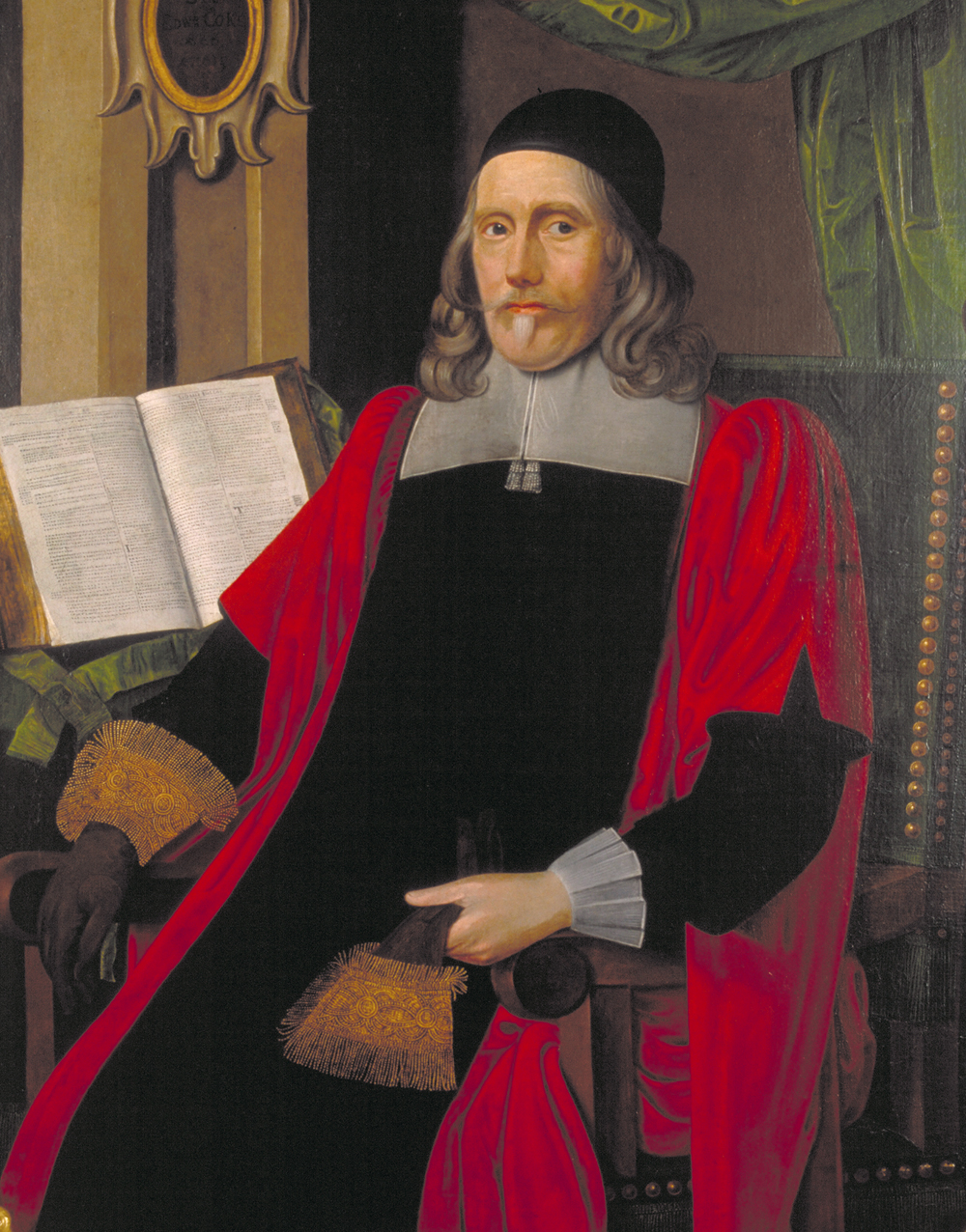
Sir Edward Coke ( CUUK, formerly ; 1 February 1552 – 3 September 1634) was an English barrister, judge, and politician. He is often considered the greatest jurist of the Elizabethan and Jacobean eras.
Born into an upper-class family, Coke was educated at Trinity College, Cambridge, before leaving to study at the Inner Temple, where he was called to the Bar on 20 April 1578. As a barrister, he took part in several notable cases, including Slade's Case, before earning enough political favour to be elected to Parliament, where he served first as Solicitor General and then as Speaker of the House of Commons. Following a promotion to Attorney General he led the prosecution in several notable cases, including those against Robert Devereux, Sir Walter Raleigh, and the Gunpowder Plot conspirators. As a reward for his services he was first knighted and then made Chief Justice of the Common Pleas.
As Chief Justice, Coke restricted the use of the ex officio (Star Chamber) oath and, in the Case of Proclamations and Dr. Bonham's Case, declared the King to be subject to the law, and the laws of Parliament to be void if in violation of "common right and reason". These actions eventually led to his transfer to the Chief Justiceship of the King's Bench, where it was felt he could do less damage. Coke then successively restricted the definition of treason and declared a royal letter illegal, leading to his dismissal from the bench on 14 November 1616. With no chance of regaining his judicial posts, he instead returned to Parliament, where he swiftly became a leading member of the opposition. During his time as a Member of Parliament he wrote and campaigned for the Statute of Monopolies, which substantially restricted the ability of the monarch to grant patents, and authored and was instrumental in the passage of the Petition of Right, a document considered one of the three crucial constitutional documents of England, along with Magna Carta and the Bill of Rights 1689.
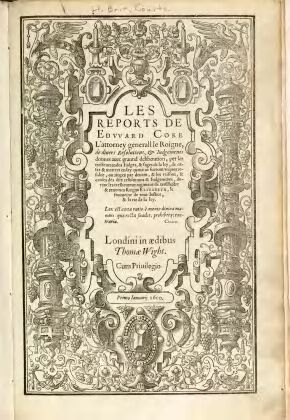
Coke is best known in modern times for his Institutes, described by John Rutledge as "almost the foundations of our law", and his Reports, which have been called "perhaps the single most influential series of named reports". Historically, he was a highly influential judge; within England and Wales, his statements and works were used to justify the right to silence, while the Statute of Monopolies is considered to be one of the first actions in the conflict between Parliament and monarch that led to the English Civil War. In America, Coke's decision in Dr. Bonham's Case was used to justify the voiding of both the Stamp Act 1765 and writs of assistance, which led to the American War of Independence; after the establishment of the United States his decisions and writings profoundly influenced the Third and Fourth amendments to the United States Constitution while necessitating the Sixteenth.
Family background and early life
The surname "Coke", or "Cocke", can be traced back to a William Coke in the hundred of South Greenhoe, now the Norfolk town of Swaffham, in around 1150. The family was relatively prosperous and influential – members from the 14th century onwards included an undersheriff, a knight banneret, a barrister and a merchant. The name "Coke" was pronounced during the Elizabethan age, although it is now pronounced . The origin of the name is uncertain: it has been suggested that "Coke" or "Cock" was a word meaning "river" or "chief" among the early Britons, but a more likely hypothesis is that the spelling arose from an attempt to disguise the word "cook". That "cook" and "coke" were homonyms at this time is shown by the fact that Coke's second wife, Elizabeth Hatton, regularly spelt his name "Cook" when writing to him.
Coke's father, Robert Coke, was a barrister and Bencher of Lincoln's Inn who built up a strong practice representing clients from his home area of Norfolk. Over time, he bought several manors at Congham, West Acre and Happisburgh, all in Norfolk, and was granted a coat of arms, becoming a minor member of the gentry. Coke's mother, Winifred Knightley, came from a family even more intimately linked with the law than her husband. Her father and grandfather had practised law in the Norfolk area, and her sister Audrey was married to Thomas Gawdy, a lawyer and Justice of the Court of King's Bench with links to the Earl of Arundel. This connection later served Edward well. Winifred's father later married Agnes, the sister of Nicholas Hare.
Edward Coke was born on 1 February 1552 in his father's manor of Mileham in Norfolk (acquired by him in 1553) one of eight children. The other seven were daughters – Winifred, Dorothy, Elizabeth, Ursula, Anna, Margaret and Ethelreda – although it is not known in which order the children were born. Two years after Robert Coke died on 15 November 1561, his widow married Robert Bozoun, a property trader noted for his piety and strong business acumen (once forcing Nicholas Bacon to pay an exorbitant amount of money for a piece of property). He had a tremendous influence on the Coke children: from Bozoun Coke learnt to "loathe concealers, prefer godly men and briskly do business with any willing client", something that shaped his future conduct as a lawyer, politician, and judge.
Education and call to the Bar
At the age of eight in 1560, Coke began studying at the Norwich Free Grammar School. The education there was based on erudition, the eventual goal being that by the age of 18 the students would have learned "to vary one sentence diversely, to make a verse exactly, to endight an epistle eloquently and learnedly, to declaim of a theme simple, and last of all to attain some competent knowledge of the Greek tongue". The students were taught rhetoric based on the Rhetorica ad Herennium, and Greek centred on the works of Homer and Virgil. Coke was taught at Norwich to value the "forcefulness of freedom of speech", something he later applied as a judge. Some accounts relate that he was a diligent student who applied himself well.
After leaving Norwich in 1567 he matriculated to Trinity College, Cambridge, where he studied for three years until the end of 1570, when he left without gaining a degree. Little is known of his time at Trinity, though he certainly studied rhetoric and dialectics under a program instituted in 1559. His biographers felt he had all the intelligence to be a good student, though a record of his academic achievements has not been found. Coke was proud of Cambridge and the time he spent there, later saying in Dr. Bonham's Case that Cambridge and Oxford were "the eyes and soul of the realm, from whence religion, the humanities, and learning were richly diffused into all parts of the realm."

After leaving Trinity College he travelled to London, where he became a member of Clifford's Inn in 1571. This was to learn the basics of the law – the Inns of Chancery, including Clifford's Inn, provided initial legal education before transfer to the Inns of Court, where one could be called to the Bar and practise as a barrister. Students were educated through arguments and debates – they would be given precedents and writs each day, discuss them at the dinner table and then argue a moot court based on those precedents and their discussions. Coke also studied various writs "till they turned honey sweet on his tongue", and after completing this stage of his legal education transferred to the Inner Temple on 24 April 1572.
At the Inner Temple, he began the second stage of his education, reading legal texts such as Glanville's Treatises and taking part in moots. He took little interest in the theatrical performances or other cultural events at the Inns, preferring to spend his time at the law courts in Westminster Hall, listening to the Serjeants argue. After six years at the Inner Temple he was called to the Bar on 20 April 1578, a remarkably fast rate of progress given the process of legal education at the time, which normally required eight years of study. Polson, a biographer of Coke, suggests that this was due to his knowledge of the law, which "excited the Benchers".
Practice as a barrister
After being called to the Bar on 20 April 1578 Coke immediately began practising as a barrister. His first case was in the Court of King's Bench in 1581, and was known as Lord Cromwell's Case after the claimant, Henry, Lord Cromwell, a landlord in Coke's home county of Norfolk. The case was a charge of slander against a Mr Denny, the Vicar of Northlinham and Coke's client. In a dispute with Denny, Cromwell had hired two unlicensed preachers to harass him, denounce the Book of Common Prayer and preach the gospel in his area. Denny retorted by telling Cromwell "you like not of me, since you like those that maintain sedition". Cromwell argued that Denny was guilty of scandalum magnatum, slander against a peer of the realm because his statement implied that Cromwell himself was seditious or had seditious tendencies.

The case was actually two actions, with the first judgement being given in Denny's favour after Coke's research found a flaw in the pleadings that invalidated Cromwell's case. His counsel had worked from an inaccurate English copy of the Latin statute of scandalum magnatum which had mistranslated several passages, forcing them to start the case anew. After the case was restarted, Coke argued that Denny had commented on Cromwell's support of people attacking the Book of Common Prayer, and was not implying any deeper disloyalty. The judge ruled that Denny's statement had indeed meant this, and from this position of strength Coke forced a settlement. Coke was very proud of his actions in this case and later described it in his Reports as "an excellent point of learning in actions of slander". The next year he was elected Reader of Lyon's Inn for three years, something surprising considering his young age and likely related to his conduct in Lord Cromwell's Case. As Reader he was tasked with reading to the students at the Inn, a group that numbered about thirty at any one time, and the quality of his readings increased his reputation even further. His lectures were on the Statute of Uses, and his reputation was such that when he retired to his house after an outbreak of the plague, "nine Benchers, forty barristers, and others of the Inn accompanied him a considerable distance on his journey" in order to talk to him.
During the 1580s, Coke became intimately linked with the Howard family, the Dukes of Norfolk and Earls of Arundel. His uncle Thomas Gawdy had close links to Earl Arundel himself. In Norfolk Arundel held a liberty – he was essentially a local prince who appointed all officials, maintained his own prison, executed justice and bribed any royal clerks. His power base was his household, particularly the network of lawyers and stewards who held his estates together. Coke's uncle Thomas Gawdy had served as Steward to the Third Duke of Norfolk, and during the 1580s Coke was employed by the Howards to counter lawyers employed by the Crown, who argued that the Howards' lands were forfeit owing to the treason of the 4th Duke. As well as defeating these direct attacks Coke travelled to Cardiff to answer a challenge by Francis Dacre, son of William Dacre, 3rd Baron Dacre and uncle-in-law to the 4th Duke's three sons, Philip Howard and his two half-brothers, Thomas Howard, 1st Earl of Suffolk and Lord William Howard – he proved that Dacre's evidence was false and had the case dismissed.
Coke became involved in the now classic Shelley's Case in 1581, which created a rule in real property that is still used in some common law jurisdictions today; the case also established Coke's reputation as an attorney and case reporter. His next famous case was Chudleigh's Case, a dispute over the interpretation of the Statute of Uses, followed by Slade's Case, a dispute between the Common Pleas and King's Bench over assumpsit now regarded as a classic example of the friction between the two courts and the forward movement of contract law; Coke's argument in Slade's Case formed the first definition of consideration.
Politics
Thanks to his work on their behalf, Coke had earned the favour of the Dukes of Norfolk. When he secured the Lordship of Aldeburgh for them in 1588 he also obtained the Aldeburgh parliamentary constituency, which elected two Members of Parliament (MPs). With their support, Coke was returned for Aldeburgh as an MP in February 1589.
Elizabeth I
Solicitor General and Speaker
The political "old guard" began to change around the time Coke became a Member of Parliament. The Earl of Leicester died in 1588, followed by Sir Walter Mildmay, the Chancellor of the Exchequer, a year later, and Sir Francis Walsingham a year after that. In 1592 the Lord Chief Justice died and, according to custom the Attorney General, John Popham, succeeded him, with the Solicitor General, Thomas Egerton, succeeding Popham. This created a vacancy among the Law Officers of the Crown, and thanks to the influence of the Cecil family, Coke became Solicitor General on 16 June 1592. This was likely a narrow victory owing to Coke's defence of unpopular clients; he was summoned before Elizabeth I, who berated him until he cried before confirming him as Solicitor General.
Coke held the position only briefly; by the time he returned from a tour of Norfolk to discuss election strategy, he had been confirmed as Speaker of the House of Commons by the Privy Council, having been proposed by Francis Knollys and Thomas Heneage following his return to Parliament as MP for Norfolk. Coke held the positions of Speaker and Solicitor-General at the same time, although he did not take up his post as Speaker until the state opening of Parliament on 19 February 1593 (despite being confirmed on 28 January 1593).
After "disabling" himself in the House of Lords (a ceremony in which the incoming Speaker apologised for his failings) Parliament was suspended until 24 February; Coke returned two days later, having suffered from a stomach problem. The Parliament was intended to be a brief and simple one; with the Black Death resurgent throughout England and the threat of Spain on the horizon, the only matter was to impose certain taxes to fund the Queen's campaign against the Spanish, with no bills to be introduced. The taxes were paramount; subsidies collected in 1589 had been spent, and the war continued.
The idea of a calm, swift Parliament foundered on the rocks of religious conflict. On 27 February James Morice, a Puritan Member of Parliament, proposed two new bills: one against the bishops of the Church of England, and the other against the Court of High Commission. Morice was placed under house arrest, and seven Members of Parliament were later arrested, but the bills remained in Parliament. They were defended by Francis Knollys, one of the few remaining Puritan Members of Parliament, while other Puritans spat and coughed to drown out speeches by opponents.
Coke and Cecil, the government's two strongest defenders in Parliament, made several efforts to put off or end the debate over the bills. Cecil first pointed out that the Queen had forbidden bills on religion; Parliament ignored him, and the bill went ahead. Coke, as Speaker of the House of Commons (whose job was to schedule any bills), conducted a delaying campaign, first suggesting that the bill was too long to be read in the morning and then that it be delegated to a committee; both suggestions were voted down by the Commons. Coke continued talking until the end of the Parliamentary day in a filibuster action, granting a day of delay for the government. Immediately afterwards, Coke was summoned by the Queen, who made it clear that any action on the bills would be considered evidence of disloyalty. The warning was accepted by the Commons, and no more action was taken on the two Puritan bills.
Attorney General
On 10 April 1594, Coke was made Attorney General for England and Wales thanks to his partnership with the Cecil family. Francis Bacon, his rival, was supported by Robert Devereux, who waged a constant war against Robert Cecil for control of the English government. The position of Master of the Rolls had become vacant in April 1593, and Coke was expected to be appointed according to convention; Bacon, therefore, would become Attorney General. Coke reacted by becoming even more dogmatic in his actions on behalf of the Crown, and when Devereux approached the queen on Bacon's behalf, she replied that even Bacon's uncle Lord Burghley considered him the second best candidate, after Coke. The Attorney General was the main prosecutor of the Crown, expected to bring all charges on its behalf and serve as its legal advisor in any situation. Coke was appointed in a time of particular difficulty; besides famine and the conflict with Spain, war had recently broken out in Ireland.
Coke primarily dealt with matters of treason, such as the cases of Sir John Smythe and Edward Squire. He also handled religious incidents such as the disputes between the Jesuits and the Church of England, personally interrogating John Gerard after his capture. As the 1590s continued, the infighting between Cecil and Devereux persisted, with Devereux's raid on Cádiz earning him national fame. In March 1599 Devereux was sent to defeat the growing rebellion in Ireland and was given command of 18,000 men, but by November his army was reduced to 4,000, the rest "frittered away" in exchange for "[conquering] nothing".
On 5 June 1600, he faced a panel of Privy Councillors, judges and members of the nobility at York House, where he was charged with appointing generals without the Queen's permission, ignoring orders and negotiating "very basely" with the leader of the rebel forces. While the members of the nobility wished to be gentle with Devereux, the lawyers and judges felt differently, recommending fines and confinement in the Tower of London. In the end a compromise was reached, with Devereux put under house arrest and dismissed from all his government offices.
Devereux immediately began plotting rebellion. Orders were sent out for "bedding" and "draperies" – codenames for weapons – and rebellious gentlemen gathered at Essex House to hear him talk of Elizabeth's "crooked mind and crooked carcass". In response, Coke and Cecil began a counter-plot. In 1599, Sir John Hayward had written and published The First Part of the Life and Raigne of King Henrie IV, dedicating it to Devereux. Elizabeth, furious, banned the book, suggesting that it was a "seditious prelude" intended to show her as a corrupt and poor monarch. Against the backdrop of Devereux's plot, Coke and Cecil started a new investigation into the book, hoping to prove some involvement of Devereux in the publishing. Coke interviewed Hayward's licensing cleric, Samuel Harsnett, who complained that the dedication had been "foisted" on him by Devereux. In reaction, Coke decided to bring charges of treason against Devereux, saying that he had "plotted and practised with the Pope and king of Spain for the deposing and selling of himself as well as the crown of England ... His permitting underhand that treasonable book of Henry IV to be printed and published; it being plainly deciphered, not only by the matter, and by the epistle itself, for what end and for whose behalf it was made, but also the Earl himself being present so often at the playing thereof, and with great applause giving countenance to it".
The charges were never brought because of an incident that soon transpired. On 8 February 1601 Devereux ordered his followers to meet at Essex House. A day later a group of emissaries led by Thomas Egerton and John Popham were sent to Devereux and immediately taken hostage. After a failed attempt to garner support from the population of London, Devereux found himself surrounded in Essex House; after burning his personal papers, he surrendered. On 19 February he was tried for treason, along with the Earl of Southampton. Coke led the case for the government, and Devereux was found guilty and executed; the Earl of Southampton was reprieved.
James I
On 24 March 1603, Elizabeth I died. James VI of Scotland set out to claim the English throne, taking the title James I, and the Cokes immediately began ingratiating themselves with the new monarch and his family. Elizabeth Hatton, Coke's wife, travelled to Scotland to meet Anne of Denmark, the incoming Queen, and "the high-tempered beauty somehow pleased that withdrawn, strong-willed woman ... for as long as Anna lived ... Lady Hatton and her husband would retain the queen's affection and trust". Coke attended divine service with the new king on 22 May, who, following the service, took a sword from his bodyguard and knighted Coke. Coke was reconfirmed as Attorney General under James, and immediately found himself dealing with "a series of treasons, whether real or imaginary". The first of these was the trial of Sir Walter Raleigh; according to Cuthbert William Johnson, one of Coke's biographers, "There is, perhaps, no reported case in which the proofs against the prisoner were weaker than in this trial ... never was an accused person condemned on slighter grounds".
Raleigh was brought to trial on 17 November 1603, on charges of "conspiring to deprive the King of his Government; to alter religion; to bring in the Roman superstition; and to procure foreign enemies to invade the kingdom". The government alleged that on 11 June 1603, Raleigh had met with Lord Cobham, and they had agreed to bring Lady Arbella Stuart (a great great granddaughter of Henry VII) to the English throne, and to accept 600,000 marks from the Spanish government. As such, Raleigh was charged with supporting Stuart's claim to the throne and claiming Spanish money. He pleaded not guilty, with Coke's only evidence being a confession from Cobham, who was described as "a weak and unprincipled creature ... who said one thing at one time, and another thing in another, and could be relied upon in nothing". This case was "no case at all ... It supports the general charges in the indictment only by the vaguest possible reference to 'these practices,' and 'plots and invasions' of which no more is said".
Coke's behaviour during the trial has been repeatedly criticised; on this weak evidence, he called Raleigh a "notorious traitor", "vile viper" and "damnable atheist", perverting the law and using every slip of the tongue as a way of further showing Raleigh's guilt. Raleigh was found guilty and imprisoned in the Tower of London for more than a decade before finally being executed. It is generally concluded that the trial was biased strongly against Raleigh, although the assessment of Coke varies. While Magruder, in the Scottish Law Review, writes that Coke's "fair fame was tarnished and outraged" by his part in the trial, Boyer notes that Coke was, above all, loyal. He prosecuted Raleigh in that fashion because he had been asked to show Raleigh's guilt by the king, and as Attorney General, Coke was bound to obey.
The next significant government prosecution was the trial of the eight main Gunpowder Plot conspirators in Westminster Hall. The men were indicted on 27 January 1605 and tried by the Lords Commissioners. Coke conducted the prosecution for the government – an easy one, since the conspirators had no legal representation – and through his speeches, "blacken[ed] them in the eyes of the world". The conspirators were all sentenced to death and died through various means. Due to his judicial appointment, this was the last important prosecution Coke participated in.
In 1606 Coke reported the Star Chamber case De Libellis Famosis, which ruled that truth was not a defence against an accusation of seditious libel, and also held that ordinary common law courts could enforce this, a doctrine which thus outlived the Star Chamber after its abolition in 1642.
Judicial work
Coke's first judicial postings came under Elizabeth; in 1585, he was made Recorder of Coventry, in 1587 Norwich, and in 1592 Recorder of London, a position he resigned upon his appointment as Solicitor General.
Common Pleas
On 20 June 1606, Coke was made a Serjeant-at-Law, a requirement for his elevation to Chief Justice of the Common Pleas, which occurred on 30 June. His conduct was noted by Johnson as "from the first, excellent; ever perfectly upright and fearlessly independent", although the convention of the day was that the judges held their positions only at the pleasure of the monarch. A biographer of Francis Bacon noted that "[t]he most offensive of Attorney Generals[sic] transformed into the most admired and venerated of Judges". Some assert that Coke became Chief Justice due to his prosecutions of Raleigh and the Gunpowder Plot conspirators, but there is no evidence to support this; instead, it was traditional at the time that a retiring Chief Justice would be replaced with the Attorney General.
Court of High Commission
Coke's changed position from Attorney General to Chief Justice allowed him to openly attack organisations he had previously supported. His first target was the Court of High Commission, an ecclesiastical court established by the monarch with nearly unlimited power; it administered a mandatory ex officio oath that deliberately trapped people. The High Commission was vastly unpopular among both common lawyers and Members of Parliament, as the idea of "prerogative law" challenged both authorities. The appointment of Richard Bancroft as Archbishop of Canterbury in 1604 caused the issue to grow in importance; according to P.B. Waite, a Canadian historian, Bancroft's zeal and strictness "could hardly fail to produce an atmosphere in which principles and issues would crystallize, in which logic would supplant reasonableness". The judges, particularly Coke, began to unite with Parliament in challenging the High Commission. In 1607 Parliament openly asked for Coke's opinion on the High Commission's practices; he replied that "No man ecclesiastical or temporal shall be examined upon secret thoughts of his heart or of his secret opinion".
During this period a "notorious suit" ran through the courts, known as Fuller's Case after the defendant, Nicholas Fuller. A barrister, Fuller had several clients fined by the High Commission for non-conformity, and stated that the High Commission's procedure was "popish, under jurisdiction not of Christ but of anti-Christ". For this, Fuller was held in custody for contempt of court. The Court of King's Bench argued that this was a lay matter, while the High Commission claimed it fell under their jurisdiction. Coke had no official role, other than acting as a mediator between the two, but in the end, Fuller was convicted by the High Commission. This was a defeat for the common law, and in response, Coke spent the summer issuing writs of prohibition to again challenge Bancroft and the High Commission. On 6 November 1608, the common law judges and members of the High Commission were summoned before the king and told that they would argue and allow him to decide. Finding themselves unable to even argue coherently, instead "[standing] sullen, merely denying each others' statements", the group was dismissed and reconvened a week later. Coke, speaking for the judges, argued that the jurisdiction of the ecclesiastical courts was limited to cases where no temporal matters were involved and the rest left to the common law.
At this point, the King's own position in relation to the law, and his authority to decide this matter, was brought up, in what became known as the Case of Prohibitions. James stated that "In cases where there is no express authority in law, the King may himself decide in his royal person; the Judges are but delegates of the King". Coke challenged this, saying "the King in his own person cannot adjudge any case, either criminal – as treason, felony etc, or betwixt party and party; but this ought to be determined and adjudged in some court of justice, according to the Law and Custom of England". Coke further stated that "The common law protecteth the King", to which James replied "The King protecteth the law, and not the law the King! The King maketh judges and bishops. If the judges interpret the laws themselves and suffer none else to interpret, they may easily make, of the laws, shipmen's hose!". Coke rejected this, stating that while the monarch was not subject to any individual, he was subject to the law. Until he had gained sufficient knowledge of the law, he had no right to interpret it; he pointed out that such knowledge "demanded mastery of an artificial reason ... which requires long study and experience, before that a man can attain to the cognizance of it". Coke was only saved from imprisonment by Cecil, who pleaded with the King to show leniency, which he granted. After the conclusion of this dispute, Coke freely left, and continued to issue writs of prohibition against the High Commission.
Dr. Bonham's Case
Thomas Bonham v College of Physicians, commonly known as Dr. Bonham's Case was a decision of the Court of Common Pleas under Coke in which he ruled that
in many cases, the common law will controul Acts of Parliament, and sometimes adjudge them to be utterly void: for when an Act of Parliament is against common right and reason, or repugnant, or impossible to be performed, the common law will controul it, and adjudge such Act to be void
Coke's meaning has been disputed over the years; some interpret his judgment as referring to judicial review of statutes to correct misunderstandings which would render them unfair, while others argue he meant that the common law courts have the power to completely strike down those statutes they deem to be repugnant.
Whatever Coke's meaning, after an initial period of application, Bonham's Case was thrown aside in favour of the growing doctrine of Parliamentary sovereignty. Initially written down by William Blackstone, this theory makes Parliament the sovereign law-maker, preventing the common law courts from not only throwing aside but also reviewing statutes in the fashion Coke suggested. Parliamentary sovereignty is now the near-universally-accepted judicial doctrine in England and Wales. Bonham's Case met a mixed reaction at the time, with the King and Lord Ellesmere both deeply unhappy with it. Nineteenth and twentieth-century academics are scarcely more favourable, calling it "a foolish doctrine alleged to have been laid down extra-judicially", and an "abortion".
In the United States, Coke's decision met with a better reaction. During the legal and public campaigns against the writs of assistance and Stamp Act 1765, Bonham's Case was given as a justification for nullifying the legislation. Marbury v. Madison, the American case which forms the basis for the exercise of judicial review in the United States under Article III of the Constitution, uses the words "void" and "repugnant", seen as a direct reference to Coke. Some academics, such as Edward Samuel Corwin, have argued that Coke's work in Bonham's Case forms the basis of judicial review and the declaration of legislation as unconstitutional in the United States. Gary L. McDowell calls this "one of the most enduring myths of American constitutional law and theory, to say nothing of history", pointing out that at no point during the Constitutional Convention was Bonham's Case referenced.
King's Bench
Coke was transferred from the Common Pleas, where he was succeeded by Hobart, to the Court of King's Bench on 25 October 1613, on the advice of Bacon, presumably because Bacon and the King felt that if he was moved from a court dedicated to protecting the rights of the people to one dedicated to the rights of the King, "his capacity for harm would be diminished". From Bacon's point of view, the King's Bench was a far more precarious position for someone loyal to the common law rather than the monarch. Coke's first case of note there was Peacham's Case, in which he dictated that the writing of a sermon by the Puritan clergyman Edmund Peacham which advocated the death of the king – a sermon which was never preached or published – could not constitute treason. The King was unwilling to accept this decision and instead had him tried by Coke's opponents on the bench, who "not surprisingly" found him guilty, although his life was spared. Refusing to admit his guilt, Peacham was tortured on the rack, but "before torture, between torture and after torture; nothing could be drawn from him".
In 1616, two years after Peacham's Case, the case of commendams arose. The in commendam writ was a method of transferring ecclesiastical property, which James used in this case to allow Richard Neile to hold his bishopric and associated revenues without actually performing the duties. On 25 April 1616 the courts, at Coke's bidding, held that this action was illegal, writing to the king that "in case any letters come unto us contrary to law, we do nothing by such letters, but certify your Majesty thereof, and go forth to do the law notwithstanding the same". James called the judges before him and, furious, ripped up the letter, telling them that "I well know the true and ancient common law to be the most favourable to Kings of any law in the world, to which law I do advise you my Judges to apply your studies". While all the other judges "succumbed to royal pressure and, throwing themselves on their knees, prayed for pardon", Coke defended the letter and stated that "When the case happens I shall do that which shall be fit for a judge to do".
This was the last straw; on advice from Bacon, who had long been jealous of Coke, James I suspended Coke from the Privy Council, forbade him from going on circuit and, on 14 November, dismissed him from his post as Chief Justice of the King's Bench. This was greeted by deep resentment in the country, which saw the King's actions as tampering with justice. Coke himself reacted by sinking into a deep depression. James I then ordered Coke to spend his time "expunging and retracting such novelties and errors and offensive conceits as are dispersed in his Reports". Bacon, now in royal favour, became Lord Chancellor on 3 March 1617 and set up a commission to purge the Reports, also using his authority to expand the powers of the High Commission. With James unable to declare Coke incompetent, some of what Humphry William Woolrych describes as "colourable excuses" were produced to justify Coke's dismissal; he was accused of concealing £12,000, uttering "high words of contempt" as a judge, and declaring himself Chief Justice of England.
Return to politics
Now out of favour and with no chance of returning to the judiciary, Coke was re-elected to Parliament as an MP, ironically by order of the King, who expected Coke to support his efforts. Elected in 1620, Coke sat for Liskeard in the 1621 Parliament, which was called by the King to raise revenues; other topics of discussion included a proposed marriage between the Prince of Wales and Maria Anna of Spain, and possible military support for the King's son-in-law, Frederick V, Elector Palatine. Coke became a leading opposition MP, along with Robert Phelips, Thomas Wentworth and John Pym, campaigning against any military intervention and the marriage of the Prince of Wales and Maria Anna. His position at the head of the opposition was unsurprising given his extensive experience in both local and central government, as well as his ability to speak with authority on matters of economics, parliamentary procedure and the law. He subsequently sat as MP for Coventry (1624), Norfolk (1625) and Buckinghamshire (1628).
In June 1614, the University of Cambridge by unanimous vote elected Coke High Steward, an honorary office immediately below Chancellor of the University. Through Cecil, (previously High Steward and then Chancellor of Cambridge), Coke had procured for the university the right to send its own two representatives to Parliament, a matter of much practical benefit. A fervent Cantabrigian, Coke had a habit of naming Cambridge first, including in Parliament. When reminded that precedence belonged to Oxford "by vote of the House", Coke persisted in giving Cambridge primacy. A Privy Counsellor, Sir Thomas Edmondes, interrupted with a rebuke. It was reported that Coke suggested Edmondes not bother worrying about the primacy of Oxford or Cambridge, given that he had not attended either university.