
The divine twins are youthful horsemen, either gods or demigods, who serve as rescuers and healers in Proto-Indo-European mythology.
Like other Proto-Indo-European divinities, the Divine Twins are not directly attested by archaeological or written materials, but scholars of comparative mythology and Indo-European studies generally agree on the motifs they have reconstructed by way of the comparative method.
Common traits
Scholar Donald Ward proposed a set of common traits that pertain to divine twin pairs of Indo-European mythologies:
dual paternity;
mention of a female figure (their mother or their sister);
deities of fertility;
known by a single dual name or having rhymed / alliterative names;
associated with horses;
saviours at sea;

of astral nature;
protectors of oaths;
mischievous;

providers of divine aid in battle; and
magic healers.
Name
Although the Proto-Indo-European (PIE) name of the Divine Twins cannot be reconstructed with certainty based on the available linguistic evidence, the most frequent epithets associated with the two brothers in liturgic and poetic traditions are the "Youthful" and the "Descendants" (sons or grandsons) of the Sky-God (Dyēus).

Two well-accepted reflexes of the Divine Twins, the Vedic Aśvins and the Lithuanian Ašvieniai, are linguistic cognates ultimately deriving from the Proto-Indo-European word for the horse, *h1éḱwos. They are related to Sanskrit áśva and Avestan aspā (both from Indo-Iranian *Haćwa), and to Old Lithuanian ašva, which all share the meaning of "mare". This may point to an original PIE divine name *h1éḱw-n-, although this form could also have emerged from later contacts between Proto-Indo-Iranian and Proto-Balto-Slavic speakers, which are known to have occurred in prehistoric times.
Role
Represented as young men rescuing mortals from peril in battle or at sea, the Divine Twins rode the steeds that pull the sun across the sky and were sometimes depicted as horses themselves. They shared a sister, *H₂éwsōs 'Dawn', who is also portrayed as the daughter of *Dyēus 'Sky' in Indo-European mythology. The two brothers are generally depicted as healers and helpers, travelling in miraculous vehicles to save shipwrecked mortals. They are often differentiated: one is represented as a physically strong and aggressive warrior, while the other is seen as a healer who gives attention to domestic duties, agrarian pursuits, or romantic adventures.
In the Vedic, Greek and Baltic traditions, the Divine Twins similarly appear as the personifications of the morning and evening star. They are depicted as the lovers or the companions of a solar female deity, preferably the Sun's daughter but sometimes also the Dawn. In most stories in which they appear, the Divine Twins rescue the Dawn from a watery peril, a theme that stems from their role as the solar steeds.

During the night, the Divine Twins were said to return to the east in a golden boat, where they traversed a sea to bring back the rising sun each morning. During the day, they crossed the nocturnal sky in pursuit of their consort, the morning star. In what seems to be a later addition confined to Europe, they were said to rest at the end of the day on the Fortunate Isles, a land situated in the sea in the West with magical apples on it in the Garden of the Hesperides. By the Bronze Age, the Divine Twins were also represented as the coachmen of horse-driven solar chariots.
Evidence
Linguistic cognates
Three Indo-European traditions (Greek, Indic and Baltic) attest the mytheme of equestrian twins, all associated with the dawn or the sun's daughter. Although their names do not form a complete group of cognates, they nonetheless share a similar epithet, suggesting a possible ancestral name or epithet: the 'sons (or descendants) of Dyēus'.
(?) proto-Indo-European mythology: *diwós suHnū́ ('sons of Dyēus'), or *diwós népoth1e ('descendants of Dyēus'),
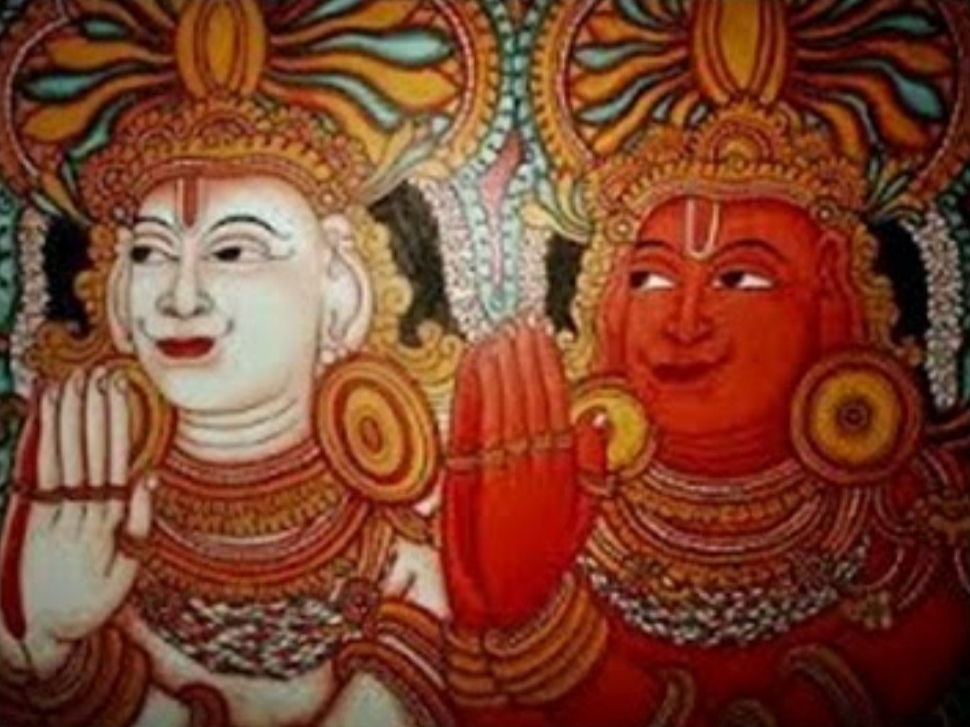
Historical Vedic religion: the divó nápātā Aśvins, the "sons of Dyaús", always referred to in dual in the Rigveda without individual names,
Lithuanian mythology: the Dievo sūneliai (the Ašvieniai), the "sons of Dievas", pulling the solar carriage of Saulė through the sky,
Latvian mythology: the Dieva Dēli, the "sons of Dievs", the sky-god,
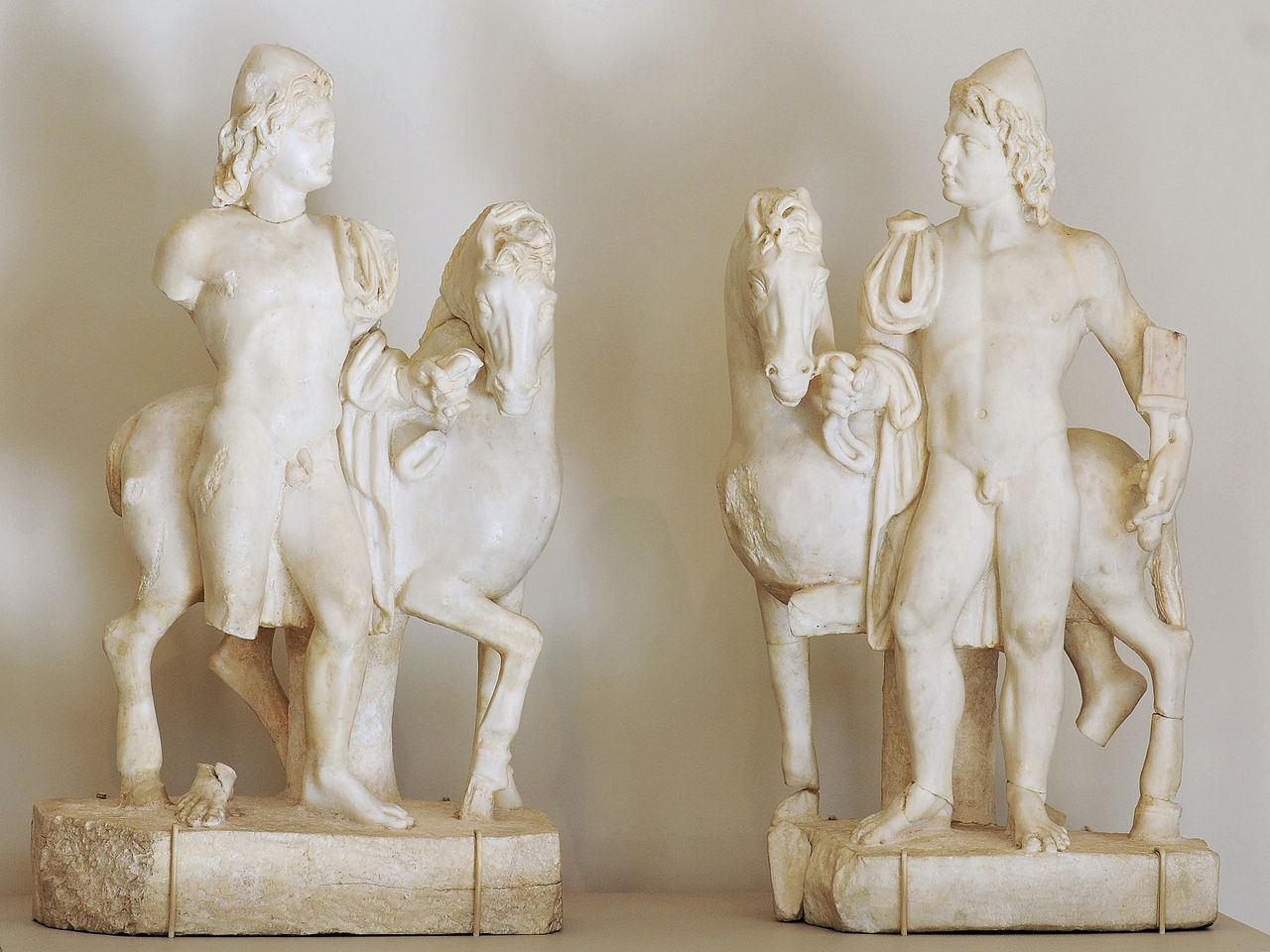
Greek mythology: the Diós-kouroi Castor and Pollux, the "boys of Zeus".
Italic languages: both Paelignian Ioviois Pvclois and Marsian Ioveis Pvcles are interpreted as a calque of the Greek theonym Diós-kouroi.
Possible reflexes
Since they cannot be linked together to a common linguistic origin, other reflexes found in the Indo-European myths are less secure, although their motifs can be compared to that of the Divine Twins.
Celtic
The Gaulish Divanno and Dinomogetimarus are said to be protective deities and "the Gallic equivalents" of the Greek Dioskouroi. They seem to be represented in monuments and reliefs in France flanked by horses, which would make them comparable to Gaulish Martes and the Germanic Alcis. Scholars suggest that the numerous Gallo-Roman dedicatory epigraphs to Castor and Pollux, more than any other region of the Roman Empire, attest a cult of the Dioskoroi.
Greek historian Timaeus mentions that Atlantic Celts venerated the "Dioskouroi" above all other gods and that they [Dioskouroi] had visited them from across the Ocean. Historian Diodorus Siculus, in the fourth book of Bibliotheca historica, writes that the Celts who dwelt along the ocean worshipped the Dioscuroi "more than the other gods". The conjecture that it refers to the Gallic gods Divanno and Dinomogetimarus has no firm support.
In one of the Irish myths involving Macha (the Dindsenchas of Ard Macha), she is forced to race against the horses of King of Ulster while in late pregnancy. As a talented rider, she wins the race but starts giving birth to Fír and Fial immediately after crossing the finish line. The archetype is also partly matched by figures such as the Gallic sun god Belenus, whose epithet Atepomarus meant "having good horses"; Grannus, who is associated with the healing goddess Sirona (her name means "star"); Maponos ("Son of God"), considered in Irish mythology as the son of Dagda, associated with healing,
The Welsh Brân and Manawydan may also be reflexes of the Divine Twins.
Comparative mythologist Alexander Haggerty Krappe suggested that two heroes, Feradach and Foltlebar, brothers and sons of the king of Innia, are expressions of the mytheme. These heroes help the expedition of the Fianna into Tir fa Thuinn (a realm on the other side of the sea), in a Orphean mission to rescue some of their members, in the tale The pursuit of the Gilla Decair and his horse. Both are expert navigators: one can build a ship and the other can follow the wild birds.
Other possible candidates are members of Lugh's retinue, Atepomarus and Momorus (fr). Atepomarus is presumed to mean "Great Horseman" or "having great horses", based on the possible presence of Celtic stem -epo- 'horse' in his name. Both appear as a pair of Celtic kings and founders of Lugdunum. They escape from Sereroneus and arrive at a hill. Momorus, who had skills in augury, sees a murder of crows and names the hill Lougodunum, after the crows. This myth is reported in the works of Klitophon of Rhodes and in Pseudo-Plutarch's De fluviis.
Germanic
Tacitus mentions a divine pair of twins called the Alcis worshipped by the Naharvali, whom he compares to the Roman twin horsemen Castor and Pollux. These twins can be associated with the Indo-European myth of the divine twin horsemen (Dioscuri) attested in various Indo-European cultures. Among later Germanic peoples, twin founding figures such as Hengist and Horsa allude to the motif of the divine twins. The Anglo-Saxon heroes are said to have come by the sea in response to a plea from the beleaguered British king Vortigern. Descendants of Odin, their names mean 'Stallion' and 'Horse', respectively, strengthening the connection.
In Scandinavia, images of divine twins are attested from the 15th century BCE until the 8th century CE, after which they disappear, apparently as a result of religious change. Norse texts contain no identifiable divine twins, though scholars have sought parallels between gods and heroes.
The myth of the Icelandic settlers Ingólfr Arnarson and Hjörleifr Hróðmarsson, which appears in the legendary account of the settlement of Iceland, may contain several motifs of the Indo-European twin mytheme (being founders and brothers), also paralleling Hengist and Horsa.
Another founding pair of twins in Germanic tradition is brothers Dan and Angul, described in the Gesta Danorum by scholar Saxo Grammaticus.
The Haddingjar were two brothers who appear in many versions of Germanic legends.
Graeco-Roman
Amphion and Zethus, another pair of twins fathered by Zeus and Antiope, are portrayed as the legendary founders of Thebes. They are called "Dioskouroi, riders of white horses" (λευκόπωλοι) by Euripides in his play The Phoenician Women (the same epithet is used in Heracles and in the lost play Antiope). In keeping with the theme of distinction between the twins, Amphion was said to be the more contemplative, sensitive one, whereas Zethus was more masculine and tied to physical pursuits, like hunting and cattle-breeding.
The mother of Romulus and Remus, Rhea Silvia, placed them in a basket before her death, which she put in the river to protect them from murder, before they were found by the she-wolf who raised them. The Palici, a pair of Sicilian twin deities fathered by Zeus in one account, may also be a reflex of the original mytheme.
Greek rhetorician and grammar Athenaeus of Naucratis, in his work Deipnosophistae, Book II, cited that poet Ibycus, in his Melodies, described twins Eurytus and Cteatus as "λευκίππους κόρους" ("white-horsed youths") and said they were born from a silver egg, a story that recalls the myth of Greek divine twins Castor and Pollux and their mother Leda. This pair of twins was said to have been fathered by sea god Poseidon and a human mother, Molione.
Baltic
There is possibility that Ūsiņš (alternately, Ūsinis), a Baltic god mentioned in the dainas, is a reflex of the mytheme in Latvian tradition. He is associated with horses, the light and sun, and possibly one of the sons of Dievs. Historical linguist Václav Blažek argues he is "a functional and etymological counterpart" of a minor Vedic character Auśijá- (a servant of the Vedic twins and related to bees) and the Aśvins themselves. Also, according to David Leeming, Usins appears as a charioteer, conducting a chariot pulled by two horses across the sky.
It has also been argued that Auseklis is the other reflex of the mytheme in Latvian. Auseklis is referred to as male in the context of the dainas (folksong), and is seen as the groom of Saules meita ("daughter of the sun"), who came all the way to Germany to court her. In addition, according to scholar Elza Kokare, Auseklis belongs to a group of heavenly deities that take part in a mythological drama about a "celestial wedding". Auseklis is seen as a groom of Saules meita, a daughter of Saule, the female Baltic sun. Sometimes, he is deprived of his bride (Ausekļa līgaviņa and variations) because of Meness's quarreling. In other accounts, he is a guest or member of the bridal cortege at the wedding of Saules meita with another character. He is also said to own a horse, bought by him or for him. According to Marija Gimbutas's analysis, Auseklis is a "dievaitis" ('little god') that appears with a horse the Sun gave him, and falls in love with the daughter of the (female) Sun ("Saules dukterims").
Slavic
The Polish deities Lel and Polel, first mentioned by Maciej Miechowita in 1519, are presented as the equivalents of Castor and Pollux, the sons of the goddess Łada (counterpart of the Greek Leda) and an unknown male god. An idol was found in 1969 on the Fischerinsel island, where the cult centres of the Slavic tribe of Veleti was located, depicting two male figures joined with their heads. Scholars believe it may represent Lel and Polel. Lelek means "strong youth" in Russian dialect. The brightest stars of the Gemini constellation, α Gem and β Gem, are thought to have been originally named Lele and Polele in Belarusian tradition, after the twin characters.
According to Polish professor of medieval history, Jacek Banaszkiewicz, the two Polabian gods, Porevit and Porenut, manifest dioscuric characteristics. According to him, the first part of their names derives from a Proto-Slavic root -por meaning "strength," with first being "Lord of strength" – the stronger one, and the other "Lord in need of support (strength)" – the weaker one. They both have five faces each and appear alongside Rugiaevit, the chief god.
During childbirth, the mother of the Polish hero twins Waligóra ("Mountain Beater") and Wyrwidąb ("Oak Tearer") died in the forest, where wild animals took care of them. Waligóra was raised of by a she-wolf and Wyrwidąb by a she-bear, who fed them with their own milk. Together, they defeated the dragon who tormented the kingdom, for which the grateful king gave each of them half of the kingdom and one of his two daughters as a wife. The sons of Krak: Krak II and Lech II also appear in Polish legends as the killers of the Wawel dragon.
Indo-Iranian
Another possible reflex may be found in Nakula and Sahadeva. Mothered by Princess Madri, who summoned the Aśvins themselves in a prayer to beget her sons (thus them being called Ashvineya (आश्विनेय)), the twins are two of the five Pandava brothers, married to the same woman, Draupadi. In the Mahabharata epic, Nakula is described in terms of his exceptional beauty, warriorship and martial prowess, while Sahadeva is depicted as patient, wise, intelligent and a "learned man". Nakula takes great interest in Virata's horses, and his brother Sahadeva become Virata's cowherd. Scholarship also points out that the Vedic Ashvins had an Avestic counterpart called Aspinas.
Armenian
The Armenian heroes Sanasar and Baldasar appear as twins in the epic tradition, born of princess Tsovinar (as depicted in Daredevils of Sassoun); Sanasar finds a "fiery horse", is more warlike than his brother, and becomes the progenitor of a dynasty of heroes. In an alternate account, their mother is named princess Saṙan, who drinks water from a horse's footprint and gives birth to both heroes.