The Dead Sea Scrolls (DSS), in the narrow sense identical with the Qumran Caves Scrolls, are a set of ancient Jewish manuscripts from the Second Temple period. They were discovered over a period of ten years, between 1946 and 1956, at the Qumran Caves near Ein Feshkha in the West Bank, on the northern shore of the Dead Sea. Dating from the 3rd century BCE to the 1st century CE, the Dead Sea Scrolls include the oldest surviving manuscripts of entire books later included in the various Jewish and Christian biblical canons, including deuterocanonical manuscripts from late Second Temple Judaism, as well as extrabiblical books. As such, they cast new light on the emergence of Rabbinic Judaism and of Christianity, and their relationship with Jewish religious traditions. In the wider sense, the Dead Sea Scrolls also include similar findings from elsewhere in the Judaean Desert, and are sometimes called Judaean Desert scrolls. Some of the scrolls found outside Qumran are from later centuries. Almost all of the 15,000 scrolls and scroll fragments are held in the Shrine of the Book at the Israel Museum in Jerusalem.
The Israeli government's custody of the Dead Sea Scrolls is disputed by Jordan and the Palestinian Authority on territorial, legal, and humanitarian grounds—they were mostly discovered following the Jordanian annexation of the West Bank and were acquired by Israel after Jordan lost the 1967 Arab–Israeli War—whilst Israel's claims are primarily based on historical and religious grounds, given their significance in Jewish history and in the heritage of Judaism.
Many thousands of written fragments have been discovered in the Dead Sea area – most have been published, together with the details of their discovery, in the 40-volume Discoveries in the Judaean Desert. They represent the remnants of larger manuscripts damaged by natural causes or through human interference, with the vast majority holding only small scraps of text. However, a small number of well-preserved and nearly intact manuscripts have survived—fewer than a dozen among those from the Qumran Caves. Researchers have assembled a collection of 981 different manuscripts (discovered in 1946/1947 and in 1956) from 11 caves, which lie in the immediate vicinity of the Hellenistic Jewish settlement at the site of Khirbet Qumran in the eastern Judaean Desert in the West Bank. The caves are located about 1.5 kilometres (1 mi) west of the northwestern shore of the Dead Sea, whence the scrolls derive their name. Archaeologists have long associated the scrolls with the ancient Jewish sect known as the Essenes, although some recent interpretations have challenged this connection and argue that priests in Jerusalem or other unknown Jewish groups wrote the scrolls.

Most of the manuscripts are written in Hebrew, with some written in Aramaic (for example the Son of God Text, in different regional dialects, including Nabataean) and a few in Greek. Other discoveries from the Judaean Desert add Latin (from Masada), and some later Arabic manuscripts from the 7th-8th centuries CE (from Khirbet al-Mird). Most of the texts are written on parchment, some on papyrus, and one on copper. Though scholarly consensus dates the Dead Sea Scrolls to between the 3rd century BCE and the 1st century CE, there are Arabic manuscripts from associated Judaean Desert sites that are dated between the 8th and 10th century CE. Bronze coins found at the same sites form a series beginning with John Hyrcanus, a ruler of Hasmonean Judea (in office 135–104 BCE), and continuing until the period of the First Jewish–Roman War (66–73 CE), supporting the paleography and radiocarbon dating of the scrolls.
Owing to the poor condition of some of the scrolls, scholars have not identified all of their texts. The identified texts fall into three general groups:
About 40% are copies of texts from the canonical Hebrew scriptures.

Approximately 30% are texts from the Second Temple period that ultimately were not canonized in the Hebrew Bible, such as the Book of Enoch, the Book of Jubilees, the Book of Tobit, the Wisdom of Sirach, Psalms 152–155, etc.
The remainder (roughly 30%) are sectarian manuscripts of previously unknown documents that shed light on the rules and beliefs of a particular sect or groups within greater Judaism, such as the Community Rule, the War Scroll, the Pesher on Habakkuk, and The Rule of the Blessing.
Discoveries
The Dead Sea Scrolls were discovered in a series of 12 caves around the site originally known as Ein Feshkha near the Dead Sea in the West Bank (then controlled by Jordan) between 1946 and 1956 by Bedouin shepherds and a team of archaeologists. The practice of storing worn-out sacred manuscripts in earthenware vessels buried in the earth or within caves is related to the ancient Jewish custom of genizah.

Initial discovery (1946–1947)
The initial discovery by Bedouin shepherd Muhammed edh-Dhib, his cousin Jum'a Muhammed, and Khalil Musa took place between November 1946 and February 1947. The shepherds discovered seven scrolls (see § Qumran caves and their contents) housed in jars in a cave near what is now known as the Qumran site. John C. Trever reconstructed the story of the scrolls from several interviews with the Bedouins. Edh-Dhib's cousin noticed the caves, but edh-Dhib was the first to actually fall into one (the cave now called Cave 1). He retrieved a handful of scrolls, which Trever identifies as the Isaiah Scroll, Habakkuk Commentary, and the Community Rule, and took them back to the camp to show to his family. None of the scrolls were destroyed in this process. The Bedouins kept the scrolls hanging on a tent pole while they contemplated what they should do with them, periodically showing the scrolls to their people. At some point during this time, the Community Rule was split in two. The Bedouins first took the scrolls to a dealer named Ibrahim 'Ijha in Bethlehem. 'Ijha returned them, saying they were worthless, after being warned that they might have been stolen from a synagogue. Undaunted, the Bedouins went to a nearby market, where a Syrian Christian offered to buy them. A sheikh joined their conversation and suggested that they take the scrolls to Khalil Eskander Shahin, "Kando", a cobbler and part-time antiques dealer. The Bedouins and the dealers returned to the site, leaving one scroll with Kando and selling three others to a dealer for seven Jordanian pounds (approximately $28, or $404 in 2025 dollars). The original scrolls continued to change hands after the Bedouins left them in the possession of a third party until a sale could be arranged. (see Ownership.)
In 1947 the original seven scrolls caught the attention of Trever of the American Schools of Oriental Research (ASOR), who compared the script in the scrolls to the Nash Papyrus, the oldest biblical manuscript then known, and found similarities between them. In March the 1948 Arab–Israeli War prompted the move of some of the scrolls to Beirut, Lebanon, for safekeeping. On 11 April 1948, Millar Burrows, head of the ASOR, announced the discovery of the scrolls in a general press release.
Search for the Qumran caves (1948–1949)
Early in September 1948, Metropolitan bishop Mar Samuel brought some additional scroll fragments that he had acquired to professor Ovid R. Sellers, the succeeding director of ASOR. By the end of 1948, nearly two years after the discovery of the scrolls, scholars had yet to locate the original cave where the fragments had been found. With unrest in the country at that time, no large-scale search could be safely undertaken. Sellers tried to persuade the Syrians to assist in the search for the cave, but he was unable to pay their price. In early 1949, the government of Jordan granted permission to the Arab Legion to search the area in which the original Qumran cave was believed to exist. Consequently, Cave 1 was rediscovered on 28 January 1949 by Belgian United Nations observer captain Phillipe Lippens and Arab Legion captain Akkash el-Zebn.
Qumran caves rediscovery and new scroll discoveries (1949–1951)
The rediscovery of what became known as Cave 1 at Qumran prompted the initial excavation of the site from 15 February to 5 March 1949 by the Jordanian Department of Antiquities, led by Gerald Lankester Harding and Roland de Vaux. The Cave 1 site yielded discoveries of additional Dead Sea Scroll fragments, linen cloth, jars, and other artefacts.
Excavations of Qumran and new cave discoveries (1951–1956, 2017, 2021)
In November 1951, de Vaux and his team from the ASOR began a full excavation of Qumran. By February 1952, the Bedouins had discovered 30 fragments in what was to be designated Cave 2. The discovery of a second cave eventually yielded 300 fragments from 33 manuscripts, including fragments of Jubilees and the Wisdom of Sirach written in Hebrew. The following month, on 14 March 1952, the ASOR team discovered a third cave with fragments of Jubilees and the Copper Scroll. Between September and December 1952, the fragments and scrolls of Caves 4, 5, and 6 were discovered by the ASOR teams.
With the monetary value of the scrolls rising as their historical significance was made more public, the Bedouins and the ASOR archaeologists accelerated their search for the scrolls separately in the same general area of Qumran, which was more than one kilometre in length. Between 1953 and 1956, de Vaux led four more archaeological expeditions in the area to uncover scrolls and artefacts. Cave 11 was discovered in 1956 and yielded the last fragments to be found in the vicinity of Qumran.

Caves 4–10 are clustered in an area lying in relative proximity 150 m (160 yd) from Khirbet Qumran, while caves 1, 2, 3 and 11 are located 1 mile (1–2 kilometres) north, with Cave 3 the most remote. In February 2017, Hebrew University archaeologists announced the discovery of a new 12th cave. There was one blank parchment found in a jar, but broken and empty scroll jars and pickaxes suggest that the cave was looted in the 1950s.
In March 2021, Israeli archaeologists announced the discovery of dozens of fragments bearing biblical text, written in Greek, from the books of Zechariah and Nahum. This group of findings is believed to have been hidden in a cave between 132 and 136 CE during the Bar Kokhba Revolt. However, a 10,500-year-old basket made of woven reeds was also discovered in the Muraba'at caves in the Nahal Darga Reserve. Other discoveries included the remains of a child wrapped in cloth dated to around 6,000 years ago, and a cache of coins from the days of the Bar Kokhba Revolt. In 2021, more scrolls were discovered by Israeli authorities in a different cave near the Dead Sea called the Cave of Horrors.
Tefillin strips rediscovered (2014)
Nine tiny Tefillin strips were rediscovered by the IAA in 2014, after they had been stored unopened for six decades following their excavation in 1952.

Qumran caves and their contents
The 972 manuscripts found at Qumran were found primarily in two separate formats: as scrolls and as fragments of previous scrolls and texts. In the fourth cave the fragments were torn into up to 15,000 pieces. These small fragments created somewhat of a problem for scholars. G.L. Harding, director of the Jordanian Department of Antiquities, began working on piecing the fragments together but did not finish this before his death in 1979.
Cave 1
Wadi Qumran Cave 1 was discovered for the first time in 1946. The original seven Dead Sea Scrolls from Cave 1 are the Great Isaiah Scroll (1QIsaa), a second copy of Isaiah (1QIsab), the Community Rule Scroll (1QS), the Pesher on Habakkuk (1QpHab), the War Scroll (1QM), the Thanksgiving Hymns (1QH), and the Genesis Apocryphon (1QapGen). One of the pottery jars containing the scrolls from Cave 1 is now kept in the British Museum.
Cave 2
Wadi Qumran Cave 2 was discovered in February 1952 in which the Bedouins discovered 30 fragments. The cave eventually yielded 300 fragments from 33 manuscripts of Dead Sea Scrolls, including fragments of Jubilees and the Wisdom of Sirach written in Hebrew.
Cave 3
Wadi Qumran Cave 3 was discovered on 14 March 1952 by the ASOR team. The cave initially yielded fragments of Jubilees and the Copper Scroll.
Caves 4a and 4b
Wadi Qumran Cave 4 was discovered in August 1952 and was excavated from 22 to 29 September 1952 by Harding, de Vaux, and Józef Milik. Cave 4 is actually two hand-cut caves (4a and 4b), but since the fragments were mixed they are labelled as 4Q. Cave 4 is the most famous of Qumran caves both because of its visibility from the Qumran plateau and its productivity. It is visible from the plateau to the south of the Qumran settlement. It is by far the most productive of all Qumran caves, producing 90% of the Dead Sea Scrolls and scroll fragments (approx. 15,000 fragments from 500 different texts), including 9–10 copies of Jubilees, along with 21 tefillin and 7 mezuzot.
Cave 5
Wadi Qumran Cave 5 was discovered in 1952, shortly after the discovery of Cave 4. Cave 5 produced approximately 25 manuscripts.
Cave 6
Wadi Qumran Cave 6 was discovered alongside Cave 5 in 1952, shortly after the discovery of Cave 4. Cave 6 contained fragments of about 31 manuscripts.
Cave 7
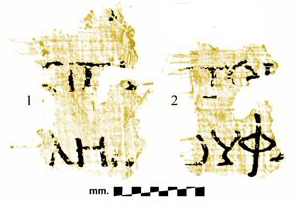
Wadi Qumran Cave 7 yielded fewer than 20 fragments of Greek documents, including 7Q2 (the "Letter of Jeremiah" = Baruch 6), 7Q5 (which became the subject of much speculation in later decades), and a Greek copy of a scroll of Enoch. Cave 7 also produced several inscribed potsherds and jars.
Cave 8
Wadi Qumran Cave 8, along with caves 7 and 9, is one of the only caves that are accessible by passing through the settlement at Qumran. Carved into the southern end of the Qumran plateau, cave 8 was excavated by archaeologists in 1957. Cave 8 produced five fragments: Genesis (8QGen), Psalms (8QPs), a tefillin fragment (8QPhyl), a mezuzah (8QMez), and a hymn (8QHymn). Cave 8 also produced several tefillin cases, a box of leather objects, many lamps, jars, and the sole of a leather shoe.
Cave 9
Wadi Qumran Cave 9, along with caves 7 and 8, was one of the only caves that are accessible by passing through the settlement at Qumran. Carved into the southern end of the Qumran plateau, Cave 9 was excavated by archaeologists in 1957. There was only one manuscript fragment found in Cave 9.
Cave 10
In Qumran Cave 10 archaeologists found two ostraca with writing on them, along with an unknown symbol on a grey stone slab.
Cave 11
Wadi Qumran Cave 11 was discovered in 1956 and yielded 21 texts of the Dead Sea Scrolls, some of which were quite lengthy. The Temple Scroll, so called because more than half of it pertains to the construction of the Temple of Jerusalem, was found in Cave 11 and is by far the longest scroll. It is 26.7 feet (8.15 m) long; its original length may have been over 28 feet (8.75 m). The Temple Scroll was regarded by scholar Yigael Yadin as "The Torah According to the Essenes". On the other hand, Hartmut Stegemann, a contemporary and friend of Yadin, believes the scroll was not to be regarded as such but was a document without exceptional significance. Stegemann notes that it is not mentioned or cited in any known Essene writing.
An eschatological fragment about the biblical figure Melchizedek (11Q13) was found in Cave 11. Cave 11 also produced a copy of Jubilees, and a proto-Masoretic text of the Torah scroll (only a fragment of the Book of Leviticus surviving), known as the Paleo-Hebrew Leviticus Scroll. According to former chief editor of the Dead Sea Scrolls editorial team John Strugnell, there are at least four privately owned scrolls from Cave 11 that have not yet been made available for scholars. Among them is a complete Aramaic manuscript of the Book of Enoch.
Cave 12
Cave 12 was discovered in February 2017 on cliffs west of Qumran, near the north-western shore of the Dead Sea. Archaeological examination found pickaxes and empty broken scroll jars, indicating that the cave had been discovered and looted in the 1950s. One of the joint Hebrew University of Jerusalem and Liberty University project's lead researchers, Oren Gutfeld, stated, "Although at the end of the day no scroll was found, and instead we 'only' found a piece of parchment rolled up in a jug that was being processed for writing, the findings indicate beyond any doubt that the cave contained scrolls that were stolen."
Fragments with unknown provenance
Some fragments of scrolls have neither significant archaeological provenance nor records that reveal in which designated Qumran cave area they were found. They are believed to have come from Wadi Qumran caves but are just as likely to have come from other archaeological sites in the Judaean Desert area. These fragments have therefore been designated to the temporary "X" series.
Origin
There has been much debate about the origin of the Dead Sea Scrolls. The dominant theory remains that the scrolls were produced by the Essenes, a sect of Jews living at nearby Qumran, but this theory has come to be challenged by several modern scholars.
Qumran–Essene theory
The view among scholars, almost universally held until the 1990s, is the "Qumran–Essene" hypothesis originally posited by Roland Guérin de Vaux and Józef Tadeusz Milik, though independently both Eliezer Sukenik and Butrus Sowmy of St Mark's Monastery connected scrolls with the Essenes well before any excavations at Qumran. The Qumran–Essene theory holds that the scrolls were written by the Essenes or by another Jewish sectarian group residing at Khirbet Qumran. They composed the scrolls and ultimately hid them in the nearby caves during the Jewish Revolt sometime between 66 and 68 CE. The site of Qumran was destroyed and the scrolls never recovered. Arguments supporting this theory include:
There are striking similarities between the description of an initiation ceremony of new members in the Community Rule and descriptions of the Essene initiation ceremony mentioned in the works of Flavius Josephus, a Jewish-Roman historian of the Second Temple period.
Josephus mentioned the Essenes as sharing property among the members of the community, as does the Community Rule.
During the excavation of Khirbet Qumran, two inkwells and plastered elements thought to be tables were found, offering evidence that some form of writing was done there. More inkwells were discovered nearby. De Vaux called this area the "scriptorium" based upon this discovery.