
David Hilbert (; German: [ˈdaːvɪt ˈhɪlbɐt]; 23 January 1862 – 14 February 1943) was a German mathematician and philosopher of mathematics and one of the most influential mathematicians of all time.
Hilbert discovered and developed a broad range of fundamental ideas including invariant theory, the calculus of variations, commutative algebra, algebraic number theory, the foundations of geometry, spectral theory of operators and its application to integral equations, mathematical physics, and the foundations of mathematics (particularly proof theory). He adopted and defended Georg Cantor's set theory and transfinite numbers. In 1900, he presented a collection of problems that set a course for mathematical research of the 20th century.
Hilbert and his students contributed to establishing rigor and developed important tools used in modern mathematical physics. He was a co-founder of proof theory and mathematical logic.
Life
Early life and education
Hilbert, the first of two children and only son of Otto, a county judge, and Maria Therese Hilbert (née Erdtmann), the daughter of a merchant, was born in the Province of Prussia, Kingdom of Prussia, either in Königsberg, now Kaliningrad, (according to Hilbert's own statement) or in Wehlau (known since 1946 as Znamensk) near Königsberg where his father worked at the time of his birth. His paternal grandfather was David Hilbert, a judge and Geheimrat. His mother Maria had an interest in philosophy, astronomy and prime numbers, while his father Otto taught him Prussian virtues. After his father became a city judge, the family moved to Königsberg. David's sister, Elise, was born when he was six. He began his schooling aged eight, two years later than the usual starting age.
In late 1872, Hilbert entered the Friedrichskolleg Gymnasium (Collegium fridericianum, the same school that Immanuel Kant had attended 140 years before); but, after an unhappy period, he transferred to (late 1879) and graduated from (early 1880) the more science-oriented Wilhelm Gymnasium. Upon graduation, in autumn 1880, Hilbert enrolled at the University of Königsberg, the "Albertina". In early 1882, Hermann Minkowski (two years younger than Hilbert and also a native of Königsberg but had gone to Berlin for three semesters), returned to Königsberg and entered the university. Hilbert developed a lifelong friendship with the shy, gifted Minkowski.
Career
In 1884, Adolf Hurwitz arrived from Göttingen as an Extraordinarius (i.e., an associate professor). An intense and fruitful scientific exchange among the three began, and Minkowski and Hilbert especially would exercise a reciprocal influence over each other at various times in their scientific careers. Hilbert obtained his doctorate in 1885, with a dissertation, written under Ferdinand von Lindemann, titled Über invariante Eigenschaften spezieller binärer Formen, insbesondere der Kugelfunktionen ("On the invariant properties of special binary forms, in particular the spherical harmonic functions").

Hilbert remained at the University of Königsberg as a Privatdozent (senior lecturer) from 1886 to 1895. In 1895, as a result of intervention on his behalf by Felix Klein, he obtained the position of Professor of Mathematics at the University of Göttingen. During the Klein and Hilbert years, Göttingen became the preeminent institution in the mathematical world. He remained there for the rest of his life.
Göttingen school
Among Hilbert's students were Hermann Weyl, chess champion Emanuel Lasker, Ernst Zermelo, and Carl Gustav Hempel. John von Neumann was his assistant. At the University of Göttingen, Hilbert was surrounded by a social circle of some of the most important mathematicians of the 20th century, such as Emmy Noether and Alonzo Church.
Among his 69 Ph.D. students in Göttingen were many who later became famous mathematicians, including (with date of thesis): Otto Blumenthal (1898), Felix Bernstein (1901), Hermann Weyl (1908), Richard Courant (1910), Erich Hecke (1910), Hugo Steinhaus (1911), and Wilhelm Ackermann (1925). Between 1902 and 1939 Hilbert was editor of the Mathematische Annalen, the leading mathematical journal of the time. He was elected an International Member of the United States National Academy of Sciences in 1907.
Personal life
In 1892, Hilbert married Käthe Jerosch (1864–1945), who was the daughter of a Königsberg merchant, "an outspoken young lady with an independence of mind that matched [Hilbert's]." While at Königsberg, they had their one child, Franz Hilbert (1893–1969).
Franz suffered throughout his life from mental illness, and after he was admitted into a psychiatric clinic, Hilbert said, "From now on, I must consider myself as not having a son." His attitude toward Franz brought Käthe considerable sorrow.
Hilbert considered the mathematician Hermann Minkowski to be his "best and truest friend".

Hilbert was baptized and raised a Calvinist in the Prussian Evangelical Church. He later left the Church and became an agnostic. He also argued that mathematical truth was independent of the existence of God or other a priori assumptions. When Galileo Galilei was criticized for failing to stand up for his convictions on the Heliocentric theory, Hilbert objected: "But [Galileo] was not an idiot. Only an idiot could believe that scientific truth needs martyrdom; that may be necessary in religion, but scientific results prove themselves in due time."
Later years
Like Albert Einstein, Hilbert had closest contacts with the Berlin Group, whose leading founders had studied under Hilbert in Göttingen (Kurt Grelling, Hans Reichenbach, and Walter Dubislav).
Around 1925, Hilbert developed pernicious anemia, a then-untreatable vitamin deficiency of which the primary symptom is exhaustion; his assistant Eugene Wigner described him as subject to "enormous fatigue" and how he "seemed quite old", and that even after eventually being diagnosed and treated, he "was hardly a scientist after 1925, and certainly not a Hilbert".
Hilbert was elected to the American Philosophical Society in 1932.
Hilbert lived to see the Nazis purge many of the prominent faculty members at University of Göttingen in 1933. Those forced out included Hermann Weyl (who had taken Hilbert's chair when he retired in 1930), Emmy Noether, and Edmund Landau. One who had to leave Germany, Paul Bernays, had collaborated with Hilbert in mathematical logic, and co-authored with him the important book Grundlagen der Mathematik (which eventually appeared in two volumes, in 1934 and 1939). This was a sequel to the Hilbert–Ackermann book Principles of Mathematical Logic (1928). Hermann Weyl's successor was Helmut Hasse.
About a year after the purge, Hilbert attended a banquet and was seated next to the new Minister of Education, Bernhard Rust. Rust asked whether "the Mathematical Institute really suffered so much because of the departure of the Jews". Hilbert replied: "Suffered? It doesn't exist any longer, does it?"
Death
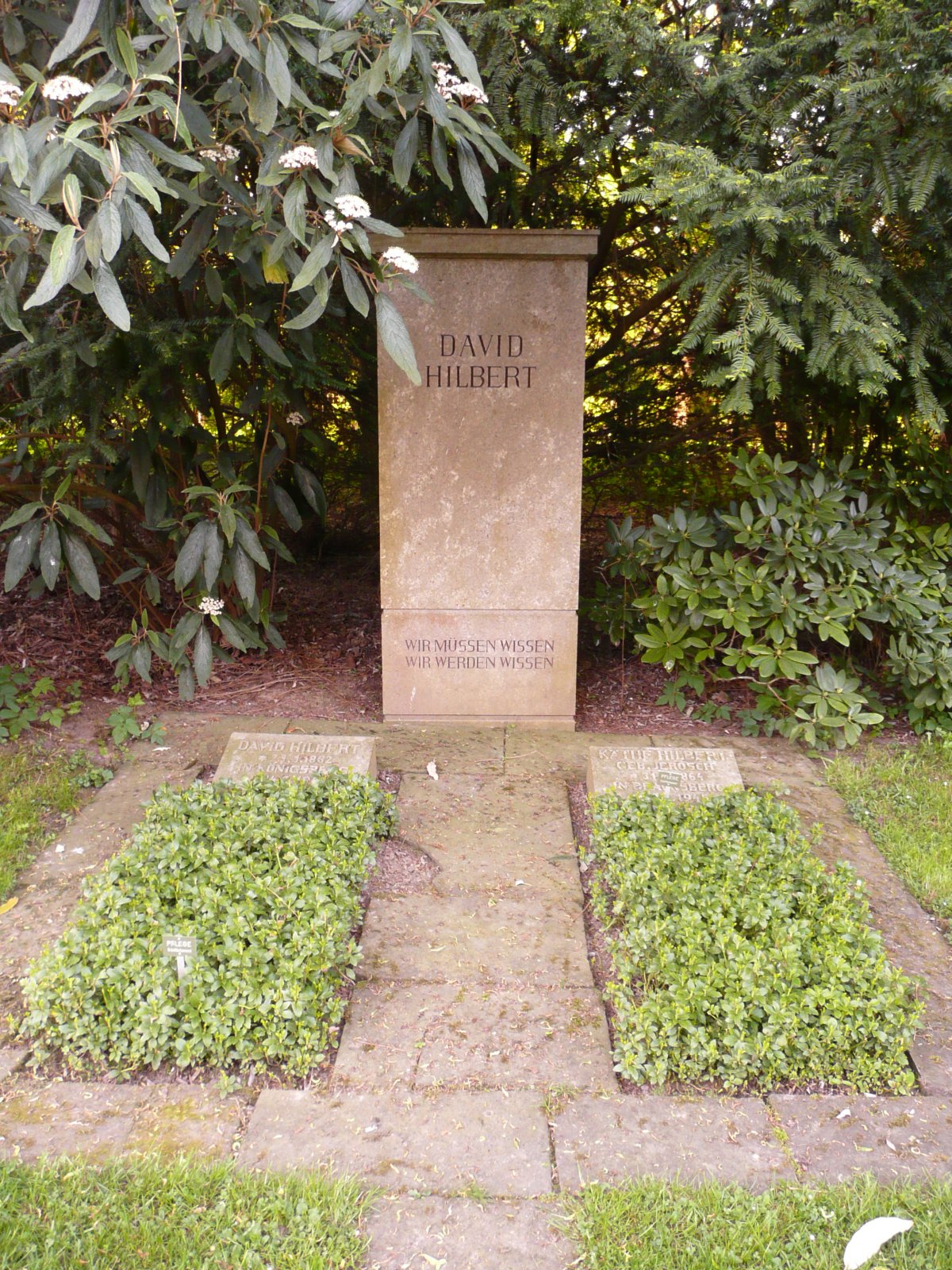
By the time Hilbert died in 1943, the Nazis had nearly completely restaffed the university, as many of the former faculty had either been Jewish or married to Jews. Hilbert's funeral was attended by fewer than a dozen people, only two of whom were fellow academics, among them Arnold Sommerfeld, a theoretical physicist and also a native of Königsberg. News of his death only became known to the wider world several months after he died.
The epitaph on his tombstone in Göttingen consists of the famous lines he spoke at the conclusion of his retirement address to the Society of German Scientists and Physicians on 8 September 1930. The words were given in response to the Latin maxim: "Ignoramus et ignorabimus" or "We do not know and we shall not know":
The day before Hilbert pronounced these phrases at the 1930 annual meeting of the Society of German Scientists and Physicians, Kurt Gödel—in a round table discussion during the Conference on Epistemology held jointly with the Society meetings—tentatively announced the first expression of his incompleteness theorem. Gödel's incompleteness theorems show that even elementary axiomatic systems such as Peano arithmetic are either self-contradicting or contain logical propositions that are impossible to prove or disprove within that system.
Contributions to mathematics and physics
Solving Gordan's Problem
Hilbert's first work on invariant functions led him to the demonstration in 1888 of his famous finiteness theorem. Twenty years earlier, Paul Gordan had demonstrated the theorem of the finiteness of generators for binary forms using a complex computational approach. Attempts to generalize his method to functions with more than two variables failed because of the enormous difficulty of the calculations involved. To solve what had become known in some circles as Gordan's Problem, Hilbert realized that it was necessary to take a completely different path. As a result, he demonstrated Hilbert's basis theorem, showing the existence of a finite set of generators, for the invariants of quantics in any number of variables, but in an abstract form. That is, while demonstrating the existence of such a set, it was not a constructive proof—it did not display "an object"—but rather, it was an existence proof and relied on use of the law of excluded middle in an infinite extension.
Hilbert sent his results to the Mathematische Annalen. Gordan, the house expert on the theory of invariants for the Mathematische Annalen, could not appreciate the revolutionary nature of Hilbert's theorem and rejected the article, criticizing the exposition because it was insufficiently comprehensive. His comment was:
Klein, on the other hand, recognized the importance of the work, and guaranteed that it would be published without any alterations. Encouraged by Klein, Hilbert extended his method in a second article, providing estimations on the maximum degree of the minimum set of generators, and he sent it once more to the Annalen. After having read the manuscript, Klein wrote to him, saying:
Without doubt this is the most important work on general algebra that the Annalen has ever published.
Later, after the usefulness of Hilbert's method was universally recognized, Gordan himself would say:
I have convinced myself that even theology has its merits.
For all his successes, the nature of his proof created more trouble than Hilbert could have imagined. Although Kronecker had conceded, Hilbert would later respond to others' similar criticisms that "many different constructions are subsumed under one fundamental idea"—in other words (to quote Reid): "Through a proof of existence, Hilbert had been able to obtain a construction"; "the proof" (i.e. the symbols on the page) was "the object". Not all were convinced. While Kronecker would die soon afterwards, his constructivist philosophy would continue with the young Brouwer and his developing intuitionist "school", much to Hilbert's torment in his later years. Indeed, Hilbert would lose his "gifted pupil" Weyl to intuitionism—"Hilbert was disturbed by his former student's fascination with the ideas of Brouwer, which aroused in Hilbert the memory of Kronecker". Brouwer the intuitionist in particular opposed the use of the Law of Excluded Middle over infinite sets (as Hilbert had used it). Hilbert responded:
Taking the Principle of the Excluded Middle from the mathematician ... is the same as ... prohibiting the boxer the use of his fists.
Nullstellensatz
In the subject of algebra, a field is called algebraically closed if and only if every polynomial over it has a root in it. Under this condition, Hilbert gave a criterion for when a collection of polynomials
{\displaystyle (p_{\lambda })_{\lambda \in \Lambda }}
of
{\displaystyle n}
variables has a common root: This is the case if and only if there do not exist polynomials
{\displaystyle q_{1},\ldots ,q_{k}}
and indices
{\displaystyle \lambda _{1},\ldots ,\lambda _{k}}
such that
{\displaystyle 1=\sum _{j=1}^{k}p_{\lambda _{j}}({\vec {x}})q_{j}({\vec {x}})}
This result is known as the Hilbert root theorem, or "Hilberts Nullstellensatz" in German. He also proved that the correspondence between vanishing ideals and their vanishing sets is bijective between affine varieties and radical ideals in
{\displaystyle \mathbb {C} [x_{1},\ldots ,x_{n}]}
Curve
In March 1890, Giuseppe Peano had published an article in the Mathematische Annalen describing the historically first space-filling curve. In response, Hilbert designed his own construction of such a curve, which is now called the Hilbert curve. Approximations to this curve are constructed iteratively according to the replacement rules in the first picture of this section. The curve itself is then the pointwise limit.
Axiomatization of geometry
The text Grundlagen der Geometrie (tr.: Foundations of Geometry) published by Hilbert in 1899 proposes a formal set, called Hilbert's axioms, substituting for the traditional axioms of Euclid. They avoid weaknesses identified in those of Euclid, whose works at the time were still used textbook-fashion. It is difficult to specify the axioms used by Hilbert without referring to the publication history of the Grundlagen since Hilbert changed and modified them several times. The original monograph was quickly followed by a French translation, in which Hilbert added V.2, the Completeness Axiom. An English translation, authorized by Hilbert, was made by E.J. Townsend and copyrighted in 1902. This translation incorporated the changes made in the French translation and so is considered to be a translation of the 2nd edition. Hilbert continued to make changes in the text and several editions appeared in German. The 7th edition was the last to appear in Hilbert's lifetime. New editions followed the 7th, but the main text was essentially not revised.
Hilbert's approach signaled the shift to the modern axiomatic method. In this, Hilbert was anticipated by Moritz Pasch's work from 1882. Axioms are not taken as self-evident truths. Geometry may treat things, about which we have powerful intuitions, but it is not necessary to assign any explicit meaning to the undefined concepts. The elements, such as point, line, plane, and others, could be substituted, as Hilbert is reported to have said to Schoenflies and Kötter, by tables, chairs, glasses of beer and other such objects. It is their defined relationships that are discussed.
Hilbert first enumerates the undefined concepts: point, line, plane, lying on (a relation between points and lines, points and planes, and lines and planes), betweenness, congruence of pairs of points (line segments), and congruence of angles. The axioms unify both the plane geometry and solid geometry of Euclid in a single system.
23 problems
Hilbert put forth a list of 23 unsolved problems at the International Congress of Mathematicians in Paris in 1900. This list, including the Riemann hypothesis, is generally reckoned as the most successful and deeply considered compilation of open problems ever to be produced by an individual mathematician.
After reworking the foundations of classical geometry, Hilbert could have extrapolated to the rest of mathematics. His approach differed from the later "foundationalist" Russell–Whitehead or "encyclopedist" Nicolas Bourbaki, and from his contemporary Giuseppe Peano. The mathematical community as a whole could engage in problems of which he had identified as crucial aspects of important areas of mathematics.