In astronomy and cosmology, dark matter is an invisible and hypothetical form of matter that does not interact with electromagnetic radiation, including light. Dark matter is implied by gravitational effects that cannot be explained by general relativity unless more matter is present than can be observed. Such effects occur in the context of formation and evolution of galaxies, gravitational lensing, the observable universe's current structure, mass position in galactic collisions, the motion of galaxies within galaxy clusters, and cosmic microwave background anisotropies. Dark matter is thought to serve as gravitational scaffolding for cosmic structures. After the Big Bang, dark matter clumped into blobs along narrow filaments with superclusters of galaxies forming a cosmic web at scales on which entire galaxies appear like tiny particles.
In the standard Lambda-CDM model of cosmology, the mass–energy content of the universe is 5% ordinary matter, 26.8% dark matter, and 68.2% a form of energy known as dark energy. Thus, dark matter constitutes 85% of the total mass, while dark energy and dark matter constitute 95% of the total mass–energy content. While the density of dark matter is significant in the halo around a galaxy, its local density in the Solar System is much less than normal matter. The total of all the dark matter out to the orbit of Neptune would add up to about 1017 kg, the same as a large asteroid. Dark matter is classified as "cold", "warm", or "hot" according to velocity (more precisely, its free streaming length). Recent models have favored a cold dark matter scenario, in which structures emerge by the gradual accumulation of particles.
Dark matter is not known to interact with ordinary baryonic matter and radiation except through gravity, making it difficult to detect in the laboratory. The most prevalent explanation is that dark matter is some as-yet-undiscovered subatomic particle, such as either weakly interacting massive particles (WIMPs) or axions. The other main possibility is that dark matter is composed of primordial black holes.

Although the astrophysics community generally accepts the existence of dark matter, a minority of astrophysicists, intrigued by specific observations that are not well explained by ordinary dark matter, argue for various modifications of the standard laws of general relativity. These include modified Newtonian dynamics (MOND), tensor–vector–scalar gravity, and entropic gravity. So far, none of the proposed modified gravity theories can describe every piece of observational evidence at the same time, suggesting that even if gravity has to be modified, some form of dark matter would still be required.
History
1884 to 1940
The hypothesis of dark matter has an elaborate history.
Lord Kelvin discussed the potential number of stars around the Sun in the appendices of a book based on a series of lectures given in 1884 in Baltimore. He inferred their density using the observed velocity dispersion of the stars near the Sun, assuming that the Sun was 20–100 million years old. He posed what would happen if there were a thousand million stars within 1 kiloparsec of the Sun (at which distance their parallax would be 1 milli-arcsecond). Kelvin concluded:

"Many of our supposed thousand million stars — perhaps a great majority of them — may be dark bodies."
In 1906, Henri Poincaré used the French term [matière obscure] ("dark matter") in discussing Kelvin's work. He concluded that the amount of dark matter would need to be less than that of visible matter, which was later found to be false.
The second to suggest the existence of dark matter using stellar velocities was Dutch astronomer Jacobus Kapteyn in 1922. A publication from 1930 by Swedish astronomer Knut Lundmark points to him being the first to hypothesize that the universe must contain much more mass than can be observed. Dutch radio astronomy pioneer Jan Oort also hypothesized the existence of dark matter in 1932. Oort was studying stellar motions in the galactic neighborhood and found the mass in the galactic plane must be greater than what was observed, but this measurement was later determined to be incorrect.

In 1933, Swiss astrophysicist Fritz Zwicky studied galaxy clusters while working at Caltech and made a similar inference. Zwicky applied the virial theorem to the Coma Cluster and obtained evidence of unseen mass he called dunkle Materie ('dark matter'). Zwicky estimated its mass based on the motions of galaxies near its edge and compared that to an estimate based on its brightness and number of galaxies. He estimated the cluster had about 400 times more mass than was visually observable. The gravity effect of the visible galaxies was far too small for such fast orbits, thus mass must be hidden from view. Based on these conclusions, Zwicky inferred some unseen matter provided the mass and associated gravitational attraction to hold the cluster together. Zwicky's estimates were off by more than an order of magnitude, mainly due to an obsolete value of the Hubble constant; the same calculation today shows a smaller fraction, using greater values for luminous mass. Nonetheless, Zwicky did correctly conclude from his calculation that most of the gravitational matter present was dark. However, unlike modern theories, Zwicky considered "dark matter" to be non-luminous ordinary matter.
Further indications of mass-to-light ratio anomalies came from measurements of galaxy rotation curves. In 1939, H.W. Babcock reported the rotation curve for the Andromeda Galaxy (then called the Andromeda Nebula), which suggested the mass-to-luminosity ratio increases radially. He attributed it to either light absorption within the galaxy or modified dynamics in the outer portions of the spiral, rather than to unseen matter. Following Babcock's 1939 report of unexpectedly rapid rotation in the outskirts of the Andromeda Galaxy and a mass-to-light ratio of 50; in 1940, Oort discovered and wrote about the large non-visible halo of NGC 3115.
1970s
The hypothesis of dark matter largely took root in the 1970s. Several different observations were synthesized to argue that galaxies should be surrounded by halos of unseen matter. In two papers that appeared in 1974, this conclusion was drawn in tandem by independent groups: in Princeton, New Jersey, by Jeremiah Ostriker, Jim Peebles, and Amos Yahil, and in Tartu, Estonia, by Jaan Einasto, Enn Saar, and Ants Kaasik.

One of the observations that served as evidence for the existence of galactic halos of dark matter was the shape of galaxy rotation curves. These observations were done in optical and radio astronomy. In optical astronomy, Vera Rubin and Kent Ford worked with a new spectrograph to measure the velocity curve of edge-on spiral galaxies with greater accuracy.
At the same time, radio astronomers were making use of new radio telescopes to map the 21 cm line of atomic hydrogen in nearby galaxies. The radial distribution of interstellar atomic hydrogen (HI) often extends to much greater galactic distances than can be observed as collective starlight, expanding the sampled distances for rotation curves – and thus of the total mass distribution – to a new dynamical regime. Early mapping of the Andromeda Galaxy with the 300-foot (91 m) telescope at Green Bank and the 250-foot (76 m) dish at Jodrell Bank already showed the HI rotation curve did not trace the decline expected from Keplerian orbits.
As more sensitive receivers became available, Roberts & Whitehurst (1975) were able to trace the rotational velocity of Andromeda to 30 kpc, much beyond the optical measurements. Illustrating the advantage of tracing the gas disk at large radii; that paper's Figure 16 combines the optical data (the cluster of points at radii of less than 15 kpc with a single point further out) with the HI data between 20 and 30 kpc, exhibiting the flatness of the outer galaxy rotation curve; the solid curve peaking at the center is the optical surface density, while the other curve shows the cumulative mass, still rising linearly at the outermost measurement. In parallel, the use of interferometric arrays for extragalactic HI spectroscopy was being developed. Rogstad & Shostak (1972) published HI rotation curves of five spirals mapped with the Owens Valley interferometer; the rotation curves of all five were very flat, suggesting very large values of mass-to-light ratio in the outer parts of their extended HI disks. In 1978, Albert Bosma showed further evidence of flat rotation curves using data from the Westerbork Synthesis Radio Telescope.

In 1978, Steigman et al. presented a study that extended earlier cosmological relic particle density calculations to any hypothetical stable, electrically neutral, weak-scale lepton, showing how such a particle's abundance would "freeze out" in the early Universe and providing analytic expressions that linked its mass and weak interaction cross-section to the present-day matter density. By decoupling the analysis from specific neutrino properties and treating the candidate generically, the authors set out a framework that later became the standard template for weakly interacting massive particles (WIMPs) and for comparing particle-physics models with cosmological constraints. Though subsequent work has refined the methodology and explored many alternative candidates, this paper marked the first explicit, systematic treatment of dark matter as a new particle species beyond the Standard Model. By the late 1970s the existence of dark matter halos around galaxies was widely recognized as real, and became a major unsolved problem in astronomy.
1980s and 90s
A stream of observations in the 1980–1990s supported the presence of dark matter. Persic, Salucci & Stel (1996) is notable for the investigation of 967 spirals. The evidence for dark matter also included gravitational lensing of background objects by galaxy clusters, the temperature distribution of hot gas in galaxies and clusters, and the pattern of anisotropies in the cosmic microwave background.
2000s to present
Since the turn of the millennium, the search for particle dark matter has been dominated by the hypothesis of weakly interacting massive particles (WIMPs), driven by hypothesized connections to supersymmetry. Experimental efforts were characterized by a rapid increase in sensitivity using liquid xenon detectors, including XENON, LUX, PandaX, and LUX-ZEPLIN (LZ). Despite pushing interaction limits down by orders of magnitude, these direct detection experiments all reported null results for WIMPs across the standard GeV–TeV mass range. As of late 2025, the LZ experiment had excluded WIMP cross-sections above 9 GeV/c2 and reported the first detection of boron-8 solar neutrinos via coherent elastic neutrino-nucleus scattering in a dark matter detector; this marks the experimental entry into the neutrino floor "fog," an irreducible background of neutrino noise that complicates future WIMP searches. Concurrently, the failure of the Large Hadron Collider to detect supersymmetric particles has constrained the theoretical parameter space for WIMPs. These constraints have shifted significant focus toward alternative candidates such as axions. The Axion Dark Matter Experiment achieved sensitivity to the plausible DFSZ axion model in the micro-electronvolt range by the early 2020s.
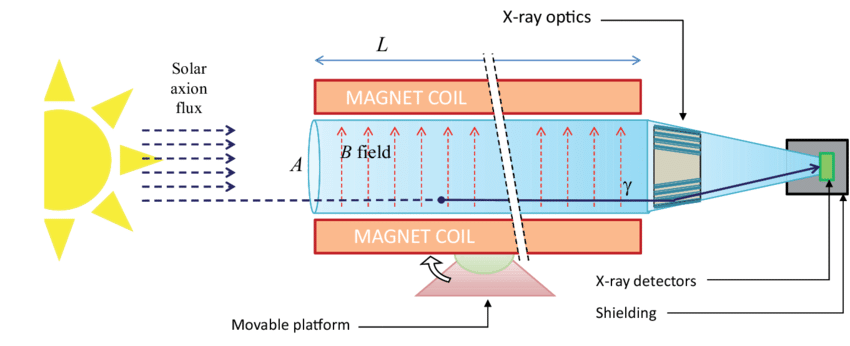
The prevailing view among cosmologists remains that dark matter is composed primarily of some type of not-yet-characterized subatomic particle. While this remains the majority opinion, the lack of particle detection has led to a divergence in consensus, with macroscopic candidates such as primordial black holes seeing renewed interest following observations by LIGO and the James Webb Space Telescope. The search for such particles, by a variety of means, is one of the major efforts in particle physics.
Technical definition
In standard cosmological calculations, "matter" means any constituent of the universe whose energy density scales with the inverse cube of the scale factor, i.e., ρ ∝ a−3 . This is in contrast to "radiation", which scales as the inverse fourth power of the scale factor ρ ∝ a−4 , and a cosmological constant, which does not change with respect to a (ρ ∝ a0). The different scaling factors for matter and radiation are a consequence of radiation redshift. For example, after doubling the diameter of the observable Universe via cosmic expansion, the scale, a, has doubled. The energy of the cosmic microwave background radiation has been halved (because the wavelength of each photon has doubled); the energy of ultra-relativistic particles, such as early-era standard-model neutrinos, is similarly halved. The cosmological constant, as an intrinsic property of space, has a constant energy density regardless of the volume under consideration.
In principle, "dark matter" means all components of the universe which are not visible but still obey ρ ∝ a−3 . In practice, the term "dark matter" is often used to mean only the non-baryonic component of dark matter, i.e., excluding "missing baryons". Context will usually indicate which meaning is intended.
Observational evidence
Galaxy rotation curves
The arms of spiral galaxies rotate around their galactic center. The luminous mass density of a spiral galaxy decreases as one goes from the center to the outskirts. If luminous mass were all the matter, then the galaxy can be modelled as a point mass in the centre and test masses orbiting around it, similar to the Solar System. From Kepler's Third Law, it is expected that the rotation velocities will decrease with distance from the center, similar to the Solar System. This is not observed. Instead, the galaxy rotation curve remains flat or even increases as distance from the center increases.
If Kepler's laws are correct, then the obvious way to resolve this discrepancy is to conclude the mass distribution in spiral galaxies is not similar to that of the Solar System. In particular, there may be a lot of non-luminous matter (dark matter) in the outskirts of the galaxy.
Velocity dispersions
Stars in bound systems must obey the virial theorem. The theorem, together with the measured velocity distribution, can be used to measure the mass distribution in a bound system, such as elliptical galaxies or globular clusters. With some exceptions, velocity dispersion estimates of elliptical galaxies do not match the predicted velocity dispersion from the observed mass distribution, even assuming complicated distributions of stellar orbits. As with galaxy rotation curves, the obvious way to resolve the discrepancy is to postulate the existence of non-luminous matter.
Galaxy clustering
Galaxy clusters are particularly important for dark matter studies since their masses can be estimated in three independent ways:
From the scatter in radial velocities of the galaxies within clusters
From X-rays emitted by hot gas in the clusters. From the X-ray energy spectrum and flux, the gas temperature and density can be estimated, hence giving the pressure; assuming pressure and gravity balance determines the cluster's mass profile.
Gravitational lensing (usually of more distant galaxies) can measure cluster masses without relying on observations of dynamics (e.g., velocity).
Generally, these three methods are in reasonable agreement that dark matter outweighs visible matter by approximately 5 to 1.
On larger scales, large galaxy redshift surveys may be used to make a three-dimensional map of the galaxy distribution. These maps are slightly distorted because distances are estimated from observed redshifts; the redshift contains a contribution from the galaxy's so-called peculiar velocity in addition to the dominant Hubble expansion term. On average, superclusters are expanding more slowly than the cosmic mean due to their gravity, while voids are expanding faster than average. In a redshift map, galaxies in front of a supercluster have excess radial velocities towards it and have redshifts slightly higher than their distance would imply, while galaxies behind the supercluster have redshifts slightly low for their distance. This effect causes superclusters to appear squashed in the radial direction, and likewise voids are stretched. Their angular positions are unaffected. This effect is not detectable for any one structure since the true shape is not known, but can be measured by averaging over many structures. It was predicted quantitatively by Nick Kaiser in 1987, and first decisively measured in 2001 by the 2dF Galaxy Redshift Survey. Results are in agreement with the Lambda-CDM model.
Bullet Cluster
The bullet cluster is the result of a recent collision of two galaxy clusters. It is of particular note because the location of the center of mass as measured by gravitational lensing is different from the location of the center of mass of visible matter. This is difficult for modified gravity theories, which generally predict lensing around visible matter, to explain. Standard dark matter theory however has no issue: the hot, visible gas in each cluster would be cooled and slowed down by electromagnetic interactions, while dark matter (which does not interact electromagnetically) would not. This leads to the dark matter separating from the visible gas, producing the separate lensing peak as observed.
Gravitational lensing
One of the consequences of general relativity is the gravitational lens. Gravitational lensing occurs when massive objects between a source of light and the observer act as a lens to bend light from this source. Lensing does not depend on the properties of the mass; it only requires there to be a mass. The more massive an object, the more lensing is observed. An example is a cluster of galaxies lying between a more distant source such as a quasar and an observer. In this case, the galaxy cluster will lens the quasar.
Strong lensing is the observed distortion of background galaxies into arcs when their light passes through such a gravitational lens. It has been observed around many distant clusters including Abell 1689. By measuring the distortion geometry, the mass of the intervening cluster can be obtained. In the weak regime, lensing does not distort background galaxies into arcs, causing minute distortions instead. By examining the apparent shear deformation of the adjacent background galaxies, the mean distribution of dark matter can be characterized. The measured mass-to-light ratios correspond to dark matter densities predicted by other large-scale structure measurements.
Type Ia supernova distance measurements
Type Ia supernovae can be used as standard candles to measure extragalactic distances, which can in turn be used to measure how fast the universe has expanded in the past. Data indicates the universe is expanding at an accelerating rate, the cause of which is usually ascribed to dark energy. Since observations indicate the universe is almost flat, it is expected the total energy density of everything in the universe should sum to 1 (Ωtot ≈ 1). The measured dark energy density is ΩΛ ≈ 0.690; the observed ordinary (baryonic) matter energy density is Ωb ≈ 0.0482 and the energy density of radiation is negligible. This leaves a missing Ωdm ≈ 0.258 which nonetheless behaves like matter (see technical definition section above) – dark matter.
Lyman-alpha forest
In astronomical spectroscopy, the Lyman-alpha forest is the sum of the absorption lines arising from the Lyman-alpha transition of neutral hydrogen in the spectra of distant galaxies and quasars. Lyman-alpha forest observations can also constrain cosmological models. These constraints agree with those obtained from WMAP data.
Cosmic microwave background
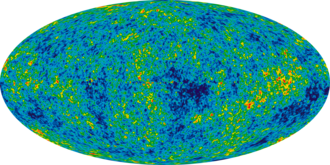
Although both dark matter and ordinary matter are matter, they do not behave in the same way. In particular, in the early universe, ordinary matter was ionized and interacted strongly with radiation via Thomson scattering. Dark matter does not interact directly with radiation, but it does affect the cosmic microwave background (CMB) by its gravitational potential (mainly on large scales) and by its effects on the density and velocity of ordinary matter. Ordinary and dark matter perturbations, therefore, evolve differently with time and leave different imprints on the CMB.
The CMB is very close to a perfect blackbody but contains very small temperature anisotropies of a few parts in 100,000. A sky map of anisotropies can be decomposed into an angular power spectrum, which is observed to contain a series of acoustic peaks at near-equal spacing but different heights. The locations of these peaks depend on cosmological parameters. Matching theory to data, therefore, constrains cosmological parameters.
The CMB anisotropy was first discovered by COBE in 1992, though this had too coarse resolution to detect the acoustic peaks.
After the discovery of the first acoustic peak by the balloon-borne BOOMERanG experiment in 2000, the power spectrum was precisely observed by WMAP in 2003–2012, and even more precisely by the Planck spacecraft in 2013–2015. The results support the Lambda-CDM model. The observed CMB angular power spectrum provides powerful evidence in support of dark matter, as its precise structure is well fitted by the Lambda-CDM model, but difficult to reproduce with any competing model such as modified Newtonian dynamics (MOND).
Structure formation
Structure formation refers to the period after the Big Bang when density perturbations collapsed to form stars, galaxies, and clusters. Prior to structure formation, the Friedmann solutions to general relativity describe a homogeneous universe. Later, small anisotropies gradually grew and condensed the homogeneous universe into stars, galaxies and larger structures. Ordinary matter is affected by radiation, which is the dominant element of the universe at very early times. As a result, its density perturbations are washed out and unable to condense into structure. If there were only ordinary matter in the universe, there would not have been enough time for density perturbations to grow into the galaxies and clusters currently seen.
Dark matter provides a solution to this problem because it is unaffected by radiation. Therefore, its density perturbations can grow first. The resulting gravitational potential acts as an attractive potential well for ordinary matter collapsing later, speeding up the structure formation process.
Sky surveys and baryon acoustic oscillations
Baryon acoustic oscillations (BAO) are fluctuations in the density of the visible baryonic matter (normal matter) of the universe on large scales. These are predicted to arise in the Lambda-CDM model due to acoustic oscillations in the photon–baryon fluid of the early universe and can be observed in the cosmic microwave background angular power spectrum. BAOs set up a preferred length scale for baryons. As the dark matter and baryons clumped together after recombination, the effect is much weaker in the galaxy distribution in the nearby universe, but is detectable as a subtle (~ 1%) preference for pairs of galaxies to be separated by 147 Mpc, compared to those separated by 130–160 Mpc. This feature was predicted theoretically in the 1990s and then discovered in 2005, in two large galaxy redshift surveys, the Sloan Digital Sky Survey and the 2dF Galaxy Redshift Survey. Combining the CMB observations with BAO measurements from galaxy redshift surveys provides a precise estimate of the Hubble constant and the average matter density in the Universe. The results support the Lambda-CDM model.
Theoretical classifications
Dark matter can be divided into cold, warm, and hot categories. These categories refer to velocity rather than an actual temperature, and indicate how far corresponding objects moved due to random motions in the early universe, before they slowed due to cosmic expansion. This distance is called the free streaming length. The categories of dark matter are set with respect to the size of the collection of mass prior to structure formation that later collapses to form a dwarf galaxy. This collection of mass is sometimes called a protogalaxy. Dark matter particles are classified as cold, warm, or hot if their free streaming length is much smaller (cold), similar to (warm), or much larger (hot) than the protogalaxy of a dwarf galaxy. Mixtures of the above are also possible: a theory of mixed dark matter was popular in the mid-1990s, but was rejected following the discovery of dark energy.