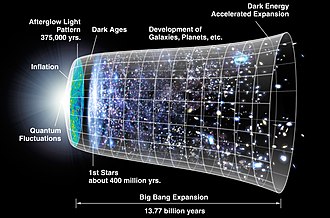
The Big Bang is a physical theory that describes how the universe expanded from an initial state of high density and temperature. Various cosmological models based on the Big Bang concept explain a broad range of phenomena, including the abundance of light elements, the cosmic microwave background (CMB) radiation, the redshift of galaxies and the large-scale structure of the universe. The observed uniformity of the universe, which leads to the horizon and flatness problems, is explained through cosmic inflation: a phase of accelerated expansion during the earliest stages. Detailed measurements of the expansion rate of the universe place the initial singularity at an estimated 13.787±0.02 billion years ago, which is considered the age of the universe. A wide range of empirical evidence strongly favors the Big Bang event, which is now widely accepted.
Extrapolating this cosmic expansion backward in time using the known laws of physics, the models describe an extraordinarily hot and dense primordial universe. Physics lacks a widely accepted theory that can model the earliest conditions of the Big Bang. As the universe expanded, it cooled sufficiently to allow the formation of subatomic particles, and later atoms. These primordial elements—mostly hydrogen, with some helium and lithium—then coalesced under the force of gravity aided by dark matter, forming early stars and galaxies. Measurements of the redshifts of supernovae indicate that the expansion of the universe is accelerating, an observation attributed to a concept called dark energy.
The concept of an expanding universe was introduced by the physicist Alexander Friedmann in 1922 with the mathematical derivation of the Friedmann equations. The earliest empirical observation of an expanding universe is known as Hubble's law, published in work by physicist Edwin Hubble in 1929, which discerned that galaxies are moving away from Earth at a rate that accelerates proportionally with distance. Independent of Friedmann's work, and independent of Hubble's observations, in 1931 physicist Georges Lemaître proposed that the universe emerged from a "primeval atom", introducing the modern notion of the Big Bang. In 1964, the CMB was accidentally discovered. Over the next few years measurements showed this radiation to be uniform over directions in the sky and the shape of the energy versus intensity curve, both consistent with the Big Bang models of high temperatures and densities in the distant past. By the late 1960s most cosmologists were convinced that competing steady-state model of cosmic evolution was incorrect.

There remain aspects of the observed universe that are not yet adequately explained by the Big Bang models. These include the unequal abundances of matter and antimatter known as baryon asymmetry, the detailed nature of dark matter surrounding galaxies, and the origin of dark energy.
Features of the models
Assumptions
Big Bang cosmology models depend on three major assumptions: the universality of physical laws, the cosmological principle, and that the matter content can be modeled as a perfect fluid. The universality of physical laws is one of the underlying principles of the theory of relativity. The cosmological principle states that on large scales the universe is homogeneous and isotropic—appearing the same in all directions regardless of location. A perfect fluid has no viscosity; the pressure of a perfect fluid is proportional to its density.
These ideas were initially taken as postulates, but later efforts were made to test each of them. For example, the first assumption has been tested by observations showing that the largest possible deviation of the fine-structure constant over much of the age of the universe is of order 10−5. The key physical law behind these models, general relativity has passed stringent tests on the scale of the Solar System and binary stars.
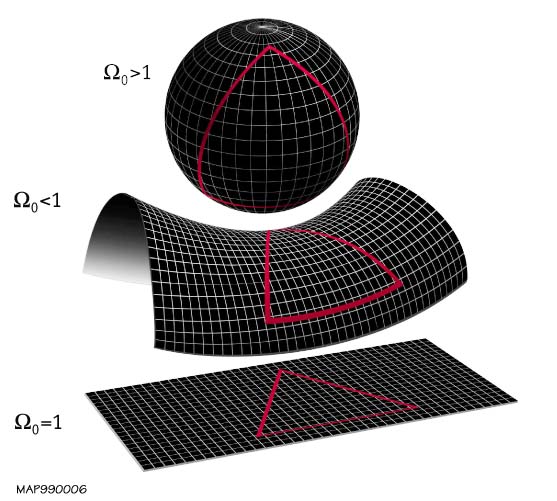
The cosmological principle has been confirmed to a level of 10−5 via observations of the temperature of the CMB. At the scale of the CMB horizon, the universe has been measured to be homogeneous with an upper bound on the order of 10% inhomogeneity, as of 1995.
Expansion prediction
The cosmological principle dramatically simplifies the equations of general relativity, giving the Friedmann–Lemaître–Robertson–Walker metric to describe the geometry of the universe and, with the assumption of a perfect fluid, the Friedmann equations giving the time dependence of that geometry. The only parameter at this level of description is the mass-energy density: the geometry of the universe and its expansion is a direct consequence of its density. All of the major features of Big Bang cosmology are related to these results.
Mass-energy density
In Big Bang cosmology, the mass–energy density controls the shape and evolution of the universe. By combining astronomical observations with known laws of thermodynamics and particle physics, cosmologists have worked out the components of the density over the lifespan of the universe. In the current universe, luminous matter, the stars, planets, and so on makes up less than 5% of the density. Dark matter accounts for 27% and dark energy the remaining 68%.

Horizons
An important feature of the Big Bang spacetime is the presence of particle horizons. Since the universe has a finite age, and light travels at a finite speed, there may be events in the past whose light has not yet had time to reach earth. This places a limit or a past horizon on the most distant objects that can be observed. Conversely, because space is expanding, and more distant objects are receding ever more quickly, light emitted by us today may never "catch up" to very distant objects. This defines a future horizon, which limits the events in the future that we will be able to influence. The presence of either type of horizon depends on the details of the Friedmann–Lemaître–Robertson–Walker (FLRW) metric that describes the expansion of the universe.
Our understanding of the universe back to very early times suggests that there is a past horizon, though in practice our view is also limited by the opacity of the universe at early times. So our view cannot extend further backward in time, though the horizon recedes in space. If the expansion of the universe continues to accelerate, there is a future horizon as well.
Thermalization
Some processes in the early universe occurred too slowly, compared to the expansion rate of the universe, to reach approximate thermodynamic equilibrium. Others were fast enough to reach thermalization. The parameter usually used to find out whether a process in the very early universe has reached thermal equilibrium is the ratio between the rate of the process (usually rate of collisions between particles) and the Hubble parameter. The larger the ratio, the more time particles had to thermalize before they were too far away from each other.

Timeline
According to the Big Bang models, the universe at the beginning was very hot and very compact, and since then it has been expanding and cooling.
Singularity
Existing theories of physics cannot tell us about the moment of the Big Bang. Extrapolation of the expansion of the universe backwards in time using only classical general relativity yields a gravitational singularity with infinite density and temperature at a finite time in the past. However this classical gravitational theory is expected to be inadequate to describe physics under these conditions. Thus the meaning of this singularity in the context of the Big Bang is unclear.
The earliest time that general relativity can be applied is called the Planck time. Earlier, during the Planck epoch, when the temperature of the universe was close to the Planck scale (around 1032 K or 1028 eV) quantum gravity effects are expected to be dominant. To date there is no accepted theory of quantum gravity; above the Planck energy scale, undiscovered physics could influence the expansion history of the universe.

Inflation and baryogenesis
The earliest phases of the Big Bang are subject to much speculation, given the lack of available data. In the most common models the universe was filled homogeneously and isotropically with a very high energy density and huge temperatures and pressures, and was very rapidly expanding and cooling. The period up to 10−43 seconds into the expansion, the Planck epoch, was a phase in which the four fundamental forces—the electromagnetic force, the strong nuclear force, the weak nuclear force, and the gravitational force—were unified as one. In this stage, the characteristic scale length of the universe was the Planck length, 1.6×10⁻³⁵ m, and consequently had a temperature of approximately 1032 degrees Celsius. Even the very concept of a particle breaks down in these conditions. A proper understanding of this period awaits the development of a theory of quantum gravity. The Planck epoch was succeeded by the grand unification epoch beginning at 10−43 seconds, where gravitation separated from the other forces as the universe's temperature fell.
At approximately 10−37 seconds into the expansion, a phase transition caused a cosmic inflation, during which the universe grew exponentially, unconstrained by the light speed invariance, and temperatures dropped by a factor of 100,000. This concept is motivated by the flatness problem, where the density of matter and energy is very close to the critical density needed to produce a flat universe. That is, the shape of the universe has no overall geometric curvature due to gravitational influence. Microscopic quantum fluctuations that occurred because of Heisenberg's uncertainty principle were "frozen in" by inflation, becoming amplified into the seeds that would later form the large-scale structure of the universe. At a time around 10−36 seconds, the electroweak epoch begins when the strong nuclear force separates from the other forces, with only the electromagnetic force and weak nuclear force remaining unified.
All of the mass-energy in all of the galaxies currently visible started in a sphere with a radius around 4 × 10⁻²⁹ m then grew to a sphere with a radius around 0.9 m by the end of inflation. Reheating followed as the inflaton field decayed, until the universe obtained the temperatures required for the production of a quark–gluon plasma as well as all other elementary particles. Temperatures were so high that the random motions of particles were at relativistic speeds, and particle–antiparticle pairs of all kinds were being continuously created and destroyed in collisions. At some point, an unknown reaction called baryogenesis violated the conservation of baryon number, leading to a very small excess of quarks and leptons over antiquarks and antileptons—of the order of one part in 30 million. This resulted in the predominance of matter over antimatter in the present universe.

Cooling
The universe continued to decrease in density and fall in temperature, hence the typical energy of each particle was decreasing. Symmetry-breaking phase transitions put the fundamental forces of physics and the parameters of elementary particles into their present form, with the electromagnetic force and weak nuclear force separating at about 10−12 seconds.
After about 10−11 seconds, the picture becomes less speculative, since particle energies drop to values that can be attained in particle accelerators. At about 10−6 seconds, quarks and gluons combined to form baryons such as protons and neutrons. The small excess of quarks over antiquarks led to a small excess of baryons over antibaryons. The temperature was no longer high enough to create either new proton–antiproton or neutron–antineutron pairs. A mass annihilation immediately followed, leaving just one in 108 of the original matter particles and none of their antiparticles. A similar process happened at about 1 second for electrons and positrons. After these annihilations, the remaining protons, neutrons and electrons were no longer moving relativistically and the energy density of the universe was dominated by photons (with a minor contribution from neutrinos).
A few minutes into the expansion, when the temperature was about a billion kelvin and the density of matter in the universe was comparable to the current density of Earth's atmosphere, neutrons combined with protons to form the universe's deuterium and helium nuclei in a process called Big Bang nucleosynthesis (BBN). Most protons remained uncombined as hydrogen nuclei.
As the universe cooled, the rest energy density of matter came to gravitationally dominate over that of the photon and neutrino radiation at a time of about 50,000 years. At a time of about 380,000 years, the universe cooled enough that electrons and nuclei combined into neutral atoms (mostly hydrogen) in an event called recombination. This process made the previously opaque universe transparent, and the photons that last scattered during this epoch comprise the cosmic microwave background.
Structure formation
After the recombination epoch, the slightly denser regions of the uniformly distributed matter gravitationally attracted nearby matter and thus grew even denser, forming gas clouds, stars, galaxies, and the other astronomical structures observable today. The details of this process depend on the amount and type of matter in the universe. The four possible types of matter are known as cold dark matter (CDM), warm dark matter, hot dark matter, and baryonic matter. The best measurements available, from the Wilkinson Microwave Anisotropy Probe (WMAP), show that the data is well-fit by a Lambda-CDM model in which dark matter is assumed to be cold. This CDM is estimated to make up about 23% of the matter/energy of the universe, while baryonic matter makes up about 4.6%.
Cosmic acceleration
Independent lines of evidence from Type Ia supernovae and the CMB imply that the universe today is dominated by a mysterious form of energy known as dark energy, which appears to homogeneously permeate all of space. Observations suggest that 73% of the total energy density of the present day universe is in this form. When the universe was very young it was likely infused with dark energy, but with everything closer together, gravity predominated, braking the expansion. Eventually, after billions of years of expansion, the declining density of matter relative to the density of dark energy allowed the expansion of the universe to begin to accelerate.
Dark energy in its simplest formulation is modeled by a cosmological constant term in Einstein field equations of general relativity, but its composition and mechanism are unknown. More generally, the details of its equation of state and relationship with the Standard Model of particle physics continue to be investigated both through observation and theory.
All of this cosmic evolution after the inflationary epoch can be rigorously described and modeled by the lambda-CDM model of cosmology, which uses the independent frameworks of quantum mechanics and general relativity. There are no easily testable models that would describe the situation prior to approximately 10−15 seconds. Understanding this earliest of eras in the history of the universe is one of the greatest unsolved problems in physics.
Concept history
Etymology
The term Big Bang did not catch on until the 1970s. Astronomer Fred Hoyle is credited with coining the term in a March 1949 BBC Third Programme broadcast, contrasting it with his own steady-state model:
One of them is distinguished by the assumption that the universe started its life a finite time ago in a single huge explosion. On this supposition, the present expansion is a relic of the violence of the explosion Now this Big Bang idea seemed to me to be unsatisfactory... On scientific grounds, too, I cannot see any grounds for preferring the Big Bang idea.
It is popularly reported that Hoyle, who favored the steady state, intended this to be pejorative, but Hoyle explicitly denied this and said it was just a striking image meant to highlight the difference between the two models. Helge Kragh writes that the evidence for the claim that it was meant as a pejorative is "unconvincing", and mentions a number of indications that it was not a pejorative.
A primordial singularity is sometimes called "the Big Bang", but the term can also refer to a more generic early hot, dense phase. The term itself has been argued to be a misnomer because it evokes an explosion. The argument is that whereas an explosion suggests expansion into a surrounding space, the Big Bang only describes the intrinsic expansion of the contents of the universe. Another issue pointed out by Santhosh Mathew is that bang implies sound, which is not an important feature of the model. However, when Sky and Telescope ran a competition in 1993 to find a more suitable alternative no alternative was successful.
Before the name
Early cosmological models developed from observations of the structure of the universe and from theoretical considerations. In 1912, Vesto Slipher measured the first Doppler shift of a "spiral nebula" (spiral nebula is the obsolete term for spiral galaxies), and soon discovered that almost all such nebulae were receding from Earth. He did not grasp the cosmological implications of this fact, and indeed at the time it was highly controversial whether or not these nebulae were "island universes" outside our Milky Way. Ten years later, Alexander Friedmann, a Russian cosmologist and mathematician, derived the Friedmann equations from the Einstein field equations, showing that the universe might be expanding in contrast to the static universe model advocated by Albert Einstein at that time.
In 1924, American astronomer Edwin Hubble's measurement of the great distance to the nearest spiral nebulae showed that these systems were indeed other galaxies. Starting that same year, Hubble painstakingly developed a series of distance indicators, the forerunner of the cosmic distance ladder, using the 100-inch (2.5 m) Hooker telescope at Mount Wilson Observatory. This allowed him to estimate distances to galaxies whose redshifts had already been measured, mostly by Slipher. In 1929, Hubble, with the help of Milton Humason, discovered a correlation between distance and recessional velocity—now known as Hubble's law.
Independently deriving Friedmann's equations in 1927, Georges Lemaître, a Belgian physicist and Roman Catholic priest, proposed that the recession of the nebulae was due to the expansion of the universe. He inferred the relation that Hubble would later observe, given the cosmological principle. In 1931, Lemaître went further and suggested that the evident expansion of the universe, if projected back in time, meant that the further in the past the smaller the universe was, until at some finite time in the past all the mass of the universe was concentrated into a single point, a "primeval atom" where and when the fabric of time and space came into existence.
In the 1920s and 1930s, almost every major cosmologist preferred an eternal steady-state universe, and several complained that the beginning of time implied by an expanding universe imported religious concepts into physics; this objection was later repeated by supporters of the steady-state theory. This perception was enhanced by the fact that the originator of the expanding universe concept, Lemaître, was a Roman Catholic priest. Arthur Eddington agreed with Aristotle that the universe did not have a beginning in time, viz., that matter is eternal. A beginning in time was "repugnant" to him. Lemaître, however, disagreed:
If the world has begun with a single quantum, the notions of space and time would altogether fail to have any meaning at the beginning; they would only begin to have a sensible meaning when the original quantum had been divided into a sufficient number of quanta. If this suggestion is correct, the beginning of the world happened a little before the beginning of space and time.
During the 1930s, other ideas were proposed as non-standard cosmologies to explain Hubble's observations, including the Milne model, the oscillatory universe (originally suggested by Friedmann, but advocated by Albert Einstein and Richard C. Tolman) and Fritz Zwicky's tired light hypothesis.
After World War II, two distinct possibilities emerged. One was Fred Hoyle's steady-state model, whereby new matter would be created as the universe seemed to expand. In this model the universe is roughly the same at any point in time. The other was Lemaître's expanding universe theory, advocated and developed by George Gamow, who used it to develop a theory for the abundance of chemical elements in the universe. and whose associates, Ralph Alpher and Robert Herman, predicted the cosmic background radiation.
As a named model
Ironically, it was Hoyle who coined the phrase that came to be applied to Lemaître's theory, referring to it as "this big bang idea" during a BBC Radio broadcast in March 1949. For a while, support was split between these two theories. Eventually, the observational evidence, most notably from radio source counts, began to favor Big Bang over steady state. The discovery and confirmation of the CMB in 1964 secured the Big Bang as the best theory of the origin and evolution of the universe.
In 1968 and 1970, Roger Penrose, Stephen Hawking, and George F. R. Ellis published papers where they showed that mathematical singularities were an inevitable initial condition of relativistic models of the Big Bang. Then, from the 1970s to the 1990s, cosmologists worked on characterizing the features of the Big Bang universe and resolving outstanding problems. In 1981, Alan Guth made a breakthrough in theoretical work on resolving certain outstanding theoretical problems in the Big Bang models with the introduction of an epoch of rapid expansion in the early universe he called "inflation". Meanwhile, during these decades, two questions in observational cosmology that generated much discussion and disagreement were over the precise values of the Hubble Constant and the matter-density of the universe (before the discovery of dark energy, thought to be the key predictor for the eventual fate of the universe).
Significant progress in Big Bang cosmology has been made since the late 1990s as a result of advances in telescope technology as well as the analysis of data from satellites such as the Cosmic Background Explorer (COBE), the Hubble Space Telescope and WMAP. Cosmologists now have fairly precise and accurate measurements of many of the parameters of the Big Bang model, and have made the unexpected discovery that the expansion of the universe appears to be accelerating.
Observational evidence
The Big Bang models offer a comprehensive explanation for a broad range of observed phenomena, including the abundances of the light elements, the cosmic microwave background, large-scale structure, and Hubble's law. The earliest and most direct observational evidence of the validity of the theory are the expansion of the universe according to Hubble's law (as indicated by the redshifts of galaxies), discovery and measurement of the cosmic microwave background and the relative abundances of light elements produced by Big Bang nucleosynthesis (BBN). More recent evidence includes observations of galaxy formation and evolution, and the distribution of large-scale cosmic structures. These are sometimes called the "four pillars" of the Big Bang models.
Precise modern models of the Big Bang appeal to various exotic physical phenomena that have not been observed in terrestrial laboratory experiments or incorporated into the Standard Model of particle physics. Of these features, dark matter is currently the subject of most active laboratory investigations. Remaining issues include the cuspy halo problem and the dwarf galaxy problem of cold dark matter. Dark energy is also an area of intense interest for scientists, but it is not clear whether direct detection of dark energy will be possible. Inflation and baryogenesis remain more speculative features of current Big Bang models. Viable, quantitative explanations for such phenomena are still being sought. These are unsolved problems in physics.
Hubble's law and the expansion of the universe
Observations of distant galaxies and quasars show that these objects are redshifted: the light emitted from them has been shifted to longer wavelengths. This can be seen by taking a frequency spectrum of an object and matching the spectroscopic pattern of emission or absorption lines corresponding to atoms of the chemical elements interacting with the light. These redshifts are uniformly isotropic, distributed evenly among the observed objects in all directions. If the redshift is interpreted as a Doppler shift, the recessional velocity of the object can be calculated. For some galaxies, it is possible to estimate distances via the cosmic distance ladder. When the recessional velocities are plotted against these distances, a linear relationship known as Hubble's law is observed: