
Czechoslovakia was a country in Central Europe. The country was bordered by Austria and Hungary to the south, Germany to the west and northwest, Poland to the northeast, and Ukraine to the southeast. Czechoslovakia had a hilly and mostly mountainous landscape that covered an area of 127,906 square kilometers (49,385 sq mi) with a mostly temperate continental and oceanic climate. The capital and largest city was Prague; other major cities and urban areas include Brno, Ostrava, Plzeň, Liberec, Bratislava and Košice.
The state was created in 1918, as Czecho-Slovakia (until 1920), when it declared its independence from Austria-Hungary. In 1938, after the Munich Agreement, the Sudetenland became part of Nazi Germany. Between 1939 and 1945, the state ceased to exist, as Slovakia proclaimed its independence and Carpathian Ruthenia became part of Hungary, while the German Protectorate of Bohemia and Moravia was proclaimed in the remainder of the Czech Lands. In 1939, after the outbreak of World War II, former Czechoslovak president Edvard Beneš formed a government-in-exile and sought recognition from the Allies.
After World War II, Czechoslovakia was re-established under its pre-1938 borders, with the exception of Carpathian Ruthenia, which became part of the Ukrainian SSR (a republic of the Soviet Union). The Communist Party seized power in a coup in 1948. From 1948 to 1989, Czechoslovakia was part of the Eastern Bloc with a planned economy. Its economic status was formalized in membership of Comecon from 1949 and its defense status in the Warsaw Pact of 1955. A period of political liberalization in 1968, the Prague Spring, ended when the Soviet Union, assisted by other Warsaw Pact countries, invaded Czechoslovakia. In 1989, as Marxist–Leninist governments and communism were ending all over Central and Eastern Europe, Czechoslovaks peacefully deposed their communist government during the Velvet Revolution, which began on 17 November 1989 and ended 11 days later on 28 November when all of the top Communist leaders and the Communist party itself resigned. On 31 December 1992, Czechoslovakia split peacefully into the two sovereign states of the Czech Republic and Slovakia.

Characteristics
Form of state
1918–1937: A democratic republic championed by Tomáš Masaryk.
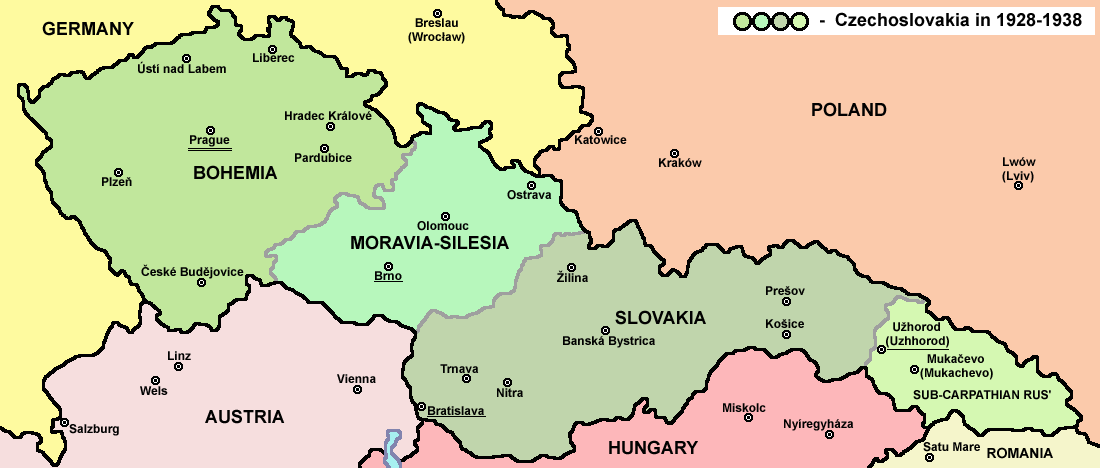
1938–1939: After the annexation of Sudetenland by Nazi Germany in 1938, the region gradually turned into a state with loosened connections among the Czech, Slovak, and Ruthenian parts. A strip of southern Slovakia and Carpathian Ruthenia was redeemed by Hungary, and the Trans-Olza region was annexed by Poland.

1939–1945: The remainder of the state was dismembered and became split into the Protectorate of Bohemia and Moravia and the Slovak Republic, while the rest of Carpathian Ruthenia was occupied and annexed by Hungary. A government-in-exile continued to exist in London, supported by the United Kingdom, United States and their Allies; after the German invasion of Soviet Union, it was also recognized by the Soviet Union. Czechoslovakia adhered to the Declaration by United Nations and was a founding member of the United Nations.
1946–1948: The country was governed by a coalition government with communist ministers, including the prime minister and the minister of interior. Carpathian Ruthenia was ceded to the Soviet Union.
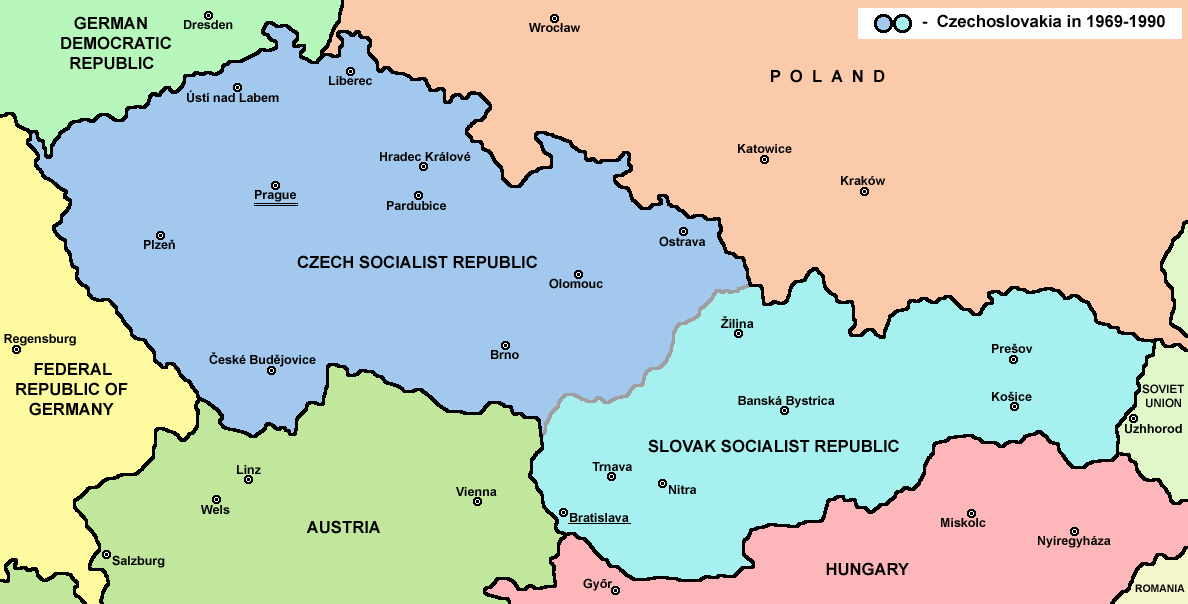
1948–1989: The country became a Marxist-Leninist state under Soviet domination with a command economy. In 1960, the country officially became a socialist republic, the Czechoslovak Socialist Republic. It was a satellite state of the Soviet Union.
1989–1990: Czechoslovakia formally became a federal republic comprising the Czech Socialist Republic and the Slovak Socialist Republic. In late 1989, the communist rule came to an end during the Velvet Revolution followed by the re-establishment of a democratic parliamentary republic.
1990–1992: Shortly after the Velvet Revolution, the state was renamed the Czech and Slovak Federative Republic, consisting of the Czech Republic and the Slovak Republic (Slovakia) until the peaceful dissolution on 31 December 1992.
Neighbours

Austria 1918–1938, 1945–1992
Germany (both predecessors, West Germany and East Germany, were neighbors between 1949 and 1990)
Hungary
Poland
Romania 1918–1938
Soviet Union 1945–1991
Ukraine 1991–1992 (Soviet Union member until 1991)
Topography
The country was of generally irregular terrain. The western area was part of the north-central European uplands. The eastern region was composed of the northern reaches of the Carpathian Mountains and lands of the Danube River basin.
Climate
The weather was characterized by mild to cold winters and mild to warm summers, influenced by the Atlantic Ocean from the west, the Baltic Sea from the north, and Mediterranean Sea from the south. The country was situated in the transition zone between the oceanic and continental climate types.
Names
1918–1938: Czechoslovak Republic (abbreviated ČSR), or Czechoslovakia, before the formalization of the name in 1920, also known as Czecho-Slovakia or the Czecho-Slovak state
1938–1939: Czecho-Slovak Republic, or Czecho-Slovakia
1945–1960: Czechoslovak Republic (ČSR), or Czechoslovakia
1960–1990: Czechoslovak Socialist Republic (ČSSR), or Czechoslovakia
1990: Czechoslovak Federative Republic (ČSFR)
1990–1992: Czech and Slovak Federative Republic (ČSFR), or Czechoslovakia
History
Origins
The area was part of the Austro-Hungarian Empire until it collapsed at the end of World War I. The new state was founded by Tomáš Garrigue Masaryk, who served as its first president from 14 November 1918 to 14 December 1935. He was succeeded by his close ally Edvard Beneš (1884–1948).
The roots of Czech nationalism go back to the 19th century, when philologists and educators, influenced by Romanticism, promoted the Czech language and pride in the Czech people. Nationalism became a mass movement in the second half of the 19th century. Taking advantage of the limited opportunities for participation in political life under Austrian rule, Czech leaders such as historian František Palacký (1798–1876) founded various patriotic self-help organizations which provided a chance for many of their compatriots to participate in communal life before independence. Palacký supported Austro-Slavism and worked for a reorganized federal Austrian Empire, which would protect the Slavic speaking peoples of Central Europe against Russian and German threats.
An advocate of democratic reform and Czech autonomy within Austria-Hungary, Masaryk was elected twice to the Reichsrat (Austrian Parliament), from 1891 to 1893 for the Young Czech Party, and from 1907 to 1914 for the Czech Realist Party, which he had founded in 1889 with Karel Kramář and Josef Kaizl.
During World War I a number of Czechs and Slovaks, the Czechoslovak Legions, fought with the Allies in France and Italy, while large numbers deserted to Russia in exchange for its support for the independence of Czechoslovakia from the Austrian Empire. With the outbreak of World War I, Masaryk began working for Czech independence in a union with Slovakia. With Edvard Beneš and Milan Rastislav Štefánik, Masaryk visited several Western countries and won support from influential publicists. The Czechoslovak National Council was the main organization that advanced the claims for a Czechoslovak state.
First Czechoslovak Republic
Formation
The Bohemian Kingdom ceased to exist in 1918 when it was incorporated into Czechoslovakia. Czechoslovakia was founded in October 1918, as one of the successor states of the Austro-Hungarian Empire at the end of World War I and as part of the Treaty of Saint-Germain-en-Laye. It consisted of the present-day territories of Bohemia, Moravia, parts of Silesia making up present-day Czech Republic, Slovakia, and a region of present-day Ukraine called Carpathian Ruthenia. Its territory included some of the most industrialized regions of the former Austria-Hungary.
Ethnicity
The new country was a multi-ethnic state, with Czechs and Slovaks as constituent peoples. The population consisted of Czechs (51%), Germans (22%), Slovaks (16%), Hungarians (5%) and Rusyns (4%). Many of the Germans, Hungarians, Ruthenians and Poles and some Slovaks, felt oppressed because the political elite did not generally allow political autonomy for minority ethnic groups. This policy led to unrest among the non-Czech population, particularly in German-speaking Sudetenland, which initially had proclaimed itself part of the Republic of German-Austria in accordance with the self-determination principle.
The state proclaimed Czechoslovakism as its official ideology, defining the population as a single Czechoslovak nation rather than distinct Czech and Slovak ethnicities. This unifying doctrine was met with significant resistance and disagreement from Slovak nationalists and other ethnic minorities within the country. Once a unified Czechoslovakia was restored after World War II (after the country had been divided during the war), the conflict between the Czechs and the Slovaks surfaced again. The governments of Czechoslovakia and other Central European nations deported ethnic Germans, reducing the presence of minorities in the nation. Most of the Jews had been killed during the war by the Germans.
*Jews identified themselves as Germans or Hungarians (and Jews only by religion not ethnicity), the sum is, therefore, more than 100%.
Interwar period
During the period between the two world wars Czechoslovakia was a democratic state. The population was generally literate, and contained fewer alienated groups. The influence of these conditions was augmented by the political values of Czechoslovakia's leaders and the policies they adopted. Under Tomas Masaryk, Czech and Slovak politicians promoted progressive social and economic conditions that served to defuse discontent.
Foreign minister Beneš became the prime architect of the Czechoslovak-Romanian-Yugoslav alliance (the "Little Entente," 1921–38) directed against Hungarian attempts to reclaim lost areas. Beneš worked closely with France. Far more dangerous was the German element, which after 1933 became allied with the Nazis in Germany.
Czech-Slovak relations came to be a central issue in Czechoslovak politics during the 1930s. The increasing feeling of inferiority among the Slovaks, who were hostile to the more numerous Czechs, weakened the country in the late 1930s. Slovakia became autonomous in the fall of 1938, and by mid-1939, Slovakia had become independent, with the First Slovak Republic set up as a satellite state of Nazi Germany and the far-right Slovak People's Party in power.
After 1933, Czechoslovakia remained the only democracy in central and eastern Europe.
Munich Agreement, the Second Republic, and the Two-Step German Occupation
In September 1938, Adolf Hitler demanded control of the Sudetenland. On 29 September 1938, Britain and France ceded control in the Appeasement at the Munich Conference; France ignored the military alliance it had with Czechoslovakia. During October 1938, Nazi Germany occupied the Sudetenland border region, effectively crippling Czechoslovak defences.
The First Vienna Award assigned a strip of southern Slovakia and Carpathian Ruthenia to Hungary. Poland occupied Zaolzie, an area whose population was majority Polish, in October 1938.
On 14 March 1939, the remainder ("rump") of Czechoslovakia was dismembered by the proclamation of the Slovak State, the next day the rest of Carpathian Ruthenia was occupied and annexed by Hungary, while the following day the German Protectorate of Bohemia and Moravia was proclaimed.
The eventual goal of the German state under Nazi leadership was to eradicate Czech nationality through assimilation, deportation, and extermination of the Czech intelligentsia; the intellectual elites and middle class made up a considerable number of the 200,000 people who passed through concentration camps and the 250,000 who died during German occupation. Under Generalplan Ost, it was assumed that around 50% of Czechs would be fit for Germanization. The Czech intellectual elites were to be removed not only from Czech territories but from Europe completely. The authors of Generalplan Ost believed it would be best if they emigrated overseas, as even in Siberia they were considered a threat to German rule. Just like Jews, Poles, Serbs, and several other nations, Czechs were considered to be untermenschen by the Nazi state. In 1940, in a secret Nazi plan for the Germanization of the Protectorate of Bohemia and Moravia it was declared that those considered to be of racially Mongoloid origin and the Czech intelligentsia were not to be Germanized.
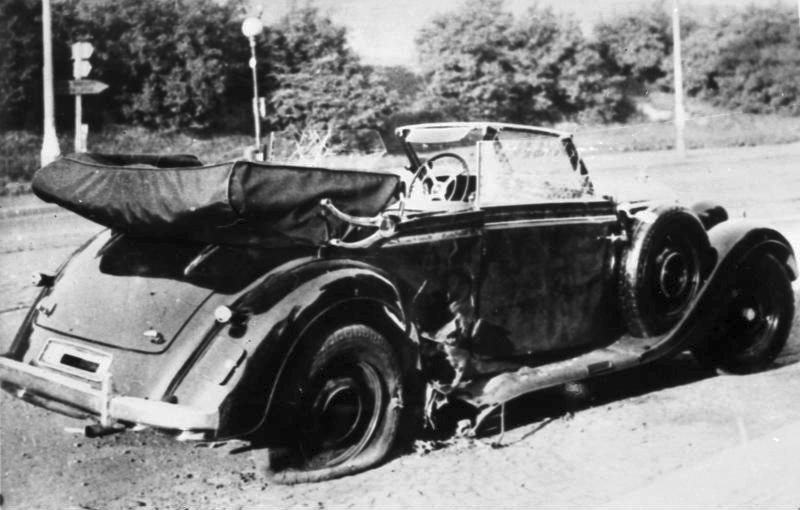
The deportation of Jews to concentration camps was organized under the direction of Reinhard Heydrich, and the fortress town of Terezín was made into a ghetto way station for Jewish families. On 4 June 1942 Heydrich died after being wounded by an assassin in Operation Anthropoid. Heydrich's successor, Colonel General Kurt Daluege, ordered mass arrests and executions and the destruction of the villages of Lidice and Ležáky. In 1943 the German war effort was accelerated. Under the authority of Karl Hermann Frank, German minister of state for Bohemia and Moravia, some 350,000 Czech laborers were dispatched to the Reich. Within the protectorate, all non-war-related industry was prohibited. Most of the Czech population obeyed quiescently up until the final months preceding the end of the war, while thousands were involved in the resistance movement.
For the Czechs of the Protectorate Bohemia and Moravia, German occupation was a period of brutal oppression. Czech losses resulting from political persecution and deaths in concentration camps totaled between 36,000 and 55,000. The Jewish populations of Bohemia and Moravia (118,000 according to the 1930 census) were virtually annihilated. Many Jews emigrated after 1939; more than 70,000 were killed; 8,000 survived at Terezín. Several thousand Jews managed to live in freedom or in hiding throughout the occupation.
Despite the estimated 136,000 deaths at the hands of the Nazi regime, the population in the Protectorate saw a net increase during the war years of approximately 250,000 in line with an increased birth rate.
On 6 May 1945, the third US Army of General Patton entered Plzeň from the south west. On 9 May 1945, Soviet Red Army troops entered Prague.
Third and Fourth Republics
After World War II, pre-war Czechoslovakia was reestablished, with the exception of Subcarpathian Ruthenia, which was annexed by the Soviet Union and incorporated into the Ukrainian Soviet Socialist Republic. The Beneš decrees were promulgated concerning ethnic Germans (see Potsdam Agreement) and ethnic Hungarians. Under the decrees, citizenship was abrogated for people of German and Hungarian ethnic origin who had accepted German or Hungarian citizenship during the occupations. In 1948, this provision was cancelled for the Hungarians, but only partially for the Germans. The government then confiscated the property of the Germans and expelled about 90% of the ethnic German population, over 2 million people. Those who remained were collectively accused of supporting the Nazis after the Munich Agreement, as 97.32% of Sudeten Germans had voted for the NSDAP in the December 1938 elections. Almost every decree explicitly stated that the sanctions did not apply to antifascists. Some 250,000 Germans, many married to Czechs, some antifascists, and also those required for the post-war reconstruction of the country, remained in Czechoslovakia. The Beneš Decrees still cause controversy among nationalist groups in the Czech Republic, Germany, Austria and Hungary.