Country music, also known as country and western or simply country, is a music genre originating from the United States. It is known for its ballads and dance tunes, identifiable by both traditional lyrics and harmonies accompanied by banjos, mandolins, fiddles, harmonicas, and many types of guitar; either acoustic, electric, steel, or resonator guitars. Once called hillbilly music, the term country music was popularized in the 1940s.
Country music was first developed in the South, and then spread throughout the Piedmont, from Louisiana along the Appalachian Mountains to New York. The music is believed to be derived from British folk music, brought to the United States during early waves of immigration. Rooted in American folk music, such as old-time and Southern Appalachian music, many traditions blended to form country music. In particular, this included cowboy and vaquero Western music and African-American traditional folk songs and spirituals. Mexican, Irish, and Gospel music have had a formative influence on the genre, as have Polynesian Hawaiian music and the Southwestern styles of New Mexico and Tejano, in addition to blues modes from blues music.
Country music has remained an integral part of the American music scene, with a recent revitalization in interest since the early 2020s. In 2023, 45% of Americans reported listening to country music, an increase in the genre's popularity.

Origins
The main components of the modern country music style date back to music traditions throughout the Southern United States and Southwestern United States, while its place in American popular music was established in the 1930s during the early days of music recording. According to country historian Bill C. Malone, country music was "introduced to the world as a Southern phenomenon."
Migration into the southern Appalachian Mountains, of the Southeastern United States, brought the folk music and instruments of Europe and the Mediterranean Basin along with it for nearly 300 years, which developed into Appalachian music. As the country expanded westward, the Mississippi River and Louisiana became a crossroads for country music, giving rise to Cajun music. In the Southwestern United States, it was the Rocky Mountains, American frontier, and Rio Grande that acted as a similar backdrop for Native American, Mexican, and cowboy ballads, which resulted in New Mexico music and the development of western music, and it is directly related to Red Dirt, Texas country, and Tejano music styles. In Oceania, the steel guitar sound of country music has its provenance in the music of Hawaii.
Role of East Tennessee
The U.S. Congress has formally recognized Bristol, Tennessee, as the "Birthplace of Country Music", based on the historic Bristol recording sessions of 1927. Nashville, Tennessee has also become a common hotspot for many country artists. Historians have also noted the influence of the less-known Johnson City sessions of 1928 and 1929, and the Knoxville sessions of 1929 and 1930. In addition, the Mountain City Fiddlers Convention, held in 1925, helped to inspire modern country music. Before these, pioneer settlers, in the Great Smoky Mountains region, had developed a rich musical heritage.

Generations
First generation (1920s)
Country music, still known as hillbilly music at the time, gained an increased audience with the invention of the radio in the 1920s. The largest country music radio show was the Grand Ole Opry, aired starting in 1925 by WSM in Nashville and continuing to present day. Okeh Records, a New York City record label began issuing hillbilly records in 1923, eventually followed by Columbia Records in 1924, and RCA Victor Records in 1927. Outside of New York, Atlanta's country music scene was also important launching many early recording artist's career. The steel guitar entered country music as early as 1922, when Jimmie Tarlton met famed Hawaiian guitarist Frank Ferera on the West Coast. Many hillbilly musicians recorded blues songs throughout the 1920s. The first commercial recordings of what was considered instrumental music in the traditional country style were "Arkansas Traveler" and "Turkey in the Straw" by fiddlers Henry Gilliland & A.C. (Eck) Robertson on June 30, 1922, for Victor Records and released in April 1923.
The first commercial recording of what is widely considered to be the first country song featuring vocals and lyrics was Fiddlin' John Carson with "Little Log Cabin in the Lane" for Okeh Records on June 14, 1923. Vernon Dalhart was considered the first country singer to have a nationwide hit in May 1924 with "Wreck of the Old 97." The flip side of the record was "Lonesome Road Blues", was also popularized. In April 1924, "Aunt" Samantha Bumgarner and Eva Davis became the first female musicians to record and release country songs. Many of the early country musicians, such as the yodeler Cliff Carlisle, recorded blues songs into the 1930s. James Gideon "Gid" Tanner, an American old-time fiddler, was one of country music's earliest stars. With his string band, the Skillet Lickers, in the 1920s and 1930s, many early country songs were written and performed.
Jimmie Rodgers and the Carter Family are widely considered to be important early country musicians. From Scott County, Virginia, the Carters had learned sight reading of hymnals and sheet music using solfege. Their songs were first captured at a historic recording session in Bristol, Tennessee, on August 1, 1927, where Ralph Peer was the talent scout and sound recordist. A scene in the movie O Brother, Where Art Thou? depicts a similar occurrence in the same timeframe. Rodgers fused hillbilly country, gospel, jazz, blues, pop, cowboy, and folk, and many of his best songs were his compositions, including "Blue Yodel", which sold over a million records and established Rodgers as the premier singer of early country music. Beginning in 1927, and for the next 17 years, the Carters recorded some 300 old-time ballads, traditional tunes, country songs and gospel hymns, all representative of America's southeastern folklore and heritage.

Second generation (1930s–1940s)
Record sales declined during the Great Depression, but radio became a popular source of entertainment, and "barn dance" shows featuring country music were popularized, beginning in the Southern United States and spreading north to Chicago and west to California. The most important was the Grand Ole Opry, aired starting in 1925 by WSM in Nashville and continuing to the present day. Some of the early stars on the Opry were Uncle Dave Macon, Roy Acuff and African American harmonica player DeFord Bailey.
Drums were looked down on by early country musicians as being too loud and not pure for the country sound. By 1935, Bob Wills added drums to his western swing band, Texas Playboys, despite opposition by the country music venue, the Grand Ole Opry. In contrast, Louisiana Hayride, a less conservative country music venue, kept a house drummer backstage as late as 1956. In the 1960s, however, it was rare for a country band not to have a drummer.
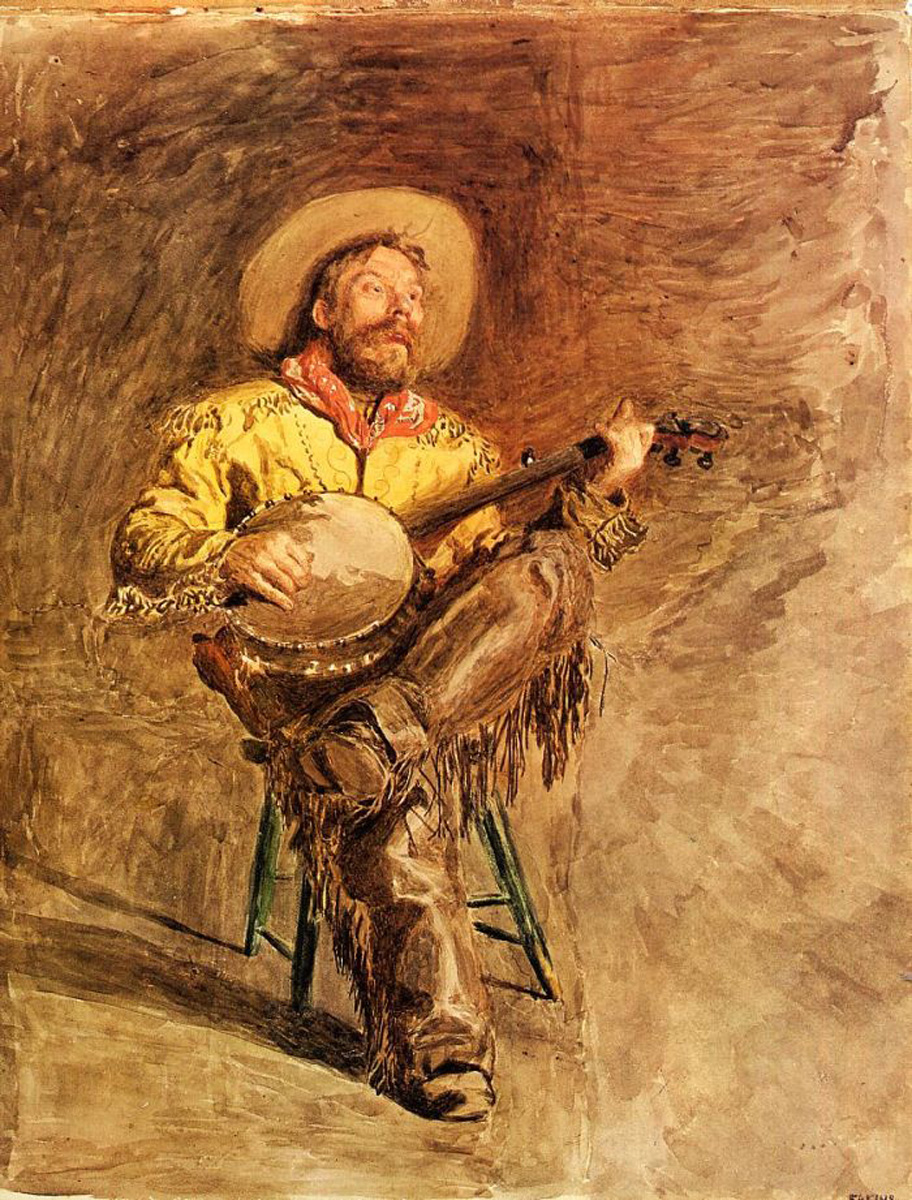
Bob Wills was one of the first country musicians known to have added an electric guitar to his band, in 1938. A decade later (1948) Arthur Smith recorded Guitar Boogie, which crossed over to the US pop charts, introducing many people to the potential of the electric guitar. For several decades Nashville session players preferred the warm tones of the Gibson and Gretsch archtop electrics, but a "hot" Fender style, using guitars which became available beginning in the early 1950s, eventually prevailed as the signature guitar sound of country. In the 1930s and 1940s, cowboy songs, or western music, which had been recorded since the 1920s, were popularized by films made in Hollywood, with popular singing cowboys such as Gene Autry, known as king of the "singing cowboys," the Sons of the Pioneers, and Roy Rogers. Country music and western music were frequently played together on the same radio stations, hence the term country and western music, despite country and western being two distinct genres. Cowgirls contributed to the sound in various family groups, with Patsy Montana opening the door for female artists with "I Want To Be a Cowboy's Sweetheart". Bob Wills developed the subgenre western swing, bringing in more instruments and players. At its height, western swing rivaled the popularity of big band swing music. Country musicians began recording boogie in 1939, shortly after it had been played at Carnegie Hall, when Johnny Barfield recorded "Boogie Woogie". The trickle of what was initially called hillbilly boogie, or okie boogie, became a flood beginning in late 1945, with notable releases like the Delmore Brothers' Freight Train Boogie, part of the evolution toward rockabilly. The hillbilly boogie period lasted into the 1950s and remains one of many subgenres of country into the 21st century. By the end of World War II, "mountaineer" string band music known as bluegrass had emerged when Bill Monroe joined with Lester Flatt and Earl Scruggs, introduced by Roy Acuff at the Grand Ole Opry. Gospel music remained a popular component, with Red Foley having one of the first million-selling gospel hits ("Peace in the Valley") and also singing boogie, blues and rockabilly. In the post-war period, country music was called "folk" in the trades, and "hillbilly" within the industry. In 1944, Billboard replaced the term "hillbilly" with "folk songs and blues," and switched to "country and western" in 1949.

Another type of stripped-down and raw music with a variety of moods and a basic ensemble of guitar, bass, dobro or steel guitar (and later) drums became popular, especially among rural residents in the three states of Texhomex, those being Texas, Oklahoma, and New Mexico. It became known as honky tonk and had its roots in western swing and the ranchera music of Mexico and the border states, particularly New Mexico and Texas, together with the blues of the American South. Bob Wills and His Texas Playboys personified this music which has been described as:
"a little bit of this, and a little bit of that, a little bit of black and a little bit of white... just loud enough to keep you from thinking too much and to go right on ordering the whiskey."
These honky tonk songs were associated with bar rooms. The music of these artists who began in this type would later be referred to as traditional country. Webb Pierce, a honky-tonk singer, was the top-charting country artist of the 1950s, with 13 of his singles spending 113 weeks at number one.

In 1951, Williams's "Cold, Cold Heart" earned crossover success with Tony Bennett's traditional pop cover version, which introduced Williams's songwriting to mainstream audiences.
Third generation (1950s–1960s)
The third generation of country music evolved the genre into sub-disciplines like bluegrass, rockabilly, and country rock, while Gospel music remained popular. After World War II, "mountaineer string band" music emerged as bluegrass when Bill Monroe, with Lester Flatt and Earl Scruggs, was introduced by Roy Acuff at the Grand Ole Opry.
By the early 1950s, a blend of western swing, country boogie, and honky tonk was played by most bands, following Gene Autry, Lydia Mendoza, Roy Rogers, and Patsy Montana; the first all-country radio station was established in Lubbock, Texas in 1953, and the Country Music Association was founded in 1958. Native American, Hispano, and American frontier music from the Southwestern United States and Northern Mexico grew popular in poor communities across New Mexico, Oklahoma, and Texas, with basic ensembles featuring classical guitar, bass guitar, dobro or steel guitar, and larger groups adding electric guitars, trumpets, keyboards (especially the honky-tonk piano, a type of tack piano), banjos, and drums. The 1960s marked a transition, with traditional country dominant but innovative acts like Loretta Lynn's feminist lens and Johnny Cash's prison concerts pushing boundaries. Western music continued influencing country, though folk revival and folk rock had little impact due to political contrasts with country's conservative audience.
Rock and roll's rise with blended with country to form rockabilly, boosted by producers like Sam Phillips at Sun Records in Memphis, launching Elvis Presley, Jerry Lee Lewis, Carl Perkins, Roy Orbison, and Johnny Cash; Norman Petty in Clovis, New Mexico, for Buddy Holly; and Bob Keane at Del-Fi Records for Ritchie Valens. Petty's studio also hosted early sessions for Hank Williams Jr., who fused rock with country, and Al Hurricane, blending country, rock, and New Mexico music on Gene Autry's Challenge Records label. Country gained TV exposure via Ozark Jubilee on ABC from 1955 to 1960 in Springfield, Missouri. 1956 was rockabilly's peak, with hits like Presley's "Heartbreak Hotel", Cash's "I Walk the Line", and Perkins' "Blue Suede Shoes"; former yodeler Bill Haley repurposed his band for rockabilly successes like "Rock Around the Clock". The Bakersfield sound grew from hardcore honky tonk and western swing among Dust Bowl migrants in Bakersfield, California, relying on electric instruments like the Telecaster; leading artists included Buck Owens, Merle Haggard, Tommy Collins, Dwight Yoakam, Gary Allan, and Wynn Stewart. Ken Nelson produced trucking songs like Haggard's White Line Fever and asked Red Simpson to record an album in the subgenre. In 1962, Ray Charles topped charts with his country album Modern Sounds in Country and Western Music, creating country soul.
The Nashville sound, peaking in the early 1960s under producers like Chet Atkins, Owen Bradley, and Billy Sherrill, turned country into a multimillion-dollar industry in Nashville, Tennessee, borrowing pop stylings with smooth vocals, strings, and "licks"; key artists included Jim Reeves, Patsy Cline, and Eddy Arnold. The "slip note" piano of Floyd Cramer was central. It collapsed in 1964 amid rock's rise and the plane crash deaths of Reeves and Cline, evolving into countrypolitan for mainstream markets through the early 1970s. From the 1950s to mid-1960s, western singer-songwriters Marty Robbins and Michael Martin Murphey gained prominence. By the late 1960s, a traditionalist backlash to the British Invasion—exemplified by the Byrds' negative Opry reception, mixed with rock's "old values" and declining Nashville interest to create country rock. The scene was dominated by western influences, leading to "country and western" labeling; fashion like cowboy hats persisted, alongside subgenres like Red Dirt in Oklahoma, New Mexico music in New Mexico, and Texas country/Tejano music in Texas.
Fourth generation (1970s–1980s)
Outlaw country emerged in the late 1950s and 1960s from traditional Western music styles like Red Dirt, New Mexico, Texas country, Tejano, and honky-tonk, with lyrics capturing anger and alienation from personal or economic struggles. Originating in the bars and honky-tonks of Oklahoma, New Mexico, and Texas, it was shaped by artists like Johnny Cash with his 1963 hit "Ring of Fire," and driven by figures like Willie Nelson, Waylon Jennings, Jerry Jeff Walker, Hank Williams, Jr., Merle Haggard, and Joe Ely. The outlaw movement revolutionized country music in the early 1970s, epitomized in the 1976 album Wanted! The Outlaws, and its influence persisted into the 1980s through supergroups like The Highwaymen, Bandido, and Texas Tornados, shaping modern alternative country within country pop. Between 1972 and 1975 singer and guitarist John Denver released a series of successful songs both with country and folk-rock musical styles. By the mid-1970s, Texas country and Tejano music gained popularity with performers like Freddie Fender.
"After I left Nashville (the early 70s), I wanted to relax and play the music that I wanted to play, and just stay around Texas, maybe Oklahoma. Waylon and I had that outlaw image going, and when it caught on at colleges and we started selling records, we were O.K. The whole outlaw thing, it had nothing to do with the music, it was something that got written in an article, and the young people said, 'Well, that's pretty cool.' And started listening." - Willie Nelson
Country pop or soft pop, with roots in the countrypolitan sound, folk music, and soft rock, first emerged in the 1970s, starting with pop music singers like Glen Campbell, Bobbie Gentry, John Denver, Olivia Newton-John, Anne Murray, B. J. Thomas, the Bellamy Brothers, and Linda Ronstadt having hits on the country charts. During the mid-1970s, Dolly Parton, a successful mainstream country artist since the late 1960s, mounted a high-profile campaign to cross over to pop music, culminating in her 1977 hit "Here You Come Again", which topped the U.S. country singles chart, and also reached No. 3 on the pop singles charts. Parton's male counterpart, Kenny Rogers, came from the opposite direction, aiming his music at the country charts, after a successful career in pop, rock and folk music with the First Edition. He achieved success with Lucille, topping reaching No. 5 on the U.S. pop singles charts, and No. 1 on the British all-genre chart, as well as the country class, The Gambler. In 1975, author Paul Hemphill stated in the Saturday Evening Post, "Country music isn't really country anymore; it is a hybrid of nearly every form of popular music in America."During the early 1980s, country artists continued to see their records perform well on the pop charts, despite some pushback from some more established artists in the industry. Many artists moved to produce country pop, a sound that had more intensive production and received radio airtime, in favor of more traditional or acoustic productions.
Described by AllMusic as the "father of country-rock", Gram Parsons' work in the early 1970s was acclaimed for its purity and for his appreciation for aspects of traditional country music. Subsequent to the initial blending of the two polar opposite genres, other offspring soon resulted, including Southern rock, heartland rock and in more recent years, alternative country. In 1980, a style of "neocountry disco music" was popularized by the film Urban Cowboy. It was during this time that a glut of pop-country crossover artists began appearing on the country charts. Sales in record stores rocketed to $250 million in 1981; by 1984, 900 radio stations began programming country or neocountry pop full-time. As with most sudden trends, however, by 1984 sales had dropped below 1979 figures. The music of the 1960s and 1970s targeted the American working class, and truckers in particular. A fusion of honky-tonk, country rock and the Bakersfield sound, truck driving music has the tempo of country rock and the emotion of honky-tonk, and its lyrics focus on a truck driver's lifestyle. As country radio became more popular, trucking songs like the 1963 hit song Six Days on the Road by Dave Dudley rose in popularity. The song was written by actual truckers and contained numerous references to the trucker culture of the time like "ICC" for Interstate Commerce Commission and "little white pills" as a reference to amphetamines. During the mid-1980s, a group of new artists began to emerge who rejected the more polished country-pop sound that had been prominent on radio and the charts, in favor of more, traditional, "back-to-basics" production. The so called "Class of '81", Ricky Skaggs, George Strait, and Reba McEntire, began a long string of hits that revisited a traditional sound. Many of the artists during the latter half of the 1980s drew on traditional honky-tonk, bluegrass, folk and western swing.
Fifth generation (1990s–2000s)
Country music was aided by the U.S. Federal Communications Commission's (FCC) Docket 80–90, which led to a significant expansion of FM radio in the 1980s by adding numerous higher-fidelity FM signals to rural and suburban areas. At this point, country music was mainly heard on rural AM radio stations; the expansion of FM was particularly helpful to country music, which migrated to FM from the AM band as AM became overcome by talk radio (the country music stations that stayed on AM developed the classic country format for the AM audience). At the same time, beautiful music stations already in rural areas began abandoning the format (leading to its effective demise) to adopt country music as well. This wider availability of country music led to producers seeking to polish their product for a wider audience. In 1990, Billboard, which had published a country music chart since the 1940s, changed the methodology it used to compile the chart: singles sales were removed from the methodology, and only airplay on country radio determined a song's place on the chart.
In the 1990s, country music became a worldwide phenomenon thanks to Garth Brooks, who enjoyed one of the most successful careers in popular music history, breaking records for both sales and concert attendance throughout the decade. He attracted fans with his fusion of neotraditionalist country and stadium rock. George Strait, whose career began in the 1980s, also continued to have widespread success in this decade and beyond. Toby Keith began his career as a more pop-oriented country singer in the 1990s, evolving into an outlaw persona in the early 2000s with Pull My Chain and its follow-up, Unleashed. Female artists such as Reba McEntire, Patty Loveless, Faith Hill, Martina McBride, Deana Carter, LeAnn Rimes, Mindy McCready, Pam Tillis, Lorrie Morgan, Shania Twain, and Mary Chapin Carpenter all released platinum-selling albums in the 1990s. The Dixie Chicks became one of the most popular country bands in the 1990s and early 2000s. Their 1998 debut album Wide Open Spaces went on to become certified 12 times platinum while their 1999 album Fly went on to become 10 times platinum. Canadian artist Shania Twain became the best selling female country artist of 1990s. Her 1997 album, Come On Over, became a worldwide phenomenon one of the world's best selling albums for three years (1998, 1999 and 2000). Twain has been credited with breaking international boundaries for country music, as well as inspiring many country artists to incorporate different genres into their music in order to attract a wider audience.
In the early-mid-1990s, country western music was influenced by the popularity of line dancing. This influence was so great that Chet Atkins was quoted as saying, "The music has gotten pretty bad, I think. It's all that damn line dancing." By the end of the decade, however, at least one line dance choreographer complained that good country line dance music was no longer being released. In contrast, artists such as Don Williams and George Jones who had more or less had consistent chart success through the 1970s and 1980s suddenly had their fortunes fall rapidly around 1991 when the new chart rules took effect. Country influences combined with Punk rock and alternative rock to forge the "cowpunk" scene in Southern California during the 1980s, which included bands such as the Long Ryders, Lone Justice and the Beat Farmers, as well as the established punk group X, whose music had begun to include country and rockabilly influences. Simultaneously, a generation of diverse country artists outside of California emerged that rejected the perceived cultural and musical conservatism associated with Nashville's mainstream country musicians in favor of more countercultural outlaw country and the folk singer-songwriter traditions of artists such as Woody Guthrie, Gram Parsons and Bob Dylan. Steve Earle, in particular, had both country and college rock audiences. In 1986, he opened for both country singer Dwight Yoakam and alt-rock band, the Replacements. Yoakam also cultivated a fanbase spanning multiple genres through his stripped-down honky-tonk influenced sound and performances at Los Angeles punk rock clubs. These early styles merged around 1990, when Uncle Tupelo released an influential debut album No Depression. The album is widely credited as being the first alt-country album, and inspired the name of No Depression magazine, which principally covered the new genre. Darius Rucker, frontman for the 1990s pop-rock band Hootie & the Blowfish, began a country solo career in the late 2000s, one that to date has produced five albums and several hits on both the country charts and the Billboard Hot 100. Singer-songwriter Unknown Hinson became famous for his appearance in the Charlotte television show Wild, Wild, South, after which Hinson started his own band and toured in southern states. Other rock stars who featured a country song on their albums were Don Henley (who released Cass County in 2015) and Poison.
Sixth generation (2010s–present)
In the 2010s, the alt-country genre saw an increase in its critical and commercial popularity, owing to the success of artists such as the Civil Wars, Chris Stapleton, Sturgill Simpson, Jason Isbell, Lydia Loveless, and Margo Price. In 2019, Kacey Musgraves – a country artist who had gained a following with indie rock fans – won the Grammy Award for Album of the Year for her album Golden Hour. One of the most commercially successful country artists of the late 2000s and early 2010s has been singer-songwriter Taylor Swift. Swift first became widely known in 2006 when her debut single, "Tim McGraw," later releasing her self-titled debut studio album, which spent 275 weeks on Billboard 200, one of the longest runs of any album on that chart. At the 2010 Grammys, Swift won Album of the Year for Fearless. Most recently, she has focused on a country sound, in her recent folk-inspired releases, Folklore (2020) and Evermore (2020). Before Swift, in 2005, country singer Carrie Underwood rose to fame as the winner of the fourth season of American Idol; now holding seven Grammy Awards. With her first single, "Inside Your Heaven", Underwood became the only solo country artist to have a number 1 hit on the Billboard Hot 100 chart in the 2000–2009 decade and also broke Billboard chart history as the first country music artist ever to debut at No. 1 on the Hot 100. In 2007, Underwood won the Grammy Award for Best New Artist, becoming the second country artist to win the award. Another key voice of this generation is singer Kacey Musgraves, who released Golden Hour, winning the 61st Annual Grammy Awards, Academy of Country Music Awards, and Country Music Association Awards, although the album has received criticism from some traditional country music fans. In 2010, the group Lady Antebellum won five Grammys, including the coveted Song of the Year and Record of the Year for "Need You Now". A large number of duos and vocal groups emerged on the charts in the 2010s, many of which feature close harmony in the lead vocals. In addition to Lady A, groups such as Little Big Town, the Band Perry, Gloriana, Thompson Square, Eli Young Band, Zac Brown Band and British duo the Shires have emerged to occupy a large share of mainstream success alongside solo singers such as Kacey Musgraves and Miranda Lambert.
In the mid to late 2010s, country and pop music fused more closely, gaining in popularity with mainstream audiences. The singers who are part of this country movement are also defined as "Nashville's new generation of country". In a broadening of the rhetorical style and coverage of themes in country music, some of these artists have explored feminism, racism, and religion. Some touched on more controversial issues, such as acceptance of the LGBT community, safe sex, recreational marijuana use, and questioning religious sentiment. In 2024, Beyonce released a country album, Cowboy Carter, to popular acclaim, featuring original songs such as Texas Hold 'Em and a cover of Dolly Parton's Jolene. The genre continues to evolve and attract new influences. The influence of rock music in country has become more overt during the late 2000s and early 2010s. Hip-hop also made its mark on country music with the emergence of country rap. In addition to the emergence of many fusion genres and the continual growth in the country pop sound and country subgenres crossed into rock, alternative and folk, the themes discussed in country music broadened. While many artists still discussed the traditional and conservative values of rural life, working class issues steered towards urban and service work, with acts such as Dougie Poole. Female acts in country music also grew rapidly, with a broadening of thematic topics, such as women's rights, being discussed by major stars, such as Kacey Musgraves.
The country rap sound was brought into the mainstream by southern rappers, with a trap style of production, and country music artists. Nelly and Tim McGraw's "Over and Over" debuted in 2004. In 2003, BubbaSparxxx's debut album, which was self-described as southern trap, was released. This style of music features rap lyrics over country instrumentation, as well as hip-hop production elements. Lil Nas X's song "Old Town Road" spent 19 weeks atop the US Billboard Hot 100 chart, becoming the longest-running number-one song since the chart debuted in 1958, winning Billboard Music Awards, MTV Video Music Awards and a Grammy Award. Sam Hunt's "Leave the Night On" peaked concurrently on the Hot Country Songs and Country Airplay charts, making Hunt the first country artist in 22 years, since Billy Ray Cyrus, to reach the top of three country charts simultaneously in the Nielsen SoundScan-era. With the fusion genre of "country trap"—a fusion of country/western themes to a hip-hop beat, but usually with fully sung lyrics—emerging in the late 2010s, line dancing country had a minor revival, examples of the phenomenon include "The Git Up" by Blanco Brown. Blanco Brown has gone on to make more traditional country soul songs such as "I Need Love" and a rendition of "Don't Take the Girl" with Tim McGraw, and collaborations like "Just the Way" with Parmalee. Another country trap artist known as Breland has seen success with "My Truck", "Throw It Back" with Keith Urban, and "Praise the Lord" featuring Thomas Rhett. Emo rap musician Sueco released a cowpunk song in collaboration with country musician Warren Zeiders titled "Ride It Hard".
In the early 2010s, "bro-country", a genre noted primarily for its themes on drinking and partying, girls, and pickup trucks became particularly popular. Artists associated with this genre are Luke Bryan, Jason Aldean, Blake Shelton, Jake Owen and Florida Georgia Line whose song "Cruise" became the best-selling country song of all time. Research in the mid-2010s suggested that about 45 percent of country's best-selling songs could be considered bro-country, with the top two artists being Luke Bryan and Florida Georgia Line. Albums by bro-country singers also sold very well—in 2013, Luke Bryan's Crash My Party was the third best-selling of all albums in the United States, with Florida Georgia Line's Here's to the Good Times at sixth, and Blake Shelton's Based on a True Story at ninth. It is also thought that the popularity of bro-country helped country music to surpass classic rock as the most popular genre in the American country in 2012. The genre however is controversial as it has been criticized by other country musicians and commentators over its themes and depiction of women, opening up a divide between the older generation of country singers and the younger bro country singers that was described as "civil war" by musicians, critics, and journalists." In 2014, Maddie & Tae's "Girl in a Country Song", addressing many of the controversial bro-country themes, peaked at number one on the Billboard Country Airplay chart. In the latter part of the 2010s, an increasing number of mainstream country acts collaborated with pop, electronic, and R&B artists; many of these songs achieved commercial success. Examples include a collaboration between Kane Brown and Marshmello and Maren Morris and Zedd, the latter of both duos being electronic music artists. Maren Morris' successful collaboration "The Middle" with EDM producer Zedd is considered to be one representation of the fusion of electro-pop with country music. In the early 2020s, the uptick in country music's popularity has resulted in more songs in this genre reaching number one on the Billboard Hot 100, including Morgan Wallen's "Last Night" and Jason Aldean's "Try That in a Small Town". Currently, Morgan Wallen is the traditional country artist with the most Billboard Hot 100 chart toppers, with four.
Regional styles of country music
International reception of American country music
Tom Roland, from Country Music Association International, explains country music's global popularity: "Country Music listeners around the globe have something in common with those in the United States. In Germany, for instance, Rohrbach identifies three general groups that gravitate to the genre: people intrigued with the US cowboy icon, middle-aged fans who seek an alternative to harder rock music and younger listeners drawn to the pop-influenced sound that underscores many current Country hits." One of the first US people to perform country music abroad was George Hamilton IV. He was the first country musician to perform in the Soviet Union. He was deemed the "International Ambassador of Country Music" for his contributions to the globalization of country music. Johnny Cash, Emmylou Harris, Keith Urban, and Dwight Yoakam have also made numerous international tours. The Country Music Association undertakes various initiatives to promote country music internationally.
Bluegrass and Americana
Bluegrass is a genre that contain songs about going through hard times, country loving, and telling stories. Its history can be traced back to the 1600s. During this time, many people were coming to America from Ireland, Scotland and England. Bill Monroe, known as the father of bluegrass, was popularized much earlier than the fifth generation, although he served as an inspiration for newer artists.
Americana music started to re-emerge in the mainstream, although the roots of the genre are traced to Hank Williams in the 1950s. Americana music incorporates elements of country music, bluegrass, folk, blues, gospel, rhythm and blues, roots rock and southern soul. As a result of an increasingly pop-leaning mainstream, many more traditional-sounding artists such as Tyler Childers, Zach Bryan and Old Crow Medicine Show began to associate themselves more with Americana and the alternative country scene where their sound was more celebrated.
Africa
Country music has risen in popularity in a number of African countries. In a series running from 2021 on NTS Radio, researcher and broadcaster Jamal Khadar's Reimagining Country documents less well-known connections between modern country music and both African and Caribbean song writing, instruments and general influence across genres. Khadar also argues that modern country music has benefited from traditional or classical African music genres.
Specific country examples include western African, where Nigerian country music has continued to grow within the large music industry there. In eastern Africa, the roots of country can be traced back even earlier. Eswatini has a number of popular singers who blend country music with local and traditional styles of guitar, beginning in the 1970s. In the 1950s in Zambia, the opening of a number of copper mines in northern Zambia's Copperbelt region brought similar stories of industrialization and movement to the people in this area. Guitar was integrated into local music, as a result of Zambians returning from WWII and a cross-cultural interactions with international mining staff, developing a unique country folk music from the region.
Asia
In Japan, country and western music first developed a following before World War II, but many Japanese became exposed to it after the war due to the Far East Network. One of the first Japanese western acts was Biji Kuroda & The Chuck Wagon Boys, other artists include Jimmie Tokita and His Mountain Playboys, The Blue Rangers, Wagon Aces, and Tomi Fujiyama. While the majority of these musicians sung in English, a few of them sang in the Japanese language. The genre continues to have a dedicated following in Japan, thanks to Charlie Nagatani, Katsuoshi Suga, J.T. Kanehira, Dicky Kitano, and Manami Sekiya. Country and western venues in Japan include the former annual Country Gold concert, organized by Charlie Nagatani, and the modern honky tonks at Little Texas in Tokyo and Armadillo in Nagoya.
In Mongolia, there is a developing country music scene. Enkh-Erdene performed a cover of George Strait's "Amarillo by Morning" on The World's Best in 2019, he released country music album Arvan Tavnii Saran in the Mongolian language with original songs in 2023, and covered Garth Brooks' "Friends In Low Places" in 2024 on America's Got Talent: Fantasy League. The Baatar is another singer and musician of "Mongolian country" by blending country music with traditional Mongolian folk elements, including urtyn duu singing techniques and instruments like the morin khuur and tsuur, they released their first album in 2022.
In India, there is an annual concert festival called "Blazing Guitars" held in Chennai brings together Anglo-Indian musicians from all over the country (including some who have emigrated to places like Australia). The year 2003 brought home-grown Indian, Bobby Cash to the forefront of the country music culture in India when he became India's first international country music artist to chart singles in Australia.
The Philippines, a US Commonwealth from 1900 to 1946, was introduced to country music during this time. Today, in the Philippines, country music has become a part of the expression of the Cordilleran way of life. Country music from this area often compares the Igorot lifestyle to that of American cowboys.
Baguio City has an FM station that caters to country music, DZWR 99.9 Country, which is part of the Catholic Media Network. Bombo Radyo Baguio has a segment on its Sunday slot for Igorot, Ilocano and country music. And as of recently, DWUB occasionally plays country music. Many country music musicians tour the Philippines. Original Pinoy Music has influences from country.
Australia
Australian country music influenced by US country music has developed a distinct style, where guitar, banjo, fiddle and harmonica are used. Shaped by British and Irish folk ballads and Australian bush balladeers like Henry Lawson and Banjo Paterson. The aboriginal population in Australia were both artists and audience members. Auriel Andrew was the first aboriginal woman to sing country music in Australia, and was an important part of the genre's rising popularity.
Folk songs sung in Australia between the 1780s and 1920s, based around such themes as the struggle against government tyranny, or the lives of bushrangers, swagmen, drovers, stockmen and shearers, continue to influence the genre. This strain of Australian country, with lyrics focusing on Australian subjects, is generally known as "bush music" or "bush band music". "Waltzing Matilda", is often regarded as Australia's unofficial national anthem. Later themes which endure to the present include the experiences of war, of droughts and flooding rains, of Aboriginality and of the railways and trucking routes which link Australia's vast distances.
Pioneers of a more Americanised country music in Australia included Tex Morton, beginning in the 1930s. Other early stars included Buddy Williams, Shirley Thoms and Smoky Dawson. Williams was the first Australian-born to record country music in Australia in the late 1930s and began writing bush ballads, later popularized by the likes of Slim Dusty. Dusty sang Waltzing Matilda in the closing ceremony of the Sydney 2000 Olympic Games.
Reg Lindsay was one of the first Australians to perform at Nashville's Grand Ole Opry in 1974. Eric Bogle's 1972 folk lament to the Gallipoli Campaign "And the Band Played Waltzing Matilda" recalled the British and Irish origins of Australian folk-country. Singer-songwriter Paul Kelly, whose music style straddles folk, rock and country, is often described as the poet laureate of Australian music.