
Proto-Germanic (abbreviated PGmc; also called Common Germanic) is the reconstructed common ancestor of the Germanic languages.
A defining feature of Proto-Germanic is the completion of the process described by Grimm's law (also known as the First Germanic Sound Shift), a set of sound changes that occurred during its gradual divergence from Proto-Indo-European.
The Proto-Germanic language is not directly attested and has been reconstructed using the comparative method with other more archaic and earlier attested Indo-European languages, extremely early Germanic loanwords in Baltic and Finnish languages (for example, Finnish kuningas 'king'), early runic inscriptions (specifically the Vimose inscriptions in Denmark, dated to the 2nd century CE), and in Roman Empire era transcriptions of individual words (notably in Tacitus's Germania, c. AD 90). The non-runic Negau helmet inscription, dated to the 2nd century BCE, has also been argued by some to represent the earliest attestation of Grimm's law.
Archaeology and early historiography
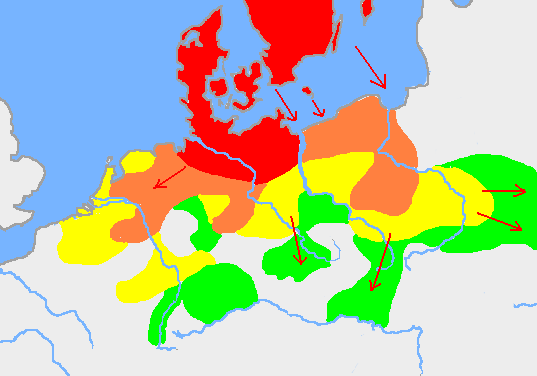
Proto-Germanic developed out of pre-Proto-Germanic during the Pre-Roman Iron Age of Northern Europe. According to the Germanic substrate hypothesis, it may have been influenced by non-Indo-European cultures, such as the Funnelbeaker culture, but the sound change in the Germanic languages known as Grimm's law points to a non-substratic development away from other branches of Indo-European. Proto-Germanic itself was likely spoken after c. 500 BC, and Proto-Norse, from the second century AD and later, is still quite close to reconstructed Proto-Germanic, but other common innovations separating Germanic from Proto-Indo-European suggest a common history of pre-Proto-Germanic speakers throughout the Nordic Bronze Age.
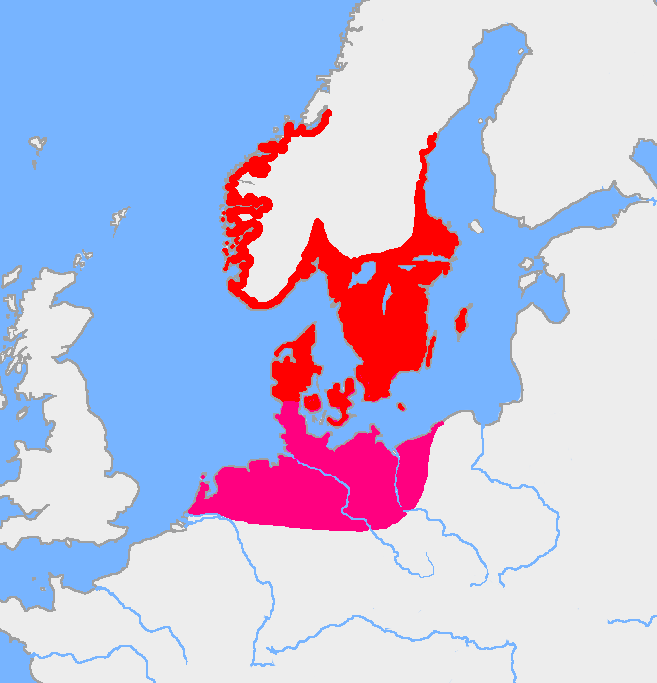
The Proto-Germanic language developed in southern Scandinavia (Denmark, south Sweden and southern Norway) and the northern-most part of Germany in Schleswig Holstein and northern Lower Saxony, the Urheimat (original home) of the Germanic tribes. It is possible that Indo-European speakers first arrived in southern Scandinavia with the Corded Ware culture in the mid-3rd millennium BC, developing into the Nordic Bronze Age cultures by the early second millennium BC. In contrast, according to Mallory, Germanicists "generally agree" that the Urheimat ('original homeland') of the Proto-Germanic language, the ancestral idiom of all attested Germanic dialects, was primarily situated in an area corresponding to the extent of the Jastorf culture in what is now Germany.
Early Germanic expansion in the Pre-Roman Iron Age (fifth to first centuries BC) placed Proto-Germanic speakers in contact with the Continental Celtic La Tène horizon. A number of Celtic loanwords in Proto-Germanic have been identified. By the first century AD, Germanic expansion reached the Danube and the Upper Rhine in the south and the Germanic peoples first entered the historical record. At about the same time, extending east of the Vistula (Oksywie culture, Przeworsk culture), Germanic speakers came into contact with early Slavic cultures, as reflected in early Germanic loans in Proto-Slavic.

By the third century, Germanic speakers had expanded over significant distance, from the Rhine to the Dniepr spanning about 1,200 km (700 mi).
The earliest attested stage of the Germanic languages is known as Proto-Norse, variably dated to the 2nd century AD, around 300 AD or the first century AD in runic inscriptions (such as the Tune Runestone).
The first coherent text recorded in a Germanic language is the Gothic Bible, written in the later fourth century in the East Germanic variety of the Thervingi Gothic Christians, who had escaped persecution by moving from Scythia to Moesia in 348. Early West Germanic text is available from the fifth century, beginning with the Frankish Bergakker runic inscription.

Evolution
The evolution of Proto-Germanic from its ancestral forms, beginning with its ancestor Proto-Indo-European, began with the development of a separate common way of speech among some geographically nearby speakers of a prior language and ended with the dispersion of the proto-language speakers into distinct populations with mostly independent speech habits. Between the two points, many sound changes occurred.
Theories of phylogeny
Solutions
Phylogeny as applied to historical linguistics involves the evolutionary descent of languages. The phylogeny problem is the question of what specific tree, in the tree model of language evolution, best explains the paths of descent of all the members of a language family from a common language, or proto-language (at the root of the tree) to the attested languages (at the leaves of the tree). The Germanic languages form a tree with Proto-Germanic at its root that is a branch of the Indo-European tree, which in turn has Proto-Indo-European at its root. Borrowing of lexical items from contact languages makes the relative position of the Germanic branch within Indo-European less clear than the positions of the other branches of Indo-European. In the course of the development of historical linguistics, various solutions have been proposed, none certain and all debatable.
In the evolutionary history of a language family, philologists consider a genetic "tree model" appropriate only if communities do not remain in effective contact as their languages diverge. Early Indo-European had limited contact between distinct lineages, and, uniquely, the Germanic subfamily exhibited a less treelike behaviour, as some of its characteristics were acquired from neighbours early in its evolution rather than from its direct ancestors. The internal diversification of West Germanic developed in an especially non-treelike manner.
Proto-Germanic is generally agreed to have begun about 500 BC. Its hypothetical ancestor between the end of Proto-Indo-European and 500 BC is termed Pre-Proto-Germanic. Whether it is to be included under a wider meaning of Proto-Germanic is a matter of usage.
Winfred P. Lehmann regarded Jacob Grimm's "First Germanic Sound Shift", or Grimm's law, and Verner's law, (which pertained mainly to consonants and were considered for many decades to have generated Proto-Germanic) as pre-Proto-Germanic and held that the "upper boundary" (that is, the earlier boundary) was the fixing of the accent, or stress, on the root syllable of a word, typically on the first syllable. Proto-Indo-European had featured a moveable pitch-accent consisting of "an alternation of high and low tones" as well as stress of position determined by a set of rules based on the lengths of a word's syllables.
The fixation of the stress led to sound changes in unstressed syllables. For Lehmann, the "lower boundary" was the dropping of final -a or -e in unstressed syllables; for example, post-PIE *wóyd-e > Gothic wait, 'knows'. Elmer H. Antonsen agreed with Lehmann about the upper boundary but later found runic evidence that the -a was not dropped: ékwakraz ... wraita, 'I, Wakraz, … wrote (this)'. He says: "We must therefore search for a new lower boundary for Proto-Germanic."
Antonsen's own scheme divides Proto-Germanic into an early stage and a late stage. The early stage includes the stress fixation and resulting "spontaneous vowel-shifts" while the late stage is defined by ten complex rules governing changes of both vowels and consonants.
Phonological stages from Proto-Indo-European to end of Proto-Germanic
The following changes are known or presumed to have occurred in the history of Proto-Germanic in the wider sense from the end of Proto-Indo-European up to the point that Proto-Germanic began to break into mutually unintelligible dialects. The changes are listed roughly in chronological order, with changes that operate on the outcome of earlier ones appearing later in the list. The stages distinguished and the changes associated with each stage rely heavily on Ringe, who in turn summarizes standard concepts and terminology.
Pre-Proto-Germanic (Pre-PGmc)
This stage began with the separation of a distinct speech, perhaps while it still formed part of the Proto-Indo-European dialect continuum. It contained many innovations that were shared with other Indo-European branches to various degrees, probably through areal contacts, and mutual intelligibility with other dialects would remain for some time. It was nevertheless on its own path, whether dialect or language.
Early Proto-Germanic
This stage began its evolution as a dialect of Proto-Indo-European that had lost its laryngeals and had five long and six short vowels as well as one or two overlong vowels. The consonant system was still that of PIE minus palatovelars and laryngeals, but the loss of syllabic resonants already made the language markedly different from PIE proper. Mutual intelligibility might have still existed with other descendants of PIE, but it would have been strained, and the period marked the definitive break of Germanic from the other Indo-European languages and the beginning of Germanic proper, containing most of the sound changes that are now held to define this branch distinctively. This stage contained various consonant and vowel shifts, the loss of the contrastive accent inherited from PIE for a uniform accent on the first syllable of the word root, and the beginnings of the reduction of the resulting unstressed syllables.
Late Proto-Germanic
By this stage, Germanic had emerged as a distinctive branch and had undergone many of the sound changes that would make its later descendants recognisable as Germanic languages. It had shifted its consonant inventory from a system that was rich in plosives to one containing primarily fricatives, had lost the PIE mobile pitch accent for a predictable stress accent, and had merged two of its vowels. The stress accent had already begun to cause the erosion of unstressed syllables, which would continue in its descendants. The final stage of the language included the remaining development until the breakup into dialects and, most notably, featured the development of nasal vowels and the start of umlaut, another characteristic Germanic feature.
Lexical evidence in other language varieties
Loans into Proto-Germanic from other (known) languages or from Proto-Germanic into other languages can be dated relative to each other by which Germanic sound laws have acted on them. Since the dates of borrowings and sound laws are not precisely known, it is not possible to use loans to establish absolute or calendar chronology.
Loans from adjoining Indo-European groups
Most loans from Celtic appear to have been made before or during the Germanic Sound Shift. For instance, one specimen *rīks 'ruler' was borrowed from Celtic *rīxs 'king' (stem *rīg-), with g → k. It is clearly not native because PIE **ē → *ī is typical not of Germanic but Celtic languages. Another is *walhaz 'foreigner; Celt' from the Celtic tribal name Volcae with k → h and o → a. Other likely Celtic loans include *ambahtaz 'servant', *brunjǭ 'mailshirt', *gīslaz 'hostage', *īsarną 'iron', *lēkijaz 'healer', *laudą 'lead', *Rīnaz 'Rhine', and *tūnaz, tūną 'fortified enclosure'. These loans would likely have been borrowed during the Celtic Hallstatt and early La Tène cultures when the Celts dominated central Europe, although the period spanned several centuries.
From East Iranian came *hanapiz 'hemp' (compare Khotanese kaṃhā, Ossetian gæn(æ) 'flax'), *humalaz, humalǭ 'hops' (compare Ossetian xumællæg), *keppǭ ~ skēpą 'sheep' (compare Persian čapiš 'yearling kid'), *kurtilaz 'tunic' (cf. Osset kʷəræt 'shirt'), *kutą 'cottage' (compare Persian kad 'house'), *paidō 'cloak', *paþaz 'path' (compare Avestan pantā, gen. pathō), and *wurstwą 'work' (compare Avestan vərəštuua). The words could have been transmitted directly by the Scythians from the Ukraine plain, groups of whom entered Central Europe via the Danube and created the Vekerzug Culture in the Carpathian Basin (sixth to fifth centuries BC), or by later contact with Sarmatians, who followed the same route. Unsure is *marhaz 'horse', which was either borrowed directly from Scytho-Sarmatian or through Celtic mediation.
Loans into non-Germanic languages
Numerous loanwords believed to have been borrowed from Proto-Germanic are known in the non-Germanic languages spoken in areas adjacent to the Germanic languages.
The heaviest influence has been on the Finnic languages, which have received hundreds of Proto-Germanic or pre-Proto-Germanic loanwords. Well-known examples include PGmc *druhtinaz 'warlord' (compare Finnish ruhtinas), *hrengaz (later *hringaz) 'ring' (compare Finnish rengas, Estonian rõngas), *kuningaz 'king' (Finnish kuningas), *lambaz 'lamb' (Finnish lammas), *lunaz 'ransom' (Finnish lunnas).
Loanwords into the Samic languages, Baltic languages and Slavic languages are also known.
Non-Indo-European substrate elements
The term substrate with reference to Proto-Germanic refers to lexical items and phonological elements that do not appear to be descended from Proto-Indo-European. The substrate theory postulates that the elements came from an earlier population that stayed amongst the Indo-Europeans and was influential enough to bring over some elements of its own language. The theory of a non-Indo-European substrate was first proposed by Sigmund Feist, who estimated that about a third of all Proto-Germanic lexical items came from the substrate.
Theo Vennemann has hypothesized a Basque substrate and a Semitic superstrate in Germanic; however, his speculations, too, are generally rejected by specialists in the relevant fields.
Phonology
Transcription
The following conventions are used in this article for transcribing Proto-Germanic reconstructed forms:
Voiced obstruents appear as b, d, g; this does not imply any particular analysis of the underlying phonemes as plosives /b/, /d/, /ɡ/ or fricatives /β/, /ð/, /ɣ/. In other literature, they may be written as graphemes with a bar to produce ƀ, đ, ǥ.
Unvoiced fricatives appear as f, þ, h (perhaps /ɸ/, /θ/, /x/). /x/ may have become /h/ in certain positions at a later stage of Proto-Germanic itself. Similarly for /xʷ/, which later became /hʷ/ or /ʍ/ in some environments.
Labiovelars appear as kw, hw, gw; this does not imply any particular analysis as single sounds (e.g. /kʷ/, /xʷ/, /ɡʷ/) or clusters (e.g. /kw/, /xw/, /ɡw/).
The yod sound appears as j /j/. Note that the normal convention for representing this sound in Proto-Indo-European is y; the use of j does not imply any actual change in the pronunciation of the sound.
Long vowels are denoted with a macron over the letter, e.g. ō. When a distinction is necessary, /ɛː/ and /eː/ are transcribed as ē¹ and ē² respectively. ē¹ is sometimes transcribed as æ or ǣ instead, but this is not followed here.
Overlong vowels appear with circumflexes, e.g. ô. In other literature they are often denoted by a doubled macron, e.g. ō̄.
Nasal vowels are written here with an ogonek, following Ringe's usage, e.g. ǫ̂ /õːː/. Most commonly in literature, they are denoted simply by a following n. However, this can cause confusion between a word-final nasal vowel and a word-final regular vowel followed by /n/, a distinction which was phonemic. Tildes (ã, ĩ, ũ...) are also used in some sources.
Diphthongs appear as ai, au, eu, iu, ōi, ōu and perhaps ēi, ēu. However, when immediately followed by the corresponding semivowel, they appear as ajj, aww, eww, iww. u is written as w when between a vowel and j. This convention is based on the usage in Ringe 2006.
Long vowels followed by a non-high vowel were separate syllables and are written as such here, except for ī, which is written ij in that case.
Consonants
The table below lists the consonantal phonemes of Proto-Germanic, ordered and classified by their reconstructed pronunciation. The slashes around the phonemes are omitted for clarity. When two phonemes appear in the same box, the first of each pair is voiceless, the second is voiced. Phones written in parentheses represent allophones and are not themselves independent phonemes. For descriptions of the sounds and definitions of the terms, follow the links on the column and row headings.
Notes:
[ŋ] was an allophone of /n/ before velar obstruents.
[ŋʷ] was an allophone of /n/ before labiovelar obstruents.
/gʷ/ only appeared after [ŋʷ].
[β], [ð] and [ɡ] were allophones of /b/, /d/ and /ɣ/ in certain positions (see below).
The phoneme written as f was probably still realised as a bilabial fricative (/ɸ/) in Proto-Germanic. Evidence for this is the fact that in Gothic, word-final b (which medially represents a voiced fricative) devoices to f and also Old Norse spellings such as aptr [ɑɸtr], where the letter p rather than the more usual f was used to denote the bilabial realisation before /t/.