
Central Asia is a region of Asia consisting of Kyrgyzstan, Tajikistan, Turkmenistan, Uzbekistan, and most of Kazakhstan. The countries as a group are also colloquially referred to as the "-stans" as all have names ending with the Persian suffix "-stan" (meaning 'land') in both respective native languages and most other languages. The region is bounded by the Caspian Sea to the southwest, European Russia to the northwest, China and Mongolia to the east, Iran and Indian subcontinent to the south, and Siberia to the north. Together, the five Central Asian countries have a total population of around 76 million.
In the pre-Islamic and early Islamic eras (c. 1000 and earlier), Central Asia was inhabited predominantly by Iranian peoples, populated by Eastern Iranian-speaking Bactrians, Sogdians, Chorasmians, and the semi-nomadic Scythians and Dahae. As the result of Turkic migration, Central Asia also became the homeland for the Kazakhs, Kyrgyzs, Tatars, Turkmens, Uyghurs, and Uzbeks; Turkic languages largely replaced the Iranian languages spoken in the area, with the exception of Tajikistan and areas where Tajik is spoken.
The Silk Road trade routes crossed through Central Asia, leading to the rise of prosperous trade cities. The region was a crossroads for the movement of people, goods, and ideas between Europe and the Far East. Most countries in Central Asia are still integral to parts of the world economy.

From the mid-19th century until near the end of the 20th century, Central Asia was incorporated into the Russian Empire, and later the Soviet Union, which led to Russians and other Slavs colonising the area. Modern-day Central Asia is home to a large population of descendants of European settlers, who mostly live in Kazakhstan: 7 million Russians, 500,000 Ukrainians, and about 170,000 Germans. During the Stalinist period, the forced deportation of Koreans in the Soviet Union resulted in a population of over 300,000 Koreans in the region.
Central Asia has historically been a region of geostrategic importance because of its location at the confluence of several power centres, in particular Russia and China. It has never been a cohesive power in its own right, rather it has served as a battleground for extra-regional influences. However, efforts to integrate economically have regained momentum since the death of Uzbek president Islam Karimov in 2016, with new initiatives like the Almaty–Bishkek Economic Corridor and the 'Silk Seven Plus' proposals gaining traction.
Countries and territory
Historical definitions
One of the first geographers to mention Central Asia as a distinct region of the world was Alexander von Humboldt. The borders of Central Asia are subject to multiple definitions. Historically, political geography and culture have been two significant parameters widely used in scholarly definitions of Central Asia. Humboldt's definition comprised every country between 5° North and 5° South of the latitude 44.5°N. Humboldt mentions some geographic features of this region, which include the Caspian Sea in the west, the Altai mountains in the north and the Hindu Kush and Pamir mountains in the South. He did not give an eastern border for the region. His legacy is still seen: Humboldt University of Berlin, named after him, offers a course in Central Asian studies. The Russian geographer Nikolaĭ Khanykov questioned the latitudinal definition of Central Asia and preferred a physical one of all countries located in the region landlocked from water, including Afghanistan, Khorasan (Northeast Iran), Kyrgyzstan, Tajikistan, Turkmenistan, East Turkestan (Xinjiang), Mongolia, and Uzbekistan.

Russian culture has two distinct terms: Средняя Азия (Srednyaya Aziya or "Middle Asia", the narrower definition, which includes only those traditionally non-Slavic, Central Asian lands that were incorporated within those borders of historical Russia) and Центральная Азия (Tsentralnaya Aziya or "Central Asia", the wider definition, which includes Central Asian lands that have never been part of historical Russia). The latter definition includes Afghanistan and 'East Turkestan'.
The most limited definition was the official one of the Soviet Union, which defined Middle Asia as consisting solely of Kyrgyzstan, Tajikistan, Turkmenistan, and Uzbekistan, omitting Kazakhstan. Soon after the dissolution of the Soviet Union in 1991, the leaders of the four former Soviet Central Asian Republics met in Tashkent and declared that the definition of Central Asia should include Kazakhstan as well as the original four included by the Soviets. Since then, this has become the most common definition of Central Asia.
In 1978, UNESCO defined the region as "Afghanistan, north-eastern Iran, Pakistan, northern India, western China, Mongolia and the Soviet Central Asian Republics".
An alternative method is to define the region based on ethnicity, and in particular, areas populated by Eastern Turkic, Eastern Iranian, or Mongolian peoples. These areas include Xinjiang Uyghur Autonomous Region, the Turkic regions of southern Siberia, the five republics, and Afghan Turkestan. Afghanistan as a whole, the northern and western areas of Pakistan and the Kashmir Valley of India may also be included. The Tibetans and Ladakhis are also included. Most of the mentioned peoples are considered indigenous to the region. Central Asia is sometimes referred to as Turkestan.
Country data
The countries most commonly included in the Central Asia grouping are Kyrgyzstan, Tajikistan, Turkmenistan, Uzbekistan, and Kazakhstan.
Geography
Central Asia is a region of varied geography, including high passes and mountains (Tian Shan), vast deserts (Kyzyl Kum, Taklamakan), and especially treeless, grassy steppes. The vast steppe areas of Central Asia are considered together with the steppes of Eastern Europe as a homogeneous geographical zone known as the Eurasian Steppe.

Much of the land of Central Asia is too dry or too rugged for farming. The Gobi Desert extends from the foot of the Pamirs, 77° E, to the Great Khingan (Da Hinggan) Mountains, 116°–118° E.
Central Asia has the following geographic extremes:
The world's northernmost desert (sand dunes), at Buurug Deliin Els, Mongolia, 50°18' N.

The Northern Hemisphere's southernmost permafrost, at Erdenetsogt sum, Mongolia, 46°17' N.
The world's shortest distance between non-frozen desert and permafrost: 770 km (480 mi).
The Eurasian pole of inaccessibility.
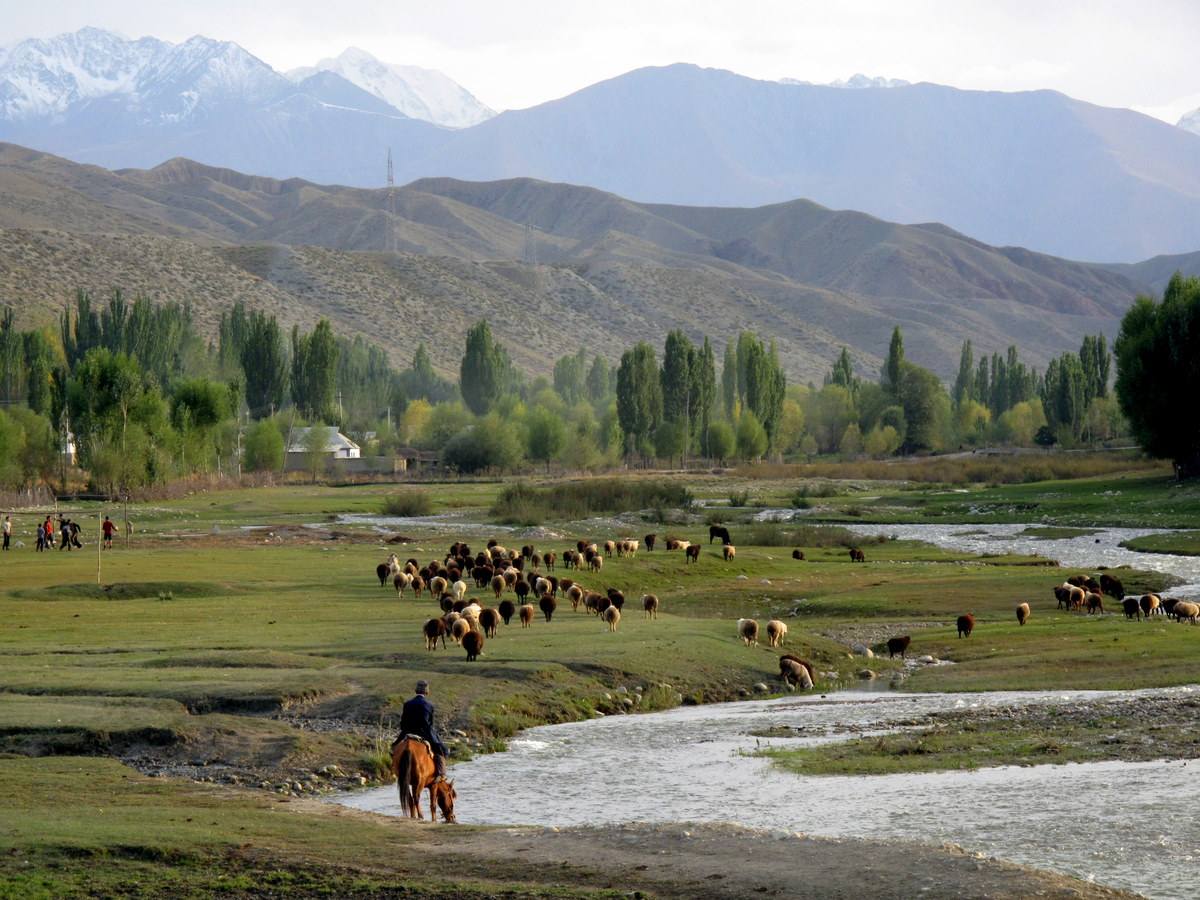
A majority of the people earn a living by herding livestock. Industrial activity centers in the region's cities.
Regions
Central Asia is bounded on the north by the forests of Siberia. The northern half of Central Asia (Kazakhstan) is the middle part of the Eurasian steppe. Westward the Kazakh steppe merges into the Russian-Ukrainian steppe and eastward into the steppes and deserts of Dzungaria and Mongolia. Southward the land becomes increasingly dry and the nomadic population increasingly thin. The south supports areas of dense population and cities wherever irrigation is possible. The main irrigated areas are along the eastern mountains, along the Oxus and Jaxartes Rivers and along the north flank of the Kopet Dagh near the Persian border. East of the Kopet Dagh is the important oasis of Merv and then a few places in Afghanistan like Herat and Balkh. Two projections of the Tian Shan create three "bays" along the eastern mountains.
The largest, in the north, is eastern Kazakhstan, traditionally called Jetysu or Semirechye which contains Lake Balkhash. In the center is the small but densely populated Ferghana valley. In the south is Bactria, later called Tocharistan, which is bounded on the south by the Hindu Kush mountains of Afghanistan. The Syr Darya (Jaxartes) rises in the Ferghana valley and the Amu Darya (Oxus) rises in Bactria. Both flow northwest into the Aral Sea. Where the Oxus meets the Aral Sea it forms a large delta called Khwarazm and later the Khanate of Khiva. North of the Oxus is the less-famous but equally important Zarafshan River which waters the great trading cities of Bokhara and Samarkand. The other great commercial city was Tashkent northwest of the mouth of the Ferghana valley. The land immediately north of the Oxus was called Transoxiana and also Sogdia, especially when referring to the Sogdian merchants who dominated the silk road trade.
To the east, Dzungaria and the Tarim Basin were united into the Manchu-Chinese province of Xinjiang (Sinkiang; Hsin-kiang) about 1759. Caravans from China usually went along the north or south side of the Tarim basin and joined at Kashgar before crossing the mountains northwest to Ferghana or southwest to Bactria. A minor branch of the silk road went north of the Tian Shan through Dzungaria and Zhetysu before turning southwest near Tashkent. Nomadic migrations usually moved from Mongolia through Dzungaria before turning southwest to conquer the settled lands or continuing west toward Europe.
The Kyzyl Kum Desert or semi-desert is between the Oxus and Jaxartes, and the Karakum Desert is between the Oxus and Kopet Dagh in Turkmenistan. Khorasan meant approximately northeast Persia and northern Afghanistan. Margiana was the region around Merv. The Ustyurt Plateau is between the Aral and Caspian Seas.
To the southwest, across the Kopet Dagh, lies Persia. From here Persian and Islamic civilisation penetrated Central Asia and dominated its high culture until the Russian conquest. In the southeast is the route to India. In early times Buddhism spread north and throughout much of history warrior kings and tribes would move southeast to establish their rule in northern India. Most nomadic conquerors entered from the northeast. After 1800, western civilisation in its Russian and Soviet form penetrated from the northwest.
Names of historical regions
Cities
Climate
Because Central Asia is landlocked and not buffered by a large body of water, temperature fluctuations are often severe, excluding the hot, sunny summer months. In most areas, the climate is dry and continental, with hot summers and cool to cold winters, with occasional snowfall. Outside high-elevation areas, the climate is mostly semi-arid to arid. In lower elevations, summers are hot with blazing sunshine. Winters feature occasional rain or snow from low-pressure systems that cross the area from the Mediterranean Sea. Average monthly precipitation is very low from July to September, rises in autumn (October and November) and is highest in March or April, followed by swift drying in May and June. Winds can be strong, producing dust storms sometimes, especially toward the end of the summer in September and October. Specific cities that exemplify Central Asian climate patterns include Tashkent and Samarkand, Uzbekistan, Ashgabat, Turkmenistan, and Dushanbe, Tajikistan. The last of these represents one of the wettest climates in Central Asia, with an average annual precipitation of over 560 mm (22 inches).
Biogeographically, Central Asia is part of the Palearctic realm. The largest biome in Central Asia is the temperate grasslands, savannas, and shrublands biome. Central Asia also contains the montane grasslands and shrublands, deserts and xeric shrublands and temperate coniferous forests biomes.
Climate change
As of 2022, there has been a scarcity of research on climate impacts in Central Asia, even though it experiences faster warming than the global average and is generally considered to be one of the more climate-vulnerable regions in the world. Along with West Asia, it has already had greater increases in hot temperature extremes than the other parts of Asia, Rainfall in Central Asia had decreased, unlike elsewhere in Asia, and the frequency and intensity of dust storms had grown (partly due to poor land use practices). Droughts have already become more likely, and their likelihood is expected to continue increasing with greater climate change.
Water
Major rivers of the region include the Amu Darya, the Syr Darya, Irtysh, the Hari River and the Murghab River. The five main river basins are the Amu Darya, Syr Darya, Balkhash-Alakol, Ob-Irtysh and Ural basins. Major bodies of water include the Aral Sea and Lake Balkhash. Together with the Caspian Sea, they form part of the huge west-central Asian endorheic system.
The Aral Sea Basin is the region's most important hydrological system, spanning about 1.5 million square kilometres and linking all five post-Soviet Central Asian states through the Amu Darya and Syr Darya river systems.
Water has long shaped the region's economic geography. Around 80% of Central Asia's water use is devoted to irrigation, and the Amu Darya and Syr Darya remain crucial for agriculture across the region.
At the same time, the mountainous upstream states of Kyrgyzstan and Tajikistan control most of the headwaters used for hydropower, while downstream states depend on summer releases for irrigation, creating a long-standing water-energy nexus in regional politics.
In addition to the better-known rivers and lakes, groundwater is an important part of Central Asia's water system. Major aquifers include those in the Aral Sea Basin and the north and south Talas aquifers along the Kazakh-Kyrgyz border.
Water scarcity
Located deep in the heart of the Eurasian continent, far from oceanic moisture, the region has faced significant challenges accessing and distributing water for several decades, in particular since the dissolution of the Soviet Union.
The Aral Sea and Lake Balkhash have shrunk significantly in recent decades due to the diversion of water from rivers that feed them for irrigation and industrial purposes. The shrinkage of the Aral Sea in particular has become one of the world's best-known environmental disasters, while falling levels in Lake Balkhash and the Caspian Sea have also raised concern.
Climate change is expected to intensify these pressures. Central Asia is warming faster than many other world regions, and the retreat of glaciers in the Tien Shan and Pamir mountains is expected to reduce long-term river flows. By 2050, people in the Amu Darya basin may be faced with severe water scarcity due to both climate and socioeconomic reasons. Some projections anticipate a 10-15% reduction in water resources in the basin by mid-century.
Population growth, inefficient irrigation and rising demand are also expected to worsen water scarcity. Central Asia's regional water deficit could grow by as much as 30% by 2050. World Bank research has further warned that worsening water stress and climate impacts could contribute to large-scale internal migration across Eastern Europe and Central Asia over the coming decades.
The uneven distribution of water resources between the countries has been a recurring source of interstate tension and local conflict. Central Asian states have known for decades that resolving the water deficit issue in the region requires collaboration, and there have been multilateral efforts to do so. The Interstate Commission of Water Coordination (ICWC), for example, was established in 1992 to manage transboundary water resources in the Aral Sea basin. However, a consensus on what needs to be done has proven hard to achieve.
History
Although, during the golden age of Orientalism the place of Central Asia in the world history was marginalised, contemporary historiography has rediscovered the "centrality" of the Central Asia. The history of Central Asia is defined by the area's climate and geography. The aridness of the region made agriculture difficult, and its distance from the sea cut it off from much trade. Thus, few major cities developed in the region; instead, the area was for millennia dominated by the nomadic horse peoples of the steppe.
Relations between the steppe nomads and the settled people in and around Central Asia were long marked by conflict. The nomadic lifestyle was well suited to warfare, and the steppe horse riders became some of the most militarily potent people in the world, limited only by their lack of internal unity. Any internal unity that was achieved was most probably due to the influence of the Silk Road, which traveled along Central Asia. Periodically, great leaders or changing conditions would organise several tribes into one force and create an almost unstoppable power. These included the Hun invasion of Europe, the Five Barbarians rebellions in China and most notably the Mongol conquest of much of Eurasia.
The Achaemenid Empire, did make deep inroads into Central Asia by founding cities and gaining control of the trading centres. Alexander the Great's conquests spread Hellenistic civilization all the way to Alexandria Eschate, established in 329 BC. The victory of the Mauryan Empire, under Ashoka The Great, in the Mauro-Seleucid War over the Hellenistic Seleucid Empire led to a brief but influencial Mauryan rule in the region, spreading Indian culture and religions there (mainly Hinduism and Buddhism). Around 250 BC, Bactria seceded from the Seleucid Empire and founded what is now known as the Greco-Bactrian Kingdom, which had extensive contacts with India and China until its end. The Kushan Empire thrived across a wide swath of the region from the 2nd century BC to the 4th century AD while blending Indian, Iranian and Hellenistic culture and traditions. The Gupta Empire also expanded and developed its trade routes with the Central Asian kingdoms and laid the spread of Hinduism, Buddhism and other Dharmic religions in the region.
During pre-Islamic and early Islamic times, Central Asia was inhabited predominantly by speakers of Iranian languages. Among the ancient sedentary Iranian peoples, the Sogdians and Chorasmians played an important role, while Iranian peoples such as Scythians and the later on Alans lived a nomadic or semi-nomadic lifestyle.
The main migration of Turkic peoples occurred between the 6th and 11th centuries, when they spread across most of Central Asia. The Eurasian Steppe slowly transitioned from Indo European and Iranian-speaking groups with dominant West-Eurasian ancestry to a more heterogeneous region with increasing East Asian ancestry through Turkic and Mongolic groups in the past thousands years, including extensive Turkic and later Mongol migrations out of Mongolia and slow assimilation of local populations. In the 8th century AD, the Islamic expansion reached the region but had no significant demographic impact. In the 13th century AD, the Mongol invasion of Central Asia by the Mongol Empire brought most of the region under Mongol influence, which had "enormous demographic success", but did not impact the cultural or linguistic landscape.
Invasion routes through Central Asia
Once populated by Iranian peoples and other Indo-European speaking people, Central Asia experienced numerous invasions emanating out of Southern Siberia and Mongolia that would drastically affect the region. Genetic data shows that the different Central Asian Turkic-speaking peoples have between ~22% and ~70% East Asian ancestry (represented by "Baikal hunter-gatherer ancestry" shared with other Northeast Asians and Eastern Siberians), in contrast to Iranian-speaking Central Asians, specifically Tajiks, which display genetic continuity to Indo-Iranians of the Iron Age. Certain Turkic ethnic groups, specifically the Kazakhs, display even higher East Asian ancestry. This is explained by substantial Mongolian influence on the Kazakh genome, through significant admixture between blue eyes, blonde hair, the medieval Kipchaks of Central Asia and the invading medieval Mongolians. The data suggests that the Mongol invasion of Central Asia had lasting impacts onto the genetic makeup of Kazakhs.
According to recent genetic genealogy testing, the genetic admixture of the Uzbeks clusters somewhere between the Iranian peoples and the Mongols. Another study shows that the Uzbeks are closely related to other Turkic peoples of Central Asia and rather distant from Iranian people. The study also analysed the maternal and paternal DNA haplogroups and shows that Turkic speaking groups are more homogenous than Iranian speaking groups. Genetic studies analyzing the full genome of Uzbeks and other Central Asian populations found that about ~27-60% of the Uzbek ancestry is derived from East Asian sources, with the remainder ancestry (~40–73%) being made up by European and Middle Eastern components. According to a recent study, the Kyrgyz, Kazakhs, Uzbeks, and Turkmens share more of their gene pool with various East Asian and Siberian populations than with West Asian or European populations, though the Turkmens have a large percentage from populations to the east, their main components are Central Asian. The study further suggests that both migration and linguistic assimilation helped to spread the Turkic languages in Eurasia.
Medieval to modern history
The Tang dynasty of China expanded westwards and controlled large parts of Central Asia, directly and indirectly through their Turkic vassals. Tang China actively supported the Turkification of Central Asia, while extending its cultural influence. The Tang Chinese were defeated by the Abbasid Caliphate at the Battle of Talas in 751, marking the end of the Tang dynasty's western expansion and the 150 years of Chinese influence. The Tibetan Empire would take the chance to rule portions of Central Asia and South Asia. During the 13th and 14th centuries, the Mongols conquered and ruled the largest contiguous empire in recorded history. Most of Central Asia fell under the control of the Chagatai Khanate.
The dominance of the nomads ended in the 16th century, as firearms allowed settled peoples to gain control of the region. Russia, China, and other powers expanded into the region and had captured the bulk of Central Asia by the end of the 19th century. The Qing dynasty gained control of East Turkestan in the 18th century as a result of a long struggle with the Dzungars. The Russian Empire conquered the lands of the nomadic Kazakhs, Turkmens, Kyrgyz and Central Asian khanates in the 19th century. A major revolt known as the Dungan Revolt occurred in the 1860s and 1870s in the eastern part of Central Asia, and Qing rule almost collapsed in all of East Turkestan. After the Russian Revolution, the western Central Asian regions were incorporated into the Soviet Union. The eastern part of Central Asia, known as Xinjiang, was incorporated into the People's Republic of China, having been previously ruled by the Qing dynasty and the Republic of China. Mongolia gained its independence from China and has remained independent but became a Soviet satellite state until the dissolution of the Soviet Union. Afghanistan remained relatively independent of major influence by the Soviet Union until the Saur Revolution of 1978.