
The Hundred Days (French: les Cent-Jours IPA: [le sɑ̃ ʒuʁ]) marked the period between Napoleon's return from eleven months of exile on the island of Elba to Paris on 20 March 1815 and the second restoration of King Louis XVIII on 8 July 1815 (a period of 110 days). This period saw the War of the Seventh Coalition (French: Guerre de la Septième Coalition), which includes the Waterloo campaign and the Neapolitan War as well as several other minor campaigns. The phrase les Cent Jours (the Hundred Days) was first used by the prefect of Paris, Gaspard, count of Chabrol, in his speech welcoming the king back to Paris on 8 July.
Napoleon returned while the Congress of Vienna was sitting. On 13 March, seven days before Napoleon reached Paris, the powers at the Congress of Vienna declared him an outlaw, and on 25 March, Austria, Prussia, Russia and the United Kingdom, the four Great Powers and key members of the Seventh Coalition, bound themselves to put 150,000 men each into the field to end his rule. This set the stage for the last conflict in the Napoleonic Wars, the defeat of Napoleon at the Battle of Waterloo, the second restoration of the French kingdom, and the permanent exile of Napoleon to the distant island of Saint Helena, where he died in 1821.
Background
Napoleon's rise and fall
The French Revolutionary and Napoleonic Wars pitted France against various coalitions of other European nations nearly continuously from 1792 onward. The overthrow and subsequent public execution of Louis XVI in France had greatly disturbed other European leaders, who vowed to crush the French Republic. Rather than leading to France's defeat, the wars allowed the revolutionary regime to expand beyond its borders and create client republics. The success of the French forces made a hero out of their best commander, Napoleon Bonaparte. In 1799, Napoleon staged a successful coup d'état and became First Consul of the new French Consulate. Five years later, he crowned himself Emperor Napoleon I.

The rise of Napoleon troubled the other European powers as much as the earlier revolutionary regime had. Despite the formation of new coalitions against him, Napoleon's forces continued to conquer much of Europe. The tide of war began to turn after a disastrous French invasion of Russia in 1812 that resulted in the loss of much of Napoleon's army. The following year, during the War of the Sixth Coalition, Coalition forces defeated the French in the Battle of Leipzig.
Following its victory at Leipzig, the Coalition vowed to press on to Paris and depose Napoleon. In the last week of February 1814, Prussian Field Marshal Gebhard Leberecht von Blücher advanced on Paris. After multiple attacks, manoeuvring, and reinforcements on both sides, Blücher won the Battle of Laon in early March 1814; this victory prevented the coalition army from being pushed north out of France. The Battle of Reims went to Napoleon, but this victory was followed by successive defeats from increasingly overwhelming odds. Coalition forces entered Paris after the Battle of Montmartre on 30 March 1814.
On 6 April 1814, Napoleon abdicated his throne, leading to the accession of Louis XVIII and the first Bourbon Restoration a month later. The defeated Napoleon was exiled to the island of Elba off the coast of Tuscany, while the victorious Coalition sought to redraw the map of Europe at the Congress of Vienna.
Exile in Elba
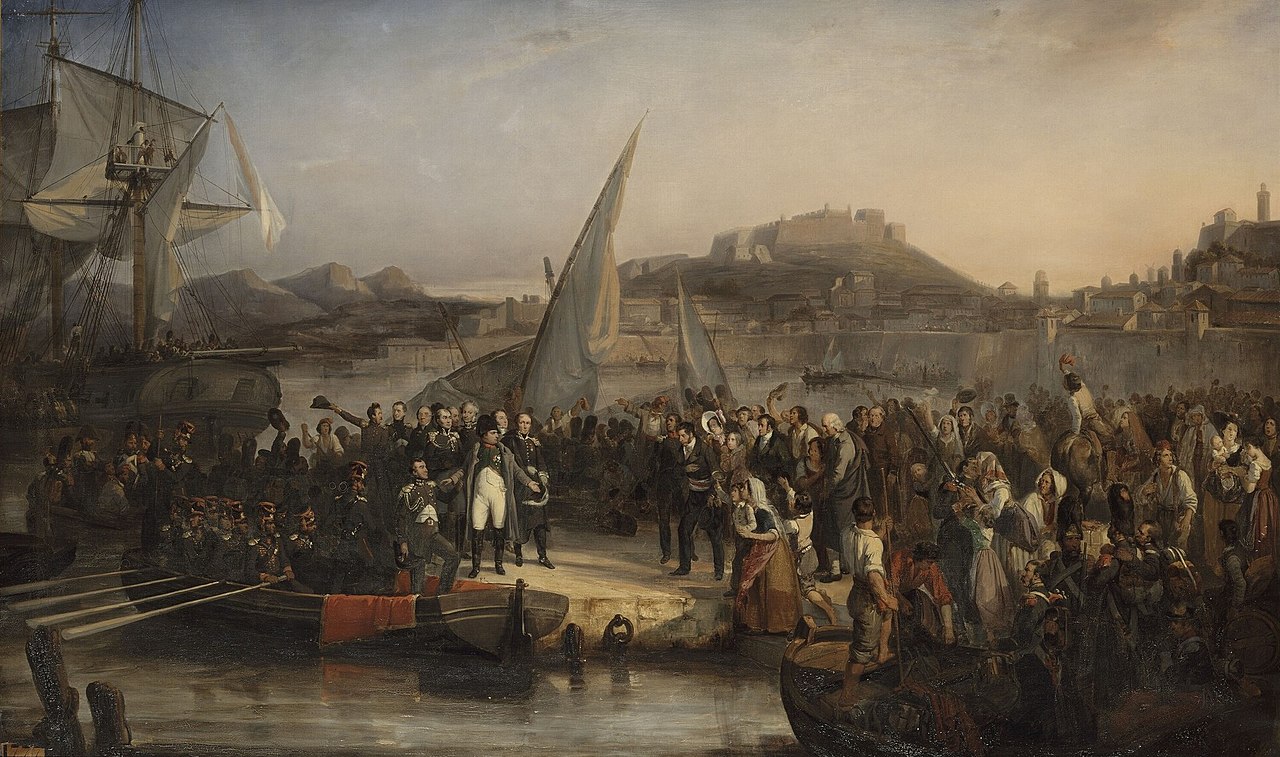
Napoleon spent only 9 months and 21 days in an uneasy forced retirement on Elba (1814–1815), watching events in France with great interest as the Congress of Vienna gradually gathered. As he foresaw, the shrinkage of the great Empire into the realm of old France caused intense dissatisfaction among the French, a feeling fed by stories of the tactless way in which the Bourbon princes treated veterans of the Grande Armée and the returning royalist nobility treated the people at large. Equally threatening was the general situation in Europe, which had been stressed and exhausted during the previous decades of near constant warfare.
The conflicting demands of major powers were for a time so exorbitant as to bring the Powers at the Congress of Vienna to the verge of war with each other. Thus every scrap of news reaching remote Elba looked favourable to Napoleon to retake power as he correctly reasoned the news of his return would cause a popular rising as he approached. He also reasoned that the return of French prisoners from Russia, Germany, Britain and Spain would furnish him instantly with a trained, veteran and patriotic army far larger than that which had won renown in the years before 1814. So threatening were the symptoms, that the royalists at Paris and the plenipotentiaries at Vienna talked of deporting him to the Azores or to Saint Helena, while others hinted at assassination.
Congress of Vienna
At the Congress of Vienna (November 1814 – June 1815) the various participating nations had very different and conflicting goals. Tsar Alexander I of Russia had expected to absorb much of Poland and to leave a Polish puppet state, the Duchy of Warsaw, as a buffer against further invasion from Europe. The renewed Prussian state demanded all of the Kingdom of Saxony. Austria wanted to allow neither of these things, while it expected to regain control of northern Italy. Castlereagh, of the United Kingdom, supported France (represented by Talleyrand) and Austria and was at variance with his own Parliament. This almost caused a war to break out, when the Tsar pointed out to Castlereagh that Russia had 450,000 men near Poland and Saxony and he was welcome to try to remove them. Indeed, Alexander stated "I shall be the King of Poland and the King of Prussia will be the King of Saxony". Castlereagh approached King Frederick William III of Prussia to offer him British and Austrian support for Prussia's annexation of Saxony in return for Prussia's support of an independent Poland. The Prussian king repeated this offer in public, offending Alexander so deeply that he challenged Metternich of Austria to a duel. Only the intervention of the Austrian crown stopped it. A breach among the four Great Powers was avoided when members of Britain's Parliament sent word to the Russian ambassador that Castlereagh had exceeded his authority, and Britain would not support an independent Poland. The affair left Prussia deeply suspicious of any British involvement.

Return to France
While the Allies were distracted, Napoleon solved his problem in characteristic fashion. On 26 February 1815, when the British and French guard ships were absent, his tiny fleet, consisting of the brig Inconstant, four small transports, and two feluccas, slipped away from Portoferraio with some 1,000 men and landed at Golfe-Juan, between Cannes and Antibes, on 1 March 1815. Except in royalist Provence, he was warmly received. He avoided much of Provence by taking a route through the Alps, marked today as the Route Napoléon.
Firing no shot in his defence, his troop numbers swelled until they became an army. On 5 March, the nominally royalist 5th Infantry Regiment at Grenoble went over to Napoleon en masse. The next day they were joined by the 7th Infantry Regiment under its colonel, Charles de la Bédoyère, who would be executed for treason by the Bourbons after the campaign ended. An anecdote illustrates Napoleon's charisma: when royalist troops were deployed to stop the march of Napoleon's force before Grenoble at Laffrey, Napoleon stepped out in front of them, ripped open his coat and said "If any of you will shoot his Emperor, here I am." The men joined his cause.
Marshal Ney, now one of Louis XVIII's commanders, had said that Napoleon ought to be brought to Paris in an iron cage, but, on 14 March, in Lons-le-Saulnier, Jura Ney joined Napoleon with a small army of 6,000 men. On 15 March Joachim Murat, King of Naples, declared war on Austria in an attempt to save his throne, starting the Neapolitan War. On 20 March, after proceeding through the countryside promising constitutional reform and direct elections to an assembly, to the acclaim of gathered crowds, Napoleon entered the capital, from where Louis XVIII had recently fled. He appointed the French Government of the Hundred Days that day.

The royalists did not pose a major threat: the duc d'Angoulême raised a small force in the south, but at Valence it did not provide resistance against Imperialists under Grouchy's command; and the duke, on 9 April 1815, signed a convention whereby the royalists received a free pardon from the Emperor. The royalists of Vendée moved later and caused more difficulty for the Imperialists. Ney was arrested on 3 August 1815, tried on 16 November and executed on 7 December 1815.
Napoleon's health
Evidence as to Napoleon's health is somewhat conflicting: Carnot, Pasquier, Lavalette, Thiébault and others thought him prematurely aged and enfeebled. At Elba Sir Neil Campbell had noted that he had become inactive and corpulent.
Also at Elba he had begun to suffer intermittently from retention of urine, but to no serious extent.

For much of his public life, Napoleon had been troubled by hemorrhoids, which made sitting on a horse for long periods of time difficult and painful. This condition had disastrous results at Waterloo; during the battle, his inability to sit on his horse for other than very short periods of time interfered with his ability to survey his troops in combat and thus exercise command.
Others reported no marked change in him. Mollien, who knew the emperor well, attributed the lassitude which now and then came over him to a feeling of perplexity caused by his changed circumstances.
Constitutional reform
At Lyon, on 13 March 1815, Napoleon issued an edict dissolving the existing chambers and ordering the convocation of a national mass meeting, or Champ de Mai, for the purpose of modifying the constitution of the Napoleonic empire. He reportedly told Benjamin Constant, "I am growing old. The repose of a constitutional king may suit me. It will more surely suit my son".

That work was carried out by Benjamin Constant in concert with the Emperor. The resulting Acte additionel (supplementary to the constitutions of the Empire) bestowed on France a hereditary Chamber of Peers and a Chamber of Representatives elected by the "electoral colleges" of the empire.
According to Chateaubriand, in reference to Louis XVIII's constitutional charter, the new constitution – dubbed La Benjamine – was merely a "slightly improved" version of the charter associated with Louis XVIII's administration; however, later historians, including Agatha Ramm, have pointed out that this constitution permitted the extension of the franchise and explicitly guaranteed press freedom. In the Republican manner, the Constitution was put to the people of France in a plebiscite, but whether due to lack of enthusiasm, or because the nation was suddenly thrown into military preparation, only 1,532,527 votes were cast, less than half of the vote in the plebiscites of the Consulat; however, the benefit of a "large majority" meant that Napoleon felt he had constitutional sanction.
Napoleon was with difficulty dissuaded from quashing the 3 June election of Jean Denis, comte Lanjuinais, the staunch liberal who had so often opposed the Emperor, as president of the Chamber of Representatives. In his last communication to them, Napoleon warned them not to imitate the Greeks of the late Byzantine Empire, who engaged in subtle discussions while the ram was battering at their gates.
Military mobilisation
During the Hundred Days the Coalition nations as well as Napoleon mobilised for war. Upon re-assumption of the throne, Napoleon found that Louis XVIII had left him with few resources. There were 56,000 soldiers, of which 46,000 were ready to campaign. By the end of May the total armed forces available to Napoleon had reached 198,000 with 66,000 more in depots training up but not yet ready for deployment. By the end of May Napoleon had formed L'Armée du Nord (the "Army of the North") which, led by himself, would participate in the Waterloo Campaign.
For the defence of France, Napoleon deployed his remaining forces within France with the intention of delaying his foreign enemies while he suppressed his domestic ones. By June he had organised his forces thus:
V Corps, – L'Armée du Rhin – commanded by Rapp, cantoned near Strasbourg;
VII Corps – L'Armée des Alpes – commanded by Suchet, cantoned at Lyon;
I Corps of Observation – L'Armée du Jura – commanded by Lecourbe, cantoned at Belfort;
II Corps of Observation – L'Armée du Var – commanded by Brune, based at Toulon;
III Corps of Observation – Army of the Pyrenees orientales – commanded by Decaen, based at Toulouse;
IV Corps of Observation – Army of the Pyrenees occidentales – commanded by Clauzel, based at Bordeaux;
Army of the West, – Armée de l'Ouest (also known as the Army of the Vendée and the Army of the Loire) – commanded by Lamarque, was formed to suppress the Royalist insurrection in the Vendée department of France which remained loyal to King Louis XVIII during the Hundred Days.
The opposing Coalition forces were the following:
Archduke Charles gathered Austrian and allied German states, while the Prince of Schwarzenberg formed another Austrian army. King Ferdinand VII of Spain summoned British officers to lead his troops against France. Tsar Alexander I of Russia mustered an army of 250,000 troops and sent these rolling toward the Rhine. Prussia mustered two armies. One under Blücher took post alongside Wellington's British army and its allies. The other was the North German Corps under General Kleist.
Assessed as an immediate threat by Napoleon:
Anglo-allied, commanded by Wellington, cantoned south-west of Brussels, headquartered at Brussels.
Prussian Army commanded by Blücher, cantoned south-east of Brussels, headquartered at Namur.
Close to the borders of France but assessed to be less of a threat by Napoleon:
The German Corps (North German Federal Army) which was part of Blücher's army, but was acting independently south of the main Prussian army. Blücher summoned it to join the main army once Napoleon's intentions became known.
The Austrian Army of the Upper Rhine, commanded by Field Marshal Karl Philipp, Prince of Schwarzenberg.
The Swiss Army, commanded by Niklaus Franz von Bachmann.
The Austrian Army of Upper Italy – Austro-Sardinian Army – commanded by Johann Maria Philipp Frimont.
The Austrian Army of Naples, commanded by Frederick Bianchi, Duke of Casalanza.
Other coalition forces which were either converging on France, mobilised to defend the homelands, or in the process of mobilisation included:
A Russian Army, commanded by Michael Andreas Barclay de Tolly, marching towards France
A Reserve Russian Army to support Barclay de Tolly if required.
A Reserve Prussian Army stationed at home in order to defend its borders.
An Anglo-Sicilian Army under General Sir Hudson Lowe, which was to be landed by the Royal Navy on the southern French coast.
Two Spanish Armies were assembling and planning to invade over the Pyrenees.
A Netherlands Corps, under Prince Frederick of the Netherlands, was not present at Waterloo but as a corps in Wellington's army it did take part in minor military actions during the Coalition's invasion of France.
A Danish contingent known as the Royal Danish Auxiliary Corps (commanded by General Prince Frederik of Hesse) and a Hanseatic contingent (from the free cities of Bremen, Lübeck and Hamburg) later commanded by the British Colonel Sir Neil Campbell, were on their way to join Wellington; both however, joined the army in July having missed the conflict.
A Portuguese contingent, which due to the speed of events never assembled.
War begins
At the Congress of Vienna, the Great Powers of Europe (Austria, Great Britain, Prussia and Russia) and their allies declared Napoleon an outlaw, and with the signing of this declaration on 13 March 1815, so began the War of the Seventh Coalition. The hopes of peace that Napoleon had entertained were gone – war was now inevitable.