
The Canadian Army (French: Armée canadienne) is the ground force of Canada, and one of the three environmental commands of the Canadian Armed Forces, responsible for conventional land operations. As of 2024, it includes about 22,500 Regular Force personnel and 21,500 reservists, including 5,300 Canadian Rangers. Headquartered at NDHQ Carling in Ottawa, it maintains bases and facilities across Canada. The commander of the Canadian Army reports to the Chief of the Defence Staff.
The army traces its roots to the colonial-era Canadian militia, though nearly all of its existing units were established after the Militia Act of 1855, which created the Active Militia in the Province of Canada. Shortly after Confederation, the Active Militia became Canada's sole functional military force, participating in several conflicts before being renamed the Canadian Army during the Second World War. It was reorganized as Force Mobile Command in 1965, ahead of the 1968 unification of Canada's military. Renamed Land Force Command in 1992, it reverted to the Canadian Army name in 2011.
The army is organized into five principal formations, which includes four geographically based divisions comprising Regular and Reserve Force elements, and the Canadian Army Doctrine and Training Centre for training and doctrine development. The four divisions include several brigade groups made up of units from the Royal Regiment of Canadian Artillery, Royal Canadian Armoured Corps, and Royal Canadian Infantry Corps. The army operates a variety of equipment sourced domestically and from other countries.
History
Origins and the Sedentary Militia
The Canadian Army traces its origins to colonial militias established in New France and British North America. These community-based militias supported French and British military actions on the continent. Prior to Canadian Confederation in 1867, militia acts passed in the Province of Canada, Nova Scotia, and New Brunswick required males aged 16 to between 50 and 60 to serve in local sedentary militias, unorganized, mostly untrained forces mustered only infrequently each year.
Some of the Canadian Army's oldest units trace their lineage to these sedentary militia units, like the predecessor of the Governor General's Horse Guards, the Governor General's Body Guard. Several modern Army units also perpetuate the lineage of Canadian units raised during the War of 1812. However, nearly all modern Army units were formed following the transformation of the Province of Canada's military system under the Militia Acts of 1846 and 1855.
Development of the Active Militia
Plans for a trained volunteer "active militia" in the Province of Canada began with the Militia Act of 1846, although actual active militia units were not formed until a more practical framework was established through the Militia Act of 1855. The Militia Act of 1868 formally integrated the colonial Canadian Militia, both the Sedentary and Active components, into the new federal framework. However, the Sedentary Militia fell into disuse by 1873, leaving the Active Militia as Canada's only functional military force.

In 1871, the Active Militia formed its first full-time volunteer units, which later became the nucleus of Permanent Force. By the 1880s, Permanent Force had expanded beyond artillery to include infantry and cavalry corps. During the late 19th century, the Active Militia repelled the Fenian raids from 1866 to 1871 and defeated the North-West Resistance in 1885. Active Militia officers first participated in overseas service during the Nile Expedition of 1884 to 1885, while Active Militia units undertook their first official overseas deployment during the Second Boer War from 1900 to 1902.
However, by the end of the 19th century, the militia remained limited in capability. Major-General Edward Hutton, former General Officer Commanding the Militia of Canada, described the Militia as "a collection of military units without cohesion, without staff, and without those military departments by which an army is moved, fed, or ministered to in sickness."
Reforms under Frederick Borden, minister of militia and defence from 1896 to 1911, revitalized the force through the creation of engineering, medical, signalling, and support corps in the early 1900s. In 1904, the position of General Officer Commanding, traditionally held by a British Army officer, was replaced by the Canadian-appointed Chief of the General Staff of the Militia. Policies adopted by Canada at the 1907 Imperial Conference and the 1909 Defence Conference led the Canadian Militia to maintain broad uniformity with the British Army in organization, equipment, and training doctrine.

World War I and Interwar Period
At the outbreak of World War I, the Canadian militia was not mobilized, with existing mobilization plans for the force considered too slow to meet the urgent demands of the war. Instead, a new force was formed, the Canadian Expeditionary Force (CEF). Although the militia provided only a small number of trained soldiers, it offered the foundation on which a national army could be built. Most CEF officers originated from the Non-Permanent Active Militia (NPAM). The militia's administrative structure and staff were also utilized to recruit personnel for the CEF.
The militia's pre-war limited development was evident in the appointment of a British lieutenant-general to command the 1st Canadian Division until 1917, when command of the Canadian Corps passed to Lieutenant-General Arthur Currie, a former NPAM officer. Canadian units first entered the front lines in February 1915, and by 1918, the Canadian Corps was regarded as "the most powerful self-contained striking force on any battlefront," in part because it retained four-battalion infantry brigades while British Army brigades were reduced to three battalions. More than 620,000 people served in the CEF, with 60,000 Canadians died during the war.
Following the war, steps were taken within the Canadian Militia to preserve the legacy and battle honours of CEF units. Two CEF units were incorporated into Permanent Force, while others had their honours perpetuated through NPAM regiments. In 1923, the civilian portfolio responsible for militia affairs was consolidated with the other service portfolios under a single Minister of National Defence. During the 1930s, the militia began a program of rearmament and reorganization, although its budget reflected its position as the lowest priority compared with the navy and the air force.

World War II and post-war period
The Government of Canada ordered a partial mobilization of the militia on 25 August, followed by full mobilization after the Canadian declaration of war on Germany on 10 September. Unlike the First World War, the mobilized units were drawn largely from existing militia battalions rather than newly created formations. In November 1940, the Canadian Militia was formally retitled as the Canadian Army, with the Permanent Active Militia becoming Canadian Army (Active) and NPAM becoming Canadian Army (Reserve).
Canadian Army units saw little action in the early stages of the war. One brigade briefly took the field during the fall of France in 1940, after which Canadian Army units were largely occupied with the defence of the UK against a possible German invasion. The Canadian Army later played major roles in the Allied invasion of Sicily and Italy, the Battle of Normandy, and the North West Europe campaign, particularly the liberation of the Netherlands, remaining in combat until 5 May 1945 with the German surrender at Lüneburg Heath. During the conflict, the First Canadian Army was formed. It became the largest field army ever assembled by the Canadian Army, with more than 450,000 personnel under the command of General Henry Crerar. Like in the First World War, the Canadian Army served under British higher command in operations. During the war, 730,000 people served in the Canadian Army, 24,500 of whom died.
Although the Canadian Army demobilized after the Second World War, it did not reduce its numbers to pre-war levels like it did following the First World War. Its participation in NATO in 1949 also led the Canadian Army to its largest peacetime size. As part of its commitments to NATO, the Canadian Army had detachments in Europe.

During this period, Canada also contributed to early UN peacekeeping operations, like the United Nations Truce Supervision Organization in 1948, the United Nations Emergency Force during the 1956 Suez Crisis and the United Nations Peacekeeping Force in Cyprus in 1964. The Canadian Army also provided several units, later consolidated into the 25th Canadian Infantry Brigade, to serve under the 1st Commonwealth Division of the United Nations Command during the Korean War.
Post-unification
The Canadian Army was reduced in size during the 1960s due to budgetary and manpower constraints. By the mid-1960s, the Canadian government began a process of unifying the country's separate armed service branches into a single force. As a part of the anticipated unification, the Army was reorganized into Force Mobile Command in 1965, before it was unified with the other two service branches, the Royal Canadian Navy and the Royal Canadian Air Force, to form the single-service Canadian Armed Forces. This resulted in some units being reduced to nil strength and transferred to the Supplementary Order of Battle. However, other new units were also created to increase French Canadian representation.
The rationale for unification was to improve efficiency and reduce cost. However, unification efforts faced resistance from army regiments, who viewed them as an attempt to erase their history, traditions, and identities. Regimental identities and ethos were gradually restored within Mobile Command during the 1970s and 1980s. During the later Cold War years, the CAF was reduced in size and scaled back troop deployments in Europe, although it continued to uphold peacekeeping commitments, participating in every UN peacekeeping mission until 1989.

The end of the Cold War prompted the CAF to end its European military deployments, although it did play a limited role in the 1991 Gulf War and took part in several peacekeeping missions. In 1992, Force Mobile Command was redesignated as Land Force Command as part of broader post-Cold War restructuring. Many of the army's post-Cold War peacekeeping missions, particularly in Yugoslavia and Rwanda, became volatile, with peacekeepers facing aggression and lacking adequate support. The misconduct of the Canadian Airborne Regiment during operations in Somalia also led to intense public scrutiny and the regiment’s eventual disbandment.
The army hit its lowest enlistment numbers in decades in 2001, before it rebounded as a result of the War in Afghanistan. The 12-year Afghan mission was the longest military campaign undertaken by the CAF. In 2011, Land Forces Command was renamed to the Canadian Army, restoring the pre-unification name for Canada's military land forces.
Following the document Inflection Point 2025, the commander of the army Lieutenant-General Michael Wright ordered staff to prepare a significant reorganization from its conventionally configured divisions to four task specific formations. The Defence of Canada Division will be primary reserve, heavy with the Canadian Rangers, with integrated air and missile defences. The Manoeuvre Division will group the regular force brigades for conventional warfare, creation of a sustainment brigade and a light infantry regiment from the three existing light battalions. In support will be a training formation and a support division.
Structure
The Canadian Army is the land component of the Canadian Armed Forces, and the CAF's largest element. Command is held by the commander of the Canadian Army, a lieutenant-general, with a major-general serving as their deputy. The commander of the Canadian Army reports to the chief of the Defence Staff, who, in turn, reports to the minister of National Defence, the head of the Department of National Defence.
The Army is made up of four geographically based divisions and a training formation, the Canadian Army Doctrine and Training Centre (CADTC). These four divisions and CADTC report to Canadian Army Headquarters, which is organized into three main sections: Operations, Strategy, and Reserve, each led by a brigadier-general. CADTC is responsible for the development of doctrine, manages the Army's intellectual growth, and oversees all individual and collective training across its establishments and divisions. Advanced and future war doctrine is also developed at the Canadian Army Land Warfare Centre (CALWC), which also publishes the peer-reviewed Canadian Army Journal.
Regular Force and Army Reserve
Army personnel and units are organized into Regular Force and the Canadian Army Reserve. The Regular Force is made up of officers and non-commissioned members enrolled for continuing, full-time military service.
The Army Reserve, also known as the Militia, is made up of officers and non-commissioned members enrolled for service other than continuing, full-time military service, including subcomponents like the Canadian Rangers, and provides a basis for national mobilization. Army Reserve personnel are spread throughout ten Canadian Brigade Groups that are primarily made up of reservists, although each unit includes small cadre of Regular Force personnel for administrative and training support.
Reservists usually serve part-time but may volunteer for full-time duty, helping augment Regular Forces' domestic and overseas deployments. In addition to supporting the Regular Force, Reserve Force brigade groups maintain readiness to respond to natural disasters and other domestic emergencies within their regions.
Divisions
The Army's four divisions are the 2nd Canadian Division, the 3rd Canadian Division, the 4th Canadian Division, and the 5th Canadian Division. The 1st Canadian Division was formerly a joint operations command within the Army, although it was transferred to the Canadian Joint Operations Command in 2015.
Three of the four divisions have a mechanized brigade group, which is commanded by a colonel and consists of Regular Force personnel. Each mechanized brigade group includes two mechanized and one light infantry battalion, a support battalion, and regiments and units from the Royal Canadian Armoured Corps, Canadian Military Engineers, Royal Regiment of Canadian Artillery, Communications and Electronics Branch. Most divisions also have a company from Intelligence Branch and Canadian Ranger patrols.
In addition to mechanized brigade groups, each division includes a combat service support group, companies from the Canadian Intelligence Corps, Canadian Ranger patrol groups, and several Reserve Force brigade groups, known as Canadian Army Reserve brigade groups. The composition of Army Reserve brigade groups is not standardized due to the reserve's historical roots in locally raised militia, although they typically field regiments of the Royal Canadian Infantry Corps, as well as armoured reconnaissance and artillery regiments. Collectively, these brigade groups include 17 armoured regiments and one independent armoured squadron, 16 artillery regiments and three independent artillery batteries, and 51 infantry battalions.
Canadian Forces Military Police regiments are generally situated with a division and placed under its operational control, although they are not formally a component of the division.
2nd Canadian Division
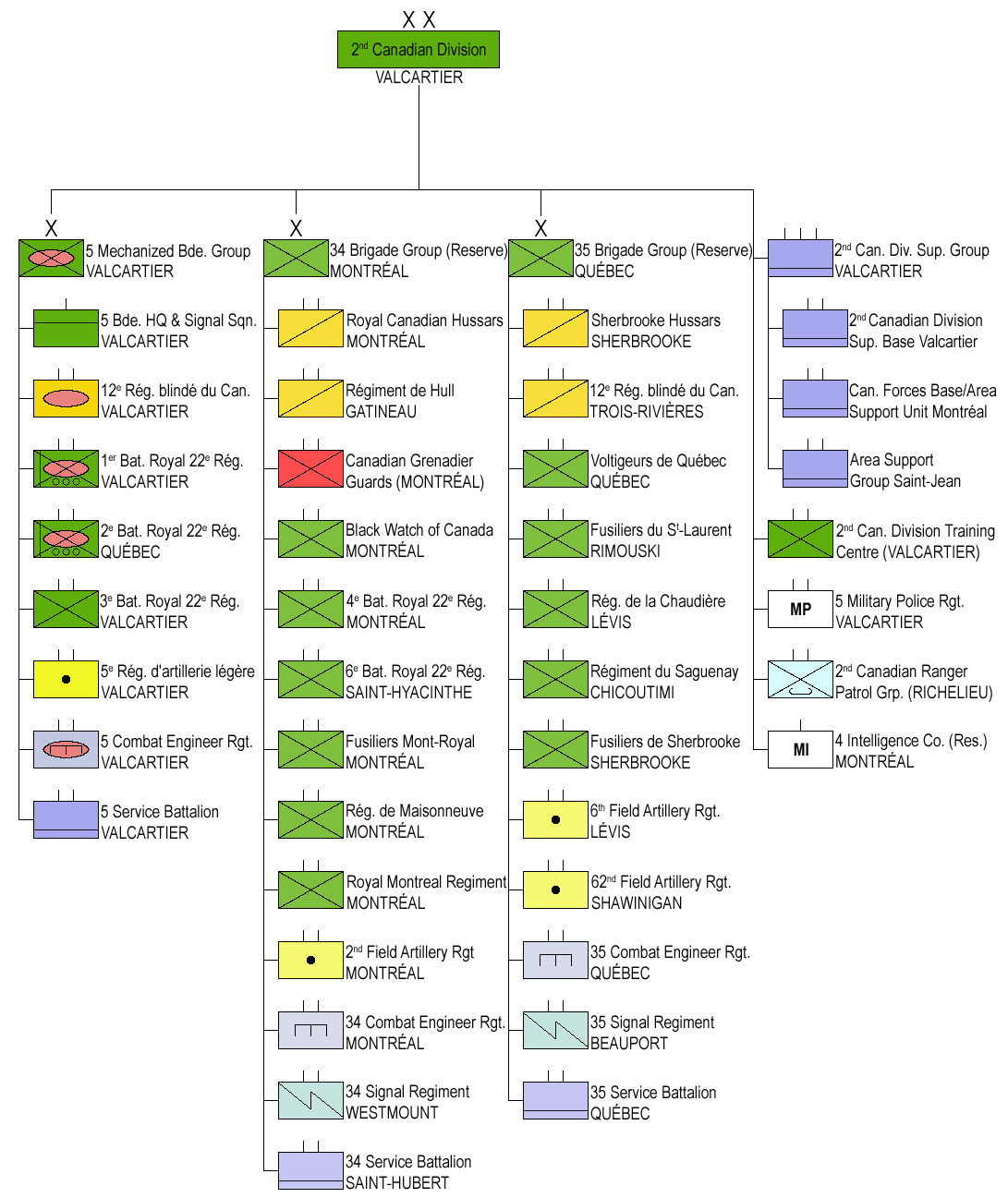
The 2nd Canadian Division is a formation that includes all Regular and Reserve units within Quebec. There are four main formations that make up the division:
5 Canadian Mechanized Brigade Group (5 CMBG)
34 Canadian Brigade Group (34 CBG)
35 Canadian Brigade Group (35 CBG)
2nd Canadian Division Support Group
5 CMBG has close to 4,800 Regular and Reserve forces and is equipped with approximately 1,200 vehicles. The two other brigade groups are Army Reserve formations. 34 Canadian Brigade Group comprises 2,500 reservists across 15 regiments, nine of which are based on the island of Montreal. 35 Canadian Brigade Group includes 2,200 reservists distributed among 12 units throughout eastern Quebec.
Additionally, the following units report directly to the division's headquarters at 2nd Canadian Division Support Base Valcartier, Detachment Montreal:
2nd Canadian Division Training Center
4 Intelligence Company
5 Military Police Regiment
2nd Canadian Ranger Patrol Group
Training for the division takes place at Canadian Forces Leadership and Recruit School and the 2nd Canadian Division Training Centre.
3rd Canadian Division
The 3rd Canadian Division is a formation that includes all Regular and Reserve units within western Canada and northwestern Ontario, except for CFB Wainwright, which is administered by the Canadian Army Training and Doctrine Centre. As of 2025, there are approximately 5,800 Regular Force soldiers, 5,300 Reserve Force soldiers, and 3,000 Canadian Rangers under the division. Additionally, the division employs approximately 1,000 civilians. The five major formations that make up the division are:
1 Canadian Mechanized Brigade Group
38 Canadian Brigade Group (38 CBG)
39 Canadian Brigade Group (39 CBG)
41 Canadian Brigade Group (41 CBG)
3rd Canadian Division Support Group
38 CBG is made up of units based throughout Saskatchewan, Manitoba, and northwestern Ontario, 39 CBG is made up of units based in British Columbia, and 41 CBG is made up of units based in Alberta and the Northwest Territories.