
Boston University (BU) is a private research university in Boston, Massachusetts, United States. BU was founded in 1839 by a group of Boston Methodists with its original campus in Newbury, Vermont. It was chartered in Boston in 1869. The university is a member of the Association of American Universities and the Boston Consortium for Higher Education.
The university has nearly 38,000 students and more than 4,000 faculty members and is one of Boston's largest employers. It offers bachelor's degrees, master's degrees, doctorates, and medical, dental, business, and law degrees through 17 schools and colleges on three urban campuses. BU athletic teams compete in the Patriot League and Hockey East conferences, and their mascot is Rhett the Boston Terrier. The Boston University Terriers compete in NCAA Division I.
The university is nonsectarian, though it retains its historical affiliation with the United Methodist Church. The main campus is situated along the Charles River in Boston's Fenway–Kenmore and Allston neighborhoods, while the Boston University Medical Campus is located in Boston's South End neighborhood. The Fenway campus houses the Wheelock College of Education and Human Development, formerly Wheelock College, which merged with BU in 2018. The university is classified among "R1: Doctoral Universities – Very high research activity".

History
Boston University traces its roots to the establishment of the "Newbury Biblical Institute" in Newbury, Vermont, in 1839, and was chartered with the name "Boston University" by the Massachusetts Legislature when it moved there in 1869. The university organized formal centennial observances both in 1939 and 1969. One or the other, or both dates, may appear on various official seals used by different schools of the university.
In Vermont and New Hampshire
On April 24–25, 1839, a group of Methodist ministers and laymen at the Old Bromfield Street Church in Boston elected to establish a Methodist theological school. Set up in Newbury, Vermont, the school was named the "Newbury Biblical Institute".
In 1847, the Congregational Society in Concord, New Hampshire, invited the institute to relocate to Concord and offered a disused Congregational church building with a capacity of 1200 people. Other citizens of Concord covered the remodeling costs. One stipulation of the invitation was that the Institute remain in Concord for at least 20 years. The charter issued by New Hampshire designated the school the "Methodist General Biblical Institute", but it was commonly called the "Concord Biblical Institute".

In Beacon Hill
With the agreed twenty years coming to a close, the trustees of the Concord Biblical Institute purchased 30 acres (120,000 m2) on Aspinwall Hill in Brookline, Massachusetts, as a possible relocation site. The institute moved in 1867 to 23 Pinkney Street in the Beacon Hill neighborhood of Boston, and received a Massachusetts Charter as the "Boston Theological Seminary".
In 1869, three trustees of the "Boston Theological Institute" obtained from the Massachusetts Legislature a charter for a university by the name of "Boston University". These trustees were successful Boston businessmen and Methodist laymen with a history of involvement in educational enterprises, and they became the founders of Boston University. They were Isaac Rich (1801–1872), Lee Claflin (1791–1871), and Jacob Sleeper (1802–1889), for whom Boston University's three West Campus dormitories were later named. Lee Claflin's son, William, was then Governor of Massachusetts and signed the University Charter on May 26, 1869, after it was passed by the Legislature.
As reported by Kathleen Kilgore in her book Transformations, A History of Boston University (see Further reading), the founders directed the inclusion in the Charter of the following provision, unusual for its time:
No instructor in said University shall ever be required by the Trustees to profess any particular religious opinions as a test of office, and no student shall be refused admission ... on account of the religious opinions he may entertain; provided, nonetheless, that this section shall not apply to the theological department of said University.
Every department of the new university was also open to all on an equal footing regardless of sex, race, or (with the exception of the School of Theology) religion.
Boston Theological Institute was absorbed into Boston University in 1871 as the BU School of Theology.

On January 13, 1872, Isaac Rich died, leaving the vast bulk of his estate to a trust that would go to Boston University after ten years of growth while the university was organized. Most of this bequest consisted of real estate throughout the core of the city of Boston, which was appraised at more than $1.5 million. Kilgore describes this as the largest single donation to an American college or university as of that time. By December, however, the Great Boston Fire of 1872 had destroyed all but one of the buildings Rich had left to the university, and the insurance companies with which they had been insured were bankrupt. The value of his estate, when turned over to the university in 1882, was half what it had been in 1872.
As a result, the university was unable to build its contemplated campus on Aspinwall Hill, and the land was sold piecemeal as development sites. Street names in the area, including Claflin Road, Claflin Path, and University Road, are the only remaining evidence of university ownership in this area. Following the fire, Boston University established its new facilities in buildings scattered throughout Beacon Hill, and later expanded into the Boylston Street and Copley Square area.
After receiving a year's salary advance to allow him to pursue his research in 1875, Alexander Graham Bell, then a professor at the school, invented the telephone in a Boston University laboratory. In 1876, Borden Parker Bowne was appointed professor of philosophy. Bowne, an important figure in the history of American religious thought, was an American Christian philosopher and theologian in the Methodist tradition. He is known for his contributions to personalism, a philosophical branch of liberal theology. The movement he led is often referred to as Boston Personalism.

The university continued its tradition of openness in this period. In 1877, Boston University became the first American university to award a PhD to a woman, when classics scholar Helen Magill White earned hers with the thesis "The Greek Drama". Then, in 1878, Anna Oliver became the first woman to receive a degree in theology in the United States, but the Methodist Church would not ordain her. Lelia J. Robinson, who graduated from the university's law school in 1881, became the first woman admitted to the bar in Massachusetts. Solomon Carter Fuller, who graduated from the university's School of Medicine in 1897, became the first black psychiatrist in the United States and would make significant contributions to the study of Alzheimer's disease.
Move to current campus and expansion
Seeking to unify a geographically scattered school and enable it to participate in the development of the city, school president Lemuel Murlin arranged that the school buy the present campus along the Charles River. Between 1920 and 1928, the school bought the 15 acres (61,000 m2) of land that had been reclaimed from the river by the Riverfront Improvement Association. Plans for a riverside quadrangle with a Gothic Revival administrative tower modeled on the "Old Boston Stump" in Boston, England were scaled back in the late 1920s when the State Metropolitan District Commission used eminent domain to seize riverfront land for Storrow Drive.
Murlin was never able to build the new campus, but his successor, Daniel L. Marsh, led a series of fundraising campaigns (interrupted by both the Great Depression and World War II) that helped Marsh to achieve his dream and to gradually fill in the university's new campus. By spring 1936, the student body included 10,384 men and women.

In 1951, Harold C. Case became the school's fifth president and under his direction the character of the campus changed significantly, as he sought to change the school into a national research university. The campus tripled in size to 45 acres (180,000 m2), and added 68 new buildings before Case retired in 1967. The first large dorms, Claflin, Rich and Sleeper Halls in West Campus were built, and in 1965 construction began on 700 Commonwealth Avenue, later named Warren Towers, designed to house 1800 students.
Between 1961 and 1966, the BU Law Tower, the George Sherman Union, and the Mugar Memorial Library were constructed in the Brutalist style, a departure from the school's traditional architecture. The College of Engineering and College of Communication were housed in a former stable building and auto-show room, respectively. Besides his efforts to expand the university into a rival for Greater Boston's more prestigious academic institutions, such as Harvard University and the Massachusetts Institute of Technology (both in Cambridge across the Charles River from the BU campus), Case involved himself in the start of the student/societal upheavals that came to characterize the 1960s.
When a mini-squabble over editorial policy at college radio WBUR-FM – whose offices were under a tall radio antenna mast in front of the School of Public Relations and Communications (later College of Communications) – started growing in the spring of 1964, Case persuaded university trustees that the university should take over the widely-heard radio station (now a major outlet for National Public Radio and still a BU-owned broadcast facility). The trustees approved the firing of student managers and clamped down on programming and editorial policy, which had been led by Jim Thistle, later a major force in Boston's broadcast news milieu. The on-campus political dispute between Case's conservative administration and the suddenly active and mostly liberal student body led to other disputes over BU student print publications, such as the B.U. News and the Scarlet, a fraternity association newspaper.
The presidency of John Silber also saw much expansion of the campus and programs. In the late 1970s, the Lahey Clinic vacated its building at 605 Commonwealth Avenue and moved to Burlington, Massachusetts. The vacated building was purchased by BU to house the School of Education. After arriving from the University of Texas in 1971, Silber set out to remake the university into a global center for research by recruiting star faculty. Two of his faculty "stars", Elie Wiesel and Derek Walcott, won Nobel Prizes shortly after Silber recruited them. Two others, Saul Bellow and Sheldon Glashow won Nobel Prizes before Silber recruited them.
In addition to recruiting new scholars, Silber expanded the physical campus, constructing the Photonics Center for the study of light, a new building for the School of Management, and the Life Science and Engineering Building for interdisciplinary research, among other projects. Campus expansion continued in the 2000s with the construction of new dormitories and the Agganis Arena.
Student and faculty activism
To protest the poor condition of Boston University's African-American curriculum, on April 25, 1968 (three weeks after the assassination of Martin Luther King Jr.), African-American students conducted a sit-in and locked BU president Arland F. Christ-Janer out of his office for 12 hours. Umoja, BU's Black Student Union, put forward ten demands to Christ-Janer and got nine of them approved that included the creation of a Martin Luther King Chair of Social Ethics, expansion of African-American library resources and tutoring services, opening an "Afro-American coordinating center," admission and selection of more Black students and faculty. No disciplinary action was taken against the students who only opened the chains after their demands were met. "There was no surprise, or feeling of victory on the students' parts," said Christ-Janer in response to the sit-in. "They had confidence in their demands, and I had a confidence in them. The university, black and white alike, was the winner."
The late twentieth century saw a culmination in student activism at Boston University during the presidency of John R. Silber.
In 1972, student protests rose against the university administration's endorsement of Marine Corps recruitment on campus which faced significant opposition from Students for a Democratic Society.
On March 27, 1972, 50 police officers in "riot gear" defused a demonstration of 150 protesters at 195 Bay State Road, the BU Placement Office, where Marine recruiters were holding student interviews. A few protesters were arrested while some sustained minor injuries, including a student and two officers. Contrary to student claims of a peaceful protest, Silber said, "Civilization doesn't abdicate in face of barbarism. Those students or nonstudents who deliberately seek violent confrontation and refuse all efforts at peaceful resolution of issues must expect society to use its police power in its own defense." In response to Silber's decision of a forceful police intervention, the Faculty State conducted a vote on Silber's resignation which could not pass due to a "vote of 140–25 with 32 abstentions." As a result of this failed motion, Peter P. Gabriel resigned his position as the dean of Boston University's School of Management in protest of Silber's presidency and his "counterproductive" leadership. Silber's support of military recruitment on campus, which he pushed to make the university eligible for federal grants, caused other demonstrations. On December 5, 1972, fifteen BU Student Government officers started a three-day hunger strike at Marsh Chapel demanding Silber "to file a lawsuit against the Federal government challenging the constitutionality of the Herbert Amendment."
On March 16, 1978, about 900 Boston University students gathered at the George Sherman Union to protest against the $400 rise in tuition and $150 rise in housing charges declared by the trustees on March 7. The protest interrupted a board of trustees conference. While John Silber and Arthur G. B. Metcalf, chairman of the board of trustees, were negotiating with student government representatives to discuss the matter further on a separate occasion, the protesters marched into the building from two entrances, effectively trapping 40 trustees and 10 university administrators in the building for over thirty minutes. Twenty officers from the Boston University Police Department had to disperse the crowd from the stairwells. The protest resulted in the arrest of 19 year old Joshua Grossman, while another student and two BUPD officers were taken to hospitals.
On April 5, 1979, several hundred faculty members, as well as clerical workers and librarians, went on strike. The faculty members were seeking a labor contract while the clerical workers and librarians were seeking union recognition. The strike ended by mid-April under terms favorable to the employees.
On November 27, 1979, the committee to Defend Iranian Students—composed of Iranian students, Youths Against Foreign Fascism and the Revolutionary Communist Party—held a demonstration at the George Sherman Union against the deposed Shah of Iran and the deportation of Iranian students from the US. "To the Iranian people, that man (the shah) is Adolf Hitler," students protested. "The Shah Must Face the Wrath of the People." This was met with chants of "God Bless America" from the opposing group. Twenty policemen broke up the confronting parties though no arrests were made.
21st century
Following the trustees' push for the resignation of the university's eighth president, Jon Westling, they voted unanimously to offer the presidency of the university to Daniel S. Goldin, former administrator of NASA under presidents George H. W. Bush, Bill Clinton, and George W. Bush. Goldin was set to take over the job on November 1, 2003, and be officially inaugurated on November 17, though the deal collapsed in the week leading up to his arrival in Boston.
The university eventually terminated Goldin's contract at a cost of $1.8 million and initiated a second search to fill the presidential position, culminating with the inauguration of Robert A. Brown as the university's 10th president on April 27, 2006. (Aram Chobanian, who had served as president ad interim during most of the second search, was formally recognized as the 9th president in 2005.) In the wake of this fiasco, several actions were taken to improve the image projected to potential presidential candidates as well as the functioning of the board itself.
In 2012, the university was invited to join the Association of American Universities, comprising 66 leading research universities in the United States and Canada. BU, one of four universities at the time invited to join the group since 2000, became the 62nd member. In the Boston area, Harvard, MIT, Tufts, and Brandeis are also members.
That same year, a $1 billion fundraising campaign was launched, its first comprehensive campaign, emphasizing financial aid, faculty support, research, and facility improvements. In 2016, the campaign goal was reached. The board of trustees voted to raise the goal to $1.5 billion and extend through 2019. The campaign has funded 74 new faculty positions, including 49 named full professorships and 25 Career Development Professorships. The campaign concluded in September 2019, raising a total of $1.85 billion over seven years.
In February 2015, the faculty adopted an open-access policy to make its scholarship publicly accessible online.
The Charles River and Medical Campuses have undergone physical transformations since 2006, from new buildings and playing fields to dormitory renovations. The campus has seen the addition of a 26-floor student residence at 33 Harry Agganis Way, nicknamed StuVi2, the New Balance Playing Field, the Yawkey Center for Student Services, the Alan and Sherry Leventhal Center, the Law tower and Redstone annex, the Engineering Product Innovation Center (EPIC), the Rajen Kilachand Center for Integrated Life Sciences & Engineering, and the Joan and Edgar Booth Theatre, which opened in fall 2017.
The construction of the Rajen Kilachand Center for Integrated Life Sciences & Engineering was funded by part of BU's largest ever gift, a $115 million donation from Rajen Kilachand. The Dahod Family Alumni Center in the renovated BU Castle began in May 2017 and was completed in fall 2018. Development of the university's existing housing stock has included significant renovations to BU's oldest dorm, 610 Beacon Street (formerly Myles Standish Hall) and Annex, and to Kilachand Hall, formerly known as Shelton Hall, and a brand new student residence on the Medical Campus. In May 2024, Boston University removed Myles Standish's name from the building. It is now referred to by its address, 610 Beacon Street.
In 2019, Boston University expanded its financial aid program so that it would "meet the full need for all domestic students who qualify for financial aid," starting in fall 2020.
In September 2022, Robert A. Brown announced he will step down at the end of the 2022–2023 academic year. Brown began his presidency in September 2005, and his contract was set to run through 2025. Although Brown chose to end his presidency, he will resume teaching at the university. On August 1, 2023, Kenneth W. Freeman started serving as president ad interim. In October 2023, Melissa Gilliam was named the incoming president, starting her term on July 1, 2024.
On July 1, 2024, Melissa Gilliam began her tenure as the university's 11th president. On October 16, 2024, the 2024 Boston University strikes ended.
Response to the COVID-19 pandemic
The university closed down due to the COVID-19 and shifted to online learning for the remainder of the semester on March 11, 2020. For the fall 2020 semester, BU offered a hybrid system that allows for students to decide whether to take a remote class or participate in-person. Larger classes would be broken down into smaller groups that rotate between online and in-person sessions. The school started administering its own COVID-19 testing for faculty, staff, and students on July 27, 2020. The new BU Clinical Testing Laboratory has accelerated testing that can give results to students, staff, and faculty by the next day. The lab uses eight robots to process up to 6,000 tests per day. A contact tracing team is part of the process to contain infections on campus. BU also started a new website "Back2BU" to provide students with the latest information on reopening. The results of the tests were published on BU's public COVID-19 Testing Data Dashboard.
BU's National Emerging Infectious Diseases Laboratories (NEIDL) has been working with live coronavirus samples since March 2020, and—at the time—was the only New England lab to have live samples.
In August 2020, BU filed a service mark application with the United States Patent and Trademark Office to secure the phrase "F*ck It Won't Cut It" for a student-led COVID-19 safety program on campus. The slogan is meant to promote "safe and smart actions and behaviors for college and university students in a COVID-19 environment", according to the application.
In July 2021, BU announced faculty and staff will be required to be vaccinated against COVID-19 for the fall 2022 semester. This comes after a vaccine requirement for all students, which was announced in April.
COVID-19 research and gain-of-function controversy
In October 2022, Boston University's National Emerging Infectious Diseases Laboratories conducted research in a Biosafety Level 3 lab that modified the original strain of the virus that causes COVID-19 with the spike proteins of the Omicron variant. This resulted in a virus that was more lethal to lab mice than the Omicron variant itself, but less lethal than the original strain. Some medical authorities criticized the research as dangerous "gain of function" research, but others argued that it did not technically count as gain of function research because the modified virus happened not to be quite as lethal as the original strain. Marc Lipsitch of Harvard, however, argued "these are unquestionably gain-of-function experiments. As many have noted, this is a very broad term encompassing many harmless and some potentially dangerous experiments. GOF is a scientific technique, not an epithet." While the BU researchers gained internal research and Boston government approvals for the research, they failed to notify the US Government's National Institute of Allergy and Infectious Diseases that was a funder of the lab.
Campus
Boston campuses and facilities
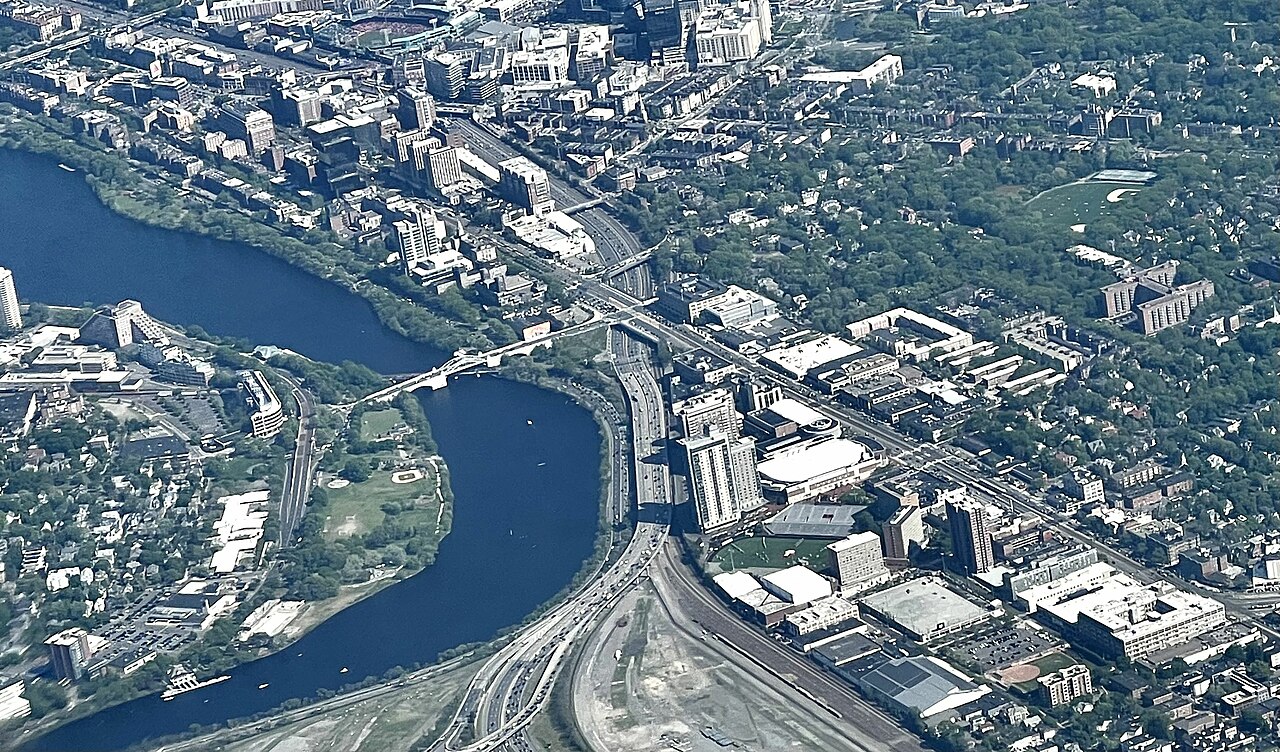
The university's main Charles River Campus follows Commonwealth Avenue and the Green Line, beginning near Kenmore Square and continuing for over a mile and a half to its end near the border of Boston's Allston neighborhood. The Boston University Bridge over the Charles River into Cambridge represents the dividing line between Main Campus, where most schools and classroom buildings are concentrated, and West Campus, home to several athletic facilities and playing fields, the large West Campus dorm, and the new John Hancock Student Village complex. Boston University also has a campus located in the Fenway area, housing undergraduate students.
The main campus buildings of BU are separated from the Charles River Esplanade parkland and the Paul Dudley White Bike Path along the banks of the nearby Charles River, by heavily trafficked Storrow Drive, a high-speed limited-access major roadway connecting downtown Boston to its western suburbs. The separation occurred in the late 1920s, when the Commonwealth of Massachusetts seized land by eminent domain for the construction of the new roadway along the riverbank.
A narrow strip of grassy lawn between BU academic buildings lining Commonwealth Avenue and the torrent of traffic on Storrow Drive has been humorously dubbed "BU Beach", because it is a favorite hangout for sunbathing in good weather. The lounging students are protected from traffic incursions by a raised earthen berm, which also muffles the traffic noise to a dull roar. To protect pedestrians from vehicular collisions, Storrow Drive is enclosed by fencing, with pedestrian bridges allowing safe crossings at Silber Way and at Marsh Chapel. An additional crossing is possible at the BU Bridge, which also allows street traffic to cross from the Boston side to the Cambridge side of the Charles River.
As a result of its continual expansion, the Charles River campus contains an array of architecturally diverse buildings. The College of Arts and Sciences, Marsh Chapel, and the School of Theology buildings are the university's most recognizable, and were built in the late-1930s and 1940s in collegiate gothic style. A sizable amount of the campus is traditional Boston brownstone, especially at Bay State Road and South Campus, where BU has acquired almost every townhouse those areas offer. The buildings are primarily dormitories, but many also serve as various institutes as well as department offices.
From the 1960s through the 1980s, several contemporary buildings were constructed, including the Mugar Library, BU Law School, and Warren Towers, all of which were built in the brutalist style of architecture. The Metcalf Science Center for Science and Engineering, constructed in 1983, might more accurately be described as Structural Expressionism. Morse Auditorium, adjacent, stands in stark architectural contrast, as it was originally constructed as a Jewish synagogue. The most recent architectural additions to BU's campus are the Duan Family Center for Computing & Data Sciences, Photonics Center, Life Science and Engineering Building, The Student Village (which includes the FitRec Center and Agganis Arena), and the Questrom School of Business. All these buildings were built in brick, a few with a substantial amount of brownstone.