
Benito Amilcare Andrea Mussolini (29 July 1883 – 28 April 1945) was an Italian politician, journalist, and dictator who led the Kingdom of Italy as a fascist dictatorship from 1922 until his overthrow in 1943. Known under his rule as Il Duce, he founded fascism in 1919 with the creation of the Fasci Italiani di Combattimento, which became the National Fascist Party (PNF) in 1921. Mussolini was appointed Prime Minister of Italy after the March on Rome in 1922, establishing a totalitarian dictatorship. He oversaw Italy's participation in World War II as a prominent member of the Axis Powers, and was executed by the Italian resistance near the end of the war in 1945.
Mussolini was originally a hard socialist journalist at Avanti!. In 1912, he became a member of the National Directorate of the Italian Socialist Party (PSI), but was expelled for advocating military intervention in World War I. In 1914, Mussolini founded a newspaper, Il Popolo d'Italia, and served in the Royal Italian Army until he was wounded and discharged in 1917. He eventually denounced the PSI, his views pivoting to focus on Italian nationalism, and founded the fascist movement, which opposed egalitarianism, and class conflict, and instead advocated "revolutionary nationalism" transcending class lines. In 1922, following the March on Rome, he was appointed prime minister by King Victor Emmanuel III. After removing opposition through his secret police and outlawing labour strikes, Mussolini consolidated power through laws, and illegal means, that transformed the nation into a one-party dictatorship. He ordered the Pacification of Libya, which is often considered a genocide. In 1929, he signed the Lateran Treaty to establish the Vatican City. Mussolini, especially after the Great Depression, espoused policies of autarky and corporatism.
Mussolini's foreign policy shifted from cautious pragmatism to aggressive expansion and close alignment with Nazi Germany. Initially, he sought to expand Italy's influence without risking a major conflict with France or Britain, aligning with them during tensions over Austria. However, his invasion of Ethiopia resulted in condemnations from the League of Nations, which isolated Italy diplomatically. This pushed Mussolini toward Adolf Hitler, leading to a rapprochement and the formation of the Rome-Berlin Axis in 1936. Mussolini began militarily supporting Francisco Franco's forces during the Spanish Civil War. Although he acted as a mediator at the Munich Conference in 1938, his ambitions for territorial expansion and growing distrust of the Western powers led him to strengthen ties with Germany, resulting in the creation of the Pact of Steel in 1939.
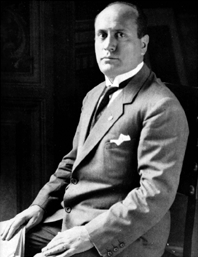
The wars of the 1930s cost Italy enormous resources, leaving it unprepared for the World War II; Mussolini initially declared Italy's non-belligerence. However, in June 1940, believing that German victory was imminent, he joined the war on Germany's side to share the spoils. Following defeats at the hands of the Allies and the landing in Sicily, the Grand Council of Fascism voted on the Grandi motion, which effectively ended Mussolini's leadership and restored powers to King Victor Emmanuel III. The King immediately dismissed Mussolini as head of government and placed him in custody in July 1943. After the king agreed to an armistice with the Allies in September 1943, Mussolini was rescued by the Germans during the Gran Sasso raid. Hitler made Mussolini the figurehead of a puppet state in German-occupied north Italy, the Italian Social Republic, which served as a collaborationist regime of Germany. With Allied victory imminent, Mussolini and his mistress Clara Petacci attempted to flee to Switzerland, but were captured by communist partisans and summarily executed on 28 April 1945.
Early life
Benito Amilcare Andrea Mussolini was born on 29 July 1883 in Dovia di Predappio, a town in the province of Forlì in Romagna. Mussolini's father, Alessandro Mussolini, was a blacksmith and socialist, while his mother, Rosa (née Maltoni), was a devout Catholic schoolteacher. Given his father's political leanings, Mussolini was named Benito after liberal Mexican president Benito Juárez, while his middle names, were for Italian socialists Amilcare Cipriani and Andrea Costa. In return, his mother required that he be baptised at birth. Benito was followed by his siblings Arnaldo and Edvige. Mussolini's family was of relatively humble status, and fascist biographers emphasized that he had "come from the people". Nevertheless, the family did not belong to the lowest social stratum. Benito's father, despite having his own business, lived on the margins of the community because of his politics, while Rosa, who taught elementary school children at Palazzo Varano, earned a salary insufficient to compensate for her husband's lack of income.
Mussolini attended the first two years of elementary school in Dovia and then in Predappio (1889–1891). At his mother's request, he entered the Salesian college in Faenza (1892–October 1894), but was transferred after disciplinary problems, including a fight in which he injured a classmate with a knife, resulting in his demotion from the fourth to the second class. In Faenza, Benito experienced an unhappy period marked by corporal punishment from the Salesian friars and frustration over his family's modest social and economic condition.

With his mother's assistance, Mussolini continued his studies at the secular Royal Carducci Male Teacher Training School in Forlimpopoli, directed by Valfredo Carducci, brother of Giosuè Carducci. He earned his lower technical qualification in 1898. Although his academic performance was good, he remained resistant to discipline. He was expelled from the boarding school twice: once after a fight in which he used a penknife, and another time for staying out all night. During his years in Forlimpopoli, and under the influence of his father, Mussolini became involved with militant socialism, speaking at evening rallies in nearby towns. In 1900 he joined the Italian Socialist Party, where he became acquainted with Olindo Vernocchi. On 8 July 1901, he received his diploma as an elementary school teacher from the same institute.
After graduation, Mussolini applied unsuccessfully for teaching posts in several municipalities, including Predappio, Legnano, Tolentino, Ancona, and Castelnuovo Scrivia. In Predappio he also sought a position as an assistant substitute to the municipal secretary, but was rejected by the moderate faction of the council. He eventually began teaching at the elementary school in Pieve Saliceto, a hamlet of Gualtieri and the first Italian municipality governed by a socialist administration. After the school year ended, he left Italy on 9 July 1902 and emigrated to Switzerland to avoid compulsory military service.
Emigration to Switzerland and military service
Without work, connections or money, he settled down on July 20 in Lausanne. Living in abject poverty, he was arrested for vagrancy by the police on 24 July under the arches of the Grand-Pont where he spent the night and was kept behind bars for three days.

During this time, he studied the ideas of the philosopher Friedrich Nietzsche, sociologist Vilfredo Pareto, and syndicalist Georges Sorel. Mussolini also later credited Charles Péguy and Hubert Lagardelle as influences. Sorel's emphasis on the need for overthrowing decadent liberal democracy and capitalism by the use of violence, direct action, the general strike, and the use of neo-Machiavellian appeals to emotion, impressed Mussolini.
Mussolini became active in the Italian socialist movement in Switzerland, working for the paper L'Avvenire del Lavoratore (The Future of the Worker), organising meetings, giving speeches to workers, and serving as secretary of the Italian workers' union in Lausanne. John Gunther alleged that Angelica Balabanov introduced Mussolini, then a bricklayer, to Vladimir Lenin. In 1903, he was arrested by Bernese police because of his advocacy of a violent general strike, spent two weeks in jail, and was handed over to Italian police in Chiasso. After he was released in Italy, he returned to Switzerland. He was arrested again in Geneva, in April 1904, for falsifying his passport expiration date, and expelled from the canton of Geneva. He was released in Bellinzona following protests from Genevan socialists. Mussolini then returned to Lausanne, where he entered the University of Lausanne's Department of Social Science on 7 May, attending the lectures of Vilfredo Pareto. In 1937, when he was prime minister of Italy, the University of Lausanne awarded Mussolini an honorary doctorate.
In December 1904, Mussolini returned to Italy to take advantage of an amnesty for desertion from the military. He had been convicted for this in absentia. Since a condition for being pardoned was serving in the army, he joined the corps of the Bersaglieri in Forlì on 30 December 1904. After serving for two years in the military (January 1905 until September 1906), he returned to teaching.

Political journalist, intellectual and socialist
In February 1909, Mussolini again left Italy, this time to take the job as the secretary of the labour party in the Italian-speaking city of Trento, then part of Austria-Hungary. He also did office work for the local Socialist Party, and edited its newspaper L'Avvenire del Lavoratore (The Future of the Worker). Returning to Italy, he spent time in Milan, and in 1910 returned to his hometown of Forlì, where he edited the weekly Lotta di classe (The Class Struggle).
Mussolini thought of himself as an intellectual and was considered to be well-read. He read avidly; his favourites in European philosophy included Sorel, the Italian Futurist Filippo Tommaso Marinetti, French Socialist Gustave Hervé, Italian anarchist Errico Malatesta, and German philosophers Friedrich Engels and Karl Marx, the founders of Marxism. Mussolini had taught himself French and German and translated excerpts from Nietzsche, Schopenhauer and Kant.
During this time, he published Il Trentino veduto da un Socialista (Trentino as viewed by a Socialist) in the radical periodical La Voce. He wrote essays about German literature, some stories, and a novel: L'amante del Cardinale: Claudia Particella, romanzo storico (The Cardinal's Mistress). This novel he co-wrote with Santi Corvaja, and it was published as a serial in the Trento newspaper Il Popolo from 20 January to 11 May 1910. The novel was bitterly anticlerical, and years later was withdrawn from circulation after Mussolini made a truce with the Vatican.
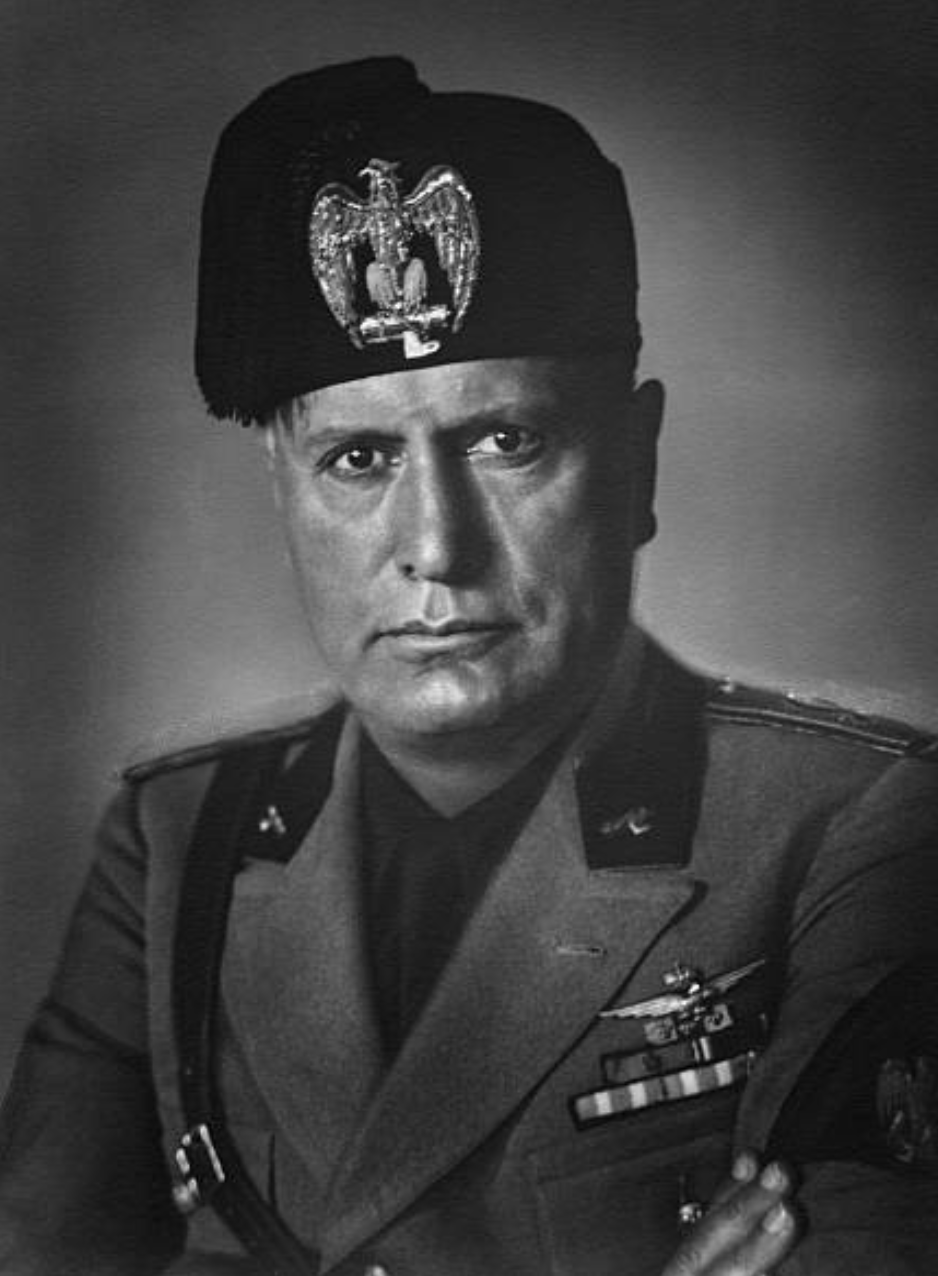
He had become one of Italy's most prominent socialists. In September 1911, Mussolini participated in a riot, led by socialists, against the Italian war in Libya. He bitterly denounced Italy's "imperialist war", an action that earned him a five-month jail term. After his release, he helped expel Ivanoe Bonomi and Leonida Bissolati from the Socialist Party, as they were two "revisionists" who had supported the war.
In 1912, he became a member of the National Directorate of the Italian Socialist Party (PSI). He was rewarded with the editorship of the party newspaper Avanti! Under his leadership, its circulation rose from 20,000 to 100,000. John Gunther in 1940 called him "one of the best journalists alive"; Mussolini was a working reporter while preparing for the March on Rome, and wrote for the Hearst News Service until 1935. Mussolini's familiarity with Marxist literature reflected itself in his quoting even from obscure works. During this period Mussolini considered himself an "authoritarian communist" and a Marxist and he described Marx as "the greatest of all theorists of socialism". In 1913, he published Giovanni Hus, il veridico (Jan Hus, true prophet), a historical and political biography about the life and mission of the Czech ecclesiastic reformer Jan Hus and his militant followers, the Hussites. During this socialist period of his life, Mussolini sometimes used the pen name "Vero Eretico" ("sincere heretic").
Mussolini rejected egalitarianism, a core doctrine of socialism. He was influenced by Nietzsche's anti-Christian ideas and negation of God's existence. Mussolini felt that socialism had faltered, in view of the failures of Marxist determinism and social democratic reformism, and believed that Nietzsche's ideas would strengthen socialism. Mussolini's writings came to reflect an abandonment of Marxism and egalitarianism in favour of Nietzsche's übermensch concept and anti-egalitarianism.
Expulsion from the Italian Socialist Party
When World War I began in August 1914, many socialist parties worldwide followed the rising nationalist current and supported their country's intervention in the war. In Italy, the war created a surge of Italian nationalism and intervention was supported by a variety of political factions. The most popular Italian nationalist supporter of the war was Gabriele d'Annunzio who promoted Italian irredentism and helped sway the Italian public to support intervention. The Italian Liberal Party under the leadership of Paolo Boselli promoted intervention on the side of the Allies and utilised the Società Dante Alighieri to promote Italian nationalism. Italian socialists were divided on whether to support the war. Prior to Mussolini taking a position, several revolutionary syndicalists had announced their support, including Alceste De Ambris, Filippo Corridoni, and Angelo Oliviero Olivetti. The Italian Socialist Party decided to oppose the war after anti-militarist protestors had been killed, resulting in a general strike called Red Week. Mussolini initially held official support for the party's decision and, in an August 1914 article, Mussolini wrote: "Down with the War. We remain neutral."
However, he saw the war as an opportunity for his ambitions, as well as those of socialists and Italians. He was influenced by anti-Austrian Italian nationalist sentiments, believing that the war offered Italians in Austria-Hungary the chance to liberate themselves from rule of the Habsburgs. He eventually decided to declare support for the war by appealing to the need for socialists to overthrow the Hohenzollern and Habsburg monarchies in Germany and Austria-Hungary who he said had consistently repressed socialism. Mussolini further justified his position by denouncing the Central Powers for being reactionary powers; for pursuing imperialist designs against Belgium and Serbia as well as historically against Denmark, France, and against Italians, since hundreds of thousands of Italians were under Habsburg rule. He argued that the fall of Hohenzollern and Habsburg monarchies and repression of "reactionary" Turkey would create conditions beneficial for the working class, and that the mobilisation required would undermine Russia's reactionary authoritarianism and bring Russia to social revolution. He said that for Italy the war would complete the process of Risorgimento by uniting the Italians in Austria-Hungary into Italy, and allowing the common people of Italy to be participating members in what would be Italy's first national war. Thus he claimed that the vast social changes that the war could offer meant that it should be supported as a revolutionary war.
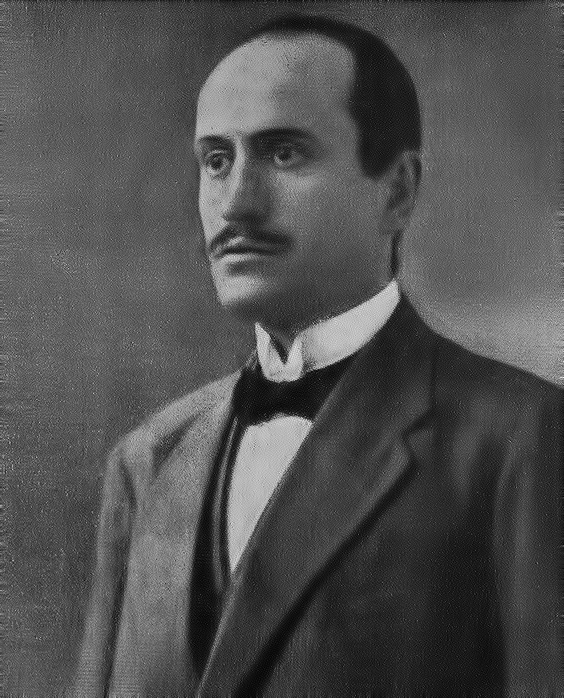
As Mussolini's support for the intervention solidified, he came into conflict with socialists who opposed the war. He attacked them and claimed those proletarians who supported pacifism were out of step with the proletarians who had joined the rising interventionist vanguard that was preparing Italy for a revolutionary war. He began to criticise the Italian Socialist Party and socialism itself for having failed to recognise the national problems that had led to the outbreak of the war. He was then accused of moral and political unworthiness and was subsequently expelled from the party.
Beginning of Fascism and service in World War I
After being ousted from the Italian Socialist Party, Mussolini made a sudden and radical transformation, ending his support for socialism and class conflict, and supporting revolutionary nationalism transcending class lines. He formed the interventionist newspaper Il Popolo d'Italia and the Fascio Rivoluzionario d'Azione Internazionalista ("Revolutionary Fasces of International Action") in October 1914. The funds to create Il Popolo d'Italia—funnelled through entrepreneur Filippo Naldi—came from many sources, including domestic industrial and agrarian interests, such as the engineering giants Fiat and Ansaldo, and the governments of France and Britain.
On 5 December 1914, Mussolini denounced orthodox socialism for failing to recognise that the war had made national identity and loyalty more significant than class distinction. He demonstrated his transformation in a speech that acknowledged the nation as an entity, a notion he had rejected prior to the war, saying:
The nation has not disappeared. We used to believe that the concept was totally without substance. Instead we see the nation arise as a palpitating reality before us! ... Class cannot destroy the nation. Class reveals itself as a collection of interests—but the nation is a history of sentiments, traditions, language, culture, and race. Class can become an integral part of the nation, but the one cannot eclipse the other.
Mussolini continued to promote the need of a revolutionary vanguard elite to lead society. He no longer advocated a proletarian vanguard, but instead a vanguard led by dynamic and revolutionary people of any social class of unity through nationality. Though he denounced orthodox socialism and class conflict, he maintained at the time that he was a nationalist socialist and supporter of the legacy of nationalist socialists in Italy's history, such as Giuseppe Garibaldi, Giuseppe Mazzini, and Carlo Pisacane. As for the Italian Socialist Party and its support of orthodox socialism, he claimed that his failure as a member to revitalise and transform it to recognise contemporary reality revealed the hopelessness of orthodox socialism as outdated. This perception of the failure of orthodox socialism in the light of the outbreak of World War I was not solely held by Mussolini; other pro-interventionist Italian socialists such as Filippo Corridoni and Sergio Panunzio had denounced classical Marxism in favour of intervention.
These basic political views and principles formed the basis of Mussolini's newly formed political movement, the Fasci d'Azione Rivoluzionaria in 1914, who called themselves Fascisti (Fascists). At this time, the Fascists did not have an integrated set of policies and the movement was small, ineffective in its attempts to hold mass meetings, and regularly harassed by government authorities and orthodox socialists. Antagonism between the interventionists versus the anti-interventionist orthodox socialists resulted in violence between the Fascists and socialists. These early hostilities shaped Mussolini's conception of the nature of Fascism in its support of political violence.
Mussolini became an ally with the irredentist politician and journalist Cesare Battisti. When World War I started, Mussolini, like many Italian nationalists, volunteered to fight. He was turned down because of his radical Socialism and told to wait for his reserve call up. He was called up on 31 August and reported for duty with his old unit, the Bersaglieri. After a refresher course he was sent to Isonzo front where he took part in the Second Battle of the Isonzo, September 1915. His unit also took part in the Third Battle of the Isonzo, October 1915. On 1 March 1916, Mussolini was promoted to the rank of corporal "for merit in war". The promotion was recommended because of his exemplary conduct and fighting quality, his mental calmness and lack of concern for discomfort, his zeal and regularity in carrying out his assignments.
Mussolini's military experience is told in his work Diario di guerra. He totalled about nine months of active, front-line trench warfare, during which he contracted paratyphoid fever. His military exploits ended in February 1917 when he was wounded by the explosion of a mortar bomb during an exercise on the Karst Plateau near Lake Doberdò. He was left with 40 shards of metal in his body and had to be evacuated. He was invalided out of the army in June 1917 and resumed his editor-in-chief position at Il Popolo d'Italia. At this time he was provided each week with 100£ from British MI5 for providing support of Italian participation in the War.
On 25 December 1915, in Treviglio, he married his compatriot Rachele Guidi, who had already borne him a daughter, Edda, at Forlì in 1910. In 1915, he had a son with Ida Dalser, a woman born in Sopramonte, a village near Trento. He legally recognised this son on 11 January 1916.
Rise to power
Formation of the National Fascist Party
Mussolini returned to politics following his return from service in the Allied forces of World War I. In early 1918 he called for the emergence of a man "ruthless and energetic enough to make a clean sweep" to revive the Italian nation. In December 1918, he published the article "Trincerocrazia" in his newspaper, Il Popolo d'Italia, in which he claimed for the veterans of the trenches the right to govern post-war Italy and envisioned the fighters of World War I as the aristocracy of tomorrow and the central nucleus of a new ruling class. On 23 March 1919, Mussolini founded the Fasci Italiani di Combattimento (Italian Combat Squad) during a meeting in the San Sepolcro Square in Milan, initially consisting of 200 members. With this, he managed to consolidate control over this small emerging fascist movement, known as Sansepolcrismo.
Most Fascisti were young men from Milan or northern Italy, from the urban lower middle class, along with socialists who had broken with their party, anarchists, revolutionary syndicalists, and disgruntled demobilized war veterans especially from the Arditi. Mussolini outlined the new movement's program in the Fascist Manifesto, including a decentralized republic, universal suffrage (including women's suffrage), abolition of the Senate and nobility, compulsory military service, capital tax, confiscation of Church property, the eight-hour day, and nationalization of war industries, alongside attacks on socialism. After the meeting, fascist groups formed in about a hundred towns, mostly in northern Italy, but many were short-lived due to limited support from both workers and the bourgeoisie. By the Florence Congress in October, there were only 56 fasces, with around 17,000 members.
Mussolini had to contend with Gabriele D'Annunzio, who had become a national hero after the Fiume expedition and who was competing with him among the former Arditi and demobilized soldiers. Il Popolo d'Italia organized a major national fundraising campaign that brought in 3 million lire in a few weeks, and Mussolini met with D'Annunzio in Fiume, but only to persuade him not to launch an insurrection whose outcome seemed uncertain, and to wait for the November elections. For these elections, Mussolini wanted to form a bloc of parties and groups claiming to advocate left-wing interventionism: the Italian Republican Party, the Italian Socialist Party, the revolutionary syndicalists of the UIL, Futurists, and Fascists. But this project failed due to opposition from the Republicans, who considered an alliance with a party preaching the subversion of the social order dangerous, and the Fascists ran alone. The result was catastrophic. The Fascist list obtained 4,795 votes and only one seat, the PSI won 170,000 votes and 156 seats, and the Popular Party (Catholic) of Luigi Sturzo won 74,000 votes. After this, Mussolini seriously considering retiring from politics and emigrating. The year 1919 marked the failure of fascism's attempt to establish itself on the left. Only about thirty fasces remained, bringing together a few thousand members.
It was squadrismo, the militarization of fascism during the Biennio Rosso, that enabled Mussolini—whose prospects had seemed minimal in 1920—to rise to power. On 24 and 25 May 1920 Mussolini participated in the Second Congress of the Fasci Italiani di Combattimento, which was held at the Teatro Lirico in Milan, local leaders or Ras (a term Mussolini borrowed from the Ethiopian aristocracy) such as Roberto Farinacci, Dino Grandi, Italo Balbo, and Giuseppe Bottai organized armed squads called blackshirts (or squadristi) that acted as violent, counter-revolutionary militias. Backed by landowners and tolerated by the state, these groups attacked socialist institutions, carried out beatings, arson, and killings, and spread rapidly across Italy. The government of Giovanni Giolitti largely allowed this violence, hoping to weaken the communists, while fascist membership surged dramatically in 1921. The blackshirts clashed with communists, socialists, and anarchists at parades and demonstrations; all of these factions were also involved in clashes against each other. The Italian government rarely interfered with the blackshirts' actions, owing in part to a looming threat and widespread fear of a communist revolution. The Fascisti grew rapidly; within two years they transformed themselves into the National Fascist Party at a congress in Rome. In 1921, Mussolini won election to the Chamber of Deputies for the first time.
Mussolini sought to channel this movement into political power, entering parliament after the 1921 elections and forming alliances with conservative groups, though his attempts to limit violence—such as the 1921 pacification pact—failed due to opposition from local ras. He then reorganized the movement into the National Fascist Party, creating a more disciplined structure and formal militia. After the failure of the 1922 socialist general strike and growing political instability, Fascism gained momentum; by October 1922, mass support and displays of strength at Naples set the stage for the March on Rome, which brought Mussolini to power.
March on Rome
On 28th - 31st October 1922, Mussolini attempted a coup d'état, titled the March on Rome by Fascist propaganda, in which almost 30,000 fascists took part. The quadrumvirs leading the Fascist Party, General Emilio De Bono, Italo Balbo (one of the most famous ras), Michele Bianchi and Cesare Maria de Vecchi, organised the March while the Duce stayed behind for most of the march, though he allowed pictures to be taken of him marching along with the Fascist marchers. Generals Gustavo Fara and Sante Ceccherini assisted the preparations of the March of 18 October. Other organisers of the march included the Marquis Dino Perrone Compagni and Ulisse Igliori. On 24 October 1922, Mussolini declared before 60,000 people at the Fascist Congress in Naples: "Our program is simple: we want to rule Italy".
Meanwhile, the Blackshirts, who had occupied the Po plain, took all strategic points of the country. On 26 October, former prime minister Antonio Salandra warned current prime minister Luigi Facta that Mussolini was demanding his resignation and that he was preparing to march on Rome. However, Facta did not believe Salandra and thought that Mussolini would govern quietly at his side. To meet the threat posed by the bands of fascist troops now gathering outside Rome, Facta (who had resigned the next day on 29 October 1922 but continued to hold power) ordered a state of siege for Rome. Having had previous conversations with the king about the repression of fascist violence, he was sure the king would agree. However, King Victor Emmanuel III refused to sign the military order. On 30 October, the King handed power to Mussolini, who was supported by the military, the business class, and the right-wing part of the population. The march itself was composed of fewer than 30,000 men, but the King in part feared a civil war since the squadristi had already taken control of the Po plain and most of the country, while fascism was no longer seen as a threat to the establishment.
Mussolini was asked to form his cabinet on 31 October 1922, while some 25,000 Blackshirts were parading in Rome. Mussolini thus legally reached power in accordance with the Statuto Albertino, the Italian Constitution. The March on Rome was not the conquest of power which fascism later celebrated, but rather the precipitating force behind a transfer of power within the framework of the constitution. This transition was made possible by the surrender of public authorities in the face of fascist intimidation. Many business and financial leaders believed it would be possible to manipulate Mussolini, whose early speeches and policies emphasised free market and laissez-faire economics.
Appointment as prime minister
Mussolini's first cabinet was a coalition government of the Italian right. Mussolini was the only leading member of the PNF with ministerial rank (Minister of Foreign Affairs and Minister of the Interior); the Fascists Giacomo Acerbo and Aldo Finzi received only state secretary positions. Important ministries went to members of the conservative and nationalist establishment (Giovanni Gentile (Education), Luigi Federzoni (Colonies), Armando Diaz (War), Paolo Thaon di Revel (Navy)). Ministers Alberto De Stefani (Finance), Aldo Oviglio (Justice), and Giovanni Giuriati (Liberated Territories), who came from the same milieu, had already joined the Fascist Party by this time. With Stefano Cavazzoni (Labor and Social Affairs), the right wing of the Italian Popular Party was also represented in the government; in addition, there were representatives of most liberal groups. Overall, it was "a conservative ministry that expressed the common will of industry, the monarchy, and also the Church; it represented an attempt to end the long period of political instability after the war by establishing a stable government that could rely on the broad spectrum of the many factions of the right".
On 16 November 1922, Mussolini appeared before Parliament for the first time as Prime Minister; threatening to turn the House into "a bivouac for my squadre" at any time, he demanded emergency powers to rule by decree. Only the Socialist and Communist deputies voted against the bills on 24 November, which granted the government special powers until 31 December 1923. Seven liberal deputies, including Nitti and Giovanni Amendola, abstained from the vote; five former liberal prime ministers—Giolitti, Salandra, Orlando, Bonomi, and Facta—voted in favor of the government. In the Senate, the majority in favor of the government was even greater; there, Mussolini was openly urged to establish a dictatorship.
In the winter of 1922–1923, particularly in the cities, the Squadrists carried out serious attacks on political opponents. In Turin, an out-of-control "fascist firing squad" systematically murdered socialists, communists, and trade unionists without the police—who were directly under Mussolini's command as Minister of the Interior—intervening. Instead, thousands of fascists benefited from an amnesty before the end of the year. The transformation of the squadre into a national militia called the Voluntary Militia for National Security (MSVN), initiated in February 1923, in whose ranks numerous squadrists disillusioned by the "fascist revolution" received "status, pay, and some local power", was presented by Mussolini to the public as a measure against fascist "illegalism". In the same month, Mussolini established the Grand Council of Fascism, whose relationship to the constitutional institutions was not initially defined in detail, as a forum for the fascist Ras who had not been considered in the formation of the government. This council was connected to the state executive only through Mussolini himself.
During 1923, the Fascist Party merged with other factions of the Italian right. The merger with the Italian Nationalist Association (ANI), orchestrated by Mussolini in March, became a "watershed for Fascism". The ANI brought with it numerous "respectable" and influential figures who were well connected in the military, the court, the bureaucracy, the diplomatic service, and the economy. Alfredo Rocco, in particular, played a crucial role in the establishment and ideological foundation of the Fascist regime in the following years. The conservative wing of political Catholicism also joined the PNF in 1923. Luigi Sturzo, the leader of the populari, yielded to pressure from the Vatican in July 1923 and withdrew from the party. In the shadow of this development, Mussolini was largely able to free himself from his relative dependence on the Old Fascists and the ras. The membership of the PNF rose to 783,000 by the end of 1923 due to the influx of numerous "fascists of the last hour" (fascisti dell'ultima ora), after having been below 300,000 in October 1922.
In June 1923, the government passed the Acerbo Law, which transformed Italy into a single national constituency. It also granted a two-thirds majority of the seats in Parliament to the party or group of parties that received at least 25% of the votes. This law applied in the elections of 6 April 1924. The "national alliance", consisting of Fascists, most of the old Liberals and others, won 64% of the vote.
On 31 August 1923, in the shadow of the Ruhr Crisis, Mussolini ordered the shelling and occupation of the Greek island of Corfu in relatation for the assassination of an Italian general on Greek territory. With this action, the new Prime Minister wanted to demonstrate that he wanted to pursue a strong foreign policy and obtained, thanks to the League of Nations, the requested reparations in exchange for abandoning the occupied island. In January 1924, Yugoslavia recognized Italy's annexation of Fiume at the Treaty of Rome. From 1925 onward, Mussolini was able to eliminate Yugoslav influence in Albania and bind the country closely to Italy politically and economically (see Treaties of Tirana).
Matteotti Crisis
The assassination of the socialist deputy Giacomo Matteotti on 10 June 1924, who had requested that the elections be annulled because of the irregularities, provoked a momentary crisis in the Mussolini government. Mussolini ordered a cover-up, but witnesses saw the car that transported Matteotti's body parked outside Matteotti's residence, which linked fascist Amerigo Dumini to the murder.
The murder of Matteotti proved to be a political catastrophe for Mussolini, because of his bourgeois origins and his highly moderate socialism, Matteotti, who had been courted by Mussolini until then, was also respected by many liberals. Mussolini was apparently informed of the deed by Dumini on the evening of 10 June, but the following day, before Parliament, he denied any knowledge of Matteotti's whereabouts. Matteotti's body was finally found on 16 August on a road leading out of Rome. Mussolini instructed his staff to create "as much confusion as possible". However, the investigation, based on the identification of the kidnappers' vehicle, led directly to Mussolini's antechamber within a few days. Thus, the anti-fascist opposition was given an unexpected opportunity to deliver a serious and possibly decisive blow to the regime.
All opposition parties then united to agree to abandon Parliamentary proceedings until the government had clarified what had happened to Matteotti in what became known as the Aventine Secession. This was an attempt to give strength to the "moral question" that would point to public disapproval of fascism but also to put pressure on the King to dismiss Mussolini.
However, Victor Emmanuel III refused to act, since the Government was supported by a large majority of the Chamber of Deputies and almost all the Senate of the Kingdom. Moreover, he feared that compelling Mussolini to resign could be considered a coup d'état that eventually could lead to a civil war between the Army and the Blackshirts.
On 31 December 1924, MVSN consuls met with Mussolini and gave him an ultimatum: crush the opposition or they would do so without him. Fearing a revolt by his own militants, Mussolini decided to drop all pretense of democracy. On 3 January 1925, Mussolini made a truculent speech before the Chamber in which he took responsibility for squadristi violence (though he did not mention the assassination of Matteotti).
Prime minister
Consolidation of power
On 3 January, Mussolini and Federzoni instructed the prefects to henceforth suppress political assemblies and demonstrations and to take active action against all organizations "undermining the power of the state". From that day forward, opposition deputies were denied return to the Chamber, which until then had at least been theoretically possible. Press censorship was enforced even more strictly than before following a relevant decree of 10 January 1925; while the press organs of the political left were gradually driven underground, the major liberal newspapers dismissed their few remaining opposition editors during 1925, before a repressive press law came into effect in December 1925. By the end of the year, local autonomy was abolished, and podestàs appointed by the Italian Senate replaced elected mayors and councils.