
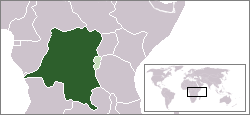
The Belgian Congo (French: Congo belge, pronounced [kɔ̃ɡo bɛlʒ]; Dutch: Belgisch-Congo) was a Belgian colony in Central Africa from 1908 until independence in 1960. It is today the Democratic Republic of the Congo (DRC).
Colonial rule in the Congo began in the late 19th century. King Leopold II of Belgium attempted to persuade the Belgian government to support colonial expansion around the then-largely unexploited Congo Basin. Their ambivalence resulted in Leopold establishing a colony himself. With support from a number of Western countries, Leopold achieved international recognition of the Congo Free State in 1885. By the end of the 19th century, the violence used by Free State officials against indigenous Congolese and a ruthless system of economic exploitation led to intense diplomatic pressure on Belgium to take official control of the country, which it did by creating the Belgian Congo in 1908.
Belgian rule in the Congo was based on the "colonial trinity" (trinité coloniale) of state, missionary and private-company interests. The privileging of Belgian commercial interests meant that large amounts of capital flowed into the Congo and that individual regions became specialised. On many occasions, the interests of the government and of private enterprise became closely linked, and the state helped companies to break strikes and to remove other barriers raised by the indigenous population. The colony was divided into hierarchically organised administrative subdivisions and run uniformly according to a set "native policy" (politique indigène). This differed from the practice of British and French colonial policies in Africa, which generally favoured systems of indirect rule, retaining traditional leaders in positions of authority under colonial oversight.

During the 1940s and 1950s, the Belgian Congo experienced extensive urbanisation and the colonial administration began various development programmes aimed at making the territory into a "model colony". One result saw the development of a new middle-class of Europeanised African "évolués" in the cities. By the 1950s, the Congo had a wage labour force twice as large as that in any other African colony.
In 1960, as the result of a widespread and increasingly radical pro-independence movement, the Belgian Congo achieved independence, becoming the First Congolese Republic under Prime Minister Patrice Lumumba and President Joseph Kasa-Vubu. Poor relations between political factions within the Congo, the continued involvement of Belgium in Congolese affairs, and the intervention by major parties (mainly the United States and the Soviet Union between the two world superpowers) during the Cold War led to a five-year-long period of war and political instability, known as the Congo Crisis, from 1960 to 1965. This ended with the seizure of power by Joseph-Désiré Mobutu (later as "Mobutu Sese Seko" or simply "Mobutu") in November 1965. Mobutu established an authoritarian regime, later renaming the country, the Republic of Zaire in 1971. He ruled as a dictator for 32 years, establishing a highly centralised state with only one legal political party as the MPR until he was overthrown in May 1997 by the rebel leader Laurent-Désiré Kabila during the First Congo War, following the 1994 Rwandan genocide and the conflict at the border.
Congo Free State
Until the later part of the 19th century, few Europeans had ventured into the Congo Basin. The rainforest, swamps and accompanying malaria and other tropical diseases, such as sleeping sickness, made it a difficult environment for European exploration. In 1876, King Leopold II of Belgium organised the International African Association with the cooperation of the leading African explorers and the support of several European governments for the promotion of the exploration and colonisation of Africa. After Henry Morton Stanley had explored the region in a journey that ended in 1878, Leopold courted the explorer and hired him to help his interests in the region.
Leopold II had been keen to acquire a colony for Belgium even before he ascended to the throne in 1865. The Belgian civil government showed little interest in its monarch's dreams of empire-building. Ambitious and stubborn, Leopold decided to pursue the matter on his own account.
European rivalry in Central Africa led to diplomatic tensions, in particular with regard to the Congo Basin, which no European power had claimed. In November 1884, Otto von Bismarck convened a 14-nation conference (the Berlin Conference) to find a peaceful resolution to the Congo situation. Though the Berlin Conference did not formally approve the territorial claims of the European powers in Central Africa, it did agree on a set of rules to ensure a conflict-free partitioning of the region. The rules recognised (inter alia) the Congo Basin as a free-trade zone. But Leopold II emerged triumphant from the Berlin Conference and his single shareholder "philanthropic" organisation received a large share of territory (2,344,000 km2 (905,000 sq mi)) to be organised as the Congo Free State.
The Congo Free State operated as a corporate state, privately controlled by Leopold II through a non-governmental organisation, the International African Association. The state included the entire area of the present-day Democratic Republic of the Congo, and existed from 1885 until 1908, when the government of Belgium reluctantly annexed the area. Under Leopold II's administration, the Congo Free State became a humanitarian disaster.

The lack of accurate records makes it difficult to quantify the number of deaths caused by the ruthless exploitation and the lack of immunity to new diseases introduced by contact with European colonists – like the 1889–1890 influenza pandemic, which caused millions of deaths on the European continent, including Prince Baudouin of Belgium, who died in 1891. William Rubinstein wrote: "More basically, it appears almost certain that the population figures given by Hochschild are inaccurate. There is, of course, no way of ascertaining the population of the Congo before the twentieth century and estimates like 20 million are purely guesses. Most of the interior of the Congo was literally unexplored if not inaccessible." Leopold's Force Publique, a private army that terrorised natives to work as forced labour for resource extraction, disrupted local societies and killed and abused natives indiscriminately. The Force Publique also became involved in the Congo–Arab War against African and Arab slavers like Zanzibari/Swahili strongman Tippu Tip.
Following the 1904 Casement Report on misdeeds and conditions, European (British included) and US press exposed the conditions in the Congo Free State to the public in the early 1900s. In 1904 Leopold II was forced to allow an international parliamentary commission of inquiry entry to the Congo Free State. By 1908, public pressure and diplomatic manoeuvres led to the end of Leopold II's personal rule and to the annexation of the Congo as a colony of Belgium, known as the "Belgian Congo".
Belgian Congo
On 18 October 1908, the Belgian Parliament voted in favour of annexing the Congo as a Belgian colony. A majority of the socialists and the radicals firmly opposed this annexation and reaped electoral benefits from their anti-colonialist campaign, but some believed that the country should annex the Congo and play a humanitarian role to the Congolese population. Eventually, two Catholic MPs and half of the Liberal MPs joined the socialists in rejecting the Colonial Charter (forty-eight votes against) and nearly all the Catholics and the other half of the Liberal MP's approved the charter (ninety votes for and seven abstentions). This way, on 15 November 1908 the Belgian Congo became a colony of the Belgian Kingdom. This was after King Leopold II had given up any hope of excluding a vast region of the Congo from the government's control by attempting to maintain a substantial part of the Congo Free State as a separate crown property.

When the Belgian government took over the administration in 1908, the situation in the Congo improved in certain respects. The brutal exploitation and arbitrary use of violence, in which some of the concessionary companies had excelled, were curbed. The crime of "red rubber" was put to a stop. Article 3 of the new Colonial Charter of 18 October 1908 stated that: "Nobody can be forced to work on behalf of and for the profit of companies or privates", but this was not enforced, and the Belgian government continued to impose forced labour on the indigenous people of the area, albeit by less obvious methods.
The transition from the Congo Free State to the Belgian Congo was a turning point, but it was also marked by a considerable continuity. The last Governor-General of the Congo Free State, Baron Wahis, remained in office in the Belgian Congo, and the majority of Leopold II's administration with him. While conditions were improved somewhat relative to rule under King Leopold, reports by doctors such as Dr. Raingeard show the low importance the Belgian government placed on healthcare and basic education of the natives. Opening up the Congo and its natural and mineral riches for the Belgian economy remained the motive for colonial expansion.
Government
The governance of the Belgian Congo was outlined in the 1908 Colonial Charter. Executive power rested with the Belgian Minister of Colonial Affairs, assisted by a Colonial Council (Conseil Colonial). Both resided in Brussels. The Belgian Parliament exercised legislative authority over the Belgian Congo.
The highest-ranking representative of the colonial administration residing in the Belgian Congo was the Governor-General. From 1886 until 1926, the Governor-General and his administration were posted in Boma, near the Congo River estuary. From 1923, the colonial capital moved to Léopoldville, some 300 km further upstream in the interior. Initially, the Belgian Congo was administratively divided into four provinces: Congo-Kasaï, Équateur, Orientale, and Katanga, each presided over by a Vice-Governor-General. An administrative reform in 1932 increased the number of provinces to six, while "demoting" the Vice-Governors-General to provincial Governors.
The territorial service was the true backbone of the colonial administration. The colony was divided into four provinces (six after the administrative reforms of 1933). Each province was in turn divided into a few districts (24 districts for the whole Congo) and each district into a handful of territories (some 130–150 territories in all; some territories were merged or split over time). A territory was managed by a territorial administrator, assisted by one or more assistants. The territories were further subdivided into numerous "chiefdoms" (chefferies), at the head of which the Belgian administration appointed "traditional chiefs" (chefs coutumiers). The territories administered by one territorial administrator and a handful of assistants were often larger than a few Belgian provinces taken together (the whole Belgian Congo was nearly 80 times larger than the whole of Belgium and was roughly twice the size of Germany and France combined). The territorial administrator was expected to inspect his territory and to file detailed annual reports with the provincial administration. The Belgian Parliament approved a transitional constitution for Belgian Congo which established a unitary constitutional monarchy with provinces having their own legislative assembly and running their own government.
In terms of the legal system, two systems co-existed: a system of European courts and one of indigenous courts (tribunaux indigènes). These indigenous courts were presided over by the traditional chiefs but had only limited powers and remained under the firm control of the colonial administration. In 1936 it was recorded that there were 728 administrators controlling the Congo from Belgium. Belgians living in the Congo had no say in the government and the Congolese did not either. No political activity was permitted in the Congo whatsoever. Public order in the colony was maintained by the Force Publique, a locally recruited army under Belgian command. It was only in the 1950s that metropolitan troops—i.e., units of the regular Belgian army—were posted in the Belgian Congo (for instance in Kamina).

The colonial state—and any authority exercised by whites in the Congo—was often referred to by the Congolese as bula matari ("break rocks"), one of the names originally given to Stanley. He had used dynamite to crush rocks when paving his way through the lower-Congo region. The term bula matari came to signify the irresistible and compelling force of the colonial state.
International conflicts
The Belgian Congo was directly involved in the two world wars. During World War I, an initial stand-off between the Force Publique and the German colonial army in German East Africa (Tanganyika) turned into open warfare with a joint Anglo-Belgian invasion of German colonial territory in 1916 and 1917 during the East African campaign. By 1916, the Belgian commander of the Force Publique, Lieutenant-General Charles Tombeur, had assembled an army of 15,000 men supported by local bearers – Reybrouck indicated that during the war no less than 260,000 native bearers were called upon – and advanced to Kigali (now the capital of Rwanda). Kigali was taken by 6 May 1916, and the army went on to take Tabora (now part of Tanzania) on 19 September after heavy fighting. In 1917, after Mahenge (now in Tanzania) had been conquered, the army of the Belgian Congo, by now 25,000 men, occupied one-third of German East Africa.
After World War I, under the Treaty of Versailles, Germany ceded control of the western section of the former German East Africa to Belgium, and Ruanda-Urundi would go on to become a League of Nations mandate territory, under Belgian administration. These areas did not become part of the Belgian Congo. Ruanda-Urundi would later become independent as the nations of Rwanda and Burundi, and the Belgian-controlled portions of German East Africa would join the nation of Tanganyika, followed by Tanzania.
During World War II, the Belgian Congo served as a crucial source of income for the Belgian government in exile in London after the occupation of Belgium by the Nazis. Following the occupation of Belgium by the Germans in May 1940, the Belgian Congo declared itself loyal to the Belgian government in exile in London. The Belgian Congo and the rest of the Free Belgian forces supported the war on the Allied side in the Battle of Britain with 28 pilots in the RAF (squadron 349) and in the Royal South African Air Force (350 Squadron) and in Africa. The Force Publique again participated in the Allied campaigns in Africa. Belgian Congolese forces (with Belgian officers) notably fought against the Italian colonial army in Italian East Africa, and were victorious in Asosa, Bortaï and in the Siege of Saïo under Major-general Auguste-Eduard Gilliaert during the second East African campaign of 1940–1941. On 3 July 1941, the Italian forces (under General Pietro Gazzera) surrendered when they were cut off by the Force Publique. A Congolese unit also served in the Far Eastern Theatre with the British army in the Burma campaign.
Economic policy
The economic development of the Congo was one of the colony’s top priorities. An important tool was the construction of railways to open up the mineral and agricultural areas.
World War I
Rubber had long been the main export of the Belgian Congo, but its importance fell in the early 20th century from 77% of exports (by value) to only 15% as British colonies in Southeast Asia like British Malaya began to farm rubber. New resources were exploited, especially copper mining in Katanga province. The Belgian-owned Union Minière, which would come to dominate copper mining, used a direct rail line to the sea at Beira. World War I increased demand for copper, and production soared from 997 tons in 1911 to 27,462 tons in 1917, then fell off to 19,000 tons in 1920. Smelters operated at Lubumbashi. Before the war the copper was sold to Germany; but the British purchased all the wartime output, with the revenues going to the Belgian government in exile. Diamond- and gold-mining also expanded during the war. The British firm of Lever Bros. (a subsidiary of Unilever Limited) greatly expanded the palm oil business during the war, and output of cocoa, rice and cotton increased. New rail and steamship lines opened to handle the expanded export traffic. During the First World War (1914–1918), the system of "mandatory cultivation" (cultures obligatoires) was introduced, forcing Congolese peasants to grow certain cash crops (cotton, coffee, groundnuts) destined as commodities for export. Territorial administrators and state agronomists had the task of supervising and, if necessary, sanctioning those peasants who evaded the mandatory cultivation.
Interbellum
Two distinct periods of investment in the Congo's economic infrastructure stand out during the period of Belgian rule: the 1920s and the 1950s.
In 1921, the Belgian government provided 300 million francs of loans to the Belgian Congo, to fund public infrastructure projects in support of the boom of the private companies in the colony. The Belgian government also privatised many of the government-owned companies that were active in the colony (e.g. the Kilo-Moto mines, La Société Nationale des transport fluviaux). After the First World War, priority was given to investments in transport infrastructure (such as the rail lines between Matadi and Léopoldville and Elisabethville and Port Francqui). From 1920 to 1932, 2,450 km of railroads were constructed. The government also invested heavily in harbour infrastructure in the cities of Boma, Matadi, Léopoldville and Coquilhatville. Electricity and waterworks in the main cities were also funded. Airports were built and a telephone line was funded that connected Brussels with Léopoldville. The government accounted for about 50% of the investments in the Belgian Congo; commercial companies accounted for the other 50%. The mining industry—with the Union Minière du Haut Katanga (U.M.H.K. or 'Union Minière', now Umicore) as a major player—, attracted the majority of private investments (copper and cobalt in Katanga, diamonds in Kasaï, gold in Ituri). This allowed, in particular, the Belgian Société Générale to build up an economic empire in the Belgian Congo. Huge profits were generated by the private companies and for a large part siphoned off to European and other international shareholders in the form of dividends.
During the economic boom of the 1920s, many young Congolese men left their often impoverished rural villages and were employed by companies located near the cities; the population of Kinshasa nearly doubled from 1920 to 1940, and the population of Elizabethville grew from approximately 16,000 in 1923, to 33,000 in 1929. The necessary work-force was recruited by specialised recruiting firms (e.g. Robert Williams & Co, Bourse du Travail Kasaï) and was in some cases supported by governmental recruiting offices (e.g. Office de Travail-Offitra). In Katanga the main labour force were seasonal migrant workers from Tanganyika, Angola, Northern Rhodesia, and after 1926, also from Ruanda-Urundi.
In many cases, this huge labour migration affected the economic viability of rural communities: many farmers left their villages, which resulted in labour shortages in these areas. To counter these problems, the colonial government used maximum quotas of "able-bodied workers" that could be recruited from every area in the Belgian Congo. In this way, tens of thousands of workers from densely populated areas were employed in copper mines in the sparsely populated south (Katanga). In agriculture, too, the colonial state forced a drastic rationalisation of production. The state took over so-called "vacant lands" (land not directly used by the local population) and redistributed the territory to European companies, to individual white landowners (colons), or to the christian missions. In this way, an extensive plantation economy developed. Palm-oil production in the Congo increased from 2,500 tons in 1914 to 9,000 tons in 1921, and to 230,000 tons in 1957. Cotton production increased from 23,000 tons in 1932 to 127,000 in 1939.
The mobilisation of the African workforce in the capitalist colonial economy played a crucial role in spreading the use of money in the Belgian Congo. The basic idea was that the development of the Congo had to be borne not by the Belgian taxpayers but by the Congolese themselves. The colonial state needed to be able to levy taxes in money on the Congolese, so it was important that they could make money by selling their produce or their labour within the framework of the colonial economy.
The economic boom of the 1920s turned the Belgian Congo into one of the leading copper-ore producers worldwide. In 1926 alone, the Union Minière exported more than 80,000 tons of copper ore, a large part of it for processing in Hoboken in Antwerp. In 1928 King Albert I visited the Congo to inaugurate the so-called 'voie national' that linked the Katanga mining region via rail (up to Port Francqui) and via river transport (from Port Francqui to Léopoldville) to the Atlantic port of Matadi.
Great Depression
The Great Depression of the 1930s affected the export-based Belgian Congo economy severely because of the drop in international demand for raw materials and agricultural products (for example, the price of peanuts fell from 1.25 francs to 25 centimes (cents)). In some areas, as in the Katanga mining region, employment declined by 70%. In the country as a whole, the wage labour force decreased by 72,000 and many such labourers returned to their villages. In Léopoldville, the population decreased by 33%, because of this labour migration. In order to improve conditions in the countryside, the colonial government developed the so-called "indigenous peasantry programme", aimed at supporting the development of a stronger internal market that was less dependent of fluctuations in export demand, but also to combat the disastrous effects of erosion and soil exhaustion brought about by the mandatory cultivation scheme. This policy began to be implemented on a large scale throughout the Congo after the Second World War, by the colonial government. The scheme aimed to modernise indigenous agriculture by assigning plots of land to individual families and by providing them with government support in the form of selected seeds, agronomic advice, fertilisers, etc. The National Institute for Agronomic Study of the Belgian Congo, established in 1934, with its large experimental fields and laboratories in Yangambe, played an important role in crop selection and in the popularisation of agronomic research and know-how.
World War II
During World War II, industrial production and agricultural output increased drastically. The Congolese population bore the brunt of the "war effort" – for instance, through a reinforcement of the mandatory cultivation policy. After Malaya fell to the Japanese (January 1942), the Belgian Congo became a strategic supplier of rubber to the Allies. The Belgian Congo became one of the major exporters of uranium to the US during World War II (and the Cold War), particularly from the Shinkolobwe mine. The colony provided the uranium used by the Manhattan Project, including in atomic bombs dropped on the Japanese cities of Hiroshima and Nagasaki in 1945.
Post-World War II
After World War II, the colonial state became more active in the economic and social development of the Belgian Congo. An ambitious ten-year plan was launched by the Belgian government in 1949. It put emphasis on house building, energy supply, rural development and health-care infrastructure. The ten-year plan ushered in a decade of strong economic growth, from which, for the first time, the Congolese began to benefit on a substantial scale. At the same time, the economy had expanded and the number of Belgian nationals in the country more than doubled, from 39,000 in 1950 to more than 88,000 by 1960.
In 1953, Belgium granted the Congolese the right – for the first time – to buy and sell private property in their own names. In the 1950s a Congolese middle class, modest at first, but steadily growing, emerged in the main cities (Léopoldville, Elisabethville, Stanleyville, and Luluabourg).
There was rapid political development, forced by African aspirations, in the last years of the 1950s, culminating in the 1960 Belgian Congo general election.
Civilising mission
Justifications for colonialism in Africa, taking as a given that tribal wars, cannibalism, human sacrifice, display of human trophies, bigamy, and other "primitive" practices were common place, often invoked as a key argument the civilising influence of the European culture. The civilising mission in the Congo went hand-in-hand with the economic and educational development. Conversion to Catholicism, basic Western-style education, and improved health-care were objectives in their own right, but at the same time helped to transform what Europeans regarded as a primitive society into the Western capitalist model, in which workers who were disciplined and healthy, and who had learned to read and write, could be assimilated into labour market. Some of the first notable missions into Africa were conducted by David Livingstone and John M. Springer during the late 19th century into the early 20th century.
Education
The educational system was dominated by the Catholic Church—as was the case for the rest of Belgium at the time—and, in some rare cases, by Protestant churches. Curricula reflected Christian and Western values. Even in 1948, 99.6% of educational facilities were run by Christian missions. Indigenous schooling was mainly religious and vocational. Children received basic education such as learning how to read, write and some mathematics. The Belgian Congo was one of the few African colonies in which local languages (Kikongo, Lingala, Tshiluba and Swahili) were taught at primary school. Even so, language policies and colonial domination often went hand in hand, as evidenced by the preference given to Lingala—a semi-artificial language spread through its common use in the Force Publique—over more local (but also more ancient) indigenous languages such as Lomongo and others.
In 1940 the schooling rates of children between 6 and 14 years old was 12%, reaching 37% in 1954, one of the highest rates in sub-Saharan Africa. Secondary and higher education for the indigenous population were not developed until relatively late in the colonial period. Black children, in small numbers, began to be admitted to European secondary schools from 1950 onward. The first university in the Belgian Congo, the Catholic Lovanium University, near Léopoldville, opened its doors to black and white students in 1954. Before the foundation of the Lovanium, the Catholic University of Louvain already operated multiple institutes for higher education in the Belgian Congo. The Fomulac (Fondation médicale de l'université de Louvain au Congo), was founded in 1926, with the goal of forming Congolese medical personnel and researchers specialised in tropical medicine. In 1932 the Catholic University of Louvain founded the Cadulac (Centres agronomiques de l'université de Louvain au Congo) in Kisantu. Cadulac was specialised in agricultural sciences and formed the basis for what was later to become Lovanium University. In 1956 a state university was founded in Elisabethville. Progress was slow though; until the end of the 1950s, no Congolese had been promoted beyond the rank of non-commissioned officer in the Force Publique, nor to a responsible position in the administration (such as head of bureau or territorial administrator).
In the late 1950s, 42% of the youth of school-going age was literate, which placed the Belgian Congo far ahead of any other country in Africa at the time. In 1960, 1,773,340 students were enrolled in schools around the Belgian Congo, of which 1,650,117 in primary school, 22,780 in post-primary school, 37,388 in secondary school and 1,445 in university and higher education. Of these 1,773,340 students, the majority (1,359,118) were enrolled in Catholic mission schools, 322,289 in Protestant mission schools and 68,729 in educational institutions organised by the state.
Health care
Health care, too, was largely supported by the missions, although the colonial state took an increasing interest. In 1906 the Institute of Tropical Medicine (ITM) was founded in Brussels. The ITM was, and still is, one of the world's leading institutes for training and research in tropical medicine and the organisation of health care in developing countries. Endemic diseases, such as sleeping sickness, were all but eliminated through large-scale and persistent campaigns.
In 1925 medical missionary Dr. Arthur Lewis Piper was the first person to use and bring tryparsamide, the Rockefeller Foundation's drug to cure sleeping sickness, to the Congo. The health-care infrastructure expanded steadily throughout the colonial period, with a comparatively high availability of hospital beds relative to the population and with dispensaries set up in the most remote regions. In 1960 the country had a medical infrastructure that far surpassed any other African nation at that time. The Belgian Congo had 3,000 health care facilities, of which 380 were hospitals. There were 5.34 hospital beds for every 1000 inhabitants (1 for every 187 inhabitants). Great progress was also made in the fight against endemic diseases; the numbers of reported cases of sleeping sickness went from 34,000 cases in 1931 to 1,100 cases in 1959, mainly by eradicating the tsetse fly in densely populated areas. All Europeans and Congolese in the Belgian Congo received vaccinations for polio, measles and yellow fever. Vast disease prevention programmes were rolled out, aimed at eradicating polio, leprosy and tuberculosis. In the primary schools, disease prevention campaigns were implemented, and disease prevention classes were part of the curriculum.
Social inequality and racial discrimination
A system of racial segregation and discrimination existed in the Belgian Congo. There was an "implicit apartheid". The colony had curfews for Congolese city-dwellers and similar racial restrictions were commonplace. Léopoldville's system of racist curfews was particularly notable and was used as a blueprint in other European colonies, such as nearby French Equatorial Africa.
Though there were no specific laws imposing racial segregation, it was practiced socially and was more de facto in nature as blacks and whites were expected to be separate with the two rarely interacting with each other on a daily basis. Cities were designed with racial segregation in mind with certain areas being intended for whites and blacks. Public spaces such as shops, restaurants, hotels, etc. were racially segregated as some spaces were meant for whites and others for blacks but blacks could serve whites but could not often be serviced at facilities meant for whites. In the Force Publique, black soldiers could not pass the rank of non-commissioned officer. The black population in the cities could not leave their houses from 21:00 to 4:00. Starting in 1950 identity cards were issued to blacks who were deemed to be "civilised" allowing them to use white facilities and even be able to live in some white neighbourhoods.
Because of the close interconnection between economic development and the 'civilising mission', and because in practice state officials, missionaries and the executives of the private companies always lent each other a helping hand, the image has emerged that the Belgian Congo was governed by a "colonial trinity" of King-Church-Capital, encompassing the colonial state, the Christian missions, and the Société Générale de Belgique.
The paternalistic ideology underpinning colonial policy was summed up in a catchphrase used by Governor-General Pierre Ryckmans (1934–46): Dominer pour servir ("Dominate to serve"). The colonial government wanted to convey images of a benevolent and conflict-free administration and of the Belgian Congo as a true model colony. Only in the 1950s did this paternalistic attitude begin to change. In the 1950s the most blatant discriminatory measures directed at the Congolese were gradually withdrawn (among these: corporal punishment by means of the feared chicote—Portuguese word for whip). From 1953, and even more so after the triumphant visit of King Baudouin to the colony in 1955, Governor-General Léon Pétillon (1952–1958) worked to create a "Belgian-Congolese community", in which blacks and whites were to be treated as equals. In 1957, the first municipal elections open to black voters took place in a handful of the largest cities — Léopoldville, Élisabethville, and Jadotville. Regardless, anti-miscegenation laws remained in place, and between 1959 and 1962 thousands of mixed-race Congolese children were forcibly deported from the Congo by the Belgian government and the Catholic Church and taken to Belgium.
Abolition of slavery
In the Congo Free State, thousands of men, women, and children were freed from Swahili Arab slave owners and slave traders in Eastern Congo between 1886 and 1892. They were then either enlisted in the militia (Force Publique) or given as prisoners to local chiefs who were allies, who then used them as labourers. Although chattel slavery was officially outlawed in 1910 when the Belgian Congo was formed, prisoners were still used as forced labourers for both public and private projects.