
Auburn University (informally known as AU or Auburn) is a public land-grant research university in Auburn, Alabama, United States. With more than 27,900 undergraduate students, over 6,200 graduate students, and a total enrollment of more than 34,100 students with 1,435 faculty members, Auburn is the second-largest university in Alabama. It is one of the state's two flagship public universities. The university is one of 146 U.S. universities classified among "R1: Doctoral Universities – Very high research activity".
Auburn was chartered in 1856, as East Alabama Male College, a private liberal arts college affiliated with the Methodist Episcopal Church, South. In 1872, under the Morrill Act, it became the state's first land-grant university and was renamed the Agricultural and Mechanical College of Alabama. In 1892, it became the first four-year coeducational school in Alabama and in 1899 was renamed Alabama Polytechnic Institute. In 1960, its name was changed to Auburn University.
In 1967, the Alabama Legislature chartered an additional campus in Montgomery as a member of the Auburn University system.
History
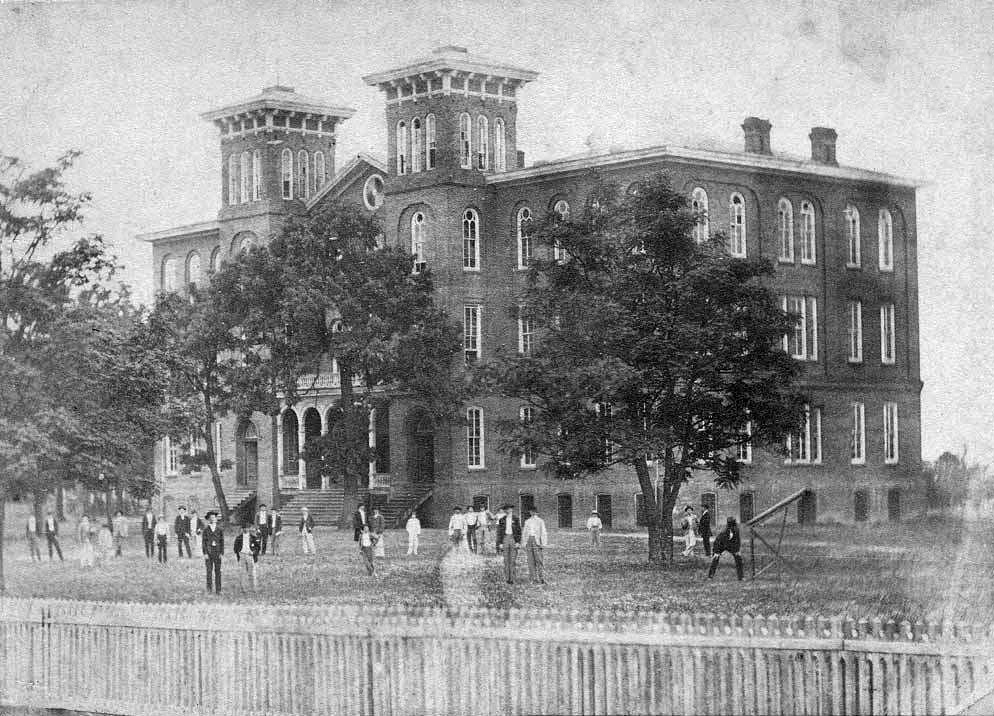
The Alabama Legislature chartered the institution as the East Alabama Male College on February 1, 1856, coming under the guidance of the Methodist Church in 1859. The first president of the college was Reverend William J. Sasnett. The college began operations with a student body of eighty and a faculty of ten in 1859.
Auburn's early history is inextricably linked with the Civil War and the Reconstruction-era South. Classes were held in "Old Main" until the college was closed due to the war when most of the students and faculty left to enlist. The campus was a training ground for the Confederate Army and "Old Main" served as a hospital for Confederate wounded.
A historic landmark cannon lathe, built in Selma and used to bore 7-inch Brooke rifles during the Civil War, was presented to Auburn in 1936 by the Tennessee Coal, Iron and Railroad Company, and rests on the lawn next to Samford Hall. In 1952, the fraternity Alpha Phi Omega held an "ugliest man" contest to fund a bronze plaque for the lathe.

Post-Civil War
The school reopened in 1866 after the end of the Civil War, its only closure. In 1872, control of the institution was transferred from the Methodist Church to the State of Alabama for financial reasons. The Reconstruction-era Alabama government placed the school under the provisions of the Morrill Act as a land-grant institution, the first in the South to be established separately from the state university, which in this case was the University of Alabama. This act provided for 240,000 acres (970 km2) of Federal land to be sold to provide funds for an agricultural and mechanical school. As a result, in 1872, the school was renamed to the Agricultural and Mechanical College of Alabama.
Under the act's provisions, land-grant institutions were also supposed to teach military tactics and train officers for the United States military. In the late 19th century, most students at the Agricultural and Mechanical College of Alabama were enrolled in the cadet program, learning military tactics and training to become officers. Each county in the state was allowed to nominate two cadets to attend the college free of charge.
The university's original curriculum focused on engineering and agriculture. This trend changed under the guidance of William Leroy Broun, who taught classics and sciences and believed both disciplines were important for the growth of the university and the individual. In 1892, two historic events occurred: women were admitted to the Agricultural and Mechanical College of Alabama and football was played as a school sport. Eventually, football replaced polo as the main sport on campus. The college was renamed the Alabama Polytechnic Institute (API) in 1899, largely because of Broun's influence.

On October 1, 1918, nearly all of API's able-bodied male students 18 or older voluntarily joined the United States Army for short-lived military careers on campus. The student soldiers numbered 878, according to API president Charles Thach, and formed the academic section of the Student Army Training Corps. The vocational section was composed of enlisted men sent to Auburn for training in radio and mechanics. The students received honorable discharges two months later, following the Armistice that ended World War I. API struggled through the Great Depression, having scrapped an extensive expansion program by then-President Bradford Knapp. Faculty salaries were cut drastically and enrollment decreased, along with state appropriations to the college. By the end of the 1930s, Auburn had essentially recovered but then faced new conditions caused by World War II.
As war approached in 1940, there was a great shortage of engineers and scientists needed for the defense industries. The U.S. Office of Education asked all American engineering schools to join in a "crash" program to produce what was often called "instant engineers". API became an early participant in an activity that eventually became Engineering, Science, and Management War Training (ESMWT). Fully funded by the government and coordinated by Auburn's Dean of Engineering, college-level courses were given in concentrated, mainly evening classes at sites across Alabama. Taken by thousands of adults – including many women – these courses helped fill the wartime ranks of civilian engineers, chemists, and other technical professionals.
During the war, API also trained U.S. military personnel on campus; between 1941 and 1945, 32,000 troops attended the university in some manner. Following the end of World War II, as with many other colleges around the country, API experienced a period of massive growth caused by returning military personnel taking advantage of the GI Bill's offer of free education. In the years following the end of the war, enrollment at API more than doubled that of pre-war enrollment.

Name change to Auburn
Recognizing the school had moved beyond its agricultural and mechanical roots, it was granted university status by the Alabama Legislature in 1960 and renamed to "Auburn University" which came from it being unofficially called "Auburn" since at least the 1930s, when Jordan-Hare Stadium opened in 1939 as "Auburn Stadium".
Civil rights era to present
Auburn University was racially segregated prior to 1963, with only white students being admitted. Integration began in 1964 with the admittance of the first African-American student, Harold A. Franklin. Franklin had to sue the university to gain admission to the graduate school and was denied a degree after he completed his master's thesis. He eventually was awarded his master's in history in 2020. The first degree granted to an African-American was in 1967. According to Auburn University's Office of Institutional Research and Assessment, African-Americans comprise 1,828 of the university's 24,864 undergraduates (7.35%), as of 2013 and 49 of the 1,192 full-time faculty (4.1%), as of 2012. Auburn has increased its "Black or African American" faculty percentage from 4.3% in 2003 to 4.7% in 2025, since the settlement of legal challenges to the underrepresentation of African Americans in AU's faculty in 2006.
In 2018, the university began a speaker series to promote racial diversity named Critical Conversations. In 2024, Auburn got rid of its Office of Inclusion and Diversity to obey SB 129, the bill that Governor Kay Ivey signed that banned DEI programs.

Campus
The Auburn campus is primarily arranged in a grid-like pattern with several distinct building groups. The northern section of the central campus (bounded by Magnolia Ave. and Thach Ave.) contains most of the College of Engineering buildings, the Lowder business building, and the older administration buildings. The middle section of the central campus (bounded by Thach Ave. and Roosevelt Dr.) contains the College of Liberal Arts (except fine arts) and the College of Education, mostly within Haley Center. The southern section of the central campus (bounded by Roosevelt Dr. and Samford Ave.) contains most of the buildings related to the College of Science and Mathematics, as well as fine arts buildings.
Several erratic building spurts, beginning in the 1950s, have resulted in some exceptions to the subject clusters as described above. Growing interaction issues between pedestrians and vehicles led to the closure of a significant portion of Thach Avenue to vehicular traffic in 2004. A similarly sized portion of Roosevelt Drive was also closed to vehicles in 2005. In an effort to make a more appealing walkway, these two sections have been converted from asphalt to concrete. The general movement towards a pedestrian only campus is ongoing, but is often limited by the requirements for emergency and maintenance vehicular access.
The current period of ongoing construction began around the year 2000. All recently constructed buildings have used a more traditional architectural style that is similar to the style of Samford Hall, Mary Martin Hall, and the Quad dorms. The Science Center complex was completed in 2005. This complex contains chemistry labs, traditional classrooms, and a large lecture hall. A new medical clinic opened behind the Hill dorm area. Taking the place of the old medical clinic and a few other older buildings, is the Shelby Center for Engineering Technology. Phase I of the Shelby Center opened in the Spring of 2008, with regular classes being held starting with the Summer 2008 term. A new Student Center opened in 2008.

In recent years, the university has been replacing or renovating older buildings. Completed in August 2017, the Mell Classroom Building was attached to the Ralph Brown Draughon Library, offering a new flexible learning space. A brand-new 89,000 square foot building for the school of nursing was also finished in 2017; it features active learning classrooms, skill and simulation labs, and public gathering areas. In 2019, two significant projects were finished: the Brown Kopel Engineering Student Achievement Center, which includes classrooms, student study spaces, a wind-tunnel laboratory, meeting spaces, and departmental spaces for professional development and labor relations; and the opening of a new Graduate Business Building, which includes flexible classrooms and lecture halls, student study pods, team areas, and offices for the college's MBA program. Most recent developments include an $83 million academic classroom and laboratory complex with a seating capacity of 2,000 students in 20 adaptable classrooms and laboratories, six EASL classrooms, and five lecture halls. A new 800-seat central dining hall with reservable dining and study areas as well as retail options is also part of the complex. Completed in August 2022, the Tony and Libba Rane Culinary Science Center combines instructional and laboratory space with operational food venues and hotel spaces in which students can obtain experiential real-world training. The new college of education building, scheduled to open in 2024 and located on the site of the former Hill dorms, is one of the projects currently under construction. This building will include collaborative classrooms, instructional laboratories, up-to-date technology, and administrative spaces for faculty and staff. The new 265,000 square foot $200 million STEM+Ag Complex will replace older STEM-related and agricultural science facilities on the former Hill site. It will offer new space for cutting-edge wet and dry research labs, collaboration spaces, shared lab support spaces, and instructional labs for six departments. The complex is scheduled to open in 2026. The STEM + Ag complex represents Auburn's largest-ever investment in academic facilities.
Organization and administration
The university is led by President Christopher Roberts and the Board of Trustees, including Governor Kay Ivey who is the president of board.
Under the president, there are senior vice presidents for student affairs, academic affairs, advancement, business and administration, research and economic development, and legal affairs. There are also various other directors, vice presidents, and the chancellor of Auburn University at Montgomery. Vini Nathan, the provost and senior vice president for academic affairs, which is over the academics at the university, which are organized into 13 colleges and a graduate school:
Academics
The 2025 edition of U.S. News & World Report ranks Auburn as tied for the 105th best national university overall in the U.S., 51st among public universities, and 171st in "Best Value Schools".
Auburn is a charter member of the Southeastern Conference (SEC), currently composed of fifteen of the largest Southern universities in the U.S. Among the other twelve pre-2024 merger peer public universities, Auburn was ranked fourth in the 2011 edition of U.S. News & World Report.
By 2018, this had risen to $778.2 million, thanks to a $500 million "It Begins at Auburn" growth campaign began in 2005, the most successful in school history. By 2017, the university raised over $1.2 billion in the "Because This is Auburn" campaign, being the first university in Alabama to raise over $1 billion as well as being the most successful fundraising campaign in school history.
Auburn University is ranked 6th most LGBTQ-unfriendly campus by The Princeton Review in its 2020 rankings of the 386 American campuses that it surveys.
Auburn's College of Architecture pioneered the nation's first interior architecture degree program; its dual degree Architecture & Interior Architecture degree was the first in the nation. Of special mention is the School's Rural Studio program, founded by the late Samuel Mockbee.
The Samuel Ginn College of Engineering has a 134-year tradition of engineering education, consistently ranking in the nation's largest 20 engineering programs in terms of numbers of engineers graduating annually. The college has a combined enrollment of close to 4,000. In 2001, Samuel L. Ginn, a noted U.S. pioneer in wireless communication and an Auburn alumnus, made a $25 million gift to the college and announced plans to spearhead an additional $150 million in support. This gave Auburn the first Bachelor of Wireless Engineering degree program in the United States. Auburn University was the first university in the Southeast to offer the bachelor of software engineering degree and the master of software engineering degree. Auburn was also the only school to offer a degree in the 2000s for Polymer & Fiber Engineering, combining medical research, advanced composites, sustainability and recycling and other disciplines into an advanced material science offering for undergraduates through doctorate degrees. Despite significant corporate sponsorship, such as from Under Armour, the undergraduate offering of the department was disbanded and absorbed into other departments leaving options for higher degrees.
Auburn has historically placed much of its emphasis on the education of engineers at the undergraduate level and in recent years, has been ranked as high as the 10th largest undergraduate engineering program in the U.S. in terms of the number of undergraduate degrees awarded on annual basis. The Ginn College of Engineering is now focused on expanding the graduate programs and was recently ranked 60th nationally with doctoral programs in engineering by U.S. News & World Report. Last year, the college ranked 67th among all engineering programs.
Auburn's Economics Department (formerly in the College of Business, now in the College of Liberal Arts) was ranked 123rd in the world in 1999 by the Journal of Applied Econometrics. Auburn was rated ahead of such international powerhouses as INSEAD in France (141st) and the London Business School (146th). Auburn's MBA Program in the College of Business has annually been ranked by U.S. News & World Report magazine in the top ten percent of the nation's more than 750 MBA Programs. The Ludwig von Mises Institute (LvMI) offices were once located in the business department of Auburn University, and the LvMI continues to work with the university on many levels.
ROTC programs are available in three branches of service: Air Force, Army, and Navy/Marine Corps with the latter being the only one in Alabama. Over 100 officers that attended Auburn have reached flag rank (general or admiral), including one, Carl Epting Mundy Jr., who served as Commandant of the U.S. Marine Corps. Auburn is one of only seven universities in the Nuclear Enlisted Commissioning Program, and has historically been one of the top ROTC producers of Navy nuclear submarine officers.
In addition to the ROTC graduates commissioned through Auburn, two master's degree alumni from Auburn, four-star generals Hugh Shelton and Richard Myers, served as Chairman of the Joint Chiefs of Staff in the last decade. Both officers received their commissions elsewhere, and attended Auburn for an M.S. (Shelton) and M.B.A. (Myers).
Auburn has graduated six astronauts (including T.K. Mattingly of Apollo 13 fame) and one current and one former director of the Kennedy Space Center. 1972 Auburn Mechanical Engineering graduate Jim Kennedy, currently director of NASA's Kennedy Space Center, was previously deputy director of NASA's Marshall Space Flight Center (MSFC). Several hundred Auburn graduates, primarily engineers and scientists, currently work directly for NASA or NASA contractors. Hundreds of Auburn engineers worked for NASA at MSFC during the peak years of the "space race" in the 1960s, when the Saturn and Apollo moon programs were in full development.
Auburn University owns and operates the 423-acre (1.71 km2) Auburn University Regional Airport, providing flight education and fuel, maintenance, and airplane storage. The Auburn University Aviation Department is fully certified by the FAA as an Air Agency with examining authority for private, commercial, instrument, and multiengine courses. In April 2015, Auburn University received the nation's first FAA approval to operate a new Unmanned Aircraft Systems Flight School as part of the Auburn University Aviation Center. The College of Business's Department of Aviation Management and Supply Chain Management is the only program in the country to hold dual accreditation by the Association to Advance Collegiate Schools of Business (AACSB) and the Aviation Accreditation Board International (AABI). Created over 65 years ago, Auburn's flight program is also the second oldest university flight program in the United States.
The Old Rotation on campus is the oldest continuous agricultural experiment in the Southeast, and third oldest in the United States, dating from 1896. In addition, the work of David Bransby on the use of switchgrass as a biofuel was the source of its mention in the 2006 State of the Union Address.
The university recently began a Master of Real Estate Development program, one of the few in the Southeast. The program has filled a void of professional real estate education in Alabama.
Modern Healthcare ranked Auburn University's Physicians Executive M.B.A. (PEMBA) program in the College of Business ninth in the nation among all degree programs for physician executives, according to the journal's May 2006 issue. Among M.B.A. programs tailored specifically for physicians, AU's program is ranked second.
Auburn's literary journal, the Southern Humanities Review, has been published at the university by members of the English faculty, graduate students in English, and the Southern Humanities Council since 1967. Auburn hosts the Encyclopedia of Alabama's editorial offices and servers and the Alabama Humanities Foundation holds copyright to the encyclopedia's original content.
Student life
Campus events
In 2019, Auburn was ranked first by The Princeton Review's list of happiest students on college campuses thanks in part to its wide variety of campus activities and events.
Campus activities and events begin with orientation and training sessions for new Auburn students. Auburn offers two orientation programs, Camp War Eagle and Successfully Orienting Students. Camp War Eagle is offered to incoming freshmen and their guests, helping familiarize students with the orientation to college life and Auburn. Successfully Orienting Students is designed for college students transferring into Auburn from another academic institution. First-year Auburn students also have the opportunity to participate in seminars with other first-year students and learning communities.
Other prominent campus events and activities include the First 56 and Hey Day. First 56 is the series of programs coordinated by the University Program Council taking place over the first 56 days of the Fall semester period designed to welcome both new and returning students. Hey Day is one of Auburn's most longstanding traditions, dating back to World War II, where the entire campus community wears nametags and greet one another.
Only 11% of Auburn students qualify for a federal Pell grant, even though Alabama has one of the highest poverty rates in the United States. Less than 5% of the student population is Black, even though 30% of the college-age population in Alabama is Black.
Dining
In 2021, Auburn opened the $26 million Central Dining Hall spanning 48,000 square feet with capacity for more than 800 seats and eight different meal stations. Outside of the Central Dining Hall, Auburn students have many options including other dining halls in Foy Hall and The Village residential neighborhood. Students may also visit restaurant chains like Chick-fil-A and Starbucks in addition to locally owned and operated food trucks at various locations across campus.
All Auburn students have access to meal plans, accessible to use at all on-campus dining locations. Students may choose to purchase plans with meal swipes for access to campus dining dollars or opt for a plan with more declining balance to use at standalone restaurants and food trucks, or a combination of both.
Campus dining utilizes the popular mobile food ordering application, Grubhub.
Auburn campus dining is engaged in sustainability practices such as minimizing food waste and reducing food packaging, and campus dining also participates in a local campus community garden for both sustainability and freshness.
Auburn works at addressing and solving student food insecurity. All Auburn students have access to the Campus Food Pantry in the event students face food insecurity.
Housing
Auburn's initial campus master plan was designed by Frederick Law Olmsted Jr. in 1929. For most of the early history of Auburn, boarding houses and barracks made up most of the student housing. Even into the 1970s, boarding houses were still available in the community. It was not until the Great Depression that Auburn began to construct the first buildings on campus that were residence halls in the modern sense. As the university gradually shifted away from agricultural and military instruction to more of an academic institution, more and more dorms began to replace the barracks and boarding houses.
Auburn's on-campus student housing consists of 30 residence halls in nine residential neighborhoods, housing a total of 4,800 residents. On-campus residents are served by 79 resident assistants, 13 housing ambassadors and many other graduate assistants and full-time university employees.
The Quad is the oldest of the five housing complexes, dating to the Great Depression projects begun by the Works Progress Administration and located in Central Campus. Comprising ten buildings split into the Upper and Lower Quads, the Quad houses undergraduate students. Eight of the buildings are coed by floor, the remaining two are female-only. The Quad is located in the center of campus and primarily consists of double-occupancy rooms connected to a bathroom.