
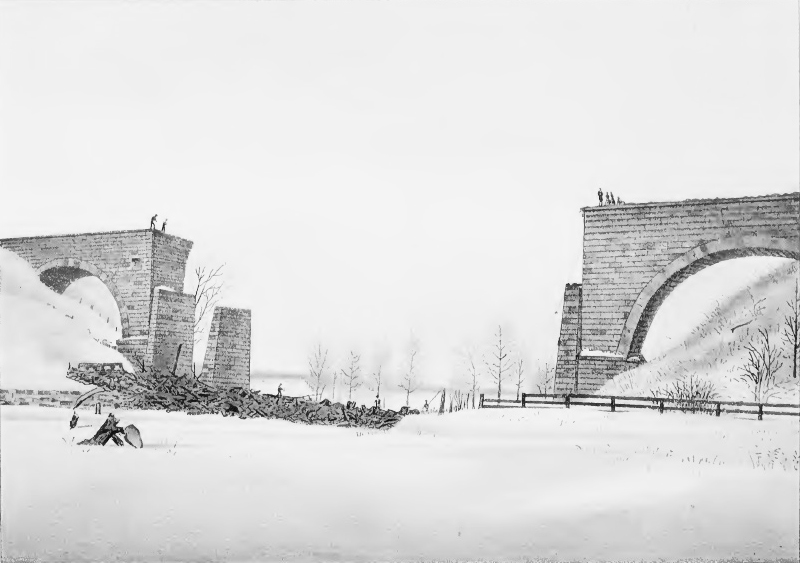
The Ashtabula River railroad disaster (also called the Ashtabula horror, the Ashtabula Bridge disaster, and the Ashtabula train disaster) was caused by the collapse of a bridge over the Ashtabula River near the town of Ashtabula, Ohio, in the United States on Friday, December 29, 1876. The Pacific Express, a train of the Lake Shore and Michigan Southern Railway, was passing over the bridge as it collapsed, falling into the icy river. All but the lead locomotive plunged into the river. The train's oil lanterns and coal-fired heating stoves set the wooden cars alight. Firefighters declined to extinguish the flames, leaving individuals to try to pull survivors from the wreck. Many who survived the crash burned to death in the wreckage. The accident killed approximately 92 of the 160 people aboard. It was the worst rail accident in the U.S. in the 19th century and the worst rail accident in U.S. history until the Great Train Wreck of 1918. It remains the third-deadliest rail accident in U.S. history.
The coroner's report found that the bridge, located about 1,000 feet (300 m) from the railway station, had been improperly designed by the railroad company president, poorly constructed, and inadequately inspected. As a result of the accident, a hospital was built in the town and a federal system set up to formally investigate fatal railroad accidents.
Design and construction of the bridge
In 1863, officials of the Cleveland, Painesville and Ashtabula Railroad (CP&A; one of the predecessors of the Lake Shore and Michigan Southern Railway), decided to replace the wooden bridge over the Ashtabula River just east of the village of Ashtabula, Ohio, with an iron structure. Amasa Stone was president of the CP&A. His construction firm had built the CP&A main line from 1850 to 1852, and Stone had purchased the patent rights to brother-in-law William Howe's truss bridge in 1842. Stone resolved to construct a Howe truss bridge, a commonly used type of railroad bridge, and personally designed the new bridge. The longest span was 154 feet (47 m) long and 76 feet (23 m) above the river below.

Stone also decided to award the contract for the ironwork to the Cleveland Rolling Mill (then known as Stone, Chisholm & Jones Company), an iron and steel company based in Cleveland, Ohio, which was managed by his older brother, Andros Stone. The I-beams were made by the mill. The mill also provided raw iron to the CP&A, which then made the cast and wrought iron elements according to the fabrication plans. Shop master mechanic Albert Congdon oversaw this latter work.
Design
Amasa Stone's bridge was, by his own admission, experimental. He had constructed only one all-iron Howe truss bridge before, a 5-foot (1.5 m) high, 30-foot (9 m) long railroad bridge over the Ohio and Erie Canal in Cleveland.
Joseph Tomlinson, a well-known bridge builder and designer, was hired to flesh out Stone's design and create the fabrication drawings for all the bridge components. Tomlinson designed the bridge's lower chord to have a camber of 6 inches (150 mm). When the falsework supporting the bridge was removed and the dead load of the bridge came into play, the camber would drop to between 3.5 to 4 inches (90 to 100 mm). Tomlinson was alarmed when Stone demanded that the bridge be constructed completely of iron, rather than a combination of wood and iron. An all-iron bridge would have a much greater dead load, reducing the bridge's live load (its ability to carry trains). He also concluded that the beams and posts Stone intended to use were undersized. Tomlinson proposed riveting plates to the I-beams to strengthen them, but Stone angrily refused. Stone demanded that Tomlinson make the changes he required. Tomlinson refused, and was fired from the design effort. Stone then ordered the CP&A's chief engineer, Charles Collins, to make the desired changes to the bridge design. Collins refused, and was fired from the design effort. Stone then made the changes to the design.

Stone made additional changes to the design. In a Howe truss bridge, the vertical posts connect the upper and lower chords (main parallels) in the truss. The deck on which the train travels usually hangs from these posts; the greater the live load, the greater the tension on the posts. The bracing reacts in compression, counteracting the tension. Amasa Stone inverted this design so that only the upper chord (now at the bottom of the bridge) provided tension. Where diagonal braces did not receive the extra compression from a live load, inverted Howe truss bridges had a tendency to buckle where the vertical posts were attached to the deck with cast iron angle blocks. Stone's other major change involved the end panels. In the traditional Howe truss bridge, the end panel on each side of each end of the bridge has three vertical posts and three diagonal braces. Only five Howe truss bridges ever built by 1863 had just one vertical post and two diagonal braces in the end panels. These were known as "Single Howe" bridges. Amasa Stone used the "Single Howe" design for the end panels at Ashtabula. Thus, the bridge's entire structure relied on just 12 beams and posts (three at each end).
Design of the angle blocks
Gasparini and Fields claim that the exact design of the angle blocks and the ends (the "bearings") of the diagonals are lost to history.
Civil engineer Charles MacDonald, who inspected the bridge's original plans in 1877, described and made drawings of part of the angle blocks. He noted that the vertical posts were made of iron pipe 3 inches (76 mm) in diameter with a wall 0.5 inches (13 mm) thick. Inside the pipe ran an iron rod 2 inches (51 mm) thick. The top of the rod passed through the space between the members of the chord at the top of the bridge and then through a gib-plate. A nut and washer screwed onto the upper end of the rod, creating tension as well as securing the gib-plate in place. Those angle blocks at the top of the bridge had vertical, squarish lugs. Those members of the chord which ended atop an angle block had their bearings placed against the lug. These lugs served to transmit stress from the chord to the angle block and thence to the diagonals. These upper angle blocks also had lugs facing inward, to which were attached (by means MacDonald did not describe) the lateral braces. The interior side of each upper angle block also had a recess to accept a lug and a tap bolt. The tap bolt was used to connect the lug on the end of the sway rod to the angle block.

MacDonald described (but did not publish a drawing of) the angle blocks at the bottom of the bridge. The bottom of the rod in the vertical posts screwed into these angle blocks.
The members of the chord at the bottom of the bridge were flat bars, not I-beams, each bar measuring 5 by 0.375 inches (127.0 by 9.5 mm). Where a member of the chord ended at an angle block, a 3-by-1-inch (76 by 25 mm) lug was forged at the base of the bar. This lug fit into a slot in the angle block. The angle blocks which made up the chord at the bottom of the bridge also had lugs facing inward, to which were attached (by means MacDonald did not describe) the lateral braces.
MacDonald and Gasparini and Fields noted that the diagonal I-beams were designed to connect to both the upper and lower angle blocks with the flanges of the I-beam in a vertical position. The web of the I-beam fit into a horizontal slot between two lugs.

It is also known that, at the ends of the bridge, only half of each angle block received load because Stone used only a single diagonal in the end panel. This put enormous shear stress on the bridgeward side of these angle blocks.
Construction
The Ashtabula River bridge was erected in 1865 using Stone's design and plans and partly under his supervision. Tomlinson was the bridge's original construction supervisor, but Stone said he fired him for "inefficiency" at some point during the bridge's construction. Tomlinson was replaced by A. L. Rogers.
When construction began, Tomlinson observed that the I-beams intended for use as diagonals were smaller than the fabrication plans called for.
The amount of camber created a problem during construction. At Congdon's suggestion, Rogers built falsework to support construction of a bridge with a 5-to-7-inch (130 to 180 mm) camber. Stone, now himself supervising Rogers' work, ordered the camber reduced to 3.5 inches (89 mm). With the members of the upper chord now too long, Rogers had the bearings shaved down. It is clear Rogers ordered other changes as well, but it is uncertain what these included. Gasparini and Fields suggest he had the lugs atop the angle block planed down as well. When the falsework began to be removed, the dead load caused the bridge to bend about 2.5 inches (64 mm) below horizontal. The bridge was jacked up and the falsework put back in place. Stone then ordered the chord members to be returned to their original lengths, restoring Tomlinson's intended camber. Rather than ordering new I-beams, Rogers used shims to close the space between the bearings and the lugs.
When the falsework was removed a second time, the bridge buckled where the vertical posts connected to the deck. Several diagonals also buckled. Once more, the falsework went back in place.
To correct this problem, Stone added more iron I-beams to the diagonals to strengthen them. The placement, size, and number of beams added is not clear, but Stone likely added two I-beams to the brace in the end panel, two I-beams to the brace in the first panel from the end, and one I-beam to the second panel from the end. This worsened the bridge's dead load problem. Collins, Congdon, Rogers, and Stone all later testified that the I-beams making up the diagonals were now turned 90 degrees, so that the flanges were horizontal. Congdon says that he realized the I-beams would carry more live load if they were rotated. Collins, Rogers, and Stone believed workers had installed the beams incorrectly (on their sides). To make the change, Stone had workers cut away portions of each diagonal I-beam's web at the bearing, enabling the web to fit over the lugs. This weakened the new diagonals. There is also some evidence that the angle blocks were damaged while the braces and counter-braces were rotated.

The bridge was prestressed again. In every other panel connection, the diagonal braces were fitted to the angle blocks using shims rather than by tightening the vertical posts and putting the diagonals under compression. This meant that the shims carried the weight of a live load, rather than the braces themselves. It is also possible that the shims created uneven contact, causing angle blocks to undergo both bending and shear stress. Nevertheless, the bridge did not sag this time.
Upon completion, the bridge was tested by having three locomotives run over the bridge at speed. A second test had the three engines stand still on the bridge. Deflection was minimal and the bridge rebounded satisfactorily.
Bridge collapse and fire
Blizzard conditions
Train No. 5 of the Lake Shore and Michigan Southern Railway, known as The Pacific Express, left Buffalo, New York, at 2 PM on December 29, 1876, 1 hour and 8 minutes behind schedule. A powerful blizzard had begun hitting northern Ohio, northwest Pennsylvania, and western New York two days earlier. More than 20 inches (510 mm) of snow had already fallen, and winds 24 to 54 miles per hour (39 to 87 km/h) were creating heavy snowdrifts on the railroad tracks 6 feet (1.8 m) deep in places. The snow was so heavy that, shortly after leaving Buffalo, a second engine was added to help pull the train.
The train left Erie, Pennsylvania, at 5:01 PM, an hour and 16 minutes behind schedule. Its two locomotives, Socrates and Columbia, were hauling two baggage cars, two day-passenger coaches, two express coaches, a drawing room car (the Yokohama), three sleeper cars (the Palatine, which originated in New York City and was bound for Chicago; the City of Buffalo, which originated in Boston and was bound for Chicago; and the Osceo, a sleeper for passengers going to St. Louis), and a smoking car with about 150 to 200 passengers and 19 crew aboard. Two additional locomotives were needed to push the train away from the station due to the heavy snow.
Initial collapse and survival of the "Socrates"
The No. 5 was due to arrive in Cleveland at 7:05 PM, but at about 7:30 PM it was just reaching Ashtabula—an hour and 53 minutes behind schedule. About half an hour earlier, the No. 8 passenger train of the LS&MS passed over the Ashtabula River bridge without incident, heading east. The bridge over the Ashtabula River was about 1,000 feet (300 m) east of the Ashtabula station, and the locomotives shut off their steam (cutting off power to the drive) about 66 to 99 feet (20 to 30 m) east of the bridge to allow the train to glide into the station. As the Pacific Express crossed the bridge, it was doing 10 to 15 miles per hour (16 to 24 km/h) (according to the locomotive engineers). Visibility was practically nonexistent, at most one or two car lengths.
As the Socrates neared the western abutment, engineer Daniel McGuire heard a crack and felt his locomotive drop slowly downward. Realizing the bridge was collapsing beneath him, he opened the throttle to maximum. The Socrates lurched ahead, just as the weight of the 11 cars began to pull on the Columbia behind it. The connection between the two locomotives snapped, enabling the Socrates to make it off the bridge. The rear trucks on his tender hung in the air, but the forward movement of the Socrates pulled the tender forward and it regained the rails and solid ground. McGuire brought the Socrates to a halt about 100 yards (91 m) down the track, and began repeatedly sounding his whistle and ringing the train bell in alarm.
Collapse of the remaining bridge
The Columbia and the 11 cars behind it acted like a linked chain load. The bridge's collapse was therefore not sudden, but rather somewhat slow and piecemeal. The Columbia struck the abutment, the engine supported by the stonework while the tender hung downward toward the river valley. The first express car fell into the ravine, crashing nose-first into the ground at the base of the abutment. The Columbia slipped backward off the abutment, landing upside-down and backward atop the first express car. It then fell onto its side, its trucks pointing north.
The second express car and the two baggage cars landed largely upright, slightly south of the bridge. The second baggage car was slightly askew, its nose resting against the western abutment and its rear pointing southeast. Most of the bridge's upper chord (the bottom of the bridge) crashed to the ground north of the bridge. The lower chord (at the top of the bridge) and what remained of the deck held for a moment, then fell directly down to land atop the locomotive, express cars, and baggage cars. Momentum pulled the rest of the train into the space where the bridge used to be. The first passenger coach landed upright in mid-stream atop the wreckage of the bridge and the second express car. The second passenger car twisted in the air as it fell, landing on its side atop the bridge and first baggage car. The smoking car, having broken free of the passenger coach ahead of it, moved more freely. It struck the forward part of the second passenger coach, crushing it, before being propelled into the first passenger coach. (It is widely believed most people in the first passenger coach died when the smoking car fell on them.)
Momentum also carried the parlor car Yokohama and the three sleeper cars into the chasm. All of them landed about 80 feet (24 m) south of the bridge. The Yokohama landed upright in mid-stream, and the sleeper Palatine landed mostly right-side up beside it to the north. The sleeper City of Buffalo then nose-dived into the rear of the Palatine, partially crushing it and killing several people. It continued through the Palatine into the rear of the Yokohama, pushing the parlor car onto its side. The Buffalo smashed forward along the length of the parlor car, likely killing everyone inside. The rear of the Buffalo lay atop the Palatine, high in the air. An eyewitness said no one in the City of Buffalo survived the crash. The final sleeper, the Osceo, landed on the east bank of the river, mostly upright.
Fire and deaths
The crash was heard at the railroad's W. 32nd Street Station (just 100 yards (100 m) to the west of the bridge) and in the town, and the alarm was raised. Rescuers first on the scene included railroad employees, those waiting on the platform at the station, and residents of Ashtabula who lived near the bridge. The only access to the valley floor was a set of steep, narrow steps, covered in snow. Most people slid down the steep incline rather than take the steps, and several people brought axes to help free survivors.
The wooden cars burst into flame when their coal- and kerosene-fed heating stoves and oil lamps overturned. An early report said fire broke out in the Osceo and in at least three other places, and within a minute the entire wreck was ablaze. Historian Darrell E. Hamilton says the fire broke out at either end, and moved toward the middle. According to rear brakeman A.H. Stone, those still left alive in the wreckage were dead within 20 minutes. By the time rescuers reached the bridge, many wounded passengers had already made their way to the shore and the fire was burning fiercely.
The response by the Ashtabula Fire Brigade was minimal. G.W. Knapp, the city's fire chief, was an alcoholic who even when sober was slow to make decisions and easily confused. The Lake Erie Hose Company's hand- and steam-pumped horse-drawn fire engines arrived first, but Knapp never gave any orders to fight the flames. He told a bystander that there was no use in fighting the fire, even though it was plain that some survivors were still trapped in the wreck. Railroad employees also told Knapp that his firefighters should get the wounded out and clear a pathway up the side of the ravine. At least one member of the town begged Knapp to put water on the flames, but he refused. Instead, the townspeople secured buckets and (with the help of some members of the fire brigade) tried to put out the blaze. The Protection Fire Company's hand-pumped engine and the Neptune Hose Company's steam-pumper (both horse-drawn) were hauled more than a mile through town to the bridge, but arrived too late to stop the spread of the fire.
The darkness and blinding snow made it difficult for surviving passengers to orient themselves and get out of the wreck. A number of passengers drowned in the river, while others escaped the blaze only to die of smoke inhalation.
The injured and dying were either carried up the steep steps or hauled up the incline on sleds or sleighs pulled up by rope. There was no hospital in Ashtabula. The injured were first taken to the railroad engine house, to the filthy and run-down Eagle Hotel adjacent to the station, or to the nearby Ashtabula House hotel. As these places filled, residents opened their homes to the survivors. Ambulatory injured were the last to be hauled up from the valley. By midnight, all the survivors had reached safety. The 10 doctors in the village attended to the wounded. About 1 AM, a special train arrived from Cleveland carrying railroad officials and five more surgeons.
Thieves moved among the dead and wounded, stealing money and valuables. A large crowd of the curious gathered at the wreck site the next morning, and some in the crowd looted the train until Ashtabula's mayor, H. P. Hepburn, stationed a guard at the site. Some of the money and valuables were discovered following investigations by local police, and a few arrests made. Hepburn later issued a proclamation promising amnesty for anyone else who turned over stolen items. Money and valuables worth about $1,500 ($45,352 in 2025 dollars) were collected, but most of the stolen money and goods were never recovered.
The number of people killed in the Ashtabula bridge disaster will never be known. The number could be as low as 87 or as high as 200, although the official count is 92 dead. Another 64 people were injured. The number of deaths is inexact, in part because the number of passengers on the train is difficult to estimate and in part because many remains were partial (a hand, a leg, a torso). Most (although not all) remains recovered from the wreck were burned beyond recognition and could not be identified from clothing or personal items. An unknown number of the dead were essentially cremated in the blaze. Among the dead was hymn writer Philip Bliss.
Identifying and burying the dead
Identification of the dead took a week or more. There were full or partial remains of about 36 bodies in the railroad freight house, with concerned families encouraged to come by and try to identify corpses. For several days after the wreck, townspeople and railroad employees used their hands and feet, hoes, rakes, and shovels to dig through the ash, ice, mud, and snow to find any personal items they could. These items—which included partially burned train tickets, diaries, photographs, watches, jewelry, unique or rare items of clothing, or keepsakes—were kept by the railroad. When a corpse could not be identified, grieving families sometimes were able to use these "relics" to confirm that a loved one had been aboard the train. Even so, identifying objects or papers often were separated from remains, and misidentification of remains was common.
Concerned friends and family members sent letters and telegrams in the hundreds to railroad and civic authorities, seeking knowledge of their loved ones. These contained descriptions of the alleged passenger, as well as any identifying personal effects. Some of these letters were fraudulent, sent by people seeking gold watches, jewelry, or other items as "loot". Fraudulent letters tended to be spotted fairly easily, and were not answered.
Wreck investigators were still turning up remains as late as mid-January.
A burial service for the unidentified dead was held at Ashtabula's Chestnut Grove Cemetery on January 19, 1877. A mile-long procession conveyed the dead to the cemetery. The railroad purchased a burial plot in which 18 coffins, containing the remains of an estimated 22 people, were placed.
Three coffins with three corpses remained at the freight house in the hope that they could still be identified. When these remains went unclaimed, they were buried about a week later in the same plot at Chestnut Grove.
Investigation
At dawn on December 30, Ashtabula resident Fred W. Blakeslee took photos of the wrecked bridge and train. These provide the most extensive documentation of the wreck known as of 2003.
Three investigations were made into the disaster.
Conclusions by the coroner's jury
There being no coroner in Ashtabula, a coroner's jury of six men from the town was convened by Justice of the Peace Edward W. Richards on December 31. The jury took testimony from 20 railroad officials and employees (including both locomotive engineers and the rear brakeman), nine members of the Ashtabula fire department, 10 residents of Ashtabula, six passengers, and eight civil engineers and bridge builders. The coroner's jury submitted its report on March 8, 1877.
The coroner's jury blamed the collapse of the Ashtabula River bridge and the deaths by fire on five factors:
The bridge was poorly designed. An all-iron Howe truss was unsuitable for such a long bridge. Some of the members of the chords and braces were not designed to be of sufficient strength, and were poorly placed. The lateral cross-bracing was so underdesigned as to be of little value. The angle blocks had too few and poorly designed lugs, which did not keep the braces and counter-braces from slipping out of place.
The bridge was poorly constructed. Each member of the bridge acted independently instead of being positively connected to its neighbors. Some of the vertical posts, braces, and cross-braces were put in the wrong places. To accommodate design changes during the bridge's strengthening, the lugs on the angle blocks and the flanges on the I-beams of the chords were cut away in part, reducing their strength and effectiveness. The construction of the yokes used to bind the braces and counter-braces was poor, and shims were used to compensate for chord members which were too short. The modifications made to the bridge before its completion used thick members where thin ones were required, and thin ones where thick ones should have been used.
Railroad bridge inspectors did not perform their jobs adequately. Inspectors should have noted the severe deficiencies in the bridge's design and construction, and did not. They also should have observed problems with members becoming loose over time.
The railroad failed to use self-extinguishing heating stoves, as required by state law passed on May 4, 1869.
The fire was worsened by the failure of those on the scene to attempt to douse the flames. The Lake Erie Hose Company's hand pump and steam pump, first on the scene, could have saved lives. The Neptune Hose Company's steam pump and the Protection Fire Company's hand pump were hauled more than 1 mile (1.6 km) through snowdrifts, but arrived too late.