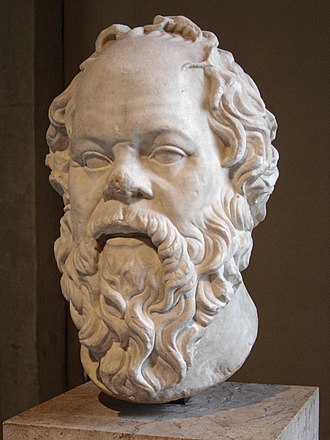
Socrates was an ancient Greek philosopher from Classical Athens, perhaps the first Western moral philosopher, and a major inspiration on his student Plato, who largely founded the tradition of Western philosophy. An enigmatic figure, Socrates authored no texts and is known mainly through the posthumous accounts of classical writers, particularly his students Plato and Xenophon. These accounts are written as dialogues, in which Socrates and his interlocutors examine a subject in the style of question and answer; they gave rise to the Socratic dialogue literary genre. Contradictory accounts of Socrates make a reconstruction of his philosophy nearly impossible, a situation known as the Socratic problem. Socrates was a polarizing figure in Athenian society. In 399 BC, he was accused of impiety and corrupting the youth. After a trial that lasted a day, he was sentenced to death. As related by Plato, he was put to death by administration of poison after refusing offers from allies to help him escape.
Key Facts
| Subject | Socrates |
| Category | Greek philosopher (c. 470–399 BC) |
| Reading time | 1 min · Advanced |
| Key date | 399 BC |
People Mentioned
Reading level
Audio Summary
Played with your browser's voice. Studio-quality audio can be added with a text-to-speech service.
Ask about this article
📝 Quick Quiz1 / 2
What is "Socrates" primarily known for?
Vocix Daily — In Your Inbox
Top stories, deep-dive articles, and "On This Day" history — one crisp digest delivered every morning.
Sources & references
Reference material for this entry is drawn from the open encyclopedic record, including Wikipedia , available under the CC BY-SA 4.0 license. Images are credited individually beside each photo.