
The Portuguese Navy (Portuguese: Marinha Portuguesa), also known as the Portuguese War Navy (Marinha de Guerra Portuguesa) or as the Portuguese Armada (Armada Portuguesa), is the navy of the Portuguese Armed Forces. Chartered in 1317 by King Dinis of Portugal, it is the oldest continuously serving navy in the world; in 2017, the Portuguese Navy commemorated the 700th anniversary of its official creation.
The navy played a key role in Portuguese maritime exploration during the Age of Discovery in the 15th and 16th centuries. The result of this technical and scientific discoveries led Portugal to develop advanced ships, including the caravel, new and more sophisticated types of carracks for interoceanic travel and the oceanic galleon, and to find the sea route to the East and routes to South America and Northern North America.
Bartolomeu Dias rounded the southern tip of Africa and Vasco da Gama reached India, linking Europe and Asia for the first time by ocean route, as well as the Atlantic and the Indian oceans. This led to the discovery of Brazil in the first expeditions that linked Europe, Africa, the New World, and Asia on a single voyage, such as the expedition of Pedro Álvares Cabral, and through the skills and experience of their navigators in the Atlantic, the Indian Ocean, and in the Far East, also contributed to the technical and geographical advance of other European navies, such as the first circumnavigation by Ferdinand Magellan (including, in the expedition, other captains, sailors and pilots), sailing across the Atlantic and the Pacific Ocean.

From the late 15th century until the late 16th century, the Portuguese navy was one of the most powerful maritime forces in the world. For most of the 16th century, the Portuguese India Armadas and fleets, then the world leader in shipbuilding and naval artillery and technology, dominated most of the Atlantic Ocean south of the Canary Islands, the Indian Ocean and the access to the western Pacific.
Following the Iberian Union, the Portuguese Empire and its maritime power lost a significant deal of its prestige, beginning to decline as other newly emerging European imperial powers began to overtake it.
Today, the Portuguese Navy assumes a dual role capacity: naval combat missions to assure Portugal's sovereignty and international commitments, and coast guard operations in its territorial waters and areas of influence. The Portuguese Navy also participates in missions related with international commitments assumed by Portugal (mainly within NATO), as well as missions of civil interest.
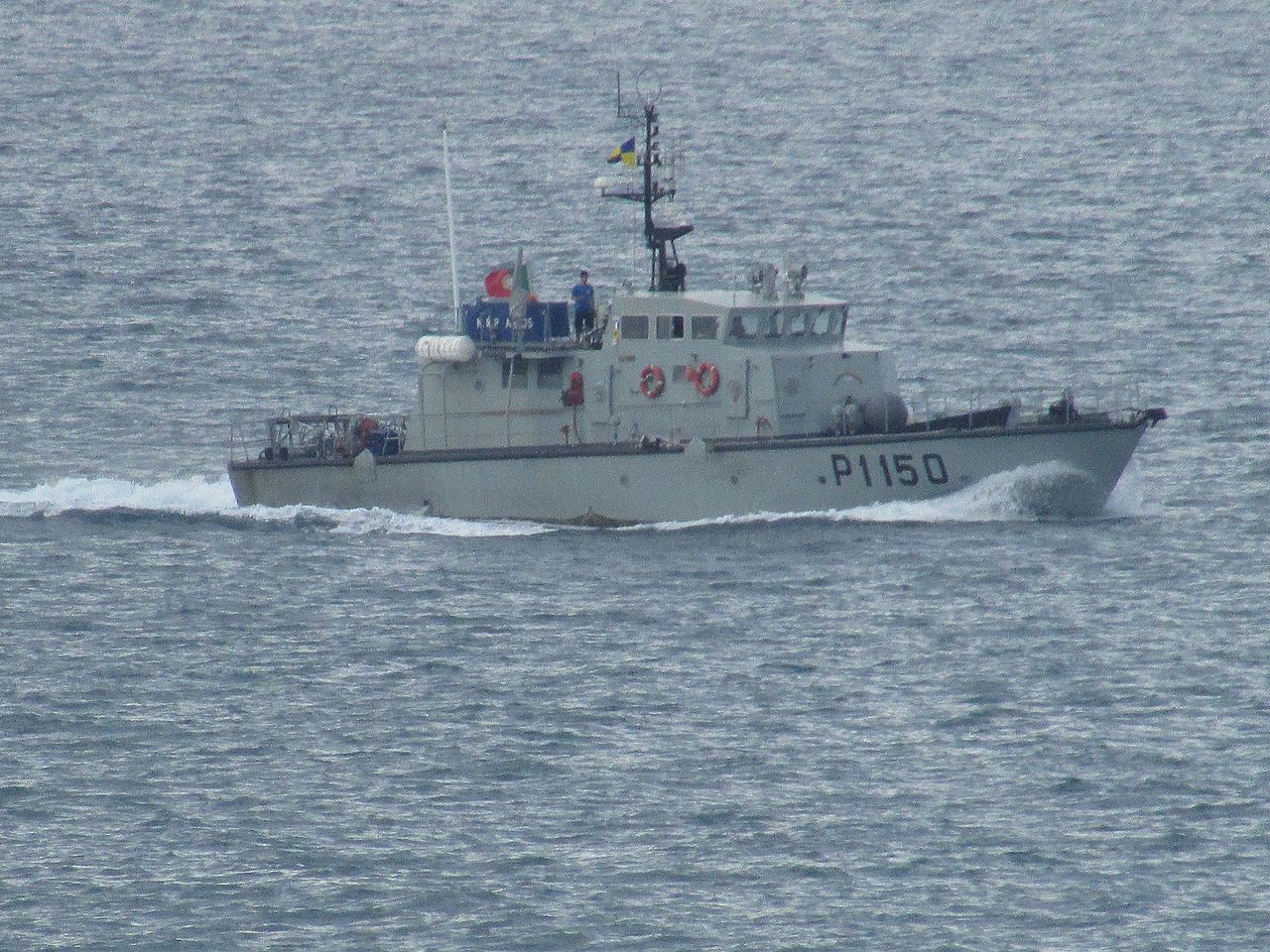
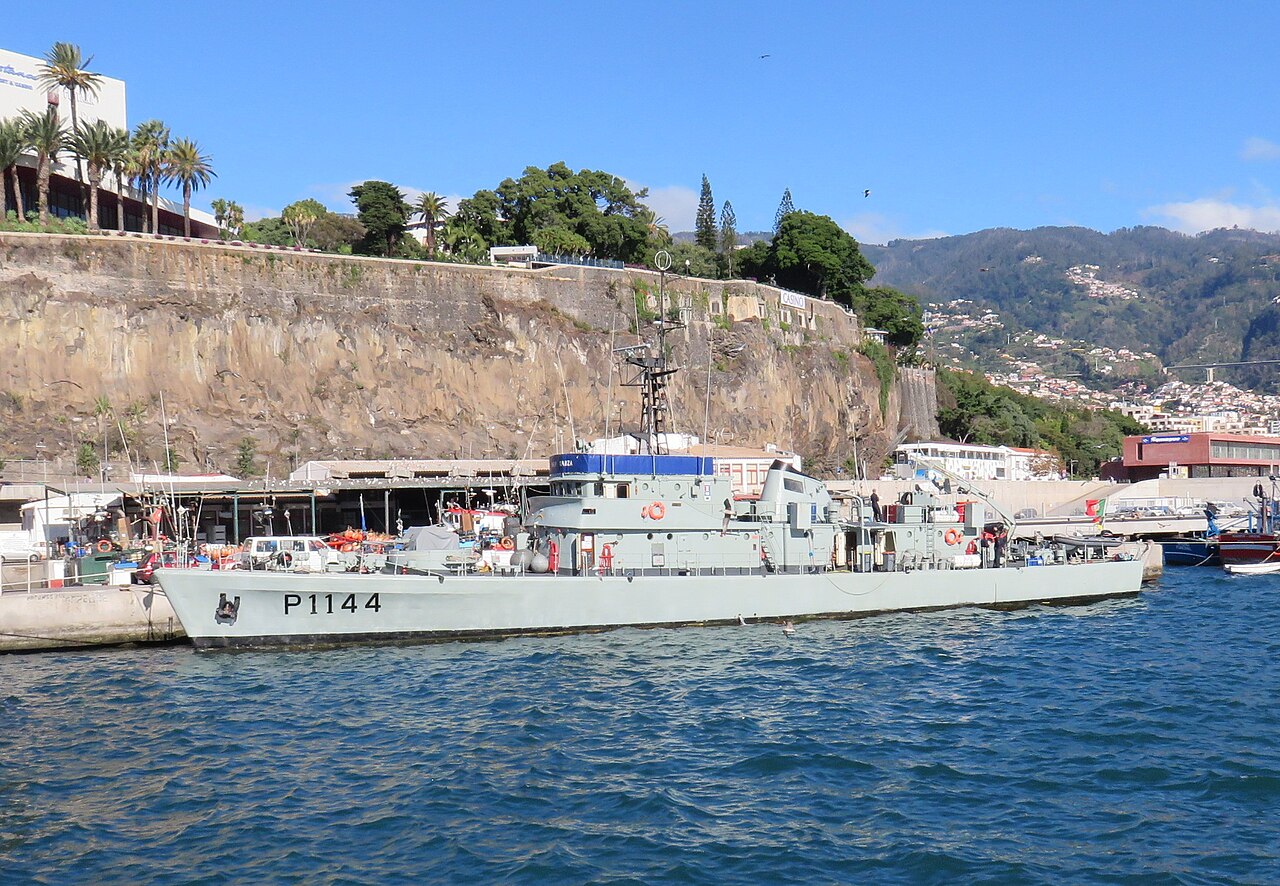
Ships of the Portuguese Navy use the ship prefix NRP for Navio da República Portuguesa, (Ship of the Portuguese Republic).
History
Creation of the Portuguese Navy
The first historically known battle involving Portuguese naval forces happened in 1180, during the reign of Portugal's first king, Afonso I. The battle occurred off Cape Espichel, with a Portuguese naval squadron, commanded by the knight Fuas Roupinho, defeating a Muslim naval squadron. Fuas Roupinho also made two incursions at Ceuta, in 1181 and 1182, and died during the latter of these attempts to conquer the North African city. During the 13th century, in the Reconquista, the Portuguese naval forces helped in the conquest of several coastal Moorish towns, like Alcácer do Sal, Silves and Faro. It was also used in the battles against Castile—through incursions in Galicia and Andalusia—and also in joint actions with other Christian fleets against the Muslims.
King Denis gave a permanent organization to his naval forces, appointing Manuel Pessanha of Genoa to be the first Admiral of the Kingdom, on the 12 December 1317. This is considered the official date of foundation of the Portuguese Navy, with its 700 years being commemorated on the 12 December 2017. In 1321, the Portuguese Navy successfully attacked Muslim ports in North Africa. Maritime insurance began in 1323 in Portugal. Between 1336 and 1341, the first attempts at maritime expansion were made, with an expedition to the Canary Islands, sponsored by King Afonso IV. In the context of the 1383–85 Crisis, the Portuguese Navy took an active participation in the war against Castile.

A Portuguese naval campaign conducted in Galicia led to the conquest of the coastal towns of Baiona, A Coruña and Neda, as well as the destruction of the naval base of Ferrol and of several ships that were on the way to reinforce the Castilian forces that were besieging Lisbon. In July 1384, the Portuguese Navy was able to break the Castilian siege of Lisbon and to supply the city, defeating the Castilian Navy in the naval battle of the Tagus.
Age of Exploration
In the beginning of the 15th century, the country entered a period of peace and stability. Europe was still involved in wars and feudal conflicts which allowed Portugal to be the only capable country to methodically and successfully start the exploration of the Atlantic. Portuguese expansion during the 15th century can be divided in:
Territorial expansion to North Africa

Hydrographic survey of the African coast and Canary Islands
Oceanographic and meteorological survey of the Atlantic Ocean
Development of navigation techniques and methods
Territorial expansion began in Morocco with the conquest of Ceuta in 1415. Exploration in the west African coast started in 1412 and ended with the crossing of the Cape of Good Hope in 1488. After his return from Ceuta, Henry the navigator founded a school of navigation in Sagres.The vessel employed in the beginning of the Discoveries was the caravel, varying from 50 to 160 tons. The first results came soon when Gonçalves Zarco discovered Porto Santo Island in 1419 and Madeira Island in 1420, and Diogo de Silves discovered the azorean island of Santa Maria in 1427. In 1424, Gil Eanes crosses the Cape Bojador. Diogo Cão and Bartolomeu Dias arrived to the mouth of the Zaire River in 1482.
In the same year, the São Jorge da Mina castle was built on the coast of Western Africa, by Diogo de Azambuja, becoming one of the most important Portuguese naval bases. The structure exists to this day and is a robust example of slave trade in this era. In 1488, Bartolomeu Dias became the first European to sail around the southernmost tip of Africa, the Cape of Good Hope. João Vaz Corte-Real arrived at Newfoundland in 1473. Part of the coast of Newfoundland was charted by the Corte-Real brothers, sons of João Vaz Corte-Real, in a failed attempt to find the Northwest Passage in 1501. In 1499, João Fernandes Lavrador and Pero de Barcelos arrive in Labrador ( named after João Fernandes Lavrador ) and map its coast.
The greatest achievement of these exploration voyages was attained by Vasco da Gama, who in 1498 became the European discoverer of the sea route to India. In 1500, when leading a second Portuguese Armada of 13 ships to India, Pedro Álvares Cabral discovered and explored Brazil, claiming it for Portugal. In the same year, Diogo Dias, as one of the Captains of the fleet to India of Pedro Álvares Cabral, is separated from the main fleet by a storm while crossing the Cape of Good Hope, and becomes the first European to reach Madagascar. Besides the already existing role of Admiral of Portugal, the Crown creates the role of Admiral of India, whose first holder becomes Vasco da Gama in 1500.
With the first established sea route to the Indian Ocean, the Portuguese started to use the carrack ship (nau in Portuguese). Nevertheless, the Portuguese penetration in the Indian Ocean was not peaceful due to the opposition of the Muslims. However, in 1509 Francisco de Almeida had a tremendous victory over the Muslims in the naval Battle of Diu, and the Portuguese presence and dominance in the area is definitely attained. In Morocco the Portuguese conquests continued and they took over the cities of Safim, Azamor, Mazagão and Mogador. In the Far East, Portuguese navigators continue their progress visiting the southeast of Asia, China in 1517 and Australia in 1522. In the same period they reached Taiwan (baptizing it Formosa) and Japan where they became the first Europeans to arrive.
They entered the Red Sea in 1542 to destroy the Ottoman armada in Suez. In the West the Portuguese visited the coast of New England in 1520, California in 1542 and Hudson Bay in 1588. All of these actions were only possible with the naval capability and the navigation knowledge of the Portuguese navigators, as well as their courage and determination. In 1520, King Manuel I organized the Portuguese Navy in three permanent armadas (fleets): the Armada of the Coast (for coastal patrol), the Armada of the Islands (based in the Azores, for the protection of the ocean navigation in the North Atlantic) and the Armada of the Strait (operating in the area of the Strait of Gibraltar, to protect the navigation with North Africa and the Mediterranean). The first two fleets were mostly made of ships of the line (carracks and galleons), while the Strait fleet was mostly made of ships powered by oars (fustas and galleys).
These fleets would subsist until the beginning of the 19th century. Besides the permanent three fleets, the Navy continued to organize the ad hoc India armadas, dispatched to India on an annual basis.To aid the Christian forces to conquest Tunis in 1535, King John III sent the Portuguese galleon Botafogo, the world's most powerful warship of the time, armed with between 80 and 200 guns and under the command of the brother of the King, Louis, Duke of Beja. In 1567, a Portuguese naval squadron, under the command of Mem de Sá, took Fort Coligny and expelled the French from the Guanabara Bay.
Habsburg dynasty
Following the Portuguese succession crisis of 1580 and having defeated António, Prior of Crato in the War of the Portuguese Succession, the Habsburg Philip II of Spain became King of Portugal as Philip I. Under the Iberian Union, Portugal continued to be formally an independent kingdom with its own Navy, but its foreign and naval policies became increasingly subordinate to and oriented by Spanish interests. The Portuguese Navy was soon ordered by King Philip to contribute to the Spanish Armada intended to invade England, although England was an old ally of Portugal. Portugal provided the most powerful squadron of ships of the Armada, including its flagship, the galleon São Martinho (called the San Martin by the Spanish).
The Portuguese participation included a squadron of nine galleons (a tenth galleon provided by Tuscany was added to the squadron) and two zabras, and another squadron of four galleys, with a total of 16 vessels and more than 5,800 men. This expedition culminated in the naval battle of Gravelines. Linked to Spain by a dual monarchy, Portugal saw its large Empire being attacked by the English, the French and the Dutch, all enemies of Spain. The reduced Portuguese population (around one million) was not sufficient to resist so many enemies, and the Empire started to fall apart. The Portuguese Navy was still involved in several other conflicts and maintained an important role in the fight against pirates.
António Saldanha commanding a fleet of 30 carracks defeated an Ottoman fleet in the Mediterranean and conquered Tunis. Meanwhile, João Queirós accomplished a double crossing of the Pacific Ocean leaving from California. In 1618, the first naval infantry regiment was founded (Portuguese: Terço da Armada da Coroa de Portugal), origin of both the modern marine corps of Portugal and of Brazil. During 14 days of fighting in February 1625, the Portuguese Navy fought an inconclusive action when a squadron of galleons, commanded by Rui Freire de Andrade, and another one of galleys, commanded by Álvaro Botelho, engaged a combined English and Dutch naval force in the Strait of Hormuz.
Following the battle, Persia and Portugal signed a treaty that regulated their commerce in the gulf. It is generally agreed that the treaty was signed in 1625, but the surviving text is undated and it may have been signed as late as 1630. A major joint Portuguese–Spanish naval and military expedition was organized in April 1625 to retake Salvador da Bahia in Brazil from the Dutch, who had captured the city one year before. The Portuguese fleet was commandeered by Manuel de Menezes and counted 22 ships, including the Terço da Armada da Coroa de Portugal, and about 4,000 men.
Portuguese Restoration War
On 1 December 1640, the Portuguese revolted and restored the full independence of Portugal after 60 years of Spanish domination. To defend its independence, the Portuguese Restoration War had to be fought against the Spanish forces. Although the threat from the powerful Spanish Navy existed, no major naval engagements occurred, with the war being fought mainly on land. At the same time, Portugal made peace agreements with England, France and the Netherlands.
In the period of the Restoration War, the major engagements of the Portuguese Navy were not against the Spanish but against the Dutch, that—despite having signed a peace agreement with the Portuguese—decided to take advantage of the difficult conditions caused by the war effort of Portugal in Europe and to assault and capture some of its colonies in America, Africa and Asia. Despite some important initial setbacks, the Portuguese were finally able to react, repulsing the Dutch assaults on Mozambique, Goa and Macau and recapturing Northeast Brazil, Angola, São Tomé and Ano Bom, in several naval and military campaigns.
18th century
During the reign of John V of Portugal, the Portuguese Navy underwent a large transformation, as warships started being differentiated from merchant ships. In 1705, a Portuguese squadron of eight ships of the line was sent to help England against the Franco-Spanish forces that were besieging Gibraltar, which culminated in the Battle of Cabrita Point. At the request of the Republic of Venice and Pope Clement XI, in 1716 the Portuguese Navy sent a fleet to counter the Ottoman Empire's activities in the Mediterranean Sea. This expedition culminated in the Battle of Matapan on 19 July 1717, in which the Portuguese fleet, supported by the Venetian and Maltese navies, defeated the Ottoman Navy.
From 1762 to 1777, Portuguese naval forces in Brazil participated in the several conflicts that occurred with the Spanish in South America, but with limited success. From 1770, under the leadership of Martinho de Melo e Castro, Secretary of State of the Navy, the Portuguese navy went through large reform and modernization. Incidentally, as part of these reforms, the old procedure of baptizing Portuguese ships with names of Saints was replaced by names of mythical or historical figures and living royals. The Royal Academy of the Midshipmen (Academia Real dos Guardas-Marinhas) was created in 1792, as a university-level naval academy. This Academy is the origin of the present naval schools of Portugal and of Brazil.
In 1792, the three naval regiments (two of infantry and one of artillery) were reorganized and merged as the Royal Brigade of the Navy (Portuguese: Brigada Real de Marinha). This Brigade was commanded by a flag officer and included divisions of naval artillery, naval infantry and naval artificers, with a total of more than 5000 men. Following the execution of Louis XVI by the French revolutionaries, Portugal entered the First Coalition. In 1793, the Portuguese Navy was tasked with transporting by sea and escorting the Portuguese Expeditionary Army sent to help Spain in the War of the Pyrenees against France. This was done by the Transport Squadron organized with four ships of the line, one frigate, four transport ships and 10 merchant ships.
To aid Britain to defend itself from a possible French invasion, the Portuguese Navy organized and sent the Channel Squadron, with five ships of the line, two frigates, two brigantines and a hospital ship. From July 1794 to March 1796, under the command of António Januário do Valle, the Portuguese Channel Squadron patrolled the English Channel in cooperation with the Royal Navy. The Portuguese Navy ended the 18th century with a fleet that included 13 ships of the line, 16 frigates, three corvettes, 17 brigs and eight support ships. In addition, the Portuguese naval forces also included the Navy of India, based in the Indian Ocean, with a ship of the line and six frigates.
Napoleonic Wars and the early 19th century
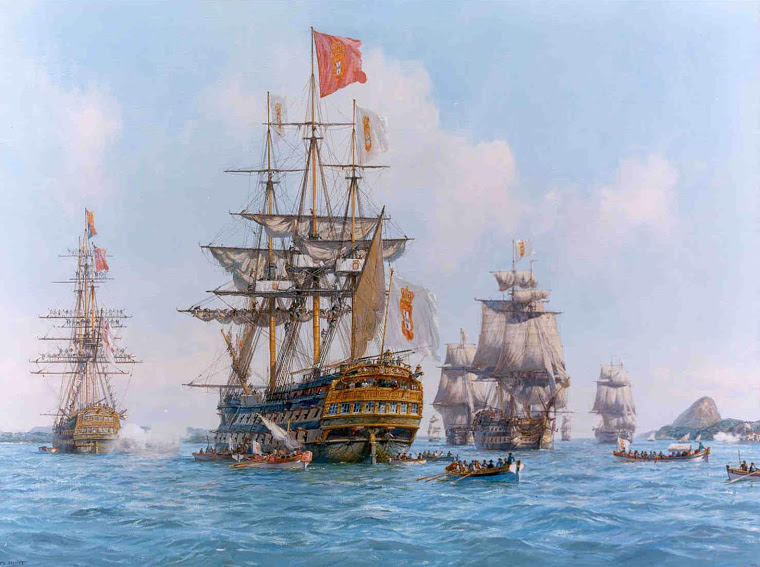
In the late 18th century, under the command of the Marquis of Nisa, the Portuguese Navy took part in the Mediterranean campaign of 1798 against the French Republic in Egypt and in the Siege of Malta. In November 1807, General Jean-Andoche Junot invaded Portugal in an attempt to expand Napoleon's continental empire. With insufficient forces to deter the invasion, in order not to be captured and keep the independence of the Kingdom, the Prince Regent John of Portugal activated an ancient strategic plan that foresaw the transfer of the Portuguese court to Brazil. The Prince Regent called upon his navy to execute this mission and, on 29 November 1807, the Royal Family, the Government and 15,000 state and military officials and their families left Lisbon and sailed to Brazil, carried by a Portuguese fleet that included eight ships of the line, five frigates and five other smaller ships.
The 90-gun ship Príncipe Real served as flagship, carrying on board the Prince Regent and his family. The fleet arrived at Bahia on 22 December, and, finally, at Rio de Janeiro on 8 March 1808. The new Portuguese capital was established in Rio de Janeiro. Carried in the fleet, the Royal Academy of Midshipmen also arrived and was installed in the city, as well as a part of the Royal Brigade of the Navy. In retaliation for the French invasion of Portugal, the Portuguese forces in Brazil conquered Cayenne in January 1809. The amphibious invasion was done by a Portuguese naval flotilla supported by a British frigate, a force of 550 marines of the Royal Brigade of the Navy and 700 Brazilian regulars.
While participating in the Napoleonic Wars in the Western Hemisphere, the Portuguese Navy was also engaged in operations in the waters of Southeast Asia. Between November 1809 and February 1810, the Portuguese naval forces based in Macau conducted a campaign against Chinese pirates of the Guangdong Pirate Confederation, defeating them in a series of naval actions in the Bocca Tigris. Political instability dominated Portugal during the 19th century after the Napoleonic invasions. In 1820, after a Revolution in the city of Oporto, the Constitutional regime is established in Portugal. The Parliament in Lisbon required the return of the King from Brazil to Europe. King John VI returns in 1821, leaving his heir, Prince Peter, as regent of Brazil. After a period of political dispute with the Parliament in Lisbon, Prince Peter finally broke with it and declared the independence of Brazil in 1822, becoming its first Emperor, as Peter I.
Peter I was supported by many of the Portuguese naval personnel stationed in Brazil, whose members became citizens of the new country. The new Brazilian Navy was constituted mainly with the Portuguese ships based in Brazil at that time and their respective crews. In the Brazilian War of Independence, naval engagements occurred between the Brazilian Navy and the Portuguese naval forces in Brazil that remained loyal to the Government of Lisbon. However, the engagements were limited by the fact that the Portuguese that constituted the majority of the crews of the Brazilian ships—although loyal to Pedro I—refused to fight against other Portuguese. The conflict ended in 1825, with Portugal recognizing the independence of Brazil in the Treaty of Rio de Janeiro. In the same year, the Royal Academy of Midshipmen in Rio de Janeiro was divided in two, one for Brazil and the other for Portugal, with the students and faculty members that opted for Portuguese nationality returning to Lisbon.
Portuguese Civil War
The death of King John VI in 1826, together with the disputes between the Absolutists and the Liberals, created a succession and political crisis. Being the heir of the Portuguese Crown, Emperor Peter I of Brazil briefly becomes the King of Portugal, as Peter IV, then abdicating in favor of his eldest daughter, who became Queen Mary II, although still a child. This succession was contested by the absolutists, that considered Peter I of Brazil a traitor and so defended that the crown should go to Michael, Peter's younger brother. After a period as Regent of Portugal in name of Mary II, Michael assumes the Crown himself and becomes King Michael I of Portugal in 1828.
These events gave origin to the Portuguese Civil War. Most of the Portuguese Navy would maintain its loyalty towards Michael, with the Liberals—loyal to Peter and Mary—building a new Navy, mostly made up of foreign ships and crews. The War started when the Liberals took control of the Terceira island in the Azores. The Miguelite Navy tried to retake the island in an amphibious operation, but the assault was repulsed by the defenders in the Battle of Praia da Vitória in 1829. The Miguelite fleet continued to blockade the island. In 1831, Peter I abdicated also from the crown of Brazil in favor of his older son, who become Peter II of Brazil, sailed to Britain and then to Terceira island with military reinforcements.
Meanwhile, the French liberal king Louis Philippe—strong supporter of Peter—sends a fleet to Portugal. The French fleet blockades Lisbon and tries to attack the rearguard of the Miguelite Navy that was blockading Terceira, but obtains limited success. Finally, on 11 July 1831, taking advantage of the absence of the bulk of the Miguelite fleet in the waters of the Azores, the French Navy was positioned at the entrance of the Tagus to compel the Miguelist Government to give in to several French demands, with the few operational and undermanned Portuguese warships (only one ship of the line, four frigates and two corvettes) that were in the Tagus not being able to oppose the superior French forces (six ships of the line, three frigates, three corvettes and four brigs).
Meanwhile, Peter gathers a fleet of about 60 ships, under the command of George Rose Sartorius, that on 8 July 1832, disembarks a force of 7500 men near Mindelo, from where they advance to the nearby city of Oporto, taking it on the next day. The Liberal army becomes them under siege inside Oporto by the Miguelite army that concentrates around the city. A dead-lock occurs then during an entire year, with neither the Miguelite forces being able to take the city neither the Liberal ones being able to break the siege. To break the impasse, the Liberals then decide to open another front in the rearguard of the enemy forces. A naval fleet sails from Oporto on 20 June 1833—with half of the Liberal army on board—and disembarks it in the Algarve. On the return voyage, the Liberal fleet under the command of Charles Napier encounters and defeats the Miguelite fleet under the command of Manuel António Marreiros in the Battle of Cape St. Vincent on 5 July 1833. The Civil War finally ended on 24 May 1834, when Michael I signed the Concession of Evoramonte, renouncing all claims to the Portuguese throne.
The long period of conflict that goes from the Napoleonic Wars to the end of the Civil War weakened the country and caused a sharp decline of its Navy. This decline was further reinforced due to the mutual mistrust between the Liberal politicians and the Navy due their past in the Civil War, symbolized by the disagreement between Queen Mary II and the Navy that will cause that, during the whole Constitutional Monarchy, this will never receive regimental colors, with its landed forces always parading carrying a simple guidon. This mistrust resulted in a lack of priority given by the Government towards the navy, with a neglecting in the investment in the naval forces for many years. In this period, the Portuguese Navy lost most of its capacity as a global blue-water navy, becoming a small naval force limited of having merely the capacity to patrol of the littoral zone of Portugal and do the naval policing of the Portuguese colonies.
Late 19th century to World War I
In the 1830s, the Portuguese Navy incorporated its first steamships. The last Portuguese ship of the line, the 80-gun Vasco da Gama, was built in Lisbon in 1841 and the last sailing frigate, the 60-gun Dom Fernando II e Glória, was built in Daman (Portuguese India) in 1845. From the late 1850s, the navy gradually replaced its sailing ships by steam or mixed propulsion ships, its principal warships becoming the mixed-propulsion corvettes for the high seas operations and the gunships mainly for coastal and colonial patrols. In 1880, the Portuguese fleet included an armored corvette, six corvettes, 13 gunships, three training ships and four support ships.
At the end of the 19th century and, specially, following the Berlin Conference called for by Portugal, the navy participated in the Portuguese exploration and mapping of the interior of Africa. From the Portuguese explorers of the African hinterland, stood out the naval officers Hermenegildo Capelo, Brito Capelo and Roberto Ivens that made several expeditions since the late 1870s. Hermenegildo Capelo and Roberto Ivens made the first land connection between Angola and Mozambique, crossing the interior of Africa by unexplored territory, leaving the west coast in January 1884 and arriving at the east coast in September 1885.
In this period, the Navy also focused on the mission of the naval defense of Lisbon, complementing its ground defense. This was part of the national strategy which considered that the defense of Portugal would be assured by the defense of its capital and most important city. As part of this mission, in 1876, the Portuguese Navy acquired the ironclad Vasco da Gama, its first armored vessel, intended to operate as a floating coastal defense battery. The plans for the naval defense of Lisbon would also include the use of torpedo boats and submarines, that are later also acquired.
In 1882, the Portuguese Navy receives its first torpedo boat and, in 1884, it receives the corvette Afonso de Albuquerque, its first unprotected cruiser.
In 1889, Naval Lieutenant João Augusto Fontes Pereira de Melo presented the project of a "submarine station". A model of the so-called submarine Fontes was tested in the Naval Arsenal of Lisbon.
At the end of the 19th century, the Portuguese Navy had the conscience that it did not have a capable force to defend the Portuguese European waters and ports against a possible enemy aggression. The Portuguese naval theorists started to defend the use of the submarine as the only weapon capable to face a more powerful enemy navy.
In 1896, an emergency naval program proposed by the Navy Minister Jacinto Cândido da Silva was approved. This included the construction of four protected cruisers, which replace the mixed propulsion corvettes as the primary ships of the fleet. A fifth cruiser was also ordered in the scope of a public subscription organized as a response to the 1890 British Ultimatum. In 1901, the old ironclad Vasco da Gama suffered a major refurbish, being transformed in an armored cruiser and, in 1907, the first submarine was ordered.
From the end of the 19th century until the beginning of the 20th century, the Portuguese Navy participated in a series of colonial pacification campaigns, aimed to neutralize local uprisings and to enforce Portuguese sovereignty in Angola, in Mozambique, in the Portuguese Guinea and in other overseas territories. Most of the campaigns were in charge of the army, but the navy actively supported them, including leading some of the operations. For these campaigns, the Portuguese Navy organized a brown-water navy constituted mainly by river gunboats that operated in the African rivers in support of the ground forces. The navy also organized expeditionary naval infantry units that operated in Africa as landing forces in support of the army units.
The Báruè Campaign, in 1902, stood out as an example of a colonial campaign led by the Navy and where important naval assets were employed. The campaign was aimed to pacify the Báruè, a hinterland region of central Mozambique, crossed by the Pungwe River. The operations were under the overall command of Lieutenant-Commander João Coutinho. They included the initial maritime movement of troops by the cruisers São Gabriel and São Rafael and the gunships Chaimite and Liberal, from several areas in Mozambique and its concentration in the area of operations. The operations in the Pungwe River were conducted by the gunboats of the Zambezi Flotilla, reinforced with chartered merchant vessels. The landing forces included Army artillery and infantry troops, Colonial native units and naval infantry forces constituted by sailors detached from the crews of the ships of the Mozambique Naval Station.
In the beginning of the 20th century, the Portuguese Naval League started to study a program of reforms and equipment to apply to the Portuguese Navy. These studies were mainly led by young naval officers from which stood out Lieutenant Álvaro Nunes Ribeiro and Lieutenant Fernando Pereira da Silva.
The modernization of the Portuguese Navy in the last years of the Monarchy meant that in 1910, it had sophisticated ships, already equipped with electric energy, wireless communications, torpedoes and modern artillery. The fleet included six cruisers, four torpedo boats, a torpedo gunboat, thirteen gunships and other auxiliary and minor vessels, with a submarine under construction. Nonetheless, owing to financial problems as a result of mismanagement and failure to develop its African possessions, Portugal was unable to maintain a larger fleet.