
Christianity in the 1st century covers the formative history of Christianity from the start of the ministry of Jesus (c. 27–29 AD) to the death of the last of the Twelve Apostles (c. 100) and is thus also known as the Apostolic Age. Early Christianity developed out of the ministry of Jesus. Subsequent to Jesus' death, his earliest followers formed an apocalyptic messianic Jewish sect during the late Second Temple period of the 1st century.
Paul the Apostle, a Pharisee who had persecuted the early Christians of Judea, converted c. 33–36 and began to proselytize among the Gentiles. According to Paul, Gentile converts were exempted from Jewish commandments, arguing that all are justified by their faith in Jesus. This was part of a gradual split between early Christianity and Judaism, as Christianity became a distinct religion including predominantly Gentile adherence.
Jerusalem had an early Christian community led by James the Just, Peter, and John. According to Acts 11:26, Antioch was where the followers were first called Christians. Peter was later martyred in Rome, the capital of the Roman Empire. The apostles went on to spread the message of the Gospel around the classical world and founded apostolic sees around the early centers of Christianity. The last apostle to die was John in c. 100.

Etymology
Early Jewish Christians referred to themselves as "The Way" (ἡ ὁδός), probably coming from Isaiah 40:3, "prepare the way of the LORD". Other Jews also called them "the Nazarenes". According to Acts 11:26, the term Christian (Greek: Χριστιανός), meaning "follower of Christ", was first used in reference to Jesus's disciples in the city of Antioch. The earliest recorded use of the term "Christianity" (Greek: Χριστιανισμός) was by Ignatius of Antioch, in around 100 AD.
Origins
Jewish–Hellenistic background
The earliest Christians were an apocalyptic sect within Second Temple Judaism. The basic tenet of Second Temple Judaism was ethical monotheism. Jews believed God had chosen them to be his people and had made a covenant with them. As part of this covenant, God gave his people the Torah (Law) to guide them in their worship of God and in their interactions with each other. The law required Jews to observe the Sabbath, follow kosher dietary laws, and circumcise their male children. Judaism's holiest place was the Temple in Jerusalem, where a hereditary priesthood offered sacrifices of incense, food, and various kinds of animals to God. Sacrifices could only be offered at the Temple, but Jews in both Palestine and throughout the Diaspora established synagogues as centers of prayer and study of Judaism's sacred scriptures.
Christianity "emerged as a sect of Judaism in Roman Palestine" in the Hellenistic world of the first century AD, which was dominated by Roman law and Greek culture. A major challenge for Jews during this time was how to respond to Hellenization and remain faithful to their religious traditions. During the early 1st century AD, there were many competing Jewish sects in the Holy Land, including Pharisees, Sadducees, Essenes, and other groups. Each group adopted different stances toward Hellenization.

In this context of foreign domination, Jewish apocalypticism became widespread. Apocalypticism is the belief that God would soon destroy the cosmic forces of evil currently ruling the world and establish an eternal kingdom. To accomplish this, God would send a savior figure or messiah. Messiah (Hebrew: meshiach) means "anointed" and is used in the Bible to designate Jewish kings and in some cases priests and prophets whose status was symbolized by being anointed with holy anointing oil.
It can refer to people chosen by God for a specific task, such as the whole Israelite nation (1 Chronicles 16:22; Psalm 105:15) or Cyrus the Great who ended the Babylonian captivity (Isaiah 45:1). The term is most associated with King David, to whom God promised an eternal kingdom (2 Samuel 7:11–17). After the destruction of David's kingdom and lineage, this promise was reaffirmed by the prophets Isaiah, Jeremiah, and Ezekiel, who foresaw a future Davidic king who would establish and reign over an idealized kingdom.
In the Second Temple period, there was no consensus on who the messiah would be or what he would do. Most commonly, he was imagined to be an Endtimes son of David going about the business of "executing judgment, defeating the enemies of God, reigning over a restored Israel, establishing unending peace". The messiah was often referred to as "King Messiah" (Hebrew: מלך משיח, romanized: melekh mashiach) or malka meshiḥa in Aramaic. Yet, there were other kinds of messianic figures proposed as well—the perfect priest or the celestial Son of Man who brings about the resurrection of the dead and the final judgment. The concept has its root in the apocalyptic literature of the 2nd century BC to 1st century BC.

Demographics
In 60 AD, there were hundreds, but not tens of thousands of Christians. At the end of the 1st century AD, there were 7000–7500 Christians in the whole world. Historians do not believe the numbers given in the book of Acts. Bart Ehrman supports the figures of 1000–1500 Christians in 60 AD, and 7000–10000 Christians in 100 AD. Keith Hopkins and Christopher Kelly support the figure of 1400 Christians in 50 AD.
Life and ministry of Jesus
Historical person
Biblical scholar Graham Stanton notes that "nearly all historians, whether Christian or not, accept that Jesus existed", and more is known about him than any other 1st or 2nd-century religious teacher with the exception of Paul. The two events of Jesus' life subject to "almost universal assent" are that Jesus was baptized by John the Baptist and was crucified by the order of Pontius Pilate, the Roman prefect. Biblical scholar Amy-Jill Levine summarizes the scholarly consensus on Jesus' life as follows:
Most scholars agree that Jesus was baptized by John, debated with fellow Jews on how best to live according to God's will, engaged in healings and exorcisms, taught in parables, gathered male and female followers in Galilee, went to Jerusalem, and was crucified by Roman soldiers during the governorship of Pontius Pilate (26–36 CE). But, to use the old cliché, the devil is in the details.

There is widespread disagreement among scholars on the details of the life of Jesus mentioned in the gospel narratives, and on the meaning of his teachings. Concerning the accuracy of the accounts, viewpoints run the gamut from considering them inerrant descriptions of Jesus's life, to doubting whether they are historically reliable on a number of points, to considering them to provide very little historical information about his life beyond the basics. According to Bart Ehrman, the gospels are "filled with nonhistorical material, accounts of events that could not have happened", and contradictory accounts of the same events. As historical sources, the gospels have to be "weighed and assessed critically". Scholars often draw a distinction between the Jesus of history and the Christ of faith, and two different accounts can be found in this regard.
Academic scholars have constructed a variety of portraits and profiles for Jesus. Contemporary scholarship places Jesus firmly in the Jewish tradition, and the most prominent understanding of Jesus is as a Jewish apocalyptic prophet or eschatological teacher. Other portraits are the charismatic healer, the Cynic philosopher, the Jewish Messiah, and the prophet of social change.
Ministry and eschatological expectations
In the canonical gospels, the ministry of Jesus begins with his baptism in the countryside of Roman Judea and Transjordan, near the Jordan River, and ends in Jerusalem, following the Last Supper with his disciples.
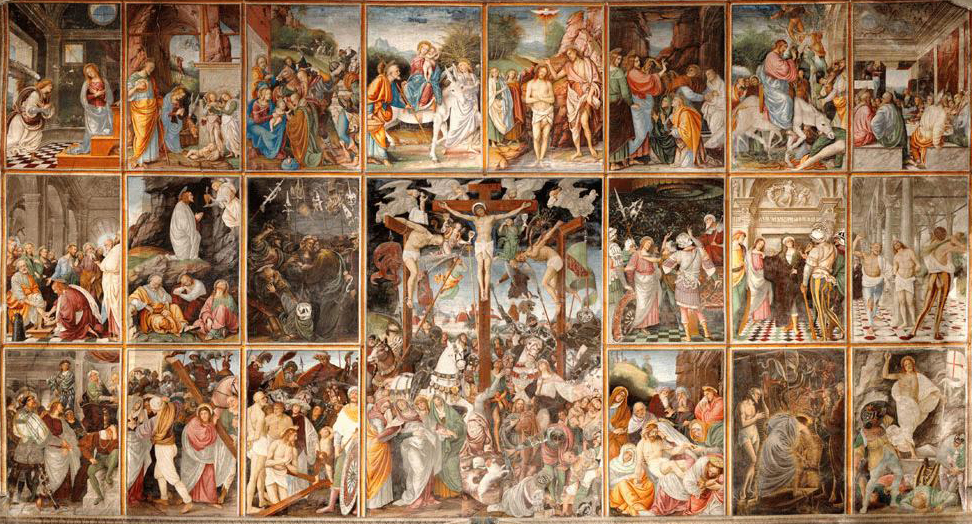
The Gospel of Luke (Luke 3:23) states that Jesus was "about 30 years of age" at the start of his ministry. A chronology of Jesus typically has the date of the start of his ministry estimated at AD 27–29 and the end in the range AD 30–36.
In the Synoptic Gospels (Matthew, Mark and Luke), Jewish eschatology stands central. After being baptized by John the Baptist, Jesus teaches extensively for a year, or maybe just a few months, about the coming Kingdom of God (or, in Matthew, the Kingdom of Heaven), in aphorisms and parables, using similes and figures of speech.
In the Gospel of John, Jesus himself is the main subject.

The Synoptics present different views on the Kingdom of God. While the Kingdom is essentially described as eschatological, some texts present the Kingdom as already being present, while other texts depict the Kingdom as a place in heaven that one enters after death, or as the presence of God on earth.. While some sayings suggest Jesus expected the end to be close, others place time between his presence and the final events, suggesting that Jesus understood the coming of the kingdom of God to be conditional on repentance with a changeable date. Jesus talks as expecting the coming of the "Son of Man" from heaven, an apocalyptic figure who would initiate "the coming judgment and the redemption of Israel." According to Davies, the Sermon on the Mount presents Jesus as the new Moses who brings a New Law (a reference to the Law of Moses, the Messianic Torah.
Death and resurrection
Jesus' life was ended by his execution by crucifixion. His early followers believed that three days after his death, Jesus rose bodily from the dead. Paul's letters and the Gospels contain reports of a number of appearances after his death and burial.
Conservative Christian scholars, in addition to apologists and theologians, generally present these as being descriptions of real appearances of a resurrected and transformed physical body. According to N.T. Wright, there is substantial unanimity among the early Christian writers in the first and second century, that Jesus had been bodily raised from the dead. Craig L. Blomberg argues there are sufficient arguments for the historicity of the resurrection. In secular and Liberal Christian scholarship, these appearances are argued to be descriptions of visionary post-mortem experiences of Jesus.
According to this view, Jesus' death was reinterpreted as an eschatological event, feeding ecstatic experiences of Jesus, and the sense of Jesus being alive "signalled for earliest believers that the days of eschatological fulfilment were at hand." Gerd Lüdemann argues that Peter had a vision of Jesus, induced by his feelings of guilt for betraying Jesus. The vision elevated this feeling of guilt, and Peter experienced it as a real appearance of Jesus, raised from dead.
The belief in the resurrection of Jesus gave the impetus in certain Christian sects to the exaltation of Jesus to the status of divine Son and Lord of God's Kingdom and the resumption of their missionary activity. His followers expected Jesus to begin the Kingdom of God.
Jewish Christianity
Christianity originated as a Jewish movement in Judaea during the 1st century AD, within the context of late Second Temple Judaism. Traditionally, the period from the death of Jesus until the death of the last of the Twelve Apostles is called the Apostolic Age. According to the Bible, the first Christians were men and women who had known Jesus and who witnessed to his resurrection.
The earliest followers of Jesus were Jews who understood his life, death and expected return through familiar Jewish apocalyptic and messianic frameworks. They remained embedded in Jewish religious life and did not initially conceive of themselves as departing from Israel or founding a new faith. Following their conviction that Jesus had been raised from the dead, they established a community in Jerusalem. They were a Jewish sect with an apocalyptic eschatology. They regarded Jesus as Lord, resurrected messiah, and the eternally existing Son of God, expecting the second coming of Jesus and the start of God's Kingdom.
They pressed fellow Jews to prepare for these events and to follow "the way" of the Lord. They believed Yahweh to be the only true God. This early community was led by the three Pillars of the Church, namely James the Just, Peter, and John. What eventually became of this earliest Christ-following community remains unclear; they were possibly displaced, relocated, or killed when the Romans destroyed Jerusalem in 70 AD.
Meanwhile, as the message about Jesus spread beyond Judea and Galilee into the broader Greco-Roman world, it increasingly attracted Gentile adherents, especially among "God-fearers": non-Jews who were attracted to Judaism and participated in synagogal worship without fully converting. This created a challenge for the movement's Jewish religious outlook, which insisted on close observance of the Jewish commandments. Against this backdrop, Paul the Apostle, a Jew of the Pharisaic school who had initially persecuted the Jesus movement, became one of its most influential missionaries following his conversion, focusing on spreading the message to non-Jews in the Eastern Mediterranean.
Paul argued that Gentiles could participate in the promises of Israel through exclusive devotion to the God of Israel, faith in Christ, baptism, and participation in his death and resurrection, without full adherence to the Torah, including circumcision. This had a formative effect on the emerging Christian identity as separate from Judaism. Over time, such developments contributed to the gradual differentiation between the Jesus movement and other Jewish communities, a process that resulted in the emergence of Christianity as a separate religion.
The Jerusalem ekklēsia
The New Testament's Acts of the Apostles and Epistle to the Galatians record that an early Jewish Christian community centered on Jerusalem, and that its leaders included Peter, James, the brother of Jesus, and John the Apostle.
The Jerusalem community "held a central place among all the churches," as witnessed by Paul's writings.
Reportedly legitimised by Jesus' appearance, Peter was the first leader of the Jerusalem ekklēsia.
Peter was soon eclipsed in this leadership by James the Just, "the Brother of the Lord," which may explain why the early texts contain scant information about Peter. According to Lüdemann, in the discussions about the strictness of adherence to the Jewish Law, the more conservative faction of James the Just gained the upper hand over the more liberal position of Peter, who soon lost influence. According to Dunn, this was not an "usurpation of power," but a consequence of Peter's involvement in missionary activities. The relatives of Jesus were generally accorded a special position within this community, which also contributed to the ascendancy of James the Just in Jerusalem.
According to a tradition recorded by Eusebius and Epiphanius of Salamis, the Jerusalem church fled to Pella at the outbreak of the First Jewish–Roman War (AD 66–73).
The Jerusalem community consisted of "Hebrews," Jews speaking both Aramaic and Greek, and "Hellenists," Jews speaking only Greek, possibly diaspora Jews who had resettled in Jerusalem. According to Dunn, Paul's initial persecution of Christians probably was directed against these Greek-speaking "Hellenists" due to their anti-Temple attitude. Within the early Jewish Christian community, this also set them apart from the "Hebrews" and their Tabernacle observance.
Beliefs and practices
Creeds and salvation
The sources for the beliefs of the apostolic community include oral traditions (which included sayings attributed to Jesus, parables and teachings), the Gospels, the New Testament epistles and possibly lost texts such as the Q source and the writings of Papias.
The texts contain the earliest Christian creeds expressing belief in the resurrected Jesus, such as 1 Corinthians 15:3–41:
[3] For I handed on to you as of first importance what I in turn had received: that Christ died for our sins in accordance with the scriptures, [4] and that he was buried, and that he was raised on the third day in accordance with the scriptures, [5] and that he appeared to Cephas, then to the twelve. [6] Then he appeared to more than five hundred brothers and sisters at one time, most of whom are still alive, though some have died. [7] Then he appeared to James, then to all the apostles.
The creed has been dated by some scholars as originating within the Jerusalem apostolic community no later than the 40s, and by some to less than a decade after Jesus' death, while others date it to about 56. Other early creeds include 1 John 4 (1 John 4:2), 2 Timothy 2 (2 Timothy 2:8), Romans 1 (Romans 1:3–4) and 1 Timothy 3 (1 Timothy 3:16).
Christology
Two fundamentally different Christologies developed in the early Church, namely a "low" or adoptionist Christology, and a "high" or "incarnation Christology". The chronology of the development of these early Christologies is a matter of debate within contemporary scholarship.
The "low Christology" or "adoptionist Christology" is the belief "that God exalted Jesus to be his Son by raising him from the dead", thereby raising him to "divine status". According to the "evolutionary model" c.q. "evolutionary theories", the Christological understanding of Christ developed over time, as witnessed in the Gospels, with the earliest Christians believing that Jesus was a human who was exalted, c.q. adopted as God's Son, when he was resurrected.
Later beliefs shifted the exaltation to his baptism, birth, and subsequently to the idea of his eternal existence, as witnessed in the Gospel of John. This evolutionary model, begun by the history of religious school, was very influential, and the "low Christology" was regarded as the oldest throughout much of the twentieth century.
The other early Christology is "high Christology", which is "the view that Jesus was a pre-existent divine being who became a human, did the Father's will on earth, and then was taken back up into heaven whence he had originally come", and from where he appeared on earth. According to Hurtado, a proponent of an Early High Christology, the devotion to Jesus as divine originated in early Jewish Christianity, and not later or under the influence of pagan religions and Gentile converts. The Pauline letters, which are the earliest Christian writings, already show "a well-developed pattern of Christian devotion [...] already conventionalized and apparently uncontroversial".
Some Christians began to worship Jesus as Lord.
Eschatological expectations
Many scholars argue that a conditional understanding of eschatology is present in the gospels, with the date of the parousia being dependent on repentance rather than being fixed. While Jesus' early followers expected the installment of the Kingdom of God, its nonarrival was understood to be the result of a lack of repentance by Israel. Paula Fredriksen argues that the earliest Christians believed in the imminent arrival of the Parousia and sought to spread this message throughout Israel and the Jewish diaspora. Jesus' resurrection signaled the Kingdom of God changed into a belief in immediate reward in heaven after death, the confirmation of the Messianic status of Jesus, and a Second Coming, heralding the expected endtime. Ferda argues that the historical Jesus predicted his death and second return after a period of absence.
Angels and Devils
Coming from a Jewish background, early Christians believed in angels (derived from the Greek word for "messengers"). Specifically, early Christians wrote in the New Testament books that angels "heralded Jesus' birth, Resurrection, and Ascension; ministered to Him while He was on Earth; and sing the praises of God through all eternity." Early Christians also believed that protecting angels—assigned to each nation and even to each individual—would herald the Second Coming, lead the saints into Paradise, and cast the damned into Hell." Satan ("the adversary"), similar to descriptions in the Old Testament, appears in the New Testament "to accuse men of sin and to test their fidelity, even to the point of tempting Jesus."