
The "American Dream" is a phrase referring to the national ethos of the United States: that every person has the freedom and opportunity to succeed and attain a better life. The tenets of the American Dream originate from the Declaration of Independence, which states "all men are created equal", and have an inalienable right to "life, liberty, and the pursuit of happiness". The Preamble to the Constitution states similarly that the Constitution's purpose is to, in part, "secure the Blessings of Liberty to ourselves and our Posterity".
The phrase was popularized by James Truslow Adams during the Great Depression in 1931; Adams defines it as
that dream of a land in which life should be better and richer and fuller for everyone, with opportunity for each according to ability or achievement. [...] It is not a dream of motor cars and high wages merely, but a dream of social order in which each man and each woman shall be able to attain to the fullest stature of which they are innately capable, and be recognized by others for what they are, regardless of the fortuitous circumstances of birth or position.

However, the term has evolved over time to have different connotations. Originally, the emphasis was on democracy, liberty, and equality, but more recently has been on achieving success, which is typically exemplified by attaining material wealth as well as upward social mobility.
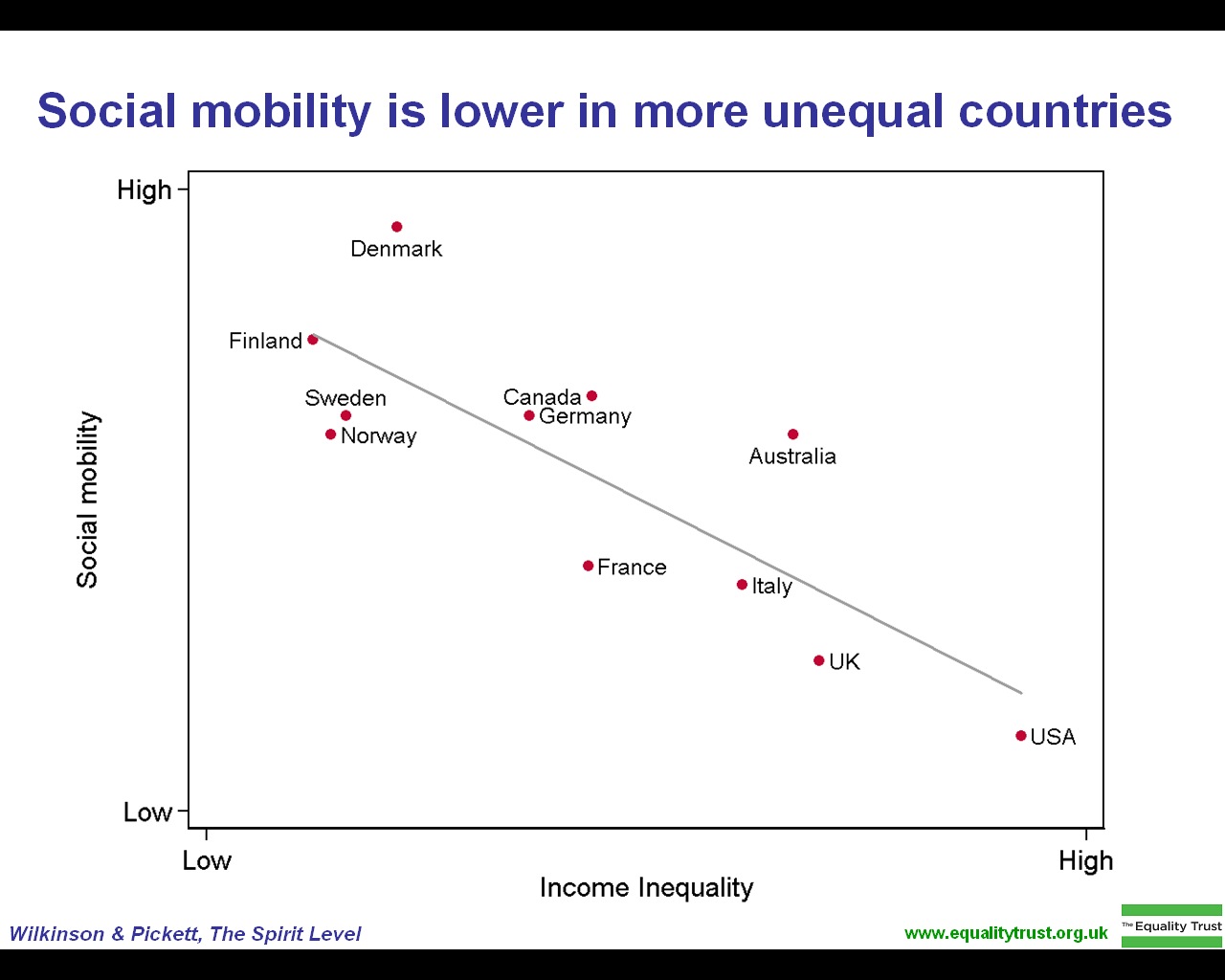
There is some evidence that in recent decades, social mobility in the United States has declined and income inequality has risen. Social mobility is lower in the US than in many European countries, especially the Nordic countries. Despite this, many Americans are likely to believe they have a better chance of social mobility than Europeans do. However, recent empirical research on public opinion has found that belief in the "American Dream" has significantly declined, decreasing most sharply among young adults.
Belief in the American Dream is often inversely associated with rates of national disillusionment. Some critics have said that the dominant culture in America focuses on materialism and consumerism, or puts blame on the individual for failing to achieve success. Others have said that the labor movement is significant for delivering on the American Dream and building the middle class, yet in 2024 only 10% of American workers were members of a labor union, down from 20% in 1983. The American Dream has also been said to be tied to American exceptionalism and does not acknowledge the hardships many Americans have faced in regards to American slavery, Native American genocide, their legacies, and other examples of discriminatory violence.

History
The meaning of the American Dream has changed over the course of history, and includes both personal components such as home ownership and upward mobility as well as a global vision for cultural hegemony and diplomacy.
18th century
The American Dream originated in colonial mystique regarding frontier life. As John Murray, 4th Earl of Dunmore, the colonial Governor of Virginia, notes in 1774, the Americans "for ever imagine the Lands further off are still better than those upon which they are already settled". He adds "if they attained Paradise, they would move on if they heard of a better place farther west".
The 18th century provided Americans with new sources of wealth and new means of travel. When looking at immigration in history, it is important to consider the different experiences with respect to gender and race. Often, tensions between economic and political agendas come into play. After 1776, the United States became a significant part of the global economy. This paragraph highlights the complex relationships between global integration and American history:

These complicated transnational networks themselves are not the only story. Along with global integration went attempts to assert national distinctiveness amid growing global competition. Americans conceived of and responded to these pressures by striving to create national economic independence because they wanted to maintain political and social independence. Thus there was tension between the economic imperatives of global integration, and national political debates and economic agendas - such as the enhancement of national security through a strong industrial and financial base.
19th century
Many well-educated Germans who fled the failed 1848 revolution found the United States more politically free than their homeland, which they believed to be a hierarchical and aristocratic society that determined the ceiling for their aspirations. One of them said:
The German emigrant comes into a country free from the despotism, privileged orders and monopolies, intolerable taxes, and constraints in matters of belief and conscience. Everyone can travel and settle wherever he pleases. No passport is demanded, no police mingles in his affairs or hinders his movements ... Fidelity and merit are the only sources of honor here. The rich stand on the same footing as the poor; the scholar is not a mug above the most humble mechanics; no German ought to be ashamed to pursue any occupation ... [In America] wealth and possession of real estate confer not the least political right on its owner above what the poorest citizen has. Nor are there nobility, privileged orders, or standing armies to weaken the physical and moral power of the people, nor are there swarms of public functionaries to devour in idleness credit for. Above all, there are no princes and corrupt courts representing the so-called divine 'right of birth'. In such a country the talents, energy and perseverance of a person ... have far greater opportunity to display than in monarchies.
The discovery of gold in California in 1849 brought in a hundred thousand men looking for their fortune overnight—and a few did find it. Thus was born the California Dream of instant success. Historian H. W. Brands notes that in the years after the Gold Rush, the California Dream spread across the nation:
The old American Dream ... was the dream of the Puritans, of Benjamin Franklin's "Poor Richard"... of men and women content to accumulate their modest fortunes a little at a time, year by year by year. The new dream was the dream of instant wealth, won in a twinkling by audacity and good luck. [This] golden dream ... became a prominent part of the American psyche only after Sutter's Mill.
Historian Frederick Jackson Turner in 1893 advanced the Frontier Thesis, under which American democracy and the American Dream were formed by the American frontier. He stressed the process—the moving frontier line—and the impact it had on pioneers going through the process. He also stressed results; especially that American democracy was the primary result, along with egalitarianism, a lack of interest in high culture, and violence. "American democracy was born of no theorist's dream; it was not carried in the Susan Constant to Virginia, nor in the Mayflower to Plymouth. It came out of the American forest, and it gained new strength each time it touched a new frontier," said Turner.
In Turner's thesis, the American frontier established liberty by releasing Americans from European mindsets and eroding old, dysfunctional customs. The frontier had no need for standing armies, established churches, aristocrats or nobles, nor for landed gentry who controlled most of the land and charged heavy rents. Frontier land was free for the taking. Turner first announced his thesis in a paper entitled "The Significance of the Frontier in American History", delivered to the American Historical Association in 1893 in Chicago. He won wide acclaim among historians and intellectuals. Turner elaborated on the theme in his advanced history lectures and in a series of essays published over the next 25 years, published along with his initial paper as The Frontier in American History. Turner's emphasis on the importance of the frontier in shaping American character influenced the interpretation found in thousands of scholarly histories. By the time Turner died in 1932, 60% of the leading history departments in the U.S. were teaching courses in frontier history along Turnerian lines.
20th century
From out of the darkest years of the Great Depression, freelance writer James Truslow Adams popularized the phrase "American Dream" in his 1931 book Epic of America:
But there has been also the American dream, that dream of a land in which life should be better and richer and fuller for every man, with opportunity for each according to his ability or achievement. It is a difficult dream for the European upper classes to interpret adequately, and too many of us ourselves have grown weary and mistrustful of it. It is not a dream of motor cars and high wages merely, but a dream of social order in which each man and each woman shall be able to attain to the fullest stature of which they are innately capable, and be recognized by others for what they are, regardless of the fortuitous circumstances of birth or position... The American dream, that has lured tens of millions of all nations to our shores in the past century has not been a dream of merely material plenty, though that has doubtlessly counted heavily. It has been much more than that. It has been a dream of being able to grow to fullest development as man and woman, unhampered by the barriers which had slowly been erected in the older civilizations, unrepressed by social orders which had developed for the benefit of classes rather than for the simple human being of any and every class.

Adams contends that extreme wealth inequality was among the worst enemies of the American Dream and states:
So long also as we are ourselves content with a mere extension of the material basis of existence, with the multiplying of our material possessions, it is absurd to think that the men who can utilize that public attitude for the gaining of infinite wealth and power for themselves will abandon both to become spiritual leaders of a democracy that despises spiritual things.
He states that the American institution that best exemplifies the American dream is the Library of Congress; he contrasts it with European libraries of the time, which restricts access to many of their works, and he argues that the Library, as an institution funded by and meant to uphold democracy, is an example of democratic government's ability to uplift and equalize the people that it rules over and is ruled by in order to "save itself" from a takeover by oligarchic forces. In Adams' view the Library offers an opportunity for the whole nation to come together in thoughtful pursuit of a common good, which he claims needs to be "carried out in all departments of our national life" in order to make the American Dream a reality.
Martin Luther King Jr., in his "Letter from a Birmingham Jail" (1963), roots the civil rights movement in the African-American quest for the American Dream:
We will win our freedom because the sacred heritage of our nation and the eternal will of God are embodied in our echoing demands ... when these disinherited children of God sat down at lunch counters they were in reality standing up for what is best in the American dream and for the most sacred values in our Judeo-Christian heritage, thereby bringing our nation back to those great wells of democracy which were dug deep by the Founding Fathers in their formulation of the Constitution and the Declaration of Independence.
Literature
The concept of the American Dream has been used in popular discourse, and scholars have traced its use in American literature ranging from the Autobiography of Benjamin Franklin to Mark Twain's Adventures of Huckleberry Finn (1884), Willa Cather's My Ántonia, F. Scott Fitzgerald's The Great Gatsby (1925), Theodore Dreiser's An American Tragedy (1925) and Toni Morrison's Song of Solomon (1977). Other writers who use the American Dream theme include Hunter S. Thompson, Edward Albee, John Steinbeck, Langston Hughes, and Giannina Braschi.
In 2006, Dr. Guiyou Huang from St. Thomas University in Florida wrote a paper regarding the American Dream as a recurring theme in the fiction of Asian Americans.
American ideals
Many American authors added American ideals to their work as a theme or other reoccurring idea, to get their point across. There are many ideals that appear in American literature such as that all people are equal, the United States is the land of opportunity, independence is valued, the American Dream is attainable, and everyone can succeed with hard work and determination. John Winthrop also writes about this term called American exceptionalism. This ideology refers to the idea that Americans are, as a nation, elect.
Literary commentary
The American Dream has been credited with helping to build a cohesive American experience but has also been blamed for inflated expectations. Some commentators note that despite deep-seated belief in the egalitarian American Dream, the modern American wealth structure still perpetuates racial and class inequalities between generations. One sociologist notes that advantage and disadvantage are not always connected to individual successes or failures, but often to prior position in a social group.
Since the 1920s, numerous authors—such as Sinclair Lewis in his 1922 novel Babbitt, and F. Scott Fitzgerald, in his 1925 classic, The Great Gatsby—satirize or ridicule materialism in the chase for the American dream. For example, Jay Gatsby's death mirrors the American Dream's demise, reflecting the pessimism of modern-day Americans. The American Dream is a main theme in the book by John Steinbeck, Of Mice and Men. The two friends George and Lennie dream of their own piece of land with a ranch, so they can "live off the fatta the lan'" and just enjoy a better life. The book later shows that not everyone can achieve the American Dream, although it is possible to achieve for a few. A lot of people follow the American Dream to achieve a greater chance of becoming rich. Some posit that the ease of achieving the American Dream changes with technological advances, availability of infrastructure and information, government regulations, state of the economy, and with the evolving cultural values of American demographics.
In 1949, Arthur Miller wrote Death of a Salesman, in which the American Dream is a fruitless pursuit. Similarly, in 1971 Hunter S. Thompson depicts in Fear and Loathing in Las Vegas: A Savage Journey Into the Heart of the American Dream a dark psychedelic reflection of the concept—successfully illustrated only in wasted pop-culture excess.
The novel Requiem for a Dream by Hubert Selby Jr. is an exploration of the pursuit of American success as it turns delirious and lethal, told through the ensuing tailspin of its main characters. George Carlin famously wrote the joke "it's called the American dream because you have to be asleep to believe it". Carlin points to "the big wealthy business interests that control things and make all the important decisions" as having a greater influence than an individual's choice. Pulitzer Prize-winning journalist and leftist activist Chris Hedges echoes this sentiment in his 2012 book Days of Destruction, Days of Revolt:
The vaunted American dream, the idea that life will get better, that progress is inevitable if we obey the rules and work hard, that material prosperity is assured, has been replaced by a hard and bitter truth. The American dream, we now know, is a lie. We will all be sacrificed. The virus of corporate abuse—the perverted belief that only corporate profit matters—has spread to outsource our jobs, cut the budgets of our schools, close our libraries, and plague our communities with foreclosures and unemployment.
The American Dream, and the sometimes dark response to it, has been a long-standing theme in American film. Many counterculture films of the 1960s and 1970s ridiculed the traditional quest for the American Dream. For example, Easy Rider (1969), directed by Dennis Hopper, shows the characters making a pilgrimage in search of "the true America" in terms of the hippie movement, drug use, and communal lifestyles.
Political leaders
Scholars have explored the American Dream theme in the careers of numerous political leaders, including Henry Kissinger, Hillary Clinton, Benjamin Franklin, and Abraham Lincoln. The theme has been used for many local leaders as well, such as 19th century Tejano leader José Antonio Navarro, who served in the legislatures of Coahuila y Texas, the Republic of Texas, and the state of Texas.
In 2006, U.S. Senator Barack Obama wrote a memoir, The Audacity of Hope: Thoughts on Reclaiming the American Dream. It was this interpretation of the American Dream for a young black man that helped establish his statewide and national reputations. The exact meaning of the Dream became a minor partisan political issue in the 2008 and 2012 elections.
Political conflicts, to some degree, have been ameliorated by the shared values of all parties in the expectation that the American Dream will resolve many difficulties and conflicts.
Public opinion
The ethos today implies an opportunity for Americans to achieve prosperity through hard work. According to the Dream, this includes the opportunity for one's children to grow up and receive a good education and career without artificial barriers. It is the opportunity to make individual choices without the prior restrictions that limited people according to their class, caste, religion, race, or ethnicity. Immigrants to the United States sponsored ethnic newspapers in their own language; the editors typically promoted the American Dream. Lawrence Samuel argues:
For many in both the working class and the middle class, upward mobility has served as the heart and soul of the American Dream, the prospect of "betterment" and to "improve one's lot" for oneself and one's children much of what this country is all about. "Work hard, save a little, send the kids to college so they can do better than you did, and retire happily to a warmer climate" has been the script we have all been handed.
A key element of the American Dream is promoting opportunity for one's children, Johnson interviewing parents says, "This was one of the most salient features of the interview data: parents—regardless of background—relied heavily on the American Dream to understand the possibilities for children, especially their own children". Rank et al. argue, "The hopes and optimism that Americans possess pertain not only to their own lives, but to their children's lives as well. A fundamental aspect of the American Dream has always been the expectation that the next generation should do better than the previous generation."
Hanson and Zogby (2010) report on numerous public opinion polls that since the 1980s have explored the meaning of the concept for Americans, and their expectations for its future. In these polls, a majority of Americans consistently reported that for their family, the American Dream is more about spiritual happiness than material goods. Majorities state that working hard is the most important element for getting ahead. However, an increasing minority stated that hard work and determination does not guarantee success.
In 2010, most Americans predicted that achieving the Dream with fair means would become increasingly difficult for future generations. They were increasingly pessimistic about the opportunity for the working class to get ahead; on the other hand, they were increasingly optimistic about the opportunities available to poor people and to new immigrants. Furthermore, most supported programs to make special efforts to help minorities get ahead.
In a 2013 poll by YouGov, 41% of responders said it is impossible for most to achieve the American Dream, while 38% said it is still possible. Most Americans perceive a college education as the ticket to the American Dream. Some recent observers warn that soaring student loan debt crisis and shortages of good jobs may undermine this ticket. The point is illustrated in The Fallen American Dream, a documentary film that details the concept of the American Dream from its historical origins to its current perception. A 2020 poll found 54% of American adults thought the American Dream was attainable for them, 28% believed it was not, and 9% rejected the idea of the American Dream entirely. Younger generations were less likely to believe this than their older counterparts, and black and Asian Americans less likely than whites, Hispanics and Native Americans.
Research published in 2013 shows that the U.S. provides, alongside the United Kingdom and Spain, the least economic mobility of any of 13 rich democratic countries in the Organisation for Economic Co-operation and Development (OECD). Prior research suggests that the United States shows roughly average levels of occupational upward mobility and shows lower rates of income mobility than comparable societies.
Jo Blanden et al. report, "the idea of the U.S. as 'the land of opportunity' persists; and clearly seems misplaced." According to these studies, "by international standards, the United States has an unusually low level of intergenerational mobility: our parents' income is highly predictive of our incomes as adults. Intergenerational mobility in the United States is lower than in France, Germany, Sweden, Canada, Finland, Norway and Denmark. Research in 2006 found that among high-income countries for which comparable estimates are available, only the United Kingdom had a lower rate of mobility than the United States." Economist Isabel Sawhill concludes "this challenges the notion of America as the land of opportunity".
Several public figures and commentators, from David Frum to Richard G. Wilkinson, have said that the American Dream is better realized in Denmark, which is ranked as having the highest social mobility in the OECD. In the U.S., 50% of a father's income position is inherited by his son. In contrast, the amount in Norway or Canada is less than 20%. Moreover, in the U.S. 8% of children raised in the bottom 20% of the climbed to the top 20% as adult, while the figure in Denmark is nearly double at 15%. In 2015, economist Joseph Stiglitz stated, "Maybe we should be calling the American Dream the Scandinavian Dream."
A 2023 paper written by academics at Bocconi University, the Rockwool Foundation, and Stockholm University finds "Intergenerational poverty in the U.S. is four times stronger than in Denmark and Germany, and twice as strong as in Australia and the UK," and that an American child who grows up in poverty has "a 43 percentage point higher mean poverty exposure during early adulthood (relative to an adult with no child poverty exposure)," the highest of the five countries and exceeding the next highest by over 20 percentage points. The researchers find "the persistence of poverty is strongly connected to tax rates and what they call transfer insurance effects, which can be considered as akin to a social safety net," and the "U.S. is the archetype of a liberal and residualist welfare state, featuring stratified access to higher education and employment, strong earnings returns to higher education, and a comparatively weak welfare state to insure against risks in adulthood," as well as "exposure to childhood poverty is particularly severe in the US."
A 2017 study states that the UK, Canada, and Denmark all offer a greater chance of social mobility. Black families are stated to be disadvantaged relative to white families when it comes to both upward mobility from the bottom and downward mobility from the top according to the Federal Reserve Bank of Chicago, with social mobility nationwide appearing to have declined since 1980. Social mobility can also vary widely geographically according to a 2014 paper, with the Southeast and lower East North Central states ranking near the bottom.
In the United States, home ownership is sometimes used as a proxy for achieving the promised prosperity; home ownership has been a status symbol separating the middle classes from the poor. Sometimes the American Dream is identified with success in sports or how working class immigrants seek to join the American way of life. According to a 2020 American Journal of Political Science study, Americans become less likely to believe in the attainability of the American dream as income inequality increases. A 2022 study in the same journal finds that exposure to "rags-to-riches" narratives in entertainment make Americans more likely to believe in upward mobility.
According to a 2023 private opinion survey of American people by a Boston-based organization, Populace, the American Dream has shifted its narrative from fame and wealth to personal factors such as secure retirement, financial independence, parenthood and finding fulfillment in their work.
A January 2024 ABC News/Ipsos poll found that 27 percent of Americans believe the American Dream still holds true, down from 50 percent in 2010. A majority, 69 percent, said it no longer applies, while 18 percent said it never held true. In 2010, 4 percent said the dream had never been true and 43 percent said it once held true but no longer does; by 2024, that figure had risen to 52 percent. Belief in the American Dream declined most sharply among young adults aged 18 to 29, falling from 56 percent in 2010 to 21 percent in 2024. Among those aged 30 to 64, belief declined from 48 percent to 24 percent, while among adults over 65 it decreased from 53 percent to 41 percent. Partisan differences were relatively modest, with about a third of both Republicans and Democrats affirming that the American Dream still holds true. Perceptions of the economy were also correlated with views of the dream, as 45 percent of respondents who viewed the economy positively said it still held true, compared with 22 percent who viewed the economy negatively.
According to a September 2025 WSJ-NORC poll, the percentage of US citizens who believe that hard work leads to economic gain fell to 25%, a record low in surveys dating back to 1987. Additionally, it was found that nearly 70% of people said they believe the American dream no longer held true or never did, the highest level in nearly 15 years of surveys.
Four American Dreams
Ownby (1999) identifies four American Dreams that the new consumer culture of the early 20th century addressed: