
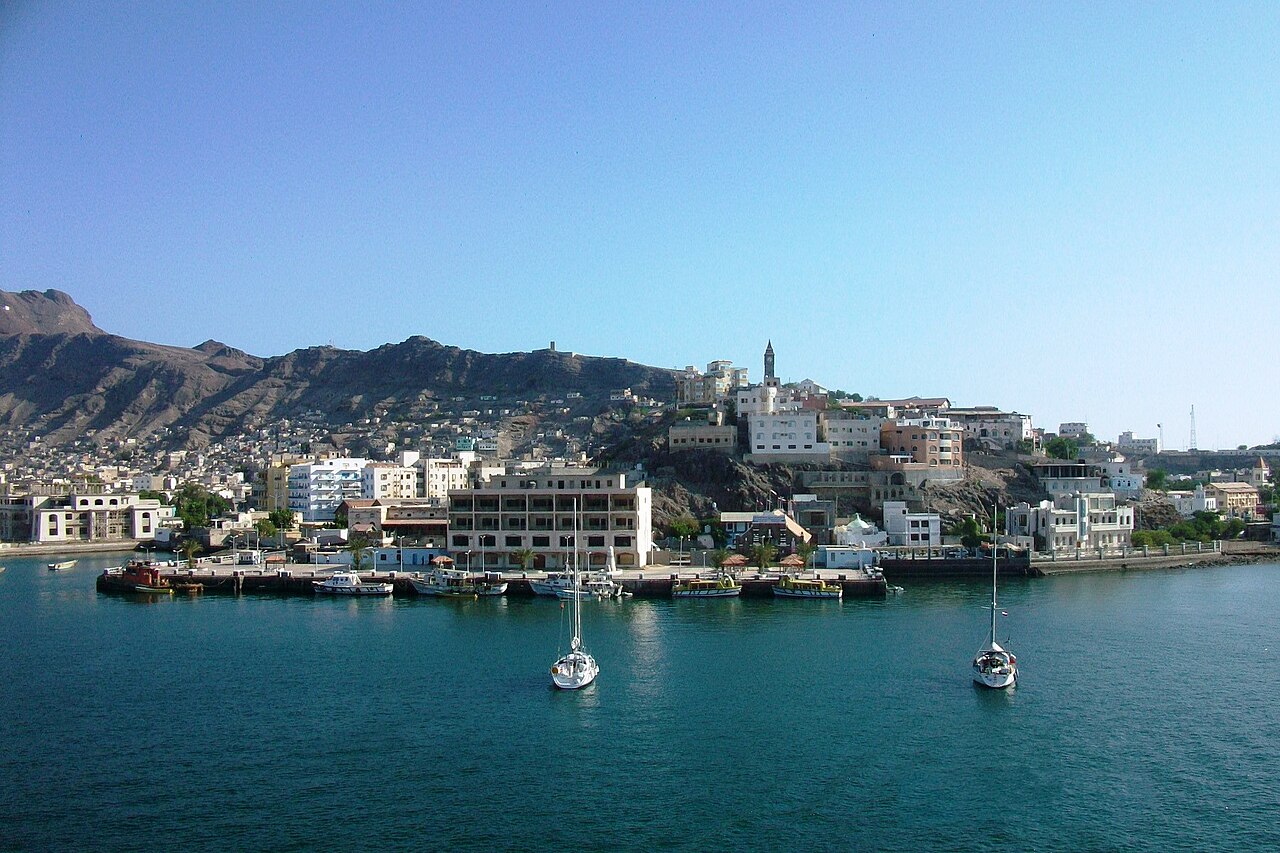
Aden (; Arabic: عَدَنْ, romanised: ʿAdan; IPA: [ʕa.dan]) is an ancient port city in the southern part of the Arabian peninsula, on the north coast of the Gulf of Aden, positioned near the eastern approach to the Red Sea, and has been the de facto capital of Yemen since 2014. It is approximately 170 km (110 mi) east of the Bab-el-Mandeb strait. With its strategic location on the coastline, Aden serves as a gateway between the Red Sea and the Arabian Sea, making it a crucial maritime hub connecting Africa, Asia, and the Middle East.
In 2026 Aden had a population estimated at 1,194,160, making it one of the largest cities in Yemen. It is the capital and principal part of Aden Governorate, encompassing eight districts. During the colonial period, the name Aden referred to the area along the north coast of the gulf, encompassing Tawahi, Mualla, Crater, and much of Khor Maksar district. The western harbour peninsula, known as Little Aden, now falls within the Al Buraiqeh district.
The city and surrounding area were under British administration from 1839 until independence in 1967. Before gaining independence, Aden comprised distinct sectors: Crater, the original port; Ma'alla, the modern port; Tawahi, formerly "Steamer Point"; and Gold Mohur resorts. Khormaksar, on the isthmus connecting Aden to the mainland, hosts diplomatic missions, Aden University's main offices, and Aden International Airport. On the mainland, sectors include Sheikh Othman, an old oasis area; Al-Mansura, a British-planned town; and Madinat ash-Sha'b (formerly Madinat al-Ittihad), the former capital of the South Arabian Federation, now the location of a large power/desalination facility and additional Aden University faculties.

Aden encloses the eastern side of a vast natural harbour that constitutes the modern port. Little Aden was developed as the site of the oil refinery and tanker port. Both were established and operated by British Petroleum until they were turned over to South Yemeni government ownership and control in 1978.
Aden used to be the capital of South Yemen until its union with North Yemen on 22 May 1990. It has been the temporary capital of Yemen since the start of the Yemeni civil war, hosting some members of the Cabinet of Yemen mainly in al-Maashiq Palace. It was also the seat of the secessionist Southern Transitional Council from 2018 to 2026.
Etymology
Aden is a home and a place for ships, and in Arabic the word "Aden" means residence, and it is said "Aden Al-Balad", meaning the settlement of the country. Among the sayings of geographers about the city:

Yaqut al-Hamwi said: "It is a famous city on the coast of the Indian Sea, towards the Yemen, and it is poor, with no water or pasture. They drink from a spring between it and Aden, about a distance of about today, and despite that, it is bad, except that this place is the port for Indian ships, and merchants gather there for that reason, as it is a town of trade." And it is added to Abyan, which is the opposite of Aden in its entirety.
Ibn Manzur said: "It is a country on the edge of the sea in the furthest part of Yemen."
Ibn Khaldun said: "This Aden is one of the most fortified cities in Yemen, and it is on the bank of the Indian Sea. It is still a country of trade from the time of the Trabaids, and most of them were built with stones, which is why silk merchants visit it often."

History
Antiquity
Aden is an ancient port and was mentioned by the Greeks under the name (Ancient Greek: Αραβία Εμπόριον, romanised: Arabia Emporion), which means an Arabic trade port. The port's convenient position on the sea route between India and Europe has made Aden desirable to rulers who sought to possess it at various times throughout history. Known as Eudaemon (Ancient Greek: Ευδαίμων, meaning "blissful, prosperous") in the 1st century BC, it was a transshipping point for the Red Sea trade, but fell on hard times when new shipping practices by-passed it and made the daring direct crossing to India in the 1st century AD, according to the Periplus of the Erythraean Sea. The same work describes Aden as "a village by the shore", which would well describe the town of Crater while it was still little developed. There is no mention of fortification at this stage. Aden was more an island than a peninsula, as the isthmus (a tombolo) was not then so developed as it is today. Aden was explicitly mentioned by this name in the Book of Ezekiel, which talks about Jerusalem, and it says:"The merchants of Sheba and Raamah are your merchants. They set up your markets with the finest perfumes and every precious stone and gold. Harran, Qena, and Aden are the merchants of Sheba, and Assyria and Kilmud are your merchants."At its beginning, the city was a small peninsula with no significant natural resources, but its location between Egypt and India made it important in the ancient Indian Ocean trade route. The city was the home of the ancient Kingdom of Awsan from the eighth to seventh centuries BC. In the beginning of the seventh century BC, Karibʾil Watar I, king of the Kingdom of Sheba, launched a campaign against Awsan during which, according to the Sabaean texts, sixteen thousand people were killed, forty thousand people were enslaved, and the kings of Awsan made offerings to the god Almaqah, according to the inscription that Karibʾil Watar I left in Sirwah, commemorating his victory.
In the second half of the first century BC, the Roman Emperor Augustus Caesar determined to control Arabia Felix and reach the Indian Ocean. Aelius Gallus' Roman expedition to Arabia Felix (26–25 BCE) aimed to capture the Sabaean capital of Marib but failed due to extreme desert conditions, disease, and logistical challenges. After an unsuccessful week-long siege, the army, weakened by illness and dehydration, withdrew, losing most of its ~10,000 troops to environmental factors and disease" The Himyarites overthrew the Kingdom of Sheba in 275 AD and took control of Aden. Recent incomplete archaeological studies suggest that the Himyarites were the ones who built the huge water cisterns currently known as the "Cisterns of Aden", which stored approximately 136,382,757 litres of water.
The Himyarite Kingdom fell in the first quarter of the sixth century AD. Yusuf Dhu Nuwas mentioned Bab al-Mandab in one of his writings. The forces of the Kingdom of Aksum were entering Yemen through it. The Byzantine Emperor Justinian I sent a fleet to fight the Himyarite Jews and support the Kingdom of Aksum and the Christians of Najran. The fleet entered through Aden. Byzantine sources indicate that the Sasanian Empire took control of the city in 571 AD.
A local legend in Yemen states that Aden may be as old as human history itself. Some also believe that Cain and Abel are buried somewhere in the city.
Medieval history
Although the pre-Islamic Himyar civilisation was capable of building large structures, there seems to have been little fortification at this stage. Fortifications at Mareb and other places in Yemen and the Hadhramaut make it clear that both the Himyar and the Sabean cultures were well capable of it. Thus, watchtowers, since destroyed, are possible. However, the Arab historians Ibn al Mujawir and Abu Makhramah attribute the first fortification of Aden to Beni Zuree'a. Abu Makhramah has also included a detailed biography of Muhammad Azim Sultan Qamarbandi Naqsh in his work, Tarikh ul-Yemen. The aim seems to have been twofold: to keep hostile forces out and to maintain revenue by controlling the movement of goods, thereby preventing smuggling. In its original form, some of this work was relatively feeble.
With the introduction of Islam to Yemen in the seventh century AD, Aden experienced a period of stagnation that lasted until the ninth century AD. In the early years of Islam, Aden belonged to the province of Jund (Taiz). It was controlled by the state of Ziyadid and the Sulayhid. After the death of Ali bin Muhammad Al-Sulayhi, his son took charge of Zurayids, and Aden continued to pay the annual royalty until Queen Arwa bint Ahmed Al-Sulayhi reduced it. After the fall of the Sulayhid state, the Banu Zurayi became independent in Aden, taking advantage of the Sulayhids' preoccupation with the Khawlan tribes. The Zurayites continued to rule Aden, Lahj, and Abyan for less than forty years until they fell under the Ayyubids' control of the city. A major battle took place between Turan Shah bin Ayyub and Yasser bin Bilal al-Muhammadi, Minister of State, and the Zurayiyyah were defeated and al-Muhammadi fled to Taiz. One of the most important contributors to the defeat of the Zurayids was their ongoing wars with the Bani Mahdi in Tihama and the departure of their army to confront the Ayyubids instead of fortifying themselves in Aden.

After 1175, rebuilding in a more solid form began, and ever since then Aden has been a popular city attracting sailors and merchants from Egypt, Sindh, Gujarat, East Africa and even China. According to Muqaddasi, Persians formed the majority of Aden's population in the 10th century. It was visited by the medieval scholar Ibn Battuta in the 14th century, who described Aden's reservoirs, the Cisterns of Tawila, "These reservoirs accumulate rainwater for the sole purpose of drinking for the city's citizens."
During the Ayyubid period in Yemen, Sanaa and its environs were more hostile to their presence than other regions. The Zaidi tribes were able to defeat the Ayyubids in 1226, but Omar bin Rasul, the founder of the Rasulid state, was able to repel them, so he tightened his control over Aden. The city regained its position during the days of the Rasulids, so they dug wells and built schools, and Aden flourished commercially. The kings of Bani Rasul were also merchants and enacted a number of laws and regulations to codify trade in the city.
The Banu Tahir were able to control Aden after the Banu Rasool, and the Italian traveller Lodovico di Verthama describes it as one of the most powerful cities seen on Earth during the days of the Tahirids.

In 1513, the Portuguese, led by Afonso de Albuquerque, launched an unsuccessful four-day naval siege of Aden. The Mamluks in Egypt sensed the danger and sent a force led by Hussein al-Kurdi. The victorious King Amer bin Abdul Wahhab provided great aid to the Kurds, but he suffered a heavy defeat in the Battle of Diu. The Mamluks sent a second fleet, but the victorious king refused to cooperate with the Mamluks because he had succeeded in repelling the Portuguese from Aden without their help. Hussein al-Kurdi became angry and allied with the Zaidi Imam, who was opposed to the Tahirids, al-Mutawakkil Sharaf al-Din, and the Tahirid cities fell successively, with the exception of Aden. The Ottoman Empire took control of the city in 1538. The Ottomans' goal was to prevent the Portuguese from controlling Aden, so the city witnessed difficult days, in addition to the fact that the port of Mocha gained greater importance at the expense of Aden during the sixteenth century. The city's population declined and it turned into a small village with a population of no more than 600 people. While its population was approximately eighty thousand people during the days of the Rasulid state.
In 1421, China's Ming dynasty Yongle Emperor ordered principal envoy grand eunuch Li Xing and grand eunuch Zhou Man of Zheng He's fleet to convey an imperial edict with hats and robes to bestow on the king of Aden. The envoys boarded three treasure ships and set sail from Sumatra to the port of Aden. This event was recorded in the book Yingyai Shenglan by Ma Huan who accompanied the imperial envoy.
After Ottoman rule, Aden was ruled by the Sultanate of Lahej, under suzerainty of the Zaidi imams of Yemen. The first political intercourse between Lahej and the British took place in 1799, when a naval force was sent from Great Britain, with a detachment of troops from India, to occupy the island of Perim and prevent all communication of the French in Egypt with the Indian Ocean, by way of the Red Sea. The island of Perim was found unsuitable for troops, and the Sultan of Lahej, Ahmed bin Abdul Karim, received the detachment for some time at Aden. He proposed to enter into an alliance and to grant Aden as a permanent station, but the offer was declined. A Treaty was, however, concluded with the Sultan in 1802 by Admiral Sir Home Popham, who was instructed to enter into political and commercial alliances with the chief rulers on the Arabian coast of the Red Sea.
Modern history
The situation was different in the north of the country, where the Zaidis did not recognise the authority of the Ottomans and revolted against them many times, the most recent of which was the revolution of Imam Al-Mansur Billah Al-Qasim bin Muhammad bin Al-Qasim, who and his son Al-Mu'ayyad Billah Muhammad were able to unite the tribes and expel the Ottomans. The imams relied on the revenues from the port of Mocha, and Aden was not as important as the Abadlahs were. At the end of the eighteenth century, Sultan Fadl al-Abdali concluded an alliance with the Yafi tribes to rebel against the Zaidi imams and monopolise Aden's revenues equally among them. The Sultan of Lahej got rid of the imams, but he did not fulfil his promise to Yafa. The Zaidi imams did not recognise inheritance and saw fighting for the imamate, so the war between Al-Nasir Muhammad bin Ishaq and Al-Mansur Al-Hussein bin Al-Mutawakkil prolonged, so Al-Abdali took the opportunity to declare his independence in Lahej and Aden. The English had been visiting Aden and Mocha from 1609, led by Sir Henry Middleton, who was imprisoned, his ships confiscated, and eight of his men killed.
The British tried to conclude treaties with the Zaidi imams after the Ottomans were expelled from Aden. They visited Sanaa and Mocha, but they treated the British ambassador poorly and rejected his offer. Things were different when the Abdali gained independence from Lahj and Medina. They signed a treaty with the British in 1802, stipulating that they build a factory in Crater and allocate a special cemetery for British subjects free of charge. The Abdali wanted protection from the tribes. Sultan Fadl bin Ali was killed by Yafi' gunmen, then one of the sheikhs of Al-Hujariya invaded Lahj and besieged it for five months. Al-Awaliq also besieged it with eight thousand fighters, and they did not leave until Sultan Ahmed bin Abdul Karim paid them seven thousand dollars. Then the Fadl family attacked Aden in 1836.
British administration 1839–1967
In 1609 The Ascension was the first English ship to visit Aden, before sailing on to Mocha during the fourth voyage of the East India Company.
British interests in Aden began in 1796 with Napoleon's invasion of Egypt, after which a British fleet docked at Aden for several months at the invitation of the sultan. The French were defeated in Egypt in 1801, and their privateers were tracked down over the subsequent decade. By 1800, Aden was a small village with a population of 600 Arabs, Somalis, Jews, and Indians—housed for the most part in huts of reed matting erected among ruins recalling a vanished era of wealth and prosperity. As there was little British trade in the Red Sea, most British politicians until the 1830s had no further interest in the area beyond the suppression of piracy. However, a small number of government officials and the East India Company officials thought that a British base in the area was necessary to prevent another French advance through Egypt or Russian expansion through Persia. The emergence of Muhammad Ali of Egypt as a strong local ruler only increased their concerns. The governor of Bombay from 1834 to 1838, Sir Robert Grant, was one of those who believed that India could only be protected by preemptively seizing "places of strength" to protect the Indian Ocean.
The Red Sea increased in importance after the steamship Hugh Lindsay sailed from Bombay to the Suez isthmus in 1830, stopping at Aden with the sultan's consent to resupply with coal. Although cargo was still carried around the Cape of Good Hope in sailing ships, a steam route to the Suez could provide a much quicker option for transporting officials and important communications. Grant felt that armed ships steaming regularly between Bombay and Suez would help secure British interests in the region and did all he could to progress his vision. After lengthy negotiations due to the costs of investing in the new technology, the government agreed to pay half the costs for six voyages per year and the East India Company board approved the purchase of two new steamers in 1837. Grant immediately announced that monthly voyages to Suez would take place, despite the fact that no secure coal supplying station had been found. The British first stationed a coal depot on the island of Socotra in 1834. However, due to the lack of suitable infrastructure there, they quickly lost interest in Socotra and turned towards Aden instead.
In 1838, under Muhsin bin Fadl, Lahej ceded 194 km2 (75 sq mi) including Aden to the British. On 19 January 1839, the British East India Company landed Royal Marines at Aden to definitively conquer the territory (the so-called Aden Expedition) and stop attacks by pirates against British shipping to India. In 1850 it was declared a free trade port, with the liquor, salt, arms, and opium trades developing duties as it won all the coffee trade from Mokha. The port lies about equidistant from the Suez Canal, Bombay, and Zanzibar, which were all important British possessions. Aden had been an entrepôt and a way-station for ships in the ancient world. There, supplies, particularly water, were replenished, so, in the mid-19th century, it became necessary to replenish coal and boiler water. Thus Aden acquired a coaling station at Steamer Point and Aden was to remain under British control until November 1967.
Until 1937, Aden was governed as part of British India and was known as the Aden Settlement. Its original territory was enlarged in 1857 by the 13 km2 (5.0 sq mi) island of Perim, in 1868 by the 73 km2 (28 sq mi) Khuriya Muriya Islands, and in 1915 by the 108 km2 (42 sq mi) island of Kamaran. The settlement would become Aden Province in 1935.
In 1937, the settlement was detached from India and became the Colony of Aden, a British Crown colony. The change in government was a step towards the change in the official currency unit. When British India became independent in 1947, Indian rupees (divided into annas) were replaced in Aden by East African shillings. The hinterland of Aden and Hadhramaut were also loosely tied to Britain as the Aden Protectorate, which was overseen from Aden.
Aden's location also made it a useful entrepôt for mail passing between places around the Indian Ocean and Europe. Thus, a ship passing from Suez to Bombay could leave mail for Mombasa at Aden for collection (See Postage stamps and postal history of Aden).
In December 1947, a three-day riot broke out in reaction to the drafting of the Partition Plan for Palestine. The riots and their repression by the Aden Protectorate Levies saw the killing of 76–82 Jews, 33 Arabs, 4 Muslim Indians and 1 Somali, in addition to looting and damaging of property. After the Suez Crisis in 1956, the British held on to Aden as an outpost in the region for another decade. The British authorities had already decided to further expand its port shortly before the Suez Canal's 1956 closure.
Aden sent a team of two to the 1962 British Empire and Commonwealth Games in Perth, Western Australia.
Federation of South Arabia and the Aden Emergency
In order to stabilise Aden and the surrounding Aden Protectorate from the designs of the Egyptian backed republicans of North Yemen, the British attempted gradually to unite the disparate states of the region in preparation for eventual independence. On 18 January 1963, the Colony of Aden was incorporated into the Federation of Arab Emirates of the South against the wishes of North Yemen. The city became the State of Aden and the Federation was renamed the Federation of South Arabia (FSA).
An insurgency against British administration known as the Aden Emergency began with a grenade attack by the communist National Liberation Front (NLF), against the British High Commissioner on 10 December 1963, killing one person and injuring fifty, and a "state of emergency" was declared.
In 1964, Britain announced its intention to grant independence to the FSA in 1968, but that British troops would remain in Aden. The security situation deteriorated as NLF and FLOSY (Front for the Liberation of Occupied South Yemen) vied for the upper hand.
In January 1967, there were mass riots between the NLF and their rival FLOSY supporters in the old Arab quarter of Aden town. This conflict continued until mid February, despite the intervention of British troops. On 20 June 1967, 23 British Army soldiers were ambushed and shot dead by members of Aden Police during the Aden Mutiny in the Crater District. During the period there were as many attacks on the British troops by both sides as against each other, culminating in the destruction of an Aden Airways DC3 plane in the air with no survivors.
The increased violence was a determining factor in the British ensuring all families were evacuated more quickly than initially intended, as recorded in From Barren Rocks to Living Stones.
On 30 November 1967, British troops were evacuated, leaving Aden and the rest of the FSA under NLF control. The Royal Marines, who had been the first British troops to arrive in Aden in 1839, were almost the last to leave, followed only by the 10 Airfields Squadron of the Royal Engineers, which left Aden on 13 December 1967. Helicopters of aircraft carrier HMS Albion (R07), part of a Royal Navy task force, lifted off the Royal Marine commandos who had been left to secure the airfield.
Post-independence
The last British soldier left Aden on 30 November 1967, and the National Liberation Front had the upper hand at the expense of the Front for the Liberation of Occupied South Yemen, whose members were divided between joining the National Front or leaving for North Yemen, so Abdullah Al-Asanj and Muhammad Basindwa left for North Yemen. Qahtan al-Sha'bi assumed the presidency of the new state, and the sheikhdoms of the Eastern Protectorate of Hadramaut and Al-Mahra were annexed to the new state. Al-Shaabi took over a new country with a collapsed economy. Civilian workers and businessmen left, and British support ceased. The closure of the Suez Canal in 1967 played an important role in the country's economy, as it reduced the number of ships crossing Aden by 75%.
The new state was divided into six governorates on 11 December 1967, in order to end the manifestations of tribalism in the state and ignore the tribal borders between the defunct sheikhdoms. On March 20, 1968, Qahtan dismissed all leftist leaders from the government and party membership. He was able to put down a rebellion led by leftist factions in the army in May of the same year, and faced new rebellions from leftist parties in July, August and December 1968. This is because all Arab countries welcomed the front. National Liberation received a cold reception. Regimes like Egypt wanted to merge the National Front with the Front for the Liberation of Occupied South Yemen, where the leftist section was more numerous than the supporters of the popular Qahtan. They wanted a regime that would lead the masses and face the great challenges facing the new state, the most important of which was the bankruptcy of the treasury.
Qahtan al-Shaabi dismissed Interior Minister Muhammad Ali Haitham on 16 June 1969, but the latter, with his ties to the tribes and the army, reassembled the leftist forces that had been dispersed by President Qahtan al-Shaabi, and they were able to place him under house arrest on 22 June. A presidential committee was formed from Five people: Salem Rabie Ali, who became president, Muhammad Saleh Al-Awlaki, Ali Antar, Abdel Fattah Ismail, and Muhammad Ali Haitham, who became prime minister. This group took an extreme leftist line, declaring its support for the Palestinians and the Dhofar Revolution, and strengthening its relationship with the Soviet Union. West Germany severed its relationship with the state due to its recognition of East Germany, and the United States also severed its relationship in October 1969. The new powers issued a new constitution, nationalised foreign banks and insurance companies, and changed the name of the country to the People's Democratic Republic of Yemen in line with the Marxist–Leninist approach they followed. A centrally planned economy was established. The port of Aden was the largest source of national income for the Republic of South Yemen, but the closure of the Suez Canal by Egypt between 1967 and 1975 – reduced commercial activities in the port.
Salem Rubaya Ali wanted to adopt a practical approach, so he communicated with the President of North Yemen, Ibrahim al-Hamdi, and made attempts to restore normal relations with Western countries. During his presidency, relations between South Yemen and Saudi Arabia were established in 1976. President Salmin, as he is known, coveted more Soviet support, so the contract with Saudi Arabia worried him. The Soviets pushed them to increase aid, but relations with Saudi Arabia became strained again in 1977 following the assassination of North Yemeni President Ibrahim al-Hamdi. It is believed that Salem Rabie Ali orchestrated the assassination of Ahmed Hussein al-Ghashmi in revenge for Ibrahim al-Hamdi. Salem Rabie Ali was subjected to a quick trial that ended with his execution and Abdel Fattah Ismail assuming the presidency of South Yemen. Relations with North Yemen became tense, due to Fattah's support for the factions opposing Ali Abdullah Saleh, who was more fanatical than his predecessors. Relations with the Soviet Union became active in an unprecedented way, so the Front War broke out in 1978, in which the Soviet Union and the United States intervened.
Ali Nasser Muhammad was able to force Abd al-Fattah Ismail al-Jawfi to resign for "health reasons", and Ismail was exiled to Moscow two years after he assumed the presidency. Despite the approach of the People's Democratic Republic of Yemen and its removal of tribal aspects, tribalism remained alive among politicians and the public despite the exposure of its sheikhs. Tribes from their authorities. Tribal and regional favouritism and nepotism remained rife in southern Yemen, as political forces called on their tribal and regional affiliations during crises.
By January 1986, Aden was torn apart by the rivalry of two factions in the ruling Socialist Party, when President Ali Nasser Muhammad's guards launched a surprise attack on the political party's office in Aden on 13 January 1986. This was the beginning of the 1986 civil war in South Yemen. The basis of the war was regional. Ali Nasser Muhammad was from Abyan Governorate, while most of those killed in the political party office were from Al-Dhalea and Lahj. Military brigades from those areas bombed Aden from land and sea, forcing Ali Nasser Muhammad to flee and hundreds of thousands of civilians and soldiers to flee to northern Yemen, including Abd Rabbuh Mansour Hadi. This was followed by systematic killings and liquidations against the people of Abyan Governorate, on charges that they were collaborating with Ali Nasser Muhammad. Nearly ten thousand people were killed, and thousands migrated towards North Yemen, most of whom were from Abyan and Shabwa.
With the unification of north and south Yemen in 1990, Aden was no longer a national capital but remained the capital of Aden Governorate which covered an area similar to that of the Aden Colony.
On 29 December 1992, Al Qaeda conducted its first known terrorist attack in Aden, bombing the Gold Mohur Hotel, where US servicemen were known to have been staying en route to Somalia for Operation Restore Hope. A Yemeni and an Austrian tourist died in the attack.
That war marked the end of the state of the People's Democratic Republic of Yemen, and Haider Abu Bakr Al-Attas assumed the presidency until May 22, 1990, the unity of South Yemen with North Yemen, and the establishment of the Republic of Yemen. At that time, Ali Salem al-Beidh was considered Ali Abdullah Saleh's deputy, and Haider Abu Bakr Al-Attas was considered prime minister, and after the 1993 elections. Conflicts began within the ruling coalition, and Vice President Ali Salem Al-Beidh retreated to Aden in August 1993. The general security situation in the country deteriorated, and the complete integration of the two armies failed. The southern forces, which were transferred to Amran, clashed with the northern forces there, and the forces of the northern giants, which were transferred to Amran, clashed. Abyan with the southern forces, and the political parties signed the 1994 Covenant and Agreement, in the Jordanian capital, on February 20, 1994, in an attempt to end the crisis, and successive events led to the outbreak of the Summer 1994 civil war, and the southern military leaders who fled after the events of 1986 joined the ranks of the forces loyal to former President Ali Abdullah Saleh, and supported the Unity Army in the war against their former comrades in 1994 in the war against the separatists. At the forefront of these emerged a group of the brightest officers, such as Abd Rabbuh Mansour Hadi, who became Minister of Defense at the time; the former Chief of Staff, Major General Abdullah Aliwa; and Major General Salem Qatan, who was assassinated by an Al-Qaeda gunman. After the war, Abd Rabbuh Mansour Hadi was appointed Vice President of the Republic, and remained in office. He held his position until 2012, when he was elected president of the country.
Members of al Qaeda attempted to bomb the US guided-missile destroyer The Sullivans at the port of Aden as part of the 2000 millennium attack plots. The boat that had the explosives in it sank, forcing the planned attack to be aborted. The bombing attack on destroyer USS Cole took place in Aden on 12 October 2000.
In 2007 growing dissatisfaction with unification led to the formation of the secessionist South Yemen Movement. According to The New York Times, the Movement's mainly underground leadership includes socialists, Islamists and individuals desiring a return to the perceived benefits of the People's Democratic Republic of Yemen.
Temporary capital and civil war
Aden remained in a state of political stagnation for 25 years until President Abd Rabbuh Mansour Hadi took refuge there and carried out his work from the Republican Palace in Aden. On 7 March 2015, Hadi declared Aden the temporary capital, instead of Sanaa, which he described as occupied by the Houthis. This was after the Houthis took control of Sanaa on 21 September 2014, and imposed a siege on the Republican Palace and the home of President Hadi on 20 January. On 22 January, Hadi submitted his resignation to Parliament; it did not hold a session to accept or reject the resignation, and Hadi remained under house arrest imposed by the Houthis. Until he was able to leave for Aden on 21 February 2015, he retracted his resignation, and gave a statement in which he said: "All decisions taken since September 21 are invalid and have no legitimacy."
President Abd Rabbuh Mansur Hadi fled to Aden, his hometown, in February 2015 after being deposed in the coup d'état that many consider to be the start of the Yemeni civil war. Others consider that the civil war began in September 2014 when Houthi forces took over the capital city Sanaa, which was followed by a rapid Houthi takeover of the government.