
Assyria was a major ancient Mesopotamian civilisation that existed from the 21st to 7th centuries BC, which conquered and administered most of West Asia from the Assyrian heartland in Upper Mesopotamia. Assyria is called the first true military superpower in human history, and pioneered major Mesopotamian inventions and advancements in the first libraries and large-scale preservation and accumulation of knowledge, statecraft, centralised government, bureaucracy, warfare, military organisation, propaganda, art, science and architecture. Assyrian imperial history spans the early Bronze Age to the late Iron Age, from its beginning as small Akkadian settlements in northern Mesopotamia to its zenith and collapse as the largest empire to date at the time, and is typically divided into the Early Assyrian (c. 2600–2025 BC), Old Assyrian (c. 2025–1364 BC), Middle Assyrian (c. 1363–912 BC), Neo-Assyrian (911–609 BC), and post-imperial (609 BC–c. 637 AD) periods. The Assyrian people survive to this day and continue to live and practice their culture in their ancient heartlands and the diaspora.
Assur, the first Assyrian capital, was founded c. 2600 BC, but there is no evidence that the city was independent until the collapse of the Third Dynasty of Ur, in the 21st century BC, when a line of independent kings starting with Puzur-Ashur I began ruling the city. Centered in the Assyrian heartland in northern Mesopotamia, Assyrian power fluctuated over time. The city underwent several periods of foreign rule or domination before Assyria rose under Ashur-uballit I in the early 14th century BC as the Middle Assyrian Empire. In the Middle and Neo-Assyrian periods, Assyria was one of the two major Mesopotamian kingdoms, alongside Babylonia in the south, and at times became the dominant power in the ancient Near East. Assyria was at its strongest in the Neo-Assyrian period, when the Assyrian army was the strongest military power in the world and the Assyrians ruled the largest empire then yet assembled in world history, spanning from parts of modern-day Iran in the east to Egypt in the west.
The Neo-Assyrian Empire fell in the late 7th century BC, following a period of civil war which weakened Assyria and allowed it to be conquered by a coalition of the Babylonians, who had lived under Assyrian rule for three centuries and were ethnically and culturally related, the Medes and the Scythians. Though the core urban territory of Assyria was extensively devastated in the Medo-Babylonian conquest of the Assyrian Empire and the succeeding Neo-Babylonian Empire invested few resources in rebuilding it until the reign Nabonidus, who was of Assyrian ancestry and reigned as the last king of Sumero-Akkadian state in Mesopotamia, ancient Assyrian culture and traditions continued to survive for centuries throughout the post-imperial period. Assyria experienced a recovery under the Seleucid and Parthian empires, the latter of which saw a number of Assyrian kingdoms and city-states arise between the 2nd century BC and mid 3rd century AD, though it declined again under the Sasanian Empire centuries later, which sacked numerous cities and semi-independent Assyrian territories in Upper Mesopotamia, including the city of Assur itself.
The remaining Assyrian people, who have survived and preserved their native culture in northern Mesopotamia, were among the first peoples to accept Christianity in the 1st century AD, traditionally held to have been evangelised by St. Thomas the Apostle, one of the Twelve Disciples of Jesus Christ, and the disciples St. Addai and St. Mari, going on to develop a unique East Syriac rite and establishing the Church of the East (which would go on to spread Christianity throughout western, central, southeastern, and eastern Asia). Ancient Mesopotamian religion persisted at Assur until its final sack in the 3rd century AD, and at certain other holdouts for centuries thereafter. A number of religious and cultural symbols, practices, customs, and artistic styles and genres from ancient Mesopotamian religion and culture would continue to be used and repurposed in Syriac Christianity to this day, such as the star of Shamash or the Easter Monday 'gayasa' (a play in the Sumerian disputation genre).
The triumph of ancient Assyria can be attributed not only to its vigorous warrior-monarchs and skilled soldiers and military institutions, but also to its adeptness in efficiently assimilating and governing conquered territories using inventive and advanced administrative and economic mechanisms. The developments in warfare and governance introduced by ancient Assyria continued to be employed by subsequent empires and states for centuries. Ancient Assyria also left a legacy of great cultural significance, particularly through the Neo-Assyrian Empire, making a prominent impression in later Assyrian, Greco-Roman, Persian and Hebrew literary and religious tradition.
Nomenclature
In the Old Assyrian period, when Assyria was merely a city-state centered on the city of Assur, the state was typically referred to as ālu Aššur ("city of Ashur"). From the time of its rise as a territorial state in the 14th century BC and onward, Assyria was referred to in official documents as māt Aššur ("land of Ashur"), marking its shift to being a regional polity. The first attested use of the term māt Aššur is during the reign of Ashur-uballit I (c. 1363–1328 BC), who was the first king of the Middle Assyrian Empire. Both ālu Aššur and māt Aššur derive from the name of the Assyrian national deity Ashur. Ashur probably originated in the Early Assyrian period as a deified personification of Assur itself. In the Old Assyrian period the deity was considered the formal king of Assur; the actual rulers only used the style Išši'ak ("governor"). From the time of Assyria's rise as a territorial state, Ashur began to be regarded as an embodiment of the entire land ruled by the Assyrian kings.

The modern name "Assyria" is of Greek origin, derived from Ασσυρία (Assuría). The term's first attested use is during the time of the ancient Greek historian Herodotus (5th century BC). The Greeks called the Levant "Syria" and Mesopotamia "Assyria", even though the local population, both at that time and well into the later Christian period, used both terms interchangeably to refer to the entire region. It is not known whether the Greeks began referring to Mesopotamia as "Assyria" because they equated the region with the Assyrian Empire, long fallen by the time the term is first attested, or because they named the region after the people who lived there, the Assyrians. Because the term is so "similar to Syria", scholars have been examining since the 17th century whether the two terms are connected. And because, in sources predating the Greek ones, the shortened form "Syria" is attested as a synonym for Assyria, notably in Luwian and Aramaic texts from the time of the Neo-Assyrian Empire, modern scholars overwhelmingly support the conclusion that the names are connected.
Both "Assyria" and the contraction, "Syria," are ultimately derived from the Akkadian Aššur. Following the decline of the Neo-Assyrian Empire, the subsequent empires that held dominion over the Assyrian lands adopted distinct appellations for the region, with a significant portion of these names also being rooted in Aššur. The Achaemenid Empire referred to Assyria as Aθūrā ("Athura"). The Sasanian Empire inexplicably referred to Lower Mesopotamia as Asoristan ("land of the Assyrians"), though the northern province of Nōdšīragān, which included much of the old Assyrian heartland, was also sometimes called Atūria or Āthōr. In Syriac, Assyria was and is referred to as ʾĀthor.
History
Early history
Agricultural villages in the region that would later become Assyria are known to have existed by the time of the Hassuna culture, c. 6300–5800 BC. Though the sites of some nearby cities that would later be incorporated into the Assyrian heartland, such as Nineveh, are known to have been inhabited since the Neolithic, the earliest archaeological evidence from Assur dates to the Early Dynastic Period, c. 2600 BC. During this time, the surrounding region was already relatively urbanized. There is no evidence that early Assur was an independent settlement, and it might not have been called Assur at all initially, but rather Baltil or Baltila, used in later times to refer to the city's oldest portion.

The name "Assur" is first attested for the site in documents of the Akkadian period in the 24th century BC. Through most of the Early Assyrian period (c. 2600–2025 BC), Assur was dominated by states and polities from southern Mesopotamia. Early on, Assur for a time fell under the loose hegemony of the Sumerian city of Kish and it was later occupied by both the Akkadian Empire and then the Third Dynasty of Ur. In c. 2025 BC, due to the collapse of the Third Dynasty of Ur, Assur became an independent city-state under Puzur-Ashur I.
Under the Puzur-Ashur dynasty, Assur was home to less than 10,000 people and likely held very limited military power; no military institutions at all are known from this time and no political influence was exerted on neighboring cities. The city was still influential in other ways; under Erishum I (r. c. 1974–1934 BC), Assur experimented with free trade, the earliest known such experiment in world history, which left the initiative for trade and large-scale foreign transactions entirely to the populace rather than the state.
Royal encouragement of trade led to Assur quickly establishing itself as a prominent trading city in northern Mesopotamia and soon thereafter establishing an extensive long-distance trade network, the first notable impression Assyria left in the historical record. Among the evidence left from this trade network are large collections of Old Assyrian cuneiform tablets from Assyrian trade colonies, the most notable of which is a set of 22,000 clay tablets found at Kültepe, near the modern city of Kayseri in Turkey.

As trade declined, perhaps due to increased warfare and conflict between the growing states of the Near East, Assur was frequently threatened by larger foreign states and kingdoms. The original Assur city-state, and the Puzur-Ashur dynasty, came to an end c. 1808 BC when the city was conquered by the Amorite ruler of Ekallatum, Shamshi-Adad I. Shamshi-Adad's extensive conquests in northern Mesopotamia eventually made him the ruler of the entire region, founding what some scholars have termed the "Kingdom of Upper Mesopotamia". The survival of this realm relied chiefly on Shamshi-Adad's own strength and charisma and thus collapsed shortly after his death c. 1776 BC.
After Shamshi-Adad's death, the political situation in northern Mesopotamia was highly volatile, with Assur at times coming under the brief control of Eshnunna, Elam and the Old Babylonian Empire. At some point, the city returned to being an independent city-state, though the politics of Assur itself were volatile as well, with fighting between members of Shamshi-Adad's dynasty, native Assyrians and Hurrians for control. The infighting came to an end after the rise of Bel-bani as king c. 1700 BC. Bel-bani founded the Adaside dynasty, which after his reign ruled Assyria for about a thousand years.
Assyria's rise as a territorial state in later times was in large part facilitated by two separate invasions of Mesopotamia by the Hittites. An invasion by the Hittite king Mursili I in c. 1595 BC destroyed the dominant Old Babylonian Empire, allowing the smaller kingdoms of Mitanni and Kassite Babylonia to rise in the north and south, respectively. Around c. 1430 BC, Assur was subjugated by Mitanni, an arrangement that lasted for about 70 years, until c. 1360 BC. Another Hittite invasion by Šuppiluliuma I in the 14th century BC effectively crippled the Mitanni kingdom. After his invasion, Assyria succeeded in freeing itself from its suzerain, achieving independence once more under Ashur-uballit I (r. c. 1363–1328 BC) whose rise to power, independence, and conquests of neighboring territory traditionally marks the rise of the Middle Assyrian Empire (c. 1363–912 BC).

Assyrian Empire
Ashur-uballit I was the first native Assyrian ruler to claim the royal title šar ("king"). Shortly after achieving independence, he further claimed the dignity of a great king on the level of the Egyptian pharaohs and the Hittite kings. Assyria's rise was intertwined with the decline and fall of the Mitanni kingdom, its former suzerain, which allowed the early Middle Assyrian kings to expand and consolidate territories in northern Mesopotamia. Under the warrior-kings Adad-nirari I (r. c. 1305–1274 BC), Shalmaneser I (r. c. 1273–1244 BC) and Tukulti-Ninurta I (r. c. 1243–1207 BC), Assyria began to realize its aspirations of becoming a significant regional power.
These kings campaigned in all directions and incorporated a significant amount of territory into the growing Assyrian Empire. Under Shalmaneser I, the last remnants of the Mitanni kingdom were formally annexed into Assyria. The most successful of the Middle Assyrian kings was Tukulti-Ninurta I, who brought the Middle Assyrian Empire to its greatest extent. His most notable military achievements were his victory at the Battle of Nihriya c. 1237 BC, which marked the beginning of the end of Hittite influence in northern Mesopotamia, and his temporary conquest of Babylonia, which became an Assyrian vassal c. 1225–1216 BC. Tukulti-Ninurta was also the first Assyrian king to try to move the capital away from Assur, inaugurating the new city Kar-Tukulti-Ninurta as capital c. 1233 BC. The capital was returned to Assur after his death.
Tukulti-Ninurta I's assassination c. 1207 BC was followed by inter-dynastic conflict and a significant drop in Assyrian power. Tukulti-Ninurta I's successors were unable to maintain Assyrian power and Assyria became increasingly restricted to just the Assyrian heartland, a period of decline broadly coinciding with the Late Bronze Age collapse. Though some kings in this period of decline, such as Ashur-dan I (r. c. 1178–1133 BC), Ashur-resh-ishi I (r. 1132–1115 BC) and Tiglath-Pileser I (r. 1114–1076 BC) worked to reverse the decline and made significant conquests, their conquests were ephemeral and shaky, quickly lost again. From the time of Eriba-Adad II (r. 1056–1054 BC) onward, Assyrian decline intensified.

The Assyrian heartland remained safe due to its geographical remoteness. Since Assyria was not the only state to undergo decline during these centuries, and the lands surrounding the Assyrian heartland were also significantly fragmented, it would ultimately be relatively easy for the reinvigorated Assyrian army to reconquer large parts of the empire. Under Ashur-dan II (r. 934–912 BC), who campaigned in the northeast and northwest, Assyrian decline was at last reversed, paving the way for grander efforts under his successors. The end of his reign conventionally marks the beginning of the Neo-Assyrian Empire (911–609 BC).
Through decades of conquests, the early Neo-Assyrian kings worked to retake the lands of the Middle Assyrian Empire. Since this reconquista had to begin nearly from scratch, its eventual success was an extraordinary achievement. Under Ashurnasirpal II (r. 883–859 BC), the Neo-Assyrian Empire became the dominant political power in the Near East. In his ninth campaign, Ashurnasirpal II marched to the coast of the Mediterranean Sea, collecting tribute from various kingdoms on the way. A significant development during Ashurnasirpal II's reign was the second attempt to transfer the Assyrian capital away from Assur. Ashurnasirpal restored the ancient and ruined town of Nimrud, also located in the Assyrian heartland, and in 879 BC designated that city as the new capital of the empire. Though no longer the political capital, Assur remained the ceremonial and religious center of Assyria.
Ashurnasirpal II's son Shalmaneser III (r. 859–824 BC) also went on wide-ranging wars of conquest, expanding the empire in all directions. After Shalmaneser III's death, the Neo-Assyrian Empire entered into a period of stagnation dubbed the "age of the magnates", when powerful officials and generals were the principal wielders of political power rather than the king. This time of stagnation came to an end with the rise of Tiglath-Pileser III (r. 745–727 BC), who reduced the power of the magnates, consolidated and centralized the holdings of the empire, and through his military campaigns and conquests more than doubled the extent of Assyrian territory. The most significant conquests were the vassalization of the Levant all the way to the Egyptian border and the 729 BC conquest of Babylonia.
The Neo-Assyrian Empire reached the height of its extent and power under the Sargonid dynasty, founded by Sargon II (r. 722–705 BC). Under Sargon II and his son Sennacherib (r. 705–681 BC), the empire was further expanded and the gains were consolidated. Both kings founded new capitals. In 706 BC, Sargon II relocated the capital to the newly constructed city of Dur-Sharrukin. The following year, Sennacherib transferred the capital to Nineveh, which he extensively expanded and renovated. He may even have been responsible for the construction of the Hanging Gardens there—one of the Seven Wonders of the Ancient World. The 671 BC conquest of Egypt under Esarhaddon (r. 681–669 BC) brought Assyria to its greatest ever extent.
After the death of Ashurbanipal (r. 669–631 BC), the Neo-Assyrian Empire swiftly collapsed. One of the primary reasons was the inability of the Neo-Assyrian kings to resolve the "Babylonian problem"; despite many attempts to appease Babylonia in the south, revolts were frequent all throughout the Sargonid period. The revolt of Babylon under Nabopolassar in 626 BC, in combination with an invasion by the Medes under Cyaxares in 615/614 BC, led to the Medo-Babylonian conquest of the Assyrian Empire. Assur was sacked in 614 BC and Nineveh fell in 612 BC. The last Assyrian ruler, Ashur-uballit II, tried to rally the Assyrian army at Harran in the west but he was defeated in 609 BC, marking the end of the ancient line of Assyrian kings and of Assyria as a state.
Later history
Despite the violent downfall of the Assyrian Empire, Assyrian culture continued to survive through the subsequent post-imperial period (609 BC – c. AD 240) and beyond. The Assyrian heartland experienced a dramatic decrease in the size and number of inhabited settlements during the rule of the Neo-Babylonian Empire founded by Nabopolassar; the former Assyrian capital cities Assur, Nimrud and Nineveh were nearly completely abandoned. Throughout the time of the Neo-Babylonian and later Achaemenid Empire, Assyria remained a marginal and sparsely populated region. Toward the end of the 6th century BC, the Assyrian dialect of the Akkadian language went extinct, having toward the end of the Neo-Assyrian Empire already largely been replaced by Aramaic as a vernacular language.
Under the empires succeeding the Neo-Babylonians, from the late 6th century BC onward, Assyria began to experience a recovery. Under the Achaemenids, most of the territory was organized into the province Athura (Aθūrā). The organization into a single large province, the lack of interference of the Achaemenid rulers in local affairs, and the return of the cult statue of Ashur to Assur soon after the Achaemenids conquered Babylon facilitated the survival of Assyrian culture. Under the Seleucid Empire, which controlled Mesopotamia from the late 4th to mid-2nd century BC, Assyrian sites such as Assur, Nimrud and Nineveh were resettled, and a large number of villages were rebuilt and expanded.
After the Parthian Empire conquered the region in the 2nd century BC, the recovery of Assyria continued, culminating in an unprecedented return to prosperity and revival in the 1st to 3rd centuries AD. The region was resettled and restored so intensely that the population and settlement density reached heights not seen since the Neo-Assyrian Empire. The region was under the Parthians primarily ruled by a group of vassal kingdoms, including Osroene, Adiabene and Hatra. Though in some aspects influenced by Assyrian culture, these states were for the most part not ruled by Assyrian rulers.
Assur itself flourished under Parthian rule. From around or shortly after the end of the 2nd century BC, the city may have become the capital of its own small semi-autonomous Assyrian realm, either under the suzerainty of Hatra, or under direct Parthian suzerainty. On account of the resemblance between the stelae by the local rulers and those of the ancient Assyrian kings, they may have seen themselves as the restorers and continuators of the old royal line. The ancient Ashur temple was restored in the 2nd century AD. This last cultural golden age came to an end with the sack of Assur by the Sasanian Empire c. 240. During the sack, the Ashur temple was destroyed again and the city's population was dispersed.
Starting from the 1st century AD onward, many of the Assyrians became Christianized, though holdouts of the old ancient Mesopotamian religion continued to survive for centuries. Despite the loss of political power, the Assyrians continued to constitute a significant portion of the population in northern Mesopotamia until religiously motivated suppression and massacres under the Ilkhanate and the Timurid Empire in the 14th century, which relegated them to a local ethnic and religious minority. The Assyrians lived largely in peace under the rule of the Ottoman Empire, which gained control of Assyria in the 16th century.
In the late 19th and early 20th century, when the Ottomans grew increasingly nationalistic, further persecutions and massacres were enacted against the Assyrians, most notably the Sayfo (Assyrian genocide), which resulted in the deaths of as many as 250,000 Assyrians. Throughout the 20th century, many unsuccessful proposals have been made by the Assyrians for autonomy or independence. Further massacres and persecutions, enacted both by governments and by terrorist groups such as the Islamic State, have resulted in most of the Assyrian people living in diaspora.
Government and military
Kingship
In the Assur city-state of the Old Assyrian period, the government was in many respects an oligarchy, where the king was a permanent, albeit not the only prominent, actor. The Old Assyrian kings were not autocrats, with sole power, but rather acted as stewards on behalf of the god Ashur and presided over the meetings of the city assembly, the main Assyrian administrative body during this time. The composition of the city assembly is not known, but it is generally believed to have been made up of members of the most powerful families of the city, many of whom were merchants.
The king acted as the main executive officer and chairman of this group of influential individuals and also contributed with legal knowledge and expertise. The Old Assyrian kings were styled as iššiak Aššur ("governor [on behalf] of Ashur"), with Ashur being considered the city's formal king. That the populace of Assur in the Old Assyrian period often referred to the king as rubā’um ("great one") clearly indicates that the kings, despite their limited executive power, were seen as royal figures and as being primus inter pares (first among equals) among the powerful individuals of the city.
Assur first experienced a more autocratic form of kingship under the Amorite conqueror Shamshi-Adad I, the earliest ruler of Assur to use the style šarrum (king) and the title 'king of the Universe'. Shamshi-Adad I appears to have based his more absolute form of kingship on the rulers of the Old Babylonian Empire. Under Shamshi-Adad I, Assyrians also swore their oaths by the king, not just by the god. This practice did not survive beyond his death. The influence of the city assembly had disappeared by the beginning of the Middle Assyrian period. Though the traditional iššiak Aššur continued to be used at times, the Middle Assyrian kings were autocrats, in terms of power having little in common with the rulers of the Old Assyrian period.
As the Assyrian Empire grew, the kings began to employ an increasingly sophisticated array of royal titles. Ashur-uballit I was the first to assume the style šar māt Aššur ("king of the land of Ashur") and his grandson Arik-den-ili (r. c. 1317–1306 BC) introduced the style šarru dannu ("strong king"). Adad-nirari I's inscriptions required 32 lines to be devoted just to his titles. This development peaked under Tukulti-Ninurta I, who assumed, among other titles, the styles "king of Assyria and Karduniash", "king of Sumer and Akkad", "king of the Upper and the Lower Seas" and "king of all peoples". Royal titles and epithets were often highly reflective of current political developments and the achievements of individual kings; during periods of decline, the royal titles used typically grew more simple again, only to grow grander once more as Assyrian power experienced resurgences.
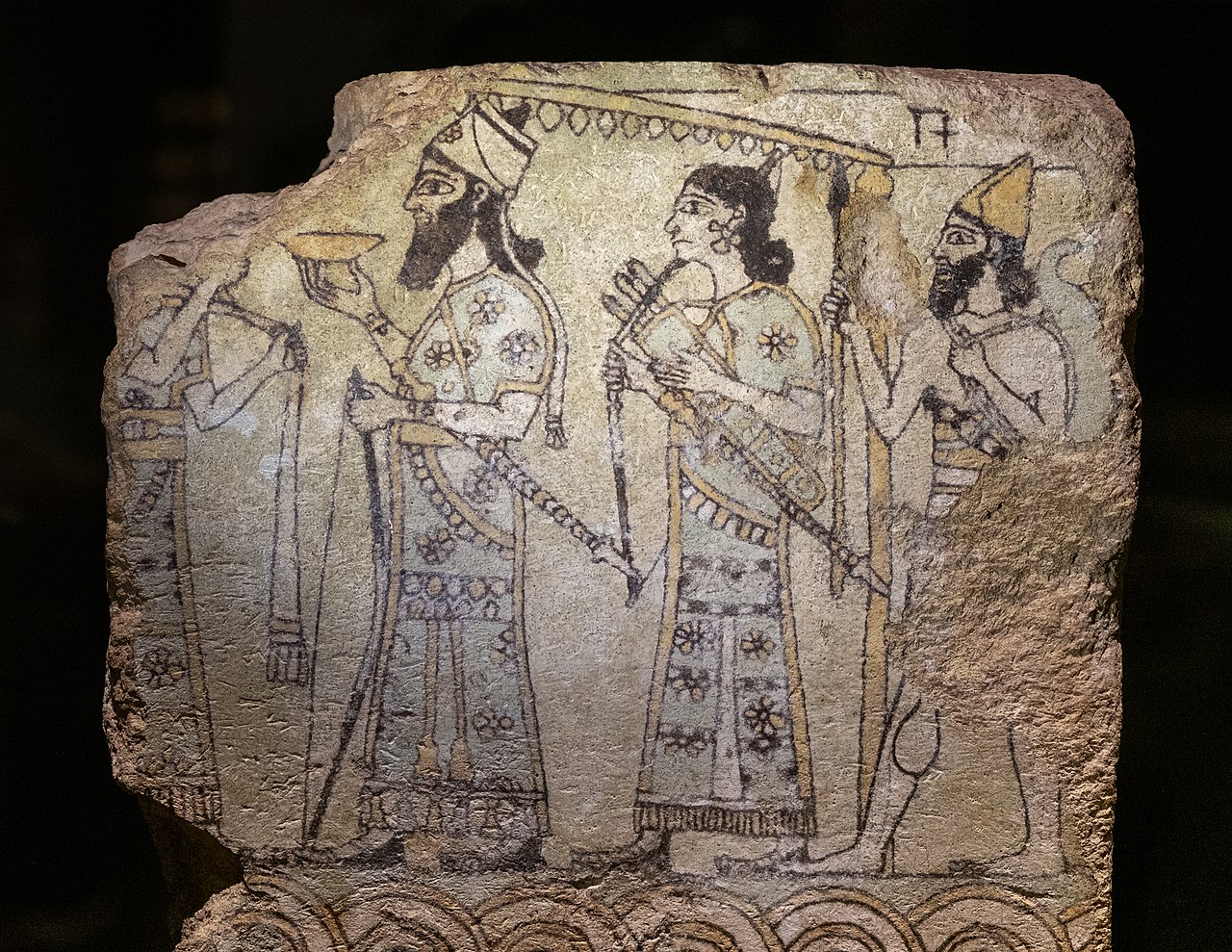
The kings of the Middle and Neo-Assyrian periods continued to present themselves, and be viewed by their subjects, as the intermediaries between Ashur and mankind. This position and role was used to justify imperial expansion: the Assyrians saw their empire as being the part of the world overseen and administered by Ashur through his human agents. In their ideology, the outer realm outside of Assyria was characterized by chaos and the people there were uncivilized, with unfamiliar cultural practices and strange languages. The mere existence of the "outer realm" was regarded as a threat to the cosmic order within Assyria and as such, it was the king's duty to expand the realm of Ashur and incorporate these strange lands, converting chaos to civilization.
Texts describing the coronation of Middle and Neo-Assyrian kings at times include Ashur commanding the king to "broaden the land of Ashur" or "extend the land at his feet". As such, expansion was cast as a moral and necessary duty. Because the rule and actions of the Assyrian king were seen as divinely sanctioned, resistance to Assyrian sovereignty in times of war was regarded to be resistance against divine will, which deserved punishment. Peoples and polities who revolted against Assyria were seen as criminals against the divine world order. Since Ashur was the king of the gods, all other gods were subjected to him and thus the people who followed those gods should be subjected to the representative of Ashur, the Assyrian king.
The kings also had religious and judicial duties. Kings were responsible for performing various rituals in support of the cult of Ashur and the Assyrian priesthood. They were expected, together with the Assyrian people, to provide offerings to not only Ashur but also all the other gods. From the time of Ashur-resh-ishi I onward, the religious and cultic duties of the king were pushed somewhat into the background, though they were still prominently mentioned in accounts of building and restoring temples. Assyrian titles and epithets in inscriptions from then on generally emphasized the kings as powerful warriors. Developing from their role in the Old Assyrian period, the Middle and Neo-Assyrian kings were the supreme judicial authority in the empire, though they generally appear to have been less concerned with their role as judges than their predecessors in the Old Assyrian period were. The kings were expected to ensure the welfare and prosperity of the Assyria and its people, indicated by multiple inscriptions referring to the kings as "shepherds" (re’û).
Capital cities
No word for the idea of a capital city existed in Akkadian, the nearest being the idea of a "city of kingship", i.e. an administrative center used by the king, but there are several examples of kingdoms having multiple "cities of kingship". Due to Assyria growing out of the Assur city-state of the Old Assyrian period, and due to the city's religious importance, Assur was the administrative center of Assyria through most of its history. Though the royal administration at times moved elsewhere, the ideological status of Assur was never fully superseded and it remained a ceremonial center in the empire even when it was governed from elsewhere. The transfer of the royal seat of power to other cities was ideologically possible since the king was Ashur's representative on Earth. The king, like the deity embodied Assyria itself, and so the capital of Assyria was in a sense wherever the king happened to have his residence.
The first transfer of administrative power away from Assur occurred under Tukulti-Ninurta I, who c. 1233 BC inaugurated Kar-Tukulti-Ninurta as capital. Tukulti-Ninurta I's foundation of a new capital was perhaps inspired by developments in Babylonia in the south, where the Kassite dynasty had transferred the administration from the long-established city of Babylon to the newly constructed city of Dur-Kurigalzu, also named after a king. It seems that Tukulti-Ninurta I intended to go further than the Kassites and also establish Kar-Tukulti-Ninurta as the new Assyrian cult center. The city was however not maintained as capital after Tukulti-Ninurta I's death, with subsequent kings once more ruling from Assur.
The Neo-Assyrian Empire underwent several different capitals. There is some evidence that Tukulti-Ninurta II (r. 890–884 BC), perhaps inspired by his predecessor of the same name, made unfulfilled plans to transfer the capital to a city called Nemid Tukulti-Ninurta, either a completely new city or a new name applied to Nineveh, which by this point already rivalled Assur in scale and political importance. The capital was transferred under Tukulti-Ninurta II's son Ashurnasirpal II to Nimrud in 879 BC. An architectural detail separating Nimrud and the other Neo-Assyrian capitals from Assur is that they were designed in a way that emphasized royal power: the royal palaces in Assur were smaller than the temples but the situation was reversed in the new capitals.
In 706 BC, Sargon II transferred the capital to the city of Dur-Sharrukin, which he built himself. Since the location of Dur-Sharrukin had no obvious practical or political merit, this move was probably an ideological statement. Immediately after Sargon II's death in 705 BC, his son Sennacherib transferred the capital to Nineveh, a far more natural seat of power. Though it was not meant as a permanent royal residence, Ashur-uballit II chose Harran as his seat of power after the fall of Nineveh in 612 BC. Harran is typically seen as the short-lived final Assyrian capital. No building projects were conducted during this time, but Harran had been long-established as a major religious center, dedicated to the god Sîn.
Aristocracy and elite
Because of the nature of source preservation, more information about the upper classes of ancient Assyria survives than for the lower ones. At the top of Middle and Neo-Assyrian society were members of long-established and large families called "houses". Members of this aristocracy tended to occupy the most important offices within the government and they were likely descendants of the most prominent families of the Old Assyrian period.
One of the most influential offices in the Assyrian administration was the position of vizier (sukkallu). From at least the time of Shalmaneser I onward, there were grand viziers (sukkallu rabi’u), superior to the ordinary viziers, who at times governed their own lands as appointees of the kings. At least in the Middle Assyrian period, the grand viziers were typically members of the royal family and the position was at this time, as were many other offices, hereditary.
The elite of the Neo-Assyrian Empire was expanded and included several different offices. The Neo-Assyrian inner elite is typically divided by modern scholars into the "magnates", a set of high-ranking offices, and the "scholars" (ummânī), tasked with advising and guiding the kings through interpreting omens. The magnates included the offices masennu (treasurer), nāgir ekalli (palace herald), rab šāqê (chief cupbearer), rab ša-rēši (chief officer/eunuch), sartinnu (chief judge), sukkallu (grand vizier) and turtanu (commander-in-chief), which at times continued to be occupied by royal family members.
Some of the magnates acted as governors of important provinces and all of them were deeply involved with the Assyrian military, controlling significant forces. They owned large tax-free estates, scattered throughout the empire. In the late Neo-Assyrian Empire, there was a growing disconnect between the traditional Assyrian elite and the kings due to eunuchs growing unprecedently powerful. The highest offices both in the civil administration and the army began to be occupied by eunuchs with deliberately obscure and lowly origins, since this ensured that they would be loyal to the king. Eunuchs were trusted, since they were believed incapable of having any dynastic aspirations of their own.
From the time of Erishum I in the early Old Assyrian period onward, a yearly office-holder, a limmu official, was elected from the influential men of Assyria. The limmu official gave their name to the year, meaning that their name appeared in all administrative documents signed that year. Kings were typically the limmu officials in their first regnal years. In the Old Assyrian period, the limmu officials also held substantial executive power, though this aspect of the office had disappeared by the time of the rise of the Middle Assyrian Empire.
Administration
The success of Assyria was not only due to energetic kings who expanded its borders but more importantly due to its ability to efficiently incorporate and govern conquered lands. From the rise of Assyria as a territorial state at the beginning of the Middle Assyrian period onward, Assyrian territory was divided into a set of provinces or districts (pāḫutu). The total number and size of these provinces varied and changed as Assyria expanded and contracted. Every province was headed by a provincial governor (bel pāḫete, bēl pīhāti or šaknu) who was responsible for handling local order, public safety and economy.
Governors stored and distributed the goods produced in their province, which were inspected and collected by royal representatives once a year. Through these inspections, the central government could keep track of current stocks and production throughout the country. Governors had to pay both taxes and offer gifts to the god Ashur, though such gifts were usually small and mainly symbolic. The channeling of taxes and gifts were a method of collecting profit and served to connect the elite of the entire empire to the Assyrian heartland.
In the Neo-Assyrian period, an extensive hierarchy within the provincial administration is attested. At the bottom of this hierarchy were lower officials, such as village managers (rab ālāni) who oversaw one or more villages, collecting taxes in the form of labor and goods and keeping the administration informed of the conditions of their settlements, and corvée officers (ša bēt-kūdini) who kept tallies on the labor performed by forced laborers and the remaining time owed. Individual cities had their own administrations, headed by mayors (ḫazi’ānu), responsible for the local economy and production.
Some regions of the Assyrian Empire were not incorporated into the provincial system but were still subjected to the rule of the Assyrian kings. Such vassal states could be ruled indirectly through allowing established local lines of kings to continue ruling in exchange for tribute or through the Assyrian kings appointing their own vassal rulers. Through the ilku system, the Assyrian kings could also grant arable lands to individuals in exchange for goods and military service.
To overcome the challenges of governing a large empire, the Neo-Assyrian Empire developed a sophisticated state communication system, which included various innovative techniques and relay stations. Per estimates by Karen Radner, an official message sent in the Neo-Assyrian period from the western border province Quwê to the Assyrian heartland, a distance of 700 kilometers (430 miles) over a stretch of lands featuring many rivers without any bridges, could take less than five days to arrive. Such communication speed was unprecedented before the rise of the Neo-Assyrian Empire and was not surpassed in the Middle East until the telegraph was introduced by the Ottoman Empire in 1865, nearly two and a half thousand years after the Neo-Assyrian Empire's fall.