
Abraham (originally Abram) is widely revered as a foundational legendary figure among adherents of the eponymous Abrahamic religions. In Judaism, he is the ethnic ancestor and first Hebrew patriarch who began the covenantal relationship between the Jewish people and God; in Christianity, he is regarded as the forebear of Jesus and the spiritual ancestor of all Christians; and in Islam, he is a link in the chain of Islamic prophets that begins with Adam and culminates in Muhammad. Abraham is revered in all other Abrahamic religions, such as the Baháʼí Faith and the Druze faith. He is regarded as the common forefather of both the Arab people through his son Ishmael and the Jewish people through his son Isaac.
The story of the life of Abraham, as told in the narrative of the Book of Genesis in the Hebrew Bible, revolves around the themes of blessing and promise, especially the promise of progeny and land. He is said to have been called by God to leave the house of his father Terah and settle in the land of Canaan, which God now promises to Abraham and his progeny. This promise is subsequently inherited by Isaac, Abraham's son by his wife Sarah, while Isaac's half-brother Ishmael is also promised that he will be the founder of a great nation. Abraham purchases a tomb (the Cave of the Patriarchs) at Hebron to be Sarah's grave, thus establishing his right to the land; and, in the second generation, his heir Isaac is married to a woman from his own kin to earn his parents' approval. Abraham later marries Keturah and has six more sons; but, on his death, when he is buried beside Sarah, it is Isaac who receives "all Abraham's goods" while the other sons receive only "gifts".
Most scholars view the patriarchal age, along with the Exodus, as a late literary construct that does not relate to any particular historical era. Many scholars believe the Abraham traditions developed orally over centuries, before being incorporated into the Book of Genesis during the Persian period of Judah, where they helped shape post-exilic Jewish identity and were used to support competing claims to the land.
The Abraham cycle
Structure and narrative programs
The Abraham cycle (Genesis 11:27–Genesis 25:11) unfolds as a narrative of mounting tension, centered on the conflict between God's promise that Abram (Abraham's birth name) would father a lineage and become the ancestor of numerous nations, and a succession of crises that jeopardize this divine commitment. The storytelling method used here is the “obstacle story,” a literary device renowned for its enduring and universal popularity across cultures and eras.
The Abraham cycle is not structured by a unified plot centered on a conflict and its resolution or a problem and its solution. The episodes are often only loosely linked, and the sequence is not always logical. The story portrays Abraham gradually assuming the role of the ideal religious person amid themes of blessing and promise, especially the promise of progeny and land. These themes form "narrative programs" set out in Genesis 11:27–31 concerning the sterility of Sarah and Genesis 12:1–3 in which Abraham is ordered to leave the land of his birth for the land God will show him.
Origins and calling
Terah, the ninth in descent from Noah, was the father of Abram, Nahor and Haran (Hebrew: הָרָן Hārān). Haran was the father of Lot, who was Abram's nephew; the family lived in Ur of the Chaldees. Haran died there while Terah was still alive. Abram married Sarah (Sarai) but, unlike Nahor and his wife Milcah, they were childless.

Genesis 11 records that Terah, Abram, Sarai, and Lot departed for Canaan, but settled in a place named Haran (Hebrew: חָרָן Ḥārān), where Terah died at the age of 205.
Then the narrative in Genesis 12 shows that God told Abram to leave his country and his kindred, and go to a land that God would show him, and promised to make of him a great nation, bless him, make his name great, bless them that bless him, and curse them who may curse him. Abram was 75 years old when he and Sarai left Haran with his nephew Lot, and their possessions and people that they had acquired, and they traveled to Shechem in Canaan. Abram built an altar to God in Shechem, and later he built another altar between Bethel and Ai. From there the party travelled to the Negev, or to the south.
According to some exegetes, like Nahmanides, Abram was actually born in Haran and he later relocated to Ur, while some of his family remained in Haran.

Sarai and Pharaoh
There was a severe famine in the land of Canaan, so that Abram, Lot, and their households traveled to Egypt. On the way Abram told Sarai to tell the Egyptians she was his sister, so that the Egyptians would not kill him. When they entered Egypt, the Pharaoh's officials praised Sarai's beauty to Pharaoh, and they took her into the palace and gave Abram goods in exchange. God afflicted Pharaoh and his household with plagues, which led Pharaoh to try to find out what was wrong. Upon discovering that Sarai was a married woman, Pharaoh demanded that Abram and Sarai leave, escorting them to the frontier.
Abram and Lot separate
When they lived for a while in the Negev after being banished from Egypt and came back to the Bethel and Ai area, Abram's and Lot's sizable herds occupied the same pastures. This became a problem for the herdsmen, who were assigned to each family's cattle. The conflicts between herdsmen had become so troublesome that Abram suggested that Lot choose a separate area, either on the left hand or on the right hand, that there be no conflict between them. Lot decided to go eastward to the plain of Jordan, where the land was well watered everywhere as far as Zoara, and he dwelled in the cities of the plain toward Sodom. Abram went south to Hebron and settled in the plain of Mamre, where he built another altar to worship God.
Chedorlaomer
During the rebellion of the Jordan River cities, Sodom and Gomorrah, against Elam, Abram's nephew, Lot, was taken prisoner along with his entire household by the invading Elamite forces. The Elamite army came to collect the spoils of war, after having just defeated the king of Sodom's armies. Lot and his family, at the time, were settled on the outskirts of the Kingdom of Sodom which made them a visible target.

One person who escaped capture came and told Abram what happened. Once Abram received this news, he immediately assembled 318 trained servants. Abram's force headed north in pursuit of the Elamite army, who were already worn down from the Battle of Siddim. When they caught up with them at Dan, Abram devised a battle plan by splitting his group into more than one unit, and launched a night raid. Not only were they able to free the captives, Abram's unit chased and slaughtered the Elamite King Chedorlaomer at Hobah, just north of Damascus. They freed Lot, as well as his household and possessions, and recovered all of the goods from Sodom that had been taken.
Upon Abram's return, Sodom's king came out to meet with him in the Valley of Shaveh, the "king's dale". Also, Melchizedek king of Salem (Jerusalem), a priest of El Elyon, brought out bread and wine and blessed Abram and God. Abram then gave Melchizedek a tenth of everything. The king of Sodom then offered to let Abram keep all the possessions if he would merely return his people. Abram declined to accept anything other than the share to which his allies were entitled.
Covenant of the pieces
Some time after these events, the voice of the LORD came to Abram in a vision, promising him a "reward", namely a son, and repeating the promise of the land and descendants as numerous as the stars. Abram was childless until then, and had anticipated that Eliezer of Damascus, head of his household, would inherit his estate on his death. He was to be rewarded in virtue of his trust in God.
Abram and God then made a covenant ceremony, and God told Abram of the future bondage of his people "in a land that is not theirs", referring to Egypt. God then described to Abram the land that his offspring would claim: the land of the Kenites, Kenizzites, Kadmonites, Hittites, Perizzites, the Rephaim, Amorites, Canaanites, Girgashites, and Jebusites.
Hagar
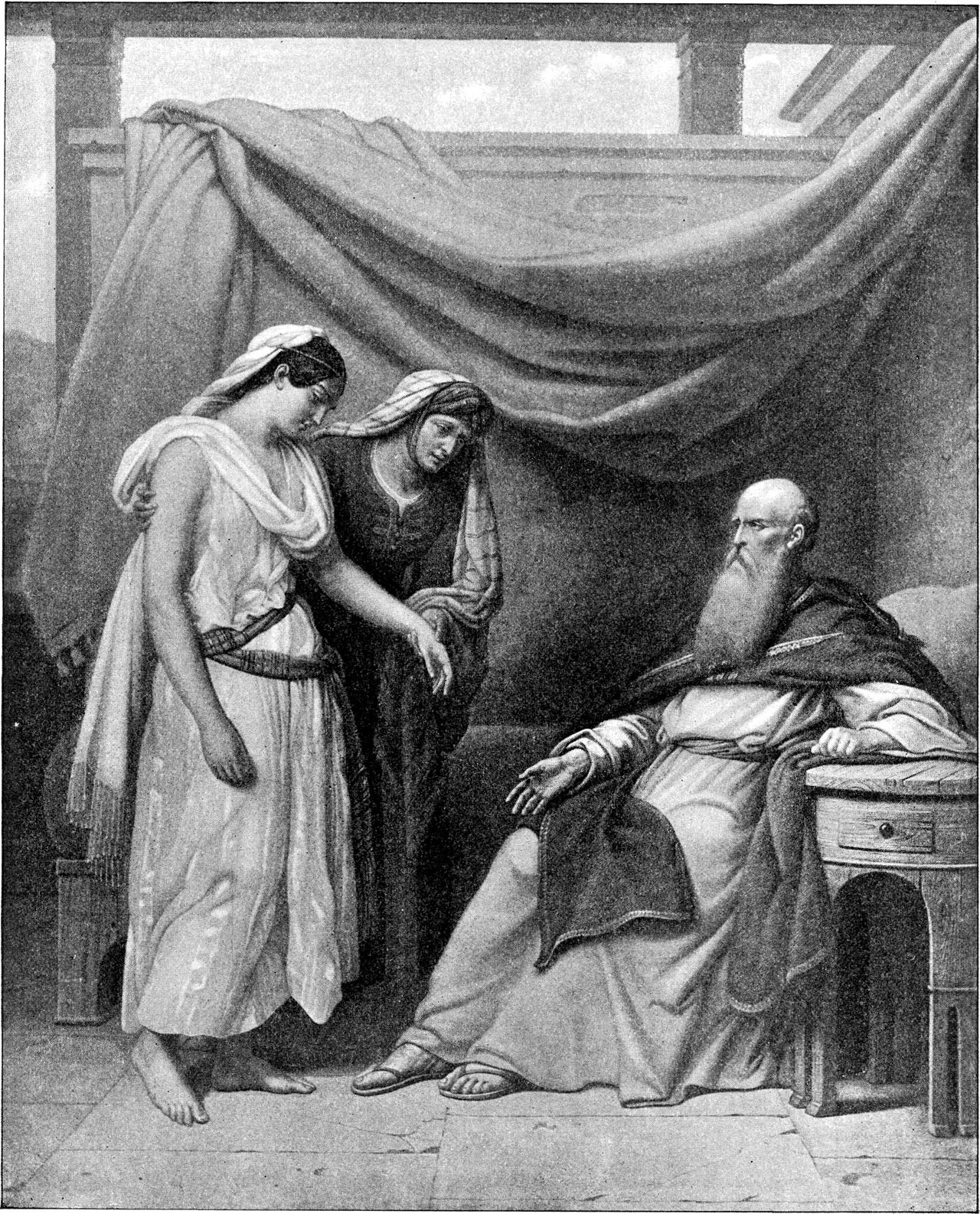
Abram and Sarai tried to make sense of how he would become a progenitor of nations, because after 10 years of living in Canaan, no child had been born. Sarai then offered her Egyptian slave, Hagar, to Abram with the intention that she would bear him a son.
After Hagar found she was pregnant, she began to despise her mistress, Sarai. Sarai responded by mistreating Hagar, and Hagar fled into the wilderness. An angel spoke with Hagar at the fountain on the way to Shur. He instructed her to return to Abram's camp and that her son would be "a wild ass of a man; his hand shall be against every man, and every man's hand against him; and he shall dwell in the face of all his brethren." She was told to call her son Ishmael. Hagar then called God who spoke to her "El-roi", ("Thou God seest me": KJV). From that day onward, the well was called Beer-lahai-roi, ("The well of him that liveth and seeth me": KJV margin), located between Kadesh and Bered. She then did as she was instructed by returning to her mistress in order to have her child. Abram was 86 years of age when Ishmael was born.
The covenant of circumcision
Thirteen years later, when Abram was 99 years of age, God appeared to Abram again and called upon him to be "perfect" or "blameless", so that God could make a covenant with him. Abram fell or bowed to the ground in a gesture of reverence, and God gave Abram a new name: he was now to be called "Abraham". Abraham means "father of a multitude": he would be "a father of many nations". The new name denotes a new stage in Abraham's life.
Abraham then received God's instructions concerning circumcision.
God also declared Sarai's new name to be "Sarah", blessed her, and told Abraham, "I will give thee a son also of her". Abraham again fell to the ground, and he laughed, saying "in his heart, 'Shall a child be born unto him that is a hundred years old? and shall Sarah, that is ninety years old, bear [a child]?'"
Immediately after Abraham's encounter with God, he had his entire household of men, including himself (age 99) and Ishmael (age 13), circumcised.
Three visitors
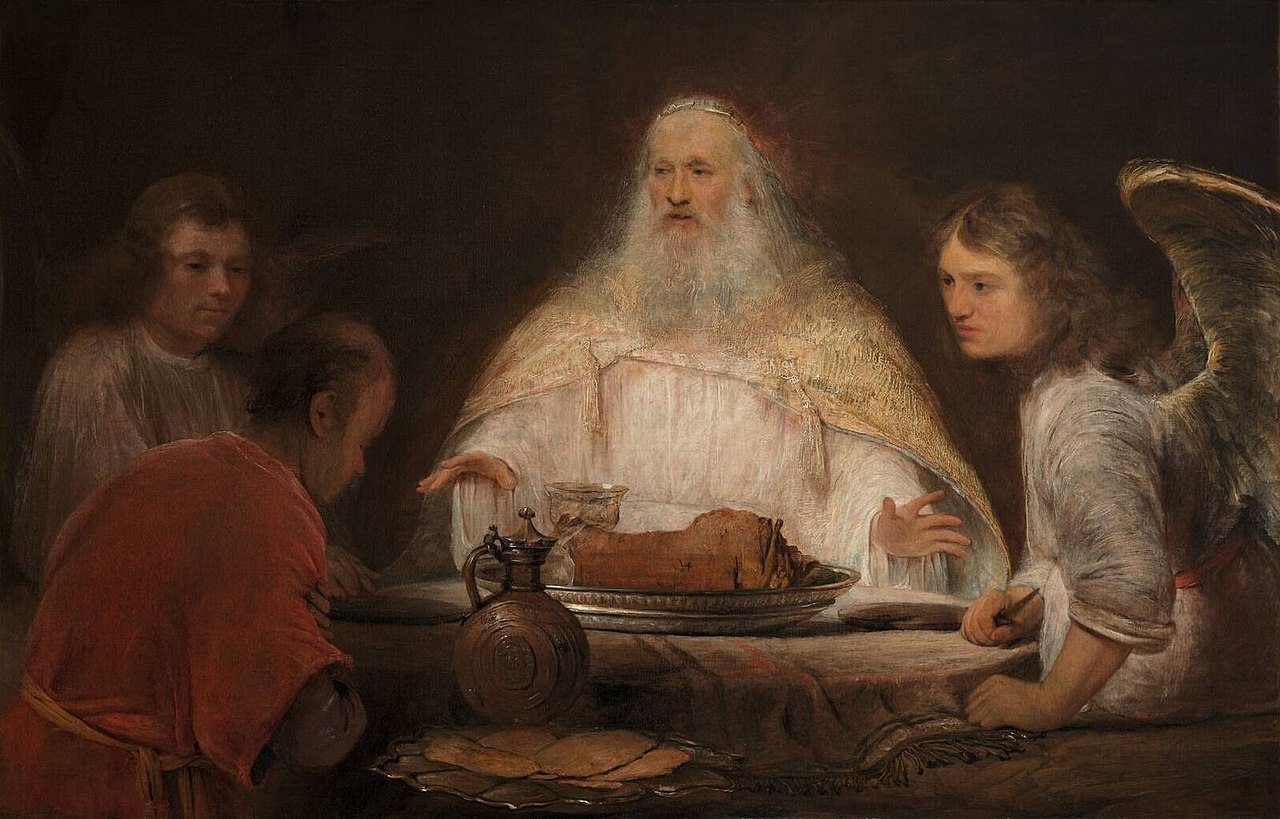
Not long afterward, during the heat of the day, Abraham had been sitting at the entrance of his tent by the terebinths of Mamre. He looked up and saw three men in the presence of God. Then he ran and bowed to the ground to welcome them. Abraham then offered to wash their feet and fetch them a morsel of bread, to which they assented. Abraham rushed to Sarah's tent to order ash cakes made from choice flour, then he ordered a servant-boy to prepare a choice calf. When all was prepared, he set curds, milk and the calf before them, waiting on them, under a tree, as they ate.
One of the visitors told Abraham that upon his return next year, Sarah would have a son. While at the tent entrance, Sarah overheard what was said and she laughed to herself about the prospect of having a child at their ages. The visitor inquired of Abraham why Sarah laughed at bearing a child at her age, as nothing is too hard for God. Frightened, Sarah denied laughing.
Abraham's plea
After eating, Abraham and the three visitors got up. Accompanied by Abraham, the visitors walked over to the peak that overlooked the "cities of the plain" to discuss the fate of Sodom and Gomorrah for their detestable sins that were so great, they moved God to action. Because of God's promise to Abraham regarding his destiny, God revealed plans to assess what these cities have done and confer judgment on them. At this point, the two other visitors left for Sodom. Then Abraham turned to God and pleaded decrementally with Him (from fifty persons to less) that "if there were at least ten righteous men found in the city, would not God spare the city?" For the sake of ten righteous people, God declared that he would not destroy the city.
When the two visitors arrived in Sodom to conduct their report, they planned on staying in the city square. However, Abraham's nephew, Lot, met with them and strongly insisted that these two "men" stay at his house for the night. A rally of men stood outside of Lot's home and demanded that Lot bring out his guests so that they may "know" (v. 5) them. However, Lot objected and offered his virgin daughters who had not "known" (v. 8) man to the rally of men instead. They rejected that notion and sought to break down Lot's door to get to his male guests, thus confirming the wickedness of the city and portending their imminent destruction.
Early the next morning, Abraham went to the place where he stood before God. He "looked out toward Sodom and Gomorrah" and saw what became of the cities of the plain, where not even "ten righteous" (v. 18:32) had been found, as "the smoke of the land went up as the smoke of a furnace."
Abimelech
Abraham moved to live between Kadesh and Shur, settling in Gerar, later associated with the Philistines". While he was living in there, Abraham openly claimed that Sarah was his sister, and she confirmed this assertion, leading King Abimelech to call for Sarah to be brought to him. God then came to Abimelech in a dream and declared that taking her would result in his death, because she was a man's wife. Abimelech had not laid hands on her, so he inquired if he would also slay a righteous nation, especially since Abraham and Sarah had claimed that they were siblings. In response, God told Abimelech that he did indeed have a blameless heart and that is why he continued to exist. However, should he not return the wife of Abraham back to him, God would surely destroy Abimelech and his entire household. Abimelech was informed that Abraham was a prophet who would pray for him.
Early next morning, Abimelech informed his servants of his dream and approached Abraham inquiring as to why he had brought such great guilt upon his kingdom. Abraham stated that he thought there was no fear of God in that place, and that they might kill him for his wife. Then Abraham defended what he had said as not being a lie at all: "And yet indeed she is my sister; she is the daughter of my father, but not the daughter of my mother; and she became my wife." Abimelech returned Sarah to Abraham, and gave him gifts of sheep, oxen, and servants; and invited him to settle wherever he pleased in Abimelech's lands. Further, Abimelech gave Abraham a thousand pieces of silver to serve as Sarah's vindication before all. Abraham then prayed for Abimelech and his household, since God had stricken the women with infertility because of the taking of Sarah.
Two incidents follow in which Abraham and Abimelech resolve issues by agreement. Firstly, Abimelech, supported by Phicol, the chief of his troops, secures from the patriarch an agreement that he will act honestly in his dealings with Abimelech and his descendants, reciprocating the manner in which Abimelech says he has treated Abraham. Subsequently, a specific issue arises in relation to a well which Abraham has dug but which Abimelech's servants have taken over. Abimelech and Phicol approached Abraham because of a dispute over the well. Abraham reproached Abimelech due to his servants' aggressive attacks and the seizing of the well. Abimelech claimed ignorance of the incident. Then Abraham offered a pact by providing sheep and oxen to Abimelech. Further, to attest that Abraham was the one who had dug the well, he also gave Abimelech seven ewes for proof. Because of this sworn oath, they called the place of this well Beersheba. After Abimelech and Phicol headed back to Philistia, Abraham planted a tamarisk grove in Beersheba and called upon "the name of the LORD, the everlasting God".
Isaac
As had been prophesied at Mamre the previous year, Sarah became pregnant and bore a son to Abraham, on the first anniversary of the covenant of circumcision. Abraham was "an hundred years old" when his son, whom he named Isaac, was born, and he circumcised him when he was eight days old. For Sarah, the thought of giving birth and nursing a child, at such an old age, also brought her much laughter, as she declared, "God hath made me to laugh, so that all who hear will laugh with me." Isaac continued to grow, and on the day he was weaned, Abraham held a great feast to honor the occasion. During the celebration, however, Sarah found Ishmael mocking; an observation that would begin to clarify the birthright of Isaac.
Ishmael
Ishmael was fourteen years old when Abraham's son Isaac was born to Sarah. When she found Ishmael teasing Isaac, Sarah told Abraham to send both Ishmael and Hagar away. She declared that Ishmael would not share in Isaac's inheritance. Abraham was greatly distressed by his wife's words and sought the advice of his God. God told Abraham not to be distressed but to do as his wife commanded. God reassured Abraham that "in Isaac shall seed be called to thee." He also said Ishmael would make a nation, "because he is thy seed".
Early the next morning, Abraham brought Hagar and Ishmael out together. He gave her bread and water and sent them away. The two wandered in the wilderness of Beersheba until her bottle of water was completely consumed. In a moment of despair, she burst into tears. After God heard the boy's voice, an angel of the Lord confirmed to Hagar that he would become a great nation, and will be "living on his sword". A well of water then appeared so that it saved their lives. As the boy grew, he became a skilled archer living in the wilderness of Paran. Eventually his mother found a wife for Ishmael from her home country, the land of Egypt.
Binding of Isaac
At some point in Isaac's youth, Abraham was commanded by God to offer his son up as a sacrifice in the land of Moriah. The patriarch traveled three days until he came to the mount that God told him of. He then commanded the servants to remain while he and Isaac proceeded alone into the mount. Isaac carried the wood upon which he would be sacrificed. Along the way, Isaac asked his father where the animal for the burnt offering was, to which Abraham replied "God will provide himself a lamb for a burnt offering". Just as Abraham was about to sacrifice his son, he was interrupted by the angel of the Lord, and he saw behind him a "ram caught in a thicket by his horns", which he sacrificed instead of his son. The place was later named as Jehovah-jireh. For his obedience he received another promise of numerous descendants and abundant prosperity. After this event, Abraham went to Beersheba.
Later years
Sarah died, and Abraham buried her in the Cave of the Patriarchs (the "cave of Machpelah"), near Hebron which he had purchased along with the adjoining field from Ephron the Hittite. After the death of Sarah, Abraham took another wife, a concubine named Keturah, and together they had six sons: Zimran, Jokshan, Medan, Midian, Ishbak, and Shuah.
Abraham lived to see Isaac marry Rebekah, and to see the birth of his twin grandsons Jacob and Esau. He died at age 175, and was buried in the cave of Machpelah by his sons Isaac and Ishmael.
Historical context
Historicity
In the early and middle 20th century, leading archaeologists such as William F. Albright and G. Ernest Wright and biblical scholars such as Albrecht Alt and John Bright believed that the patriarchs and matriarchs were either real individuals or believable composites of people who lived in the "patriarchal age", the 2nd millennium BCE. However, in the 1970s, new arguments concerning Israel's past and the biblical texts challenged these views; these arguments can be found in Thomas L. Thompson's The Historicity of the Patriarchal Narratives (1974), and John Van Seters' Abraham in History and Tradition (1975). Thompson, a literary scholar, based his argument on archaeology and ancient texts. His thesis centered on the lack of compelling evidence that the patriarchs lived in the 2nd millennium BCE, and noted how certain biblical texts reflected first millennium conditions and concerns. Van Seters examined the patriarchal stories and argued that their names, social milieu, and messages strongly suggested that they were Iron Age creations. Van Seters' and Thompson's works were a paradigm shift in biblical scholarship and archaeology, which gradually led scholars to no longer consider the patriarchal narratives as historical. Some conservative scholars attempted to defend the Patriarchal narratives in the following years, but this has not found acceptance among scholars. By the beginning of the 21st century, archaeologists had stopped trying to recover any context that would make Abraham, Isaac or Jacob credible historical figures.
Origins of the narrative
Abraham's story, like those of the other patriarchs, most likely had a substantial oral prehistory: he is mentioned in the Book of Ezekiel and in the Book of Isaiah.) As with Moses, Abraham's name is apparently very ancient, as the tradition found in the Book of Genesis no longer understands its original meaning, which is likely "father is exalted" – the meaning offered in Genesis 17:5, "Father of a multitude", is a folk etymology. At some stage the oral traditions became part of the written tradition of the Pentateuch; a majority of scholars believe this stage belongs to the Persian period, roughly 520–320 BCE. The mechanisms by which this came about remain unknown, but there are currently at least two hypotheses. The first, called Persian Imperial authorisation, is that the post-Exilic community devised the Torah as a legal basis on which to function within the Persian Imperial system; the second is that the Pentateuch was written to provide the criteria for determining who would belong to the post-Exilic Jewish community and to establish the power structures and relative positions of its various groups, notably the priesthood and the lay "elders".
The completion of the Torah and its elevation to the centre of post-Exilic Judaism was as much or more about combining older texts as writing new ones – the final Pentateuch was based on existing traditions. In the Book of Ezekiel, written during the Exile (i.e., in the first half of the 6th century BCE), Ezekiel, an exile in Babylon, tells how those who remained in Judah are claiming ownership of the land based on inheritance from Abraham; but the prophet tells them they have no claim because they do not observe Torah. The Book of Isaiah similarly testifies to tension between the people of Judah and the returning post-Exilic Jews (the "gôlâ"), stating that God is the father of Israel and that Israel's history begins with the Exodus and not with Abraham. The conclusion to be inferred from this and similar evidence (e.g., Ezra–Nehemiah) is that the figure of Abraham must have been preeminent among the great landowners of Judah at the time of the Exile and after, serving to support their claims to the land in opposition to those of the returning exiles.
Amorite origin hypothesis
According to Nissim Amzallag, the Book of Genesis portrays Abraham as having an Amorite origin, arguing that the patriarch's provenance from the region of Harran as described in Genesis 11:31 associates him with the territory of the Amorite homeland. He also notes parallels between the biblical narrative and the Amorite migration into the Southern Levant in the 2nd millennium BCE. Likewise, some scholars like Daniel E. Fleming and Alice Mandell have argued that the biblical portrayal of the Patriarchs' lifestyle appears to reflect the Amorite culture of the 2nd millennium BCE as attested in texts from the ancient city-state of Mari, suggesting that the Genesis stories retain historical memories of the ancestral origins of some of the Israelites. Alan Millard argues that the name Abram is of Amorite origin and that it is attested in Mari as ʾabī-rām. He also suggests that the Patriarch's name corresponds to a form typical of the Middle Bronze Age and not of later periods. Some papers identify Abraham with the Amorite chieftain Abum, and his son Ishmael with Sumulael.