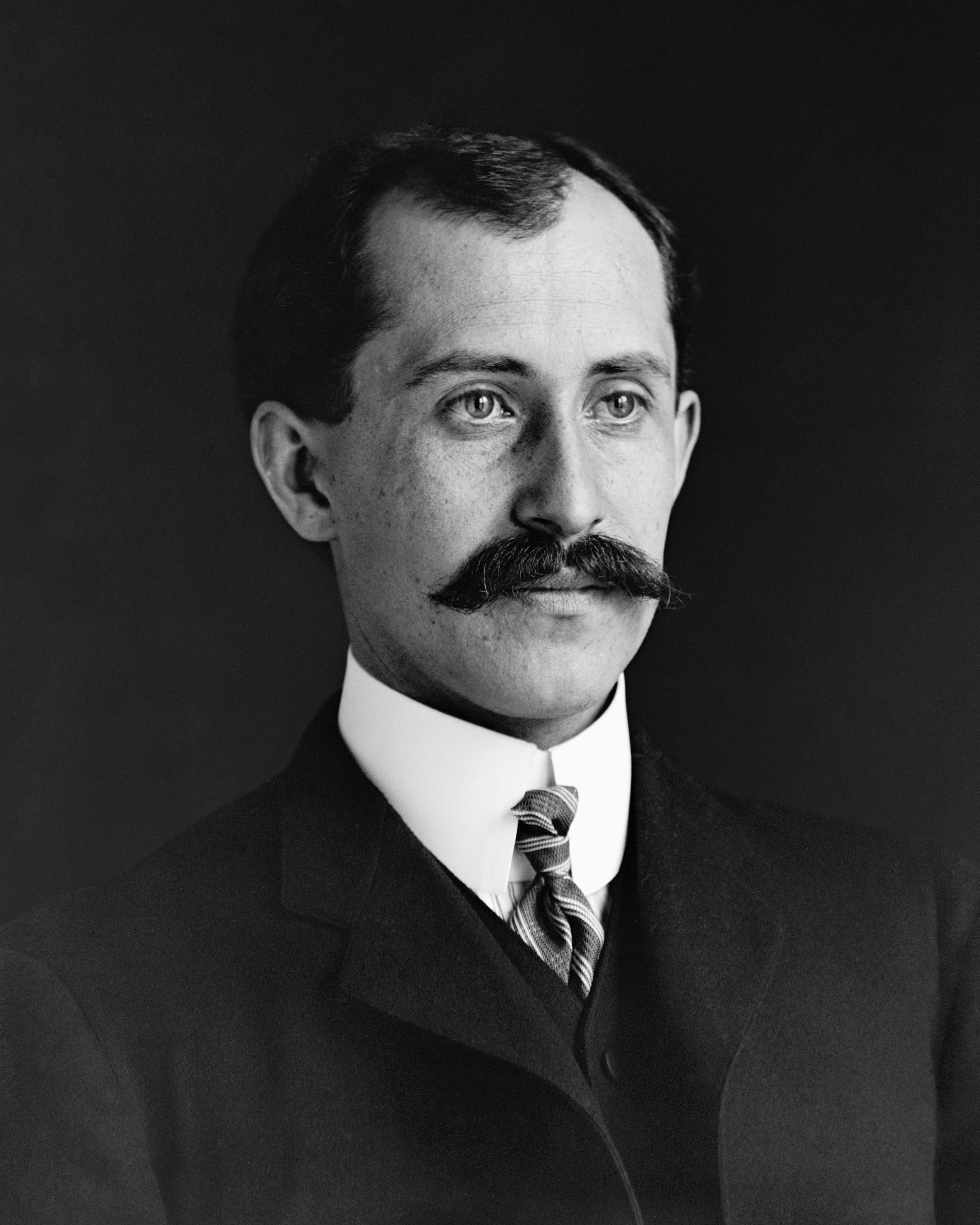
The Wright Brothers — Orville (1871–1948) and Wilbur Wright (1867–1912) — invented and flew the world's first successful powered, heavier-than-air aircraft on December 17, 1903, at Kitty Hawk, North Carolina. Self-taught engineers who financed their experiments with profits from a bicycle shop, they solved the fundamental problem of controlled flight that had eluded scientists and inventors for centuries. Their 12-second, 120-foot inaugural flight triggered the age of aviation and permanently reshaped warfare, commerce, and human civilisation.
Who Were the Wright Brothers? Early Life and Background
Wilbur Wright was born on April 16, 1867, near Millville, Indiana, and Orville on August 19, 1871, in Dayton, Ohio. They were the third and fourth surviving children of Milton Wright, a bishop in the Church of the United Brethren in Christ, and Susan Catherine Koerner Wright, a mechanically gifted woman who reportedly built household gadgets. Neither brother attended college. Wilbur was accepted to Yale but suffered a serious ice-hockey injury in 1885 that damaged his teeth and heart, causing a prolonged depression that kept him home. Orville dropped out of high school. Despite lacking formal credentials, both were voracious readers and instinctive engineers. In 1889 Orville started a printing business, and Wilbur eventually joined him. By 1892 they had pivoted to bicycles — first selling, then repairing, and finally manufacturing their own 'Wright Special' model by 1896. The mechanical precision and financial discipline of the bicycle trade would prove directly transferable to aeronautics.
What Inspired the Wright Brothers to Pursue Flight?
The brothers' fascination with flight traces to 1878, when their father brought home a small rubber-band-powered helicopter toy designed by French aeronautical pioneer Alphonse Pénaud. Rather than destroy the toy as most children did, Orville and Wilbur studied it and built copies. The death of German glider pioneer Otto Lilienthal in a gliding accident on August 10, 1896, was a turning point. Wilbur later wrote that news of Lilienthal's crash 'aroused a passive interest' that became active study. He began corresponding with the Smithsonian Institution in May 1899, requesting all published materials on aeronautics. The Smithsonian sent pamphlets on Lilienthal, Samuel Langley, and others, and the brothers consumed every scrap of existing aeronautical knowledge — then systematically identified what was wrong with it. Crucially, they concluded that the central unsolved problem was not power or lift, but control: how to stabilise and steer a flying machine in three dimensions.
How Did the Wright Brothers Solve the Problem of Flight Control?
The Wright Brothers' most original contribution was their three-axis control system — the foundation of every aircraft flying today. Observing birds, Wilbur noticed that vultures regained balance by twisting, or 'warping,' the tips of their wings. In the summer of 1899 he demonstrated the concept to Orville using a long cardboard box: by twisting opposite corners, the lift on each side could be independently varied. They called the technique 'wing warping.' Combined with a movable forward elevator (to control pitch) and a rear rudder (to control yaw), their system gave the pilot authority over roll, pitch, and yaw simultaneously — the three axes of flight. No other experimenter had integrated all three. To validate their theories cheaply, they built a 5-foot biplane kite in 1899 that successfully demonstrated wing warping. They then wrote to the U.S. Weather Bureau asking for a site with consistent, moderate winds and soft landing surfaces. The Bureau recommended Kitty Hawk, North Carolina, where Atlantic winds averaged 13 mph and sand dunes provided gentle landings.
What Happened at Kitty Hawk? The Glider Years (1900–1902)
Between 1900 and 1902 the Wrights made three extended trips to Kitty Hawk to test progressively refined gliders before risking a powered machine. Their 1900 glider, with a 17-foot wingspan, provided disappointing lift — roughly one-third of what Lilienthal's published tables predicted. Their 1901 glider, the largest ever flown at that point with a 22-foot wingspan, was also underperforming. Disturbed by the gap between theory and reality, they returned to Dayton and built a wind tunnel in their bicycle shop — a 6-foot wooden box with a fan at one end. Between October and December 1901 they tested more than 200 wing shapes, meticulously recording lift and drag data on a balance scale of their own design. Their wind-tunnel results showed that Lilienthal's published lift coefficient was incorrect. Using their own corrected figures, they designed the 1902 glider, which had a 32-foot wingspan and a dramatically improved lift-to-drag ratio. They flew it more than 1,000 times at Kill Devil Hills near Kitty Hawk, with glides exceeding 600 feet. A key refinement came when they made the rear rudder movable, linking it to the wing-warping system, which cured a dangerous tendency called 'well-digging' (an uncontrolled spin). By October 1902 they had a fully controllable glider and filed a patent application for their control system.
How Did the Wright Brothers Build Their Engine and Propellers?
With glider control mastered, the brothers needed a lightweight gasoline engine. They asked more than a dozen engine manufacturers to build one meeting their specifications — under 180 pounds and producing at least 8 horsepower — but found no takers. Their bicycle-shop mechanic, Charles Edward Taylor, designed and hand-built a 4-cylinder, water-cooled engine in just six weeks during early 1903. It weighed 179 pounds and produced approximately 12 horsepower, exceeding their minimum requirement. The propellers presented an even more novel challenge. Assuming marine propeller data would be applicable, the brothers consulted existing literature and found it useless — no reliable theory of propeller action existed. Working from first principles, they reasoned that a propeller is simply a rotating wing, generating thrust as it generates lift. Over several months of argument and analysis — reportedly so heated that they sometimes switched sides mid-debate to pressure-test each other's logic — they designed twin 8-foot wooden propellers that achieved roughly 66% efficiency, a figure not significantly bettered until the 1920s. The propellers were carved by hand from spruce laminate and rotated in opposite directions to cancel torque.
December 17, 1903: The First Powered Flight at Kitty Hawk
The Wright Flyer — formally called the Flyer I — had a 40-foot 4-inch wingspan, weighed 605 pounds including the pilot, and was covered in Pride of the West muslin fabric. It had no wheels, launching instead from a 60-foot monorail track laid on the sand. After a failed attempt on December 14 (Wilbur stalled the machine), the brothers prepared again on the morning of December 17, 1903, in 27-mph winds and near-freezing temperatures. They invited five witnesses from the nearby Kitty Hawk Life Saving Station. Orville took the first turn as pilot, lying prone on the lower wing. At 10:35 a.m. the Flyer lifted off and traveled 120 feet in 12 seconds. The brothers made four flights that day; the fourth and longest, piloted by Wilbur, covered 852 feet in 59 seconds. A gust of wind then tumbled the Flyer and damaged it beyond repair. Orville sent a telegram to their father: 'Success four flights Thursday morning all against twenty one mile wind started from Level with engine power alone average speed through air thirty one miles longest 57 [actually 59] seconds inform Press home Christmas.' The Dayton Journal declined to print the story, deeming it too incredible.
| Flight | Pilot | Distance | Duration | Wind Speed |
|---|---|---|---|---|
| 1st | Orville Wright | 120 feet (37 m) | 12 seconds | 27 mph |
| 2nd | Wilbur Wright | 175 feet (53 m) | 12 seconds | 27 mph |
| 3rd | Orville Wright | 200 feet (61 m) | 15 seconds | 27 mph |
| 4th | Wilbur Wright | 852 feet (260 m) | 59 seconds | 27 mph |
How Did the Wright Brothers Develop the Airplane After 1903?
Kitty Hawk was a proof of concept, not a practical aircraft. Returning to Dayton, the brothers spent 1904 and 1905 flying improved versions — the Flyer II and Flyer III — at Huffman Prairie, an 84-acre cow pasture eight miles east of Dayton. By October 5, 1905, Wilbur flew the Flyer III for 39 minutes and 24 seconds, covering 24.5 miles in circles — the world's first truly practical airplane. They then stopped flying for two and a half years, worried about revealing their design before securing patents and sales contracts. Their U.S. Patent No. 821,393, granted May 22, 1906, covered the control system, not the aircraft itself. The U.S. Army showed initial indifference, and the brothers negotiated first with France. A 1908 contract with the U.S. Army Signal Corps required them to demonstrate a two-seat airplane capable of carrying a passenger at 40 mph for one hour. Wilbur simultaneously demonstrated in France, where he flew 77 flights between August and December 1908, shattering European aviation records and causing a sensation. On September 17, 1908, during Army trials at Fort Myer, Virginia, a propeller shaft cracked, crashing the plane. Passenger Lt. Thomas Selfridge became the first airplane fatality; Orville suffered a broken leg and ribs. Wilbur nevertheless completed the Army contract in 1909. The brothers formed the Wright Company in November 1909, valued at $1 million.
Why Did the Wright Brothers Get Entangled in Patent Wars?
From 1910 onward the Wright Company aggressively litigated against rival manufacturers, most prominently Glenn Curtiss, whose ailerons (separate movable flaps) the Wrights claimed infringed their wing-warping patent. The legal battles consumed enormous energy and money and earned the brothers a reputation as monopolists hostile to aviation's growth. Wilbur, who bore the brunt of the litigation, reportedly told Orville in 1912 that the stress was killing him. He was right: Wilbur contracted typhoid fever in May 1912 and died on May 30, 1912, in Dayton, aged 45. Historians widely believe exhaustion and the strain of constant legal battles weakened his resistance. Orville sold the Wright Company in 1915 and largely withdrew from commercial aviation, though he continued laboratory research. The patent disputes were finally resolved during World War I when the U.S. government forced a patent pool under the Manufacturers Aircraft Association in 1917.
What Is the Legacy of the Wright Brothers?
The Wright Brothers' invention is among the most consequential in human history. Within 66 years of the first 12-second flight, Apollo 11 astronauts carried a swatch of the original Flyer's muslin fabric to the Moon in July 1969. Commercial aviation today carries more than 4.5 billion passengers annually (pre-COVID peak, 2019, IATA data) and supports an estimated $3.5 trillion in global economic activity. The three-axis control system the brothers patented remains the fundamental operating principle of every fixed-wing aircraft ever built. Orville lived long enough to see jet aircraft, breaking the sound barrier, and the dawn of the Space Age, dying on January 30, 1948, at age 76. The original Wright Flyer was donated to the Smithsonian National Air and Space Museum in Washington, D.C., where it has been on display since 1948. On February 18, 2021, NASA's Ingenuity helicopter — which carried another piece of the original Flyer's fabric — became the first powered aircraft to fly on another planet, on Mars, directly honoring the Wright Brothers' foundational achievement.