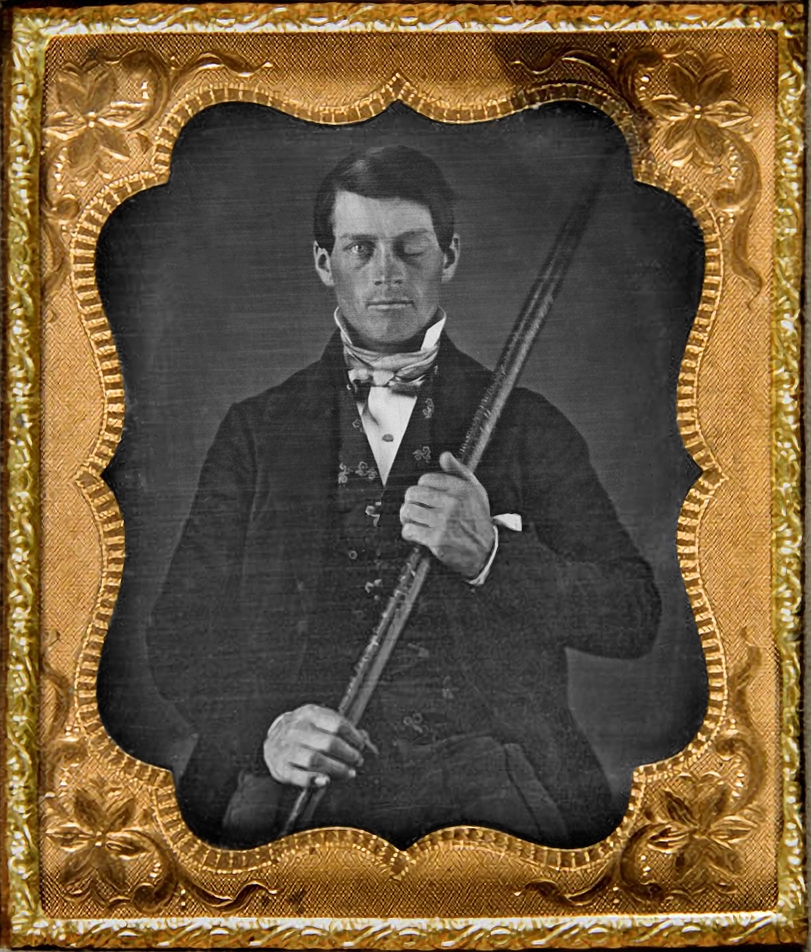
Phineas Gage was a 25-year-old Vermont railroad foreman who, on September 13, 1848, survived a 3.5-foot iron tamping rod blasting clean through his skull — entering below his left cheekbone and exiting through the top of his head. He walked away conscious, but the damage to his frontal lobes transformed his personality so dramatically that friends said he was 'no longer Gage.' His case became the single most influential accident in the history of neuroscience.
What Happened to Phineas Gage in 1848?
Gage was working for the Rutland & Burlington Railroad near Cavendish, Vermont, packing blasting powder into a rock bore with a custom-made iron rod — 1.25 inches in diameter and weighing 13.25 pounds. A premature explosion launched the rod upward through his skull at high velocity. It landed roughly 80 feet away, reportedly slick with brain matter. Gage was thrown onto his back but regained speech within minutes. He was driven by oxcart to the Cavendish hotel, where local physician Dr. John Martyn Harlow treated him. Harlow meticulously documented the case, noting that both entry and exit wounds were visible and that a large portion of the frontal lobe had been destroyed or ejected.
How Did the Injury Change Gage's Personality?
Before the accident, Gage was described by his employers as their 'most capable and efficient' foreman — responsible, well-balanced, and shrewd. After recovery, Dr. Harlow recorded a stark transformation. Gage became fitful, irreverent, and profane, unable to stick to plans and dismissive of social norms. Harlow's famous summary: 'the equilibrium or balance between his intellectual faculties and animal propensities seems to have been destroyed.' He could no longer hold the railroad job and spent years drifting — exhibiting himself at Barnum's American Museum in New York, working as a stagecoach driver in Chile, and eventually reuniting with family in San Francisco, where he died on May 21, 1860, following a series of epileptic seizures, aged 36.

Why Is Phineas Gage So Important to Neuroscience?
Gage's case was the first strong clinical evidence that the frontal lobes govern personality and social behaviour — not merely motor or sensory function. In 1994, neurologists Antonio and Hanna Damasio used computer modelling on Gage's preserved skull (held at Harvard Medical School) to reconstruct the rod's trajectory, confirming damage to the ventromedial prefrontal cortex — the same region implicated in modern studies of decision-making and emotional regulation. Their landmark paper in Science connected Gage to contemporary patients with similar lesions who also showed impaired social judgement while retaining normal intelligence. The case anchors textbooks on neurology, psychology, and philosophy of mind to this day.
Key Facts at a Glance
| Detail | Fact |
|---|---|
| Date of accident | September 13, 1848 |
| Location | Cavendish, Vermont, USA |
| Rod dimensions | 3 ft 7 in long, 1.25 in diameter, 13.25 lb |
| Brain region damaged | Ventromedial prefrontal cortex (left) |
| Attending physician | Dr. John Martyn Harlow |
| Age at accident / death | 25 / 36 |
| Skull held at | Warren Anatomical Museum, Harvard Medical School |
