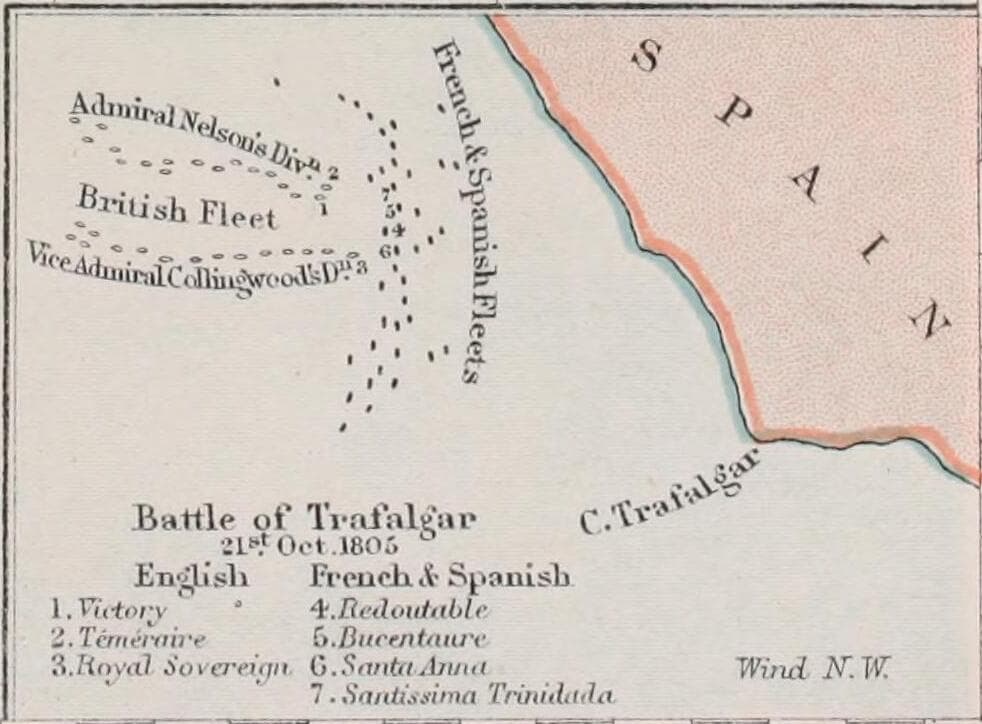
The Battle of Trafalgar, fought on 21 October 1805 off Cape Trafalgar on Spain's Atlantic coast, was the most decisive naval engagement of the Napoleonic Wars. Vice-Admiral Horatio Nelson's 27-ship British fleet destroyed a combined Franco-Spanish force of 33 ships-of-the-line, ending Napoleon Bonaparte's hopes of ever invading Britain. Nelson died in the victory, shot by a French marksman, but his tactics and the battle's outcome ensured British naval supremacy for over a century.
What Led to the Battle of Trafalgar? The Strategic Background
By 1805, Napoleon had assembled the Grande Armée — roughly 180,000 troops — at Boulogne on the French coast, poised for an invasion of England. The critical obstacle was the English Channel. To cross it safely, France needed temporary naval dominance, and Napoleon devised an elaborate plan to achieve it. He ordered Vice-Admiral Pierre-Charles Villeneuve to sail the Combined Fleet of France and Spain from the Mediterranean, cross the Atlantic to draw off the British, then return to concentrate superior numbers in the Channel. The plan never fully materialised. After a cat-and-mouse chase to the West Indies and back, Villeneuve retreated to Cadiz, Spain, in August 1805. Napoleon, furious at the failure, abandoned the invasion plan and marched the Grande Armée east toward Austria. Yet the Combined Fleet still sat in Cadiz, a threat Britain could not ignore. Under pressure from Napoleon, Villeneuve finally sortied from Cadiz on 19 October 1805 with orders to sail for the Strait of Gibraltar and enter the Mediterranean. Nelson, who had shadowed the fleet for months, was waiting.
Who Was Horatio Nelson? The Admiral Who Changed Naval Warfare
Vice-Admiral Horatio Nelson, 1st Viscount Nelson, was 47 years old at Trafalgar and already regarded as Britain's greatest naval commander. Born in Burnham Thorpe, Norfolk, in 1758, he had entered the Royal Navy at age 12. His career was marked by both brilliance and audacity: at the Battle of Cape St Vincent in 1797 he personally led a boarding party to capture two Spanish ships, and at the Battle of the Nile in 1798 he annihilated a French fleet at Aboukir Bay, trapping Napoleon's army in Egypt. He lost his right arm at Tenerife in 1797 and was blinded in his right eye at Calvi in 1794, yet these injuries never diminished his aggression. His leadership philosophy was to delegate trust to his captains — his 'Band of Brothers' — briefed in detail on his intentions so they could act independently in the chaos of battle. This was revolutionary in an era when admirals typically signalled rigid instructions throughout an engagement. Nelson's counterpart commanding the Combined Fleet, Villeneuve, was a competent but demoralised officer who had escaped the Battle of the Nile and knew Nelson's reputation intimately.
What Was Nelson's Famous Battle Plan — the 'Nelson Touch'?
Traditional 18th-century naval tactics dictated that opposing fleets form parallel lines and exchange broadsides — a 'line of battle' that minimised risk but rarely produced decisive results. Nelson discarded this convention entirely. In his memorandum to his captains on 9 October 1805, he outlined an attack in two columns sailing perpendicular to the enemy line, cutting through it at two points. This approach, which he called his 'Nelson Touch,' would create three separate engagements simultaneously, overwhelming the rear and centre of the enemy fleet before the van could turn back to assist. The bold geometry almost guaranteed chaos for Villeneuve but also exposed the leading British ships to devastating raking fire for up to 40 minutes before they could respond. Nelson accepted those losses as the price of a decisive victory. He led the weather column in HMS Victory, while Vice-Admiral Cuthbert Collingwood commanded the lee column in HMS Royal Sovereign. On the morning of 21 October, with the wind light from the west-northwest, Nelson hoisted his most famous signal: 'England expects that every man will do his duty.' Collingwood, characteristically gruff, reportedly said he wished Nelson would stop signalling; his men already knew their duty.
How Did the Battle of Trafalgar Unfold? A Hour-by-Hour Account
At around 11:45 a.m. the two British columns bore down on the Combined Fleet, which Villeneuve had formed into a ragged crescent — a line not a true arc — sailing northward. HMS Royal Sovereign broke the enemy line at noon, passing under the stern of the Spanish three-decker Santa Ana and pouring in a devastating raking broadside that killed or wounded 400 men in a single volley. Other British ships followed in succession. HMS Victory, leading the weather column, came under intense fire for over 40 minutes before reaching the line. By 1:00 p.m. she was locked in close combat with the French flagship Bucentaure and the 74-gun Redoutable. It was a marksman in Redoutable's mizzentop who, at around 1:15 p.m., fired the musket ball that struck Nelson on his left shoulder, penetrating his spine. He was carried below to the cockpit and died at approximately 4:30 p.m., reportedly saying 'Thank God, I have done my duty.' The battle raged until around 5:00 p.m. By its end, 18 ships of the Combined Fleet had been captured and one — the French Achille — had blown up. Not a single British ship was lost. Villeneuve himself was captured aboard the Bucentaure. A violent storm struck the fleet the following days, causing the loss of many prizes, but the strategic result was irreversible.
What Were the Casualties at Trafalgar? The Human Cost
The human toll was staggering, particularly for the Combined Fleet. French and Spanish forces suffered approximately 4,408 killed and 2,545 wounded, with nearly 7,000 sailors and officers taken prisoner. British losses amounted to 449 killed and 1,241 wounded — substantial, but a fraction of the enemy's casualties. Nelson's flagship HMS Victory lost 57 killed and 102 wounded. Among the Spanish dead was Rear-Admiral Ignacio María de Álava, mortally wounded aboard the Santa Ana; the Spanish Rear-Admiral Federico Gravina was also mortally wounded and died of his wounds in March 1806. The storm that followed the battle was nearly as deadly as the fighting itself — thousands of prisoners and wounded sailors drowned or perished when captured ships foundered. Of 18 prizes taken, only 4 survived the post-battle storm intact.
| Side | Ships Engaged | Ships Lost | Killed | Wounded | Prisoners |
|---|---|---|---|---|---|
| British (Royal Navy) | 27 | 0 | ~449 | ~1,241 | 0 |
| French (Marine Nationale) | 18 | 12 | ~3,370 | ~1,200 | ~4,000 |
| Spanish (Armada Española) | 15 | 7 | ~1,038 | ~1,345 | ~3,000 |
Why Did the Combined Fleet Lose? Key Reasons for the Defeat
Several compounding factors sealed the Combined Fleet's fate. First, crew quality: British sailors drilled continuously at their guns and could fire a broadside two to three times per minute, while French and Spanish crews — many of whom had rarely been to sea due to British blockades — fired at roughly half that rate. Second, morale: Villeneuve's officers knew their admiral had lost confidence, and many Spanish commanders resented serving under French command. Third, formation: the Combined Fleet's line was disordered before the battle even began, partly because Villeneuve had reversed course from south to north on the morning of the battle, which jumbled the order of ships and left the fleet strung out. Fourth, tactical surprise: no admiral in the Age of Sail had driven columns perpendicular into the enemy line at this scale, and Villeneuve had no practiced counter. He attempted to signal his van to wear and return to the fighting, but by the time those ships turned, the battle was effectively lost. Finally, British gunnery was devastating at close quarters — many British ships closed to within pistol shot or made physical contact before firing, maximising the effect of their broadsides.
How Did Nelson's Death Shape the Battle's Legacy?
Nelson's death transformed a great naval victory into a national myth. His body was preserved in a barrel of brandy and spirits of wine for the voyage home to England. He lay in state at Greenwich Hospital in January 1806, where an estimated 100,000 people filed past his coffin. On 9 January 1806 he was given a state funeral in St Paul's Cathedral — one of only a handful of non-royals to receive such honour. His tomb lies directly beneath the dome. The grief was genuine and widespread: Nelson had been a celebrity commander in the modern sense, his face reproduced on engravings, pottery, and memorabilia across Britain. The victory without the victor created a poignant narrative that endured for generations. Nelson's Column in Trafalgar Square, completed in 1843, with its 5.5-metre-high statue of Nelson atop a 51-metre column, remains one of London's most recognisable landmarks. His signal 'England expects...' became a cultural touchstone, quoted at solemn occasions for over two centuries.
What Were the Long-Term Consequences of the Battle of Trafalgar?
The strategic consequences of Trafalgar were profound and long-lasting. Most immediately, it ended any realistic French threat of invading Britain for the remainder of the Napoleonic Wars. Napoleon never again challenged British naval supremacy and shifted his grand strategy entirely to the Continental System — an economic blockade of British trade — as his primary weapon against Britain. This strategy ultimately contributed to his downfall, drawing him into disastrous entanglements in Portugal, Spain, and Russia. Trafalgar confirmed Britain as the world's dominant sea power, a position she held unchallenged for over a century, enabling the expansion of the British Empire across Asia, Africa, and the Pacific. It secured the trade routes that funded the coalitions that eventually defeated Napoleon. The Royal Navy's dominance was so complete after 1805 that no power attempted to seriously contest it until Germany's naval expansion under Kaiser Wilhelm II began in the 1890s. Tactically, the battle demonstrated that aggressive, independent-minded command — the antithesis of rigid line-of-battle doctrine — could produce annihilating results, a lesson studied at naval war colleges worldwide.
How Is the Battle of Trafalgar Remembered Today?
The bicentenary in October 2005 was marked by an International Fleet Review at Spithead attended by Queen Elizabeth II, with warships from 35 nations participating — deliberately framed as a celebration of naval heritage rather than a British victory over France and Spain, reflecting modern diplomatic sensitivities. HMS Victory, Nelson's flagship, is preserved at Portsmouth Historic Dockyard in dry dock and remains one of Britain's most visited historical sites, with over 350,000 visitors annually. In Spain, the battle is remembered with more ambivalence — the Spanish fought bravely at Trafalgar, and the loss of so many experienced sailors accelerated the decline of Spanish naval power, contributing to the eventual loss of Spain's American empire. Cape Trafalgar itself, a windswept promontory on the Costa de la Luz in the province of Cádiz, carries a simple monument to those who died on both sides. The battle's name saturates British culture, embedded in the capital's most famous square, in dozens of pubs named the 'Lord Nelson,' and in Royal Navy tradition that still celebrates Trafalgar Night on 21 October each year with formal mess dinners.